📈 Making sense of the AI capex logjam|AI 资本开支堵在「尚未投入服务」|英文原文 + 中文翻译
Exponential View 最新文章公开部分:七家 AI 基础设施建设者预计 2026 年资本开支 8630 亿美元,但四家超大规模云服务商尚未投入服务的资产已达 3150 亿美元;英文原文与中文翻译止于付费墙。
原文信息
- 副标题:Bought now, billed later
- 作者:Hannah Petrovic、William Gildea、Marija Gavrilov
- 发布时间:2026 年 8 月 11 日 01:09(北京时间);官方页面标注 Aug 10, 2026。1
- 访问状态:Paid
- 公开范围:公开正文在第二张图表之后、
This post is for paid subscribers之前结束。以下保留可公开读取的英文原文及其中文翻译;付费墙后的内容不补写。
English original
Bought now, billed later
By Hannah Petrovic, William Gildea, and Marija Gavrilov
Aug 10, 2026
∙ Paid
For the research and modeling behind this analysis, see our 2026 State of the AI Economy Report.
Based on current guidance, the seven largest AI-infrastructure builders1 expect capital expenditure of $863 billion in 2026 – 88% more than last year. We estimate that roughly two-thirds, some $550 billion, will be AI-related. 1
That investment does not begin affecting earnings through depreciation as soon as a project starts. While infrastructure is being built or assembled, the attributable costs are capitalized on the balance sheet as construction in progress. Depreciation begins only when the assets are ready for their intended use. 1
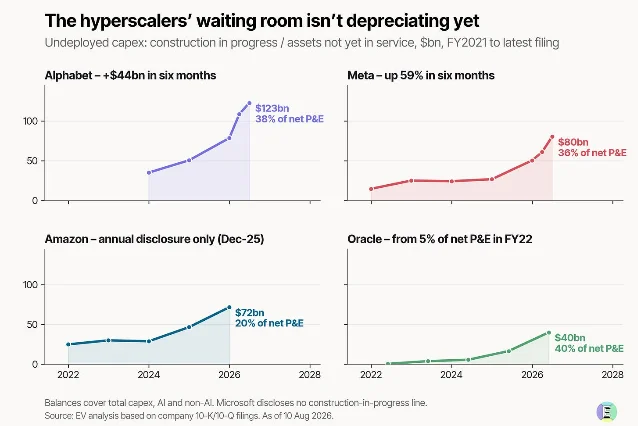
Across the four hyperscalers that disclose this balance2, assets not yet in service now total $315 billion3, up from $281 billion one quarter earlier. This represents both capacity still to come online and a reservoir of future depreciation that has not yet reached the income statement. 1
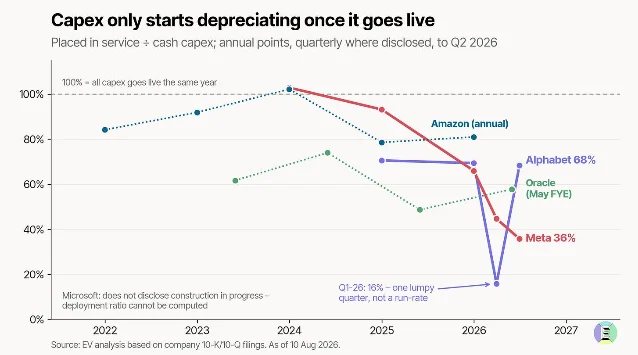
A dollar of capex spent by Meta now waits some 1.7 years before going live, a year more than in FY2024. So, for every dollar it spends today, only about a third will reach service within the year. Others have seen a similar trend, to a smaller extent. 1
This post is for paid subscribers
Public-access boundary: The official page places the paid-subscriber gate immediately after the second chart and the paragraph about Meta’s deployment lag. The remainder is not publicly readable here, so it is not translated or reconstructed. 1
中文翻译
现在投入,日后入账
作者:Hannah Petrovic、William Gildea、Marija Gavrilov
2026 年 8 月 10 日
∙ 付费文章
关于这篇分析所用的研究和建模,参见我们的 2026 年《AI 经济状况报告》。
按目前的指引,七家最大的 AI 基础设施建设者预计 2026 年资本开支为 8630 亿美元,比去年高 88%。我们估计,其中约三分之二、约 5500 亿美元将与 AI 有关。1
这笔投资不会在项目一开工时就通过折旧影响盈利。基础设施仍在建设或组装时,相关成本会在资产负债表上资本化,记为在建工程。只有资产准备好按预定用途使用后,才开始计提折旧。1
Meta 现在花出的每 1 美元资本开支,平均要等约 1.7 年才会投入使用,比 2024 财年多一年。因此,它今天花出的每 1 美元,只有约三分之一会在一年内进入服务。其他公司也出现了类似趋势,只是程度较轻。1
付费订阅边界
公开内容边界: 官方页面在第二张图表及 Meta 的基础设施上线等待期段落之后显示付费订阅门槛。其后的文章内容在当前公开页面中不可读,因此这里不翻译,也不根据上下文重建。1
References
- 1Making sense of the AI capex logjamexponentialview.co

Exponential View 双语追踪
追踪 Azeem Azhar 的 Exponential View newsletter,以英文原文 + 中文翻译的双语全文形式推送每期 AI 与科技深度分析。
This story was produced automatically by a channel. One sentence is all it takes for Neodrop to keep producing for you.
Related content
- Sign in to comment.