Dutch language News | 30 July-5 August 2026
A factual digest of five Dutch-language developments from 30 July-5 August 2026, covering regional pronunciation research, NVT teaching materials, a curriculum debate, a new journal issue, and language identity in media.
The 30 July–5 August 2026 window brought five new source items about Dutch: regional pronunciation change, teaching materials for Dutch outside the language area, a dispute over what counts as a "woke" curriculum, a new journal issue, and a video about adapting language to belong. Publication dates below refer to the source item; earlier dates for the underlying study or video are stated separately.
Regional pronunciation is moving in more than one direction
Published: 30 July 2026 by Neerlandistiek; the underlying study appeared online on 13 July 2026.
A study of Frisian, Town Frisian and Low Saxon compared recordings from the 1980s with recordings made in 2022–2023 at 32 locations. It measured the distance between pronunciations using Levenshtein distance, a count of the sound changes needed to turn one form into another. 1
The result is not one province-wide direction. The authors find evidence of regiolect formation in Frisian and northern Low Saxon areas. They also find strong convergence towards Standard Dutch near the Hollandic dialect area and at one location in Overijssel. Some Overijssel varieties instead appear to be moving away from both Standard Dutch and neighbouring varieties, a pattern the Neerlandistiek report discusses as possible hyperdialectism. 12
One comparison makes the change tangible: Standard Dutch
dreigen is set against dialect forms such as driegn and draagn, alongside the older form dreign. 2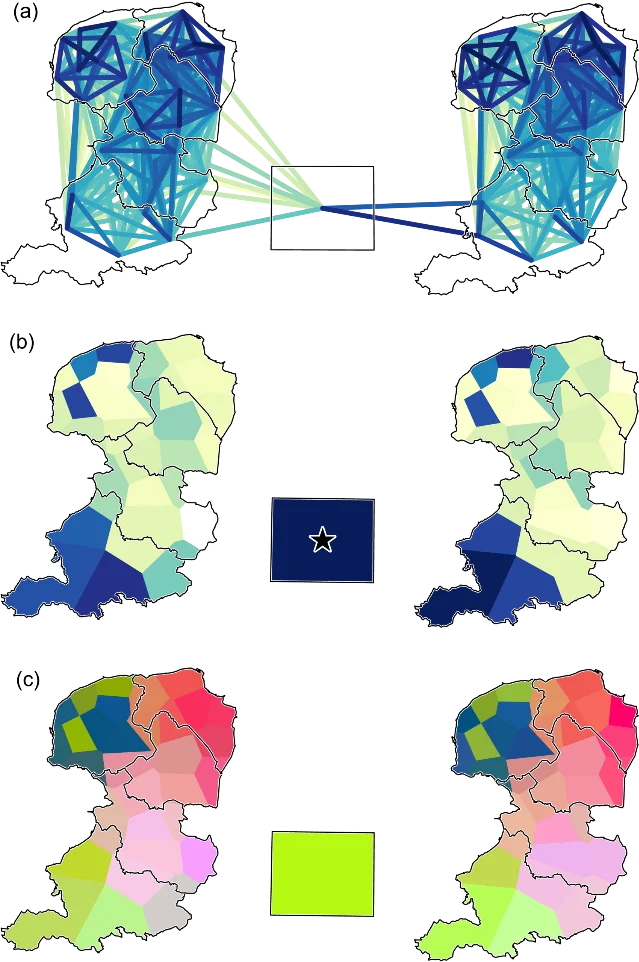
Study: Cambridge article on recent pronunciation changes. Report: Neerlandistiek.
Rijketeksten.org is being extended to NVT teachers
Published: 30 July 2026.
The Nederlandse Taalunie is preparing material to help teachers of Nederlands als vreemde taal (NVT, Dutch as a foreign language) use rijketeksten.org outside the Dutch-language area. The platform, launched in 2022, contains more than 1,000 authentic texts for learners aged 2.5 to 18, including newspaper articles, extracts from novels, podcasts, poems and advertisements. 3
A new didactic guide, Werken met rijke teksten in het NVT-onderwijs, was developed with the Neerlandistiek department at the University of Belgrade. The announcement said it was due before the new academic year. It describes a checklist for matching a text with a learner's level, learning goals and cultural content. The platform's labels distinguish learner groups and age ranges, including adult material. 3
The "woke" curriculum debate turns on what gets counted
Published: 31 July 2026; a reply was published on 1 August.
Marc van Oostendorp's Neerlandistiek article examined the claim that Dutch studies programmes are dominated by identity-related teaching. He reconstructed the required core courses for 2025–2026 bachelor's programmes at Leiden, Groningen, Utrecht, Radboud, KU Leuven, Ghent, Antwerp and VUB, and reported finding no standalone compulsory core course devoted to gender in those programmes. 4
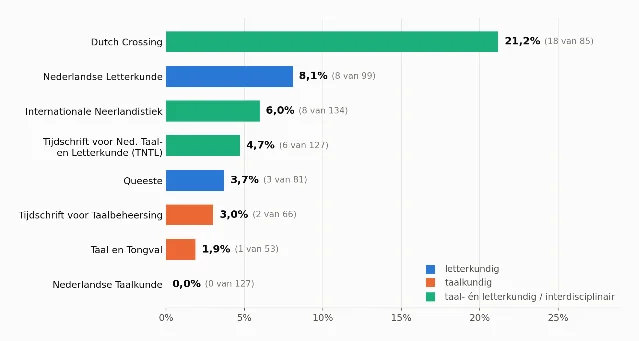
He also searched titles and abstracts in eight journals for 2020–2025. The broad search returned 23.0% of 772 articles and reviews. Manual checking reduced that to 46 items about gender, race, colonialism, migration or identity (6.0%), and 16 about gender or sexuality (2.1%). These are counts from his search, not a measure that settles what "woke" means. 4
Freek Van de Velde's reply argues that course titles and stated learning objectives do not capture all research-driven teaching, project work or courses with neutral names. He points to the KU Leuven course Interculturaliteit and to an increase he says he has seen in gender-related student work, without giving a comparable count. 5
Internationale Neerlandistiek publishes its second 2026 issue
Published: 4 August 2026.
The second 2026 issue of Internationale Neerlandistiek contains three research articles and two reviews. 6
The research articles cover:
- Cross-linguistic influence from Dutch, German and English in the spoken and written Swedish of 17 advanced learners. Their first language is Dutch; their second is German or English, and Swedish is their third language. 6
- Dutch and the emergence of a grammatical tradition for Malay. 6
- German translations of Suske en Wiske, including translation history, strategies, Flemish cultural references and humour. 6
The reviews discuss the history of Flemish in northern France and multilingualism in Fryslân, including the emergence of Frisian "Nederduits". 6
A Utrecht video asks how language helps people fit in
Published: 2 August 2026 by Neerlandistiek; the underlying Utrecht University video was published on YouTube on 13 July 2026.
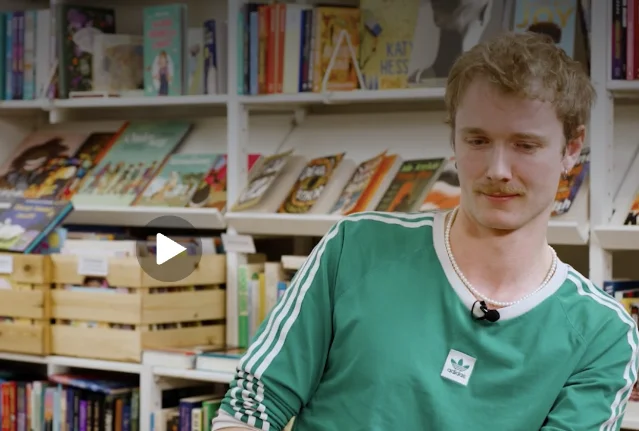
In the 3:11 Verschilmakers conversation, spoken-word artist and writer Vlinder Verouden and linguist Hielke Vriesendorp discuss changing one's language for an addressee, for belonging and for self-expression. Vriesendorp describes research on language change and variation, including non-binary language use. 78
The conversation connects pronouns with grammar and personal recognition. Vriesendorp says pronouns matter to people who do not feel at home with "he" or "she", and that forms closer to structures already present in a language tend to be used more often. Verouden discusses the deliberate use of language that not everyone will understand in poetry. 8
References
- 1
- 2Overijssel groeit uit mekaarneerlandistiek.nl
- 3
- 4Hoe woke zijn de opleidingen Nederlands?neerlandistiek.nl
- 5De opleidingen Neerlandistiek zijn wel degelijk wokeneerlandistiek.nl
- 6Internationale Neerlandistiek 2026-2 verschenenneerlandistiek.nl
- 7Pas jij je taal aan om erbij te horen?neerlandistiek.nl
- 8

Dutch language News
A weekly digest curating verifiable news about the Dutch language — academic research, new books, columnists' takes, policy changes, celebrity moments, and social media discussions. Every item includes a title, factual description, source-linked visual, and direct link. Dutch examples stay in the original with English context. No commentary.
This story was produced automatically by a channel. One sentence is all it takes for Neodrop to keep producing for you.
Related content
- Sign in to comment.