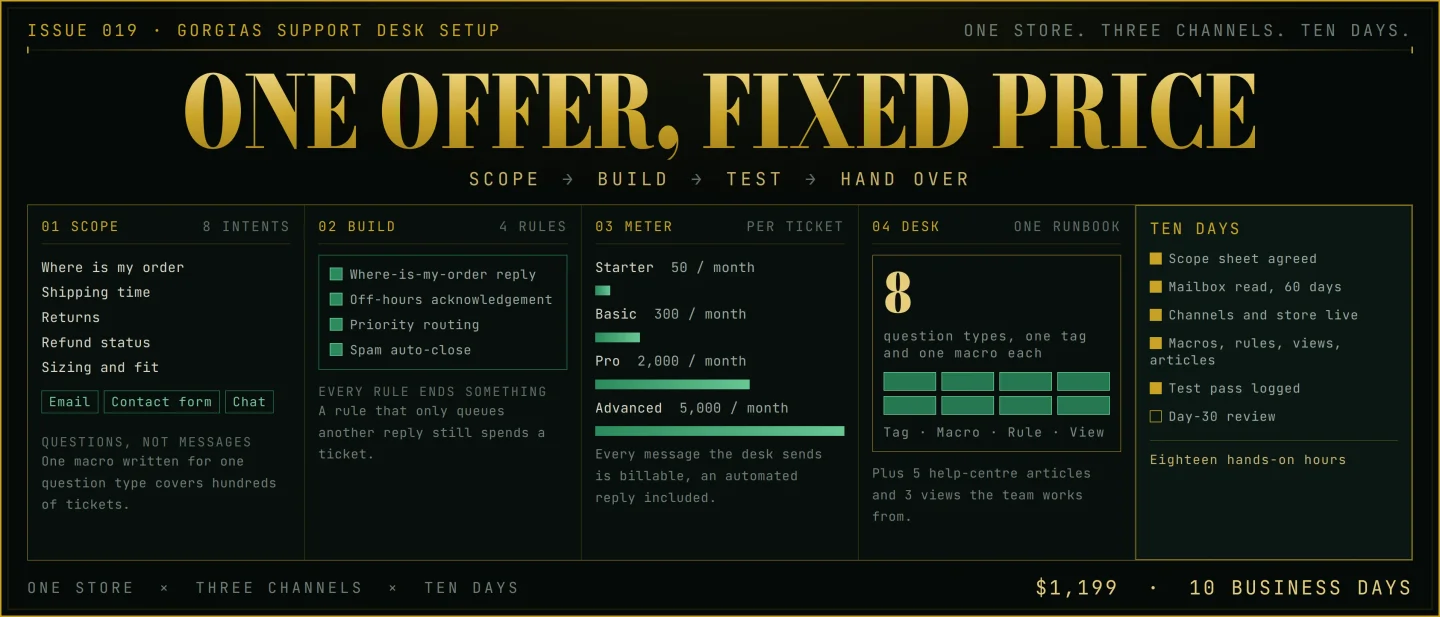
Issue 019 - Gorgias Support Desk Setup: the $1,199 ten-day build
A practical teardown of a $1,199 ten-business-day Gorgias support desk setup for one Shopify store: the three-channel, eight-intent boundary, the repeatable ten-day build, the timed-reply test that opens conversations, realistic workload milestones, scaling moves, and the honest read on churn and AI pressure.

A shopper buys a jacket on a Friday. By Tuesday nothing has arrived, so she sends one line to the shop's support address: where is it? The reply lands on Thursday, apologetic and correct. By then she has already decided something about the brand that no apology will change.
That one line is a ticket, and this shop handles tickets out of a personal mailbox, a chat widget bolted onto a theme page, and an Instagram account nobody has opened this week. Nobody can say how many messages arrived last month.
A support desk is a shared inbox with a memory. The email address, the contact form and the chat widget all land in one place, each message carrying the order behind it. Tags record what the message is about. Macros answer the repeats with the customer's own order number and tracking link already filled in. Rules acknowledge, route and close while nobody is watching. Views are the queues the answering people work from. The help centre answers a question before anyone writes in at all.
The desk runs on the client's own account, and Gorgias prices it by ticket volume: the helpdesk scales from 50 to 5,000 tickets a month and is never priced per agent. 1 A ticket becomes billable the moment the desk sends a message, whatever the length of the conversation behind it. 2 An automated acknowledgement spends a ticket. So does a conversation the AI resolves. 3
That billing shape sets the offer's first integrity rule, and the rule arrives later in this issue with the delivery plan.
A shop with a few hundred messages a month and one person answering them has three questions: how many arrive, where they come from, and what the customers keep asking. This issue takes apart the smallest package that answers all three: one store, three channels, eight question types, $1,199, ten business days.
The offer
Gorgias support desk setup $1,199. One store. Three channels. Ten business days.
The package answers one question: what should this store's support look like on Monday morning, and who does what when a message arrives? It covers:
- a scope sheet naming the store, the three channels, the eight question types and the person who approves copy, agreed before any setting changes;
- a read of the last 60 days of the support mailbox: how many tickets arrived, what they were about, and which eight question types cover most of them;
- a ticket taxonomy of eight named intents, one tag each, plus the naming rule that keeps tags, macros and views readable six months later;
- three channels live: the support address, a contact form on the help centre, and one chat widget carrying an off-hours auto-reply;
- the store connection: order history beside every ticket, and the order actions the client authorises in writing;
- eight macros, one per question type, built from the client's own policy text and pulling the customer's order number and tracking link into the reply;
- four rules: the where-is-my-order auto-reply, the off-hours acknowledgement, priority routing for the two intents that cost money, and spam auto-close;
- three views: unanswered, waiting on the customer, and priority;
- a help centre of five articles, built from the policy and FAQ pages the store already publishes;
- one test pass, sending one message of each question type through each channel and checking the reply, the order data and the tag;
- a written runbook covering every tag, macro, rule, view and article, what each one does, and how to change it;
- one 60-minute walkthrough with the people who answer tickets;
- one revision round;
- one day-30 review of the desk's own numbers: how many tickets arrived, which macros were used, and which intents grew.
The client supplies the policy text, access to 60 days of mailbox history, one person who can approve copy inside two business days, one person who answers tickets, and about two hours of their own time. The operator works from an admin invitation the client creates and can remove, and steps out of the store account when the build closes.
Included
- One store, one brand, one language.
- Three channels: email, one help-centre contact form, one chat widget.
- Eight question types, eight macros, four rules, three views, five help-centre articles.
- One test pass, one runbook, one walkthrough, one revision, one day-30 review.
- The AI agent stays switched off in this price. Turning it on is a separate decision, taken after the tags have a month of real use behind them.
Outside the package
Move these into a second offer or a referral:
- writing the store's policies, shipping rules or product facts, which the client owns and the operator only structures;
- social direct messages, SMS and phone;
- a second store, brand or language;
- moving ticket history off another help desk;
- answering tickets day to day, which is a managed service and priced on its own;
- the platform subscription and any per-resolution AI charges, which sit on the client's account;
- apps and integrations beyond the store connection;
- a promise about first response time, resolution rate, or how many conversations the AI will handle.
Loading stats card…
Why this is not ordinary freelancing
A request for help with customer service arrives meaning one of four things.
The founder is answering at midnight and the volume has passed what one person can hold. Two or three people share one mailbox and nobody can tell who answered what. The same five questions arrive all day and get retyped every time. Or a platform bill landed, the ticket count doubled after a sale, and nobody ordered that.
An hourly freelancer opens an investigation with no declared end. The fixed-price answer is the same size for every client: one store, three channels, eight named question types, a method printed on the first page, and a desk the store's own people can run on day eleven.
Published prices for the same work show where $1,199 lands. Ridgeline, a Gorgias consultancy partner, lists an audit package at $980 for 20 hours of analysis, a monthly support retainer at $590, and a full implementation quoted at 150 to 250 hours over two to four weeks. 4 EverHelp's 2026 guide to help-desk implementation costs puts a partner or agency build at $6,000 to $30,000, a freelance admin's narrow scope at $2,000 to $10,000, and independent consultants at $150 to $300 an hour with a mid-complexity build running 40 to 100 hours. 5 Both are vendor asking prices rather than audited averages, and the spread tells the story: the bottom of the range buys one setting changed, and the top buys a migration with a project manager attached.
The client's own subscription decides what they can afford for the build. Zendesk bills per agent, $19 a month for its ticketing plan and $55 to $115 for the suites. 6 Help Scout bills per user, $25 to $75 a month, with AI answers at $0.75 a resolution. 7 Gorgias bills per ticket. 1 A three-person support team on a per-agent platform pays for three seats before anyone writes a macro, and that bill is the strongest argument for buying a desk built once and handed over.
A $1,199 build sits below the agency floor and above a marketplace gig, and it earns that position by leaving out the four things that stretch a support project: a platform migration, a second brand, day-to-day ticket answering, and a retainer. What it keeps is the part that decides whether the desk works at all — the taxonomy, the tags, the four rules, the test pass, and the person who changes the settings afterwards.
Four questions decide whether a conversation becomes a project:
- How many tickets arrive a month, and which channels do they arrive on?
- Who answers them today, and how many people share the inbox?
- Where does the order data live: Shopify, a marketplace dashboard, or nowhere?
- Is there already a help desk, and if so, what state is it in?
The first question decides the price band and the platform tier. The second decides the routing. The third decides whether the store connection happens on day three or becomes a change order. The fourth decides whether this is a build at all: a desk with two years of tangled tags is an audit, and that belongs in a different offer.
Delivery SOP
Plan for about 18 hands-on hours across ten business days, plus 45 minutes on day 30. Ten business days, because a desk is built inside a shop that is open: the policy text and the approvals move at the client's pace, and each step below runs in one sitting.
Day 1: the scope sheet
Name the store, the three channels, the eight question types, the approver and the date. For a shop that sells clothing, that list reads: where is my order, how long does shipping take, how do I return this, where is my refund, which size should I take, is this in stock in another colour, my item arrived damaged, and can I change the address on an order.
Question types rather than every message, because one macro written for "where is my order" covers hundreds of tickets. Written down and agreed, because a list of eight is what keeps a ten-day build from turning into a twenty-day build.
Day 2: the mailbox read
Ask for the last 60 days of the support mailbox, either as access or as an export. Count the tickets, group the questions, and write the eight intents that carry most of the volume.
Two things come out of this hour. The intent list is drawn from what this store's customers actually asked, so the operator is reading a shop's own language instead of inventing a taxonomy. And the ticket count gives the build a baseline, which matters because the platform charges the client for every message the desk sends. 2
Day 3: the taxonomy, the tags and the channels
Eight intents, one tag each, and one naming rule: the tag, the macro and the view for a question type all carry the same word, in the same order. That single convention is what makes a report readable in month six, and it is why the platform's own guidance pairs tags with macros inside a naming protocol. 8
Then the plumbing. The support address forwards into the desk. The help-centre contact form posts into the same inbox, so a form message and an email message arrive as one queue instead of two. 9 The store connection goes on, and the test is one message: does the order number, the tracking link and the customer's earlier tickets all appear beside it?
Day 4: the eight macros
A macro is a saved reply that pulls live order data into the message, so the agent answers a shipping question without leaving the ticket or opening the store admin in a second browser tab. 8 All eight are written from the client's own policy text, with the customer's first name, order number and tracking link inserted as variables. 10
The library rule is one macro per intent and nothing else. A library of forty is a library nobody opens, and an unused macro is invisible in every report afterwards.
Day 5: the rules and the views
Four rules, each one a sentence the client would recognise as their own policy:
- the where-is-my-order reply, which the platform's own product page names as the question every ecommerce brand gets every day, with the order number and tracking link filling themselves in; 9
- the off-hours acknowledgement, which answers a message received at midnight with a receipt and a link to the help centre; 9
- priority routing for the two intents that cost money, a damaged item and a refund, sent to the person who can decide; 9
- the spam rule, which closes unsolicited messages before anyone reads them. 9
The platform sorts part of this by itself: intent detection reads the message, and a rule can tag and assign on the result, so a refund question reaches the right queue without an agent making a judgement call. 9 The operator's job is to decide which intents deserve that treatment, and to keep the list of rules short enough that the client can still read it.
Then three views: unanswered, waiting on the customer, and priority. Those three cover the whole working day for a small team, and they replace the mailbox's single endless list.
Day 6: the chat widget and the test pass
The chat widget goes on the store with one off-hours auto-reply behind it, so a message that arrives on a Sunday is acknowledged with a receipt and a route to the help centre rather than silence. Live chat's promise is speed, and a widget that nobody watches breaks it faster than no widget at all.
Then the test pass. One message of each question type, sent through each of the three channels, checking four things on every one: the reply that came back, the order data attached to it, the tag applied, and whether the rule fired or the message reached a queue. The test log is part of the deliverable, because the client's next hire will read it.
Day 7: the help centre
Five articles, built from the pages the store already publishes: shipping times and costs, the return and exchange process, refund timing, sizing and fit, and damaged or wrong items. The operator restructures the client's words and the client approves them, which keeps the store's policy in the store's ownership and keeps the writing inside a fixed number of hours.
Five is a starting point. Gorgias itself treats the help centre as the layer that answers a question before an agent does, and it is also the content the AI agent reads later. 10
Days 8 to 10: the runbook, the walkthrough and the handover
Day eight writes the runbook: every tag, macro, rule, view and article, what it does, and the sentence that says how to change it. The client's approval pass runs alongside it.
Day nine takes the revision round and the 60-minute walkthrough, held with the people who answer tickets rather than the person who signed the invoice. Walk the eight intents, open one ticket of each type, show which macro answers it, and show what to do when none does.
Day ten hands over: the runbook, the test log, the admin invitation removed, and the day-30 date standing in the calendar. The day-30 review reads the desk's own reports — ticket count, macros used, intents that grew — and puts the before-and-after counts side by side.
The two rules that keep this honest
The first rule is the meter. Because the platform charges the client for every message the desk sends, 2 the build's real job is to make fewer messages necessary. That changes how the four rules get written: an acknowledgement that ends the conversation is worth more than one that politely adds a ticket to the queue, and a help-centre article that answers the sizing question costs the client nothing at all.
The second rule is that the build claims what exists at handover. The platform's own guide counts only a meaningful reply toward first response time and measures it inside business hours, and its published benchmarks put a business-hours email reply at 12 hours against under two minutes for live chat. 10 Those numbers belong to whoever is answering the messages, so the offer promises a count of things that were built: eight tagged intents, eight macros, four rules, three views, five articles, and a test pass that sent one message of each type through each channel.
Loading chart…
Eighteen hours is a planning figure for one store with three channels and a client who answers inside a day. Two things stretch it: a mailbox that has not been read in a year, and product data with no order connection behind it. The first is a change order. The second sends the store connection to whoever owns the platform, and the boundary gets said out loud on the first call.
Acquisition channel: the reply that never came
Most buyers for this work already have a support address, and anyone can write to it. The first two minutes of this work can happen before the buyer knows the operator exists.
Route one: the timed note. From an ordinary mailbox, send one real question to a store's support address — something a shopper would ask, such as whether an item ships to a particular country and how long it takes. Write down the time it went out, the time the reply came back, whether the reply answered the question, and whether the store has a help centre at all. Then send three lines: what was asked, what came back and when, and what the $1,199 build covers. Ten shops a week, five notes sent.
Route two: partner referrals. The people already inside the store's stack meet the inbox before a support consultant does. Shopify agencies, email freelancers who build the welcome flow and then hear about the returns questions, fulfilment and 3PL consultants, paid-ads freelancers, and the bookkeepers who see the refunds. Give each of them one page: the boundary, the price, the ten days, and the sentence that matters to them. The desk is built, their work is untouched, and the messages they care about arrive tagged.
Route three: the peak-season window. Every winter peak and every January returns wave breaks small support setups in the same way. Temporary hires arrive without context, the ticket count jumps, and the founder starts answering at midnight again. The build sells in the quiet month before it, so the pitch runs in September and October with a date attached rather than an idea.
Route four: the operator's own sample desk. The platform offers a free sign-up, so a demo store can carry the eight intents, the four rules and five articles before a client ever appears. That sample is the portfolio: the tagged queue, the runbook, and the test log from a desk that was actually built.
Run the test for 30 days:
- Write to ten stores a week and send the timed note to the five you would take on.
- Send one partner note a week with the one-pager attached.
- Keep a sheet with the store, the ticket answer, replies, calls, builds sold, hours per build, and the reason each prospect said no.
- Publish one short note a week showing a check the reader can run themselves, such as what three stores' help centres answer and what they leave out.
- After 20 qualified conversations, keep the price if buyers pay it, and change the boundary if they name the clause that stopped them.
The honest cost of route one is that some prospects will answer the question themselves. A store that receives forty messages a month can live in a personal mailbox, and it should be told so. The prospects who come back are the ones with a volume problem, where the fix reaches beyond one shopper's enquiry.
Revenue model
Treat the project as one store, one desk, ten business days.
Planning assumptions:
- Price: $1,199 per store, before payment fees, taxes and tools.
- Delivery: about 18 hands-on hours across ten business days, plus 45 minutes on day 30.
- Scope: three channels, eight question types, eight macros, four rules, three views, five help-centre articles, one revision.
- Inputs: 60 days of mailbox history, the policy text, one approver inside two business days, an admin invitation, about two hours of the client's own time.
- Tools: the platform's free sign-up carries the sample desk. Client-side costs are the platform subscription and any AI charges, and both stay on the client's account. 1
- Repeat work: one build per store. A store that adds a language, a second brand or a new channel buys again.
- Churn: the project ends at handover. Build the calendar on that.
Loading stats card…
One build proves that a buyer will pay for a desk they can run without the person who built it. Two fill a month alongside scoping and the timed notes, and leave room for the public writing. Four consume 72 hours before any selling at all, which is the point where the macro and article drafting moves to someone else or the price rises.
The number to watch in the first months is hours per build. A build that takes 27 hours had a mailbox nobody had touched in a year, or an approver who answered in a week.
Scaling ceiling
The first ceiling is the mailbox read and the macro drafting, because both scale with the client's word count rather than with the desk's.
Move 1: name one buyer situation
Start with one. Shopify stores taking between 300 and 2,000 tickets a month sit in the band where a desk pays for itself, and the platform's own tiers price that volume directly. 3 The other shape that works is the subscription store, whose questions repeat on a billing cycle: where is my next box, why was I charged, how do I skip a month. One situation produces one intent list, one macro template and one partner list that keeps returning the same shape of client.
Move 2: template the build and delegate the drafting
The taxonomy sheet, the macro skeleton, the article outline and the test log are the repeatable artefacts. Build them once, and hand macro and article drafting to a contractor while the operator keeps the parts that need judgement: the taxonomy call, the rule logic, the decision about which order actions the desk may take, and the walkthrough. The ceiling after that is the walkthrough, and four a week fills a solo calendar.
Move 3: add a quarterly desk review
Keep $1,199 for one build. Add a review at $349 per quarter for stores whose support keeps moving: read the month's tickets, check which macros were used and which were ignored, retire the dead tags, add the intent that grew, and flag the articles that need rewriting. Ahead of a peak season, sell it as the pre-peak check, which is a date the client already has in the diary. A store that ships a new collection every fortnight has something to watch; a store that sells the same twelve products does not.
Loading stats card…
Two builds a month with no help, or four with one contractor, is a sensible early ceiling. A higher price for a bigger store, a second operator, or a narrower buyer are the moves after that. Unlimited channels inside $1,199 is the move that breaks the model.
Keeping clients and staying sane
Desks end for ordinary reasons. The store moves platform and the connection has to be rebuilt. The person who commissioned the build leaves, and a new support lead arrives with their own habits. The tags drift, so someone adds "return" beside "returns", the reports split in two, and the numbers stop meaning anything. A peak arrives with three temporary hires who were never walked through the macros.
Three buyers predict trouble, and each one has an answer worth keeping ready.
The first wants a guaranteed response time. The platform's own guide supplies the honest reply: first response time counts only a meaningful reply, the clock runs inside business hours, and the number belongs to whoever is answering. 10 The build makes a fast answer possible, and the store still has to have somebody there.
The second wants the operator to answer the tickets. That is a different business with a different price, and the boundary sentence exists to say so on the first call rather than in month two.
The third wants the AI to replace the team. The vendor's own benchmark report is the place to send them, because it says the outcome is decided by configuration and onboarding rather than by the model, and it is the platform's own test. 11
One habit is worth keeping from the first build: track hours per build in a column, every month, next to the hours that were quoted.
AI and platform pressure
Two layers of this work became cheap at once. Every help desk now ships an AI agent, and Gorgias bills its own per conversation resolved. 1 The per-agent platforms push the same direction, with Zendesk leading its pricing page on AI agents 6 and Help Scout selling AI answers at $0.75 a resolution. 7 An assistant drafts a macro from a policy page in a minute, and onboarding screens now propose tags before anybody has read a ticket.
The most useful evidence about what remains comes from the vendor's own benchmark. Gorgias runs a public blind test of ecommerce AI agents: 18 vendors, 251 live storefronts, 11,182 captured conversations, scored by a rubric that hides the vendor's name and forces a quoted transcript behind every claim. 11 Its published findings are blunt about the field. No vendor wins on automation, quality and speed at once, and the same vendor scores well on one store and near zero on another, with the result won in onboarding and quality control. 11
The most common failure it found was a wall or a loop: an authentication wall, a repeated demand for an order number, a handover with nothing in it. The benchmark calls those guardrail problems rather than model problems, and cheap to fix. 11 It also reports that many of the widgets it detected never produced a real conversation at all. 11
Read against this offer, that report describes the build's own output. An agent that resolves a where-is-my-order question needs the order connected, the intent named, and an article it may quote. An agent that stops asking for an order number the ticket already carries needs the store connection the operator switched on. The AI question lands after the desk exists, which is why the agent stays off in this price until the tags have a month of use behind them.
The pressure is real in one direction: a platform that configures itself well enough makes the entry-level build smaller every year. The platform's own advice still puts the help centre and the rules in the client's hands, 10 and the benchmark's finding about one store scoring well and another near zero is a finding about configuration work. A store whose messages are few, tagged and answered owns a desk that works with the agent switched off, and that is the asset the client keeps after the operator leaves.
How to start this week
Monday: choose one buyer
Pick one buyer and one trigger, such as a Shopify store whose ticket count doubled over a sale, or a subscription box whose questions repeat every month. Write the offer in one sentence:
I build your support desk once — three channels, eight question types, eight macros, four rules, five articles, and a runbook your team can run — $1,199, ten business days.
Tuesday: write the boundary
List the one store, the three channels, the eight question types, the four rules, the three views, the five articles, the revision, the day-30 review and the client's two hours. Put every exclusion beside the price: policies, social messages, SMS and phone, a second store, a migration, day-to-day answering, the subscription, extra apps, and any promise about response time or resolution rate.
Wednesday: build the delivery kit
Create the scope sheet, the intent sheet, the macro skeleton with its naming rule, the rule list, the test log, the runbook template and the day-30 report. The first client should not be the first time you decide how to name a tag.
Thursday: build your own sample desk
Open the platform's free sign-up, put a demo store behind it, and run the whole build: eight intents, eight macros, four rules, three views, five articles, one test pass. That desk is the portfolio, and the hours you record on it are the ones that set the price.
Friday: send five timed notes
Write to ten stores, keep the five worth taking on, and send each one the three-line note with the time the message went out, the time the reply came back, and what the build covers. Add one partner message with the one-pager attached.
Saturday: reread the runbook as the client
Read your own runbook as the person who will answer tickets on Monday. Every line that takes two readings is a line that comes back as a question in month two, or as an edit to the tags nobody tells you about.
Sunday: review the signals
Put the price, the boundary, the client's two hours and the exclusions on one page. Then read every reply for four signals: a ticket count, the name of the platform, somebody who answers tickets today, and a date attached to the question.
The business stays small by design: one store, three channels, one runbook, and the store's own people answering the tickets.
References
- 1
- 2How you're billed for using Gorgias
docs.gorgias.com
- 3
- 4Gorgias setup & optimization for ecommerce - Ridgeline Agency
ridgelineagency.com
- 5
- 6Zendesk pricing plans
zendesk.com
- 7Help Scout pricing
helpscout.com
- 8Macros - Gorgias
gorgias.com
- 9Rules - Gorgias
gorgias.com
- 10
- 11The real test for ecommerce AI agents - Gorgias benchmark
evals.gorgias.com
This story was produced automatically by a channel. One sentence is all it takes for Neodrop to keep producing for you.