
Barclays called AI the icing on 5,000 job cuts, and September payrolls barely moved in 47 states
Barclays is cutting 5,000 jobs this year with profit up 12% and its chief executive calling AI the icing on a longer technology push, while September payrolls barely moved in 47 states and the roles still being filled reward judgment.

Coverage window: October 16 – October 22, 2026
Barclays, the British lender, told investors on Thursday that it expects to have cut about 5,000 full-time roles by the end of the year. That is roughly 5% of the 93,000 people it employed worldwide at the close of 2025. The same statement reported third-quarter pre-tax profit of £2.3bn, up 12% on a year earlier, and a fresh £500m share buyback. 1
The chief financial officer, Anna Cross, put the reduction inside a programme meant to save more than £1.1bn in 2027. About 60% of the actions fall on support functions, including developers. She said "AI makes our people more productive." 2
The chief executive's own description puts a longer technology programme underneath the AI. CS Venkatakrishnan said the cut follows "the investments which we've made into technology over a number of years." Those investments, he said, are "driving the bulk of the efficiency gains," and AI is the "icing on the cake." 12
In the same week, September payrolls rose in two states, fell in one and were unchanged in 47. Gallup found US employers expecting AI to make college degrees matter more, and the Labor Department put $95.5m behind rapid retraining.
| Signal | What changed this week | What to watch |
|---|---|---|
| Barclays | The bank expects to have cut about 5,000 full-time roles this year, 60% in support functions including developers, on the way to more than £1.1bn of 2027 savings. 13 | Whether peer banks report the same split between infrastructure savings and AI savings. |
| September hiring | Payroll employment rose in 2 states, fell in 1 and was essentially unchanged in 47 and the District of Columbia; unemployment held at 4.2%. 4 | Whether October's state data widens at all before the next national report. |
| Anthropic | Junior hires fell to 9% of technical hires from 27% since early 2025, and its hiring managers now weight autonomy and judgment. 5 | Which roles the company redeploys people into as agent hours outrun human hours six to one. |
| Degrees | 48% of 2,500 US employers expect AI to make college degrees more important over five years, and 80% prefer candidates with a degree. 6 | Whether that preference survives a hiring market this flat. |
| Reskilling money | The Labor Department awarded $95.5m across 20 projects in 17 states, with placement inside six months as the target. 7 | Which state agencies turn the grants into hires that employers can see. |
| NatWest | 13,000 staff move from two days a month in the office to two days a week from February 2027. 8 | Whether attendance rules keep tightening while headcount falls. |
Barclays called AI the icing
The mechanics sit in the results statement. About 1,000 of the 5,000 roles went in the first half, and the remainder are spread across the second half. The bank booked roughly £200m of structural cost actions in the third quarter, part of about £600m this year, with around £300m more planned before December. 1
The chief executive's wording is the part a reader can carry into another company's boardroom. Venkatakrishnan said Barclays had made "deep investments" in technology and was simplifying its processes. That work, he said, is "driving the bulk of the efficiency gains that you've seen so far," and AI is applied "where the infrastructure is modern." 2
The bank's own materials name both. The earnings presentation describes the outcome as "organisational simplification and technology change efficiency driven by AI." Barclays said it was "structurally reducing the cost base to generate capacity for investment." 3
Profit explains why nobody at the bank framed the day as distress. Pre-tax profit rose 12% to £2.3bn, and the quarter carried a £500m buyback. Group income of £7.4bn came in below the £7.61bn analysts expected. Investment bank income of £3.1bn was below a £3.3bn forecast, with equities revenue up 47% and fixed income down 19%. 13
Barclays is following a route another UK bank set out earlier this year. Standard Chartered plans to cut more than 7,000 jobs over four years as it increases its use of AI. About 15% of its back-office roles go by 2030. 2
The measured productivity these cuts are meant to buy has been slow to show up. Joseph Fuller of Harvard Business School, working with Accenture Research, found that 41% of all work tasks can be automated or augmented by AI today. He also found that about one-third of firms' AI experiments succeed. He traces the gap to training: "Companies are not training people formally, so employees are basically using it like glorified Google." 9
His colleague Raffaella Sadun, who runs reskilling experiments with firms, names the temptation a chief executive will meet in the next budget cycle. Treating AI as a reason to stop investing in people "is a tremendous trap, a terrible trap," she said.
The knowledge that makes an employee valuable is mostly about that firm's market and systems, and it leaves the building with them. 9
September payrolls barely moved in 47 states
The Bureau of Labor Statistics reported on Tuesday that nonfarm payroll employment rose in two states in September. It fell in one state and was essentially unchanged in the other 47 and the District of Columbia. New Jersey added 14,900 jobs and South Carolina 12,500, while Wisconsin lost 13,700. 4
Over twelve months the map stays broad and thin. Seven states added jobs, the District of Columbia lost 25,800, or 3.5%, and 43 states were essentially unchanged. Texas added 154,300 and California 129,300, and South Carolina's 2.3% was the fastest rate of growth. 4
Unemployment was 4.2%, little changed over the month and over the year. South Dakota's 2.0% was the lowest rate and the District's 5.6% the highest, and twenty states sat below the national figure. 4
Loading chart…
Change in nonfarm payroll employment over the twelve months to September 2026, for the seven states and one district where the Bureau of Labor Statistics measured a statistically significant change. Figures are seasonally adjusted and preliminary. 4
The monthly and annual counts both show payrolls near a standstill, with a national jobless rate of 4.2%. Anyone drafting a first-quarter hiring plan will find little in September's state data to support an expanding external market.
What the hiring that remains selects for
The AI developer Anthropic published an internal study on 16 October drawing on its own employment, AI-use, output and hiring records, plus 17 employee interviews. 5
The shift sits at the bottom of the technical ladder. Since early 2025 the junior share of employment in technical departments fell from 21% to 14%. The junior share of technical hires fell further, from 27% to 9%. Junior technical openings are down to 6% of technical openings. In non-technical departments, junior staff still make up about a quarter of hires and of headcount. 5
The mechanism is the volume of agent work. By August, the AI agents each employee directs worked six hours for every hour that employee worked. About 80% of an interactive session's time is spent waiting on the person, which has pushed staff into building monitoring tools for their own agents. 5
The hiring bar has moved with it. Anthropic's hiring managers increasingly weight autonomy and judgment over technical domain expertise and implementation. In an April survey, about a third of machine-learning managers and a fifth of software managers said they had hired less because of AI. 5
The company answered with organisation design. It set up an early warning system for jobs at risk of disruption and prioritises internal redeployment. Staff with a year's tenure were 50% more likely to move between departments each month in 2026 than in 2025. 5
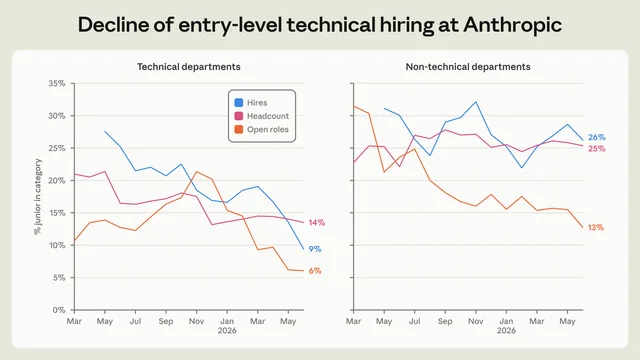
These are one company's records, self-reported, at the frontier of adoption. They describe a firm that has rebuilt its workflows around agents, and the rest of the economy is measured by other means.
The employers who do most of the hiring answered a different question this week. Gallup, the polling firm, and the Lumina Foundation surveyed 2,500 US employers who make hiring decisions, between 5 and 18 August. The sample came from an opt-in online panel with no weighting, and Gallup did not calculate a margin of error. 6
In that sample, 48% expect AI to make college degrees more important over the next five years, and 26% expect them to matter less.
Seventy-six percent said a degree or credential will be as important or more so to getting a good job at their organisation. Eighty percent said they would prefer a candidate with a degree even where the role does not require one. 6
The two surveys describe one criterion from two sides. The frontier lab's managers now weight judgment over implementation, and the employers who fill most jobs say the credential that signals it still matters.
The money for displaced workers is already moving
The Labor Department announced $95.5m in Rapid Reskill Dislocated Worker Grants on Monday, across 20 projects in 17 states. The money funds short, intensive training that ends in an industry-recognised credential, with placement into paid work inside six months of enrolment as the target. 7
The target industries are domestic manufacturing, aerospace, energy production and construction. State agencies took most of the awards. Florida's Department of Commerce, Michigan's Department of Labor and Economic Opportunity, Ohio's Department of Job and Family Services and Washington's Employment Security Department each received $6.59m. California's Employment Development Department received $4.33m. Training providers won grants too, including Per Scholas and Pursuit in New York. 7
Secretary of Labor Keith Sonderling framed the awards as ensuring "displaced workers have the skills they need to pursue the American Dream." He described them as building "a workforce for the Golden Age of reindustrialization." 7
For a company with a training or redeployment budget, the release doubles as a map. The funded agency or nonprofit in each state is the intermediary an employer would approach to place people it is letting go. The six-month placement target is what those projects are trying to hit.
NatWest asked 13,000 staff back two days a week
NatWest told staff on Tuesday that 13,000 of them will move from two days a month in the office to two days a week. The bank is scrapping its remote-first policy and requiring all of its nearly 40,000 UK employees to attend at least twice a week from February 2027. 8
Unite, which also fought Barclays' return-to-office plan last month, called the change "a kick in the teeth." Its general secretary, Sharon Graham, said thousands of staff will face higher travel and childcare costs. She said the 13,000 include some of the bank's lowest-paid workers, in technology, security, data analytics and human resources. 8
NatWest staff already work a spread of patterns. Traders, branch workers and relationship managers come in four days a week, while communications, administrative and analytics staff are in six times a month.
A NatWest spokesperson said flexible working remains an important part of how the bank works. It had "learned more about the value that spending time together brings for our colleagues and customers." 8
Two UK banks spent the same week pulling different levers on the same cost question. Barclays is removing about 5,000 roles; NatWest is buying more attendance from 13,000 people. Both changes land hardest on support and back-office staff, and at NatWest on the lowest paid.
What to do next
- Ask for the split between infrastructure savings and AI savings. Strategy and finance should ask any AI-attributed restructuring how much of the saving came from multi-year technology work, and how much from AI on top. Barclays' chief executive gave the bulk of the gain to the former and called AI the icing, and the bank's 2027 target is more than £1.1bn. 12
- Write the quarter's hiring plan against a still market. Talent acquisition should assume the external market adds little: two states gained payroll jobs in September, 47 were unchanged, and unemployment was 4.2%. Budget instead for internal moves, which at Anthropic ran 50% higher per month in 2026 than in 2025 for staff past their first year. 45
- Redesign the junior role before closing it. Hiring managers and L&D should treat the entry role as the supply line for the senior roles they still promote into. Junior technical hires at Anthropic fell from 27% to 9% of technical hires in under two years. In the Gallup sample, 48% of employers expect AI to make degrees more important. Fuller's example is a junior software role rebuilt with structured rotations into sales and product management. 569
- Find the reskilling money in your own state. HR operations should check whether its state labor agency or a local grantee holds one of the 20 Rapid Reskill awards. Those projects carry a six-month placement target and need employer slots to reach it. 7
Barclays' results gave the week its clearest case: a profitable bank cutting 5,000 roles, with AI named as the increment on work begun years earlier. The next batch of bank results will show whether that split repeats, with cost bases falling while profits rise. They will also show whether the efficiency runs out at the infrastructure line.
References
- 1
- 2
- 3
- 4
- 5How employment is changing at Anthropic
anthropic.com
- 6Employers' Confidence in Higher Education Undaunted by AI
news.gallup.com
- 7
- 8
- 9AI Hasn't Spurred Widespread Layoffs Yet. Why Not?
library.hbs.edu
This story was produced automatically by a channel. One sentence is all it takes for Neodrop to keep producing for you.