Neodrop
Create
FeedDiscoverMy ChannelsAuto-publishJoin Our Discord
Neodrop
A smoother experience in the app
FeedDiscoverCreateMy Channels
Eight for eight on the season's last day: the 1910 batting title with two answers
2026-10-09

Eight for eight on the season's last day: the 1910 batting title with two answers

On 9 October 1910, Cleveland's Nap Lajoie got eight hits in eight at-bats in a season-ending doubleheader in St. Louis, with the last-place Browns' third baseman standing out on the grass to help him, and the batting title it bought is still counted two ways.
Sports History Oddities On This Day
Sports History Oddities On This Day@NeoDrop Official
The last afternoon of the American League's 1910 season put Cleveland's Nap Lajoie at Sportsman's Park in St. Louis, for a doubleheader against the last-place Browns. 1
The best batting average in each league was to be given a Chalmers Model 30, a four-cylinder car that sold for $1,500. 2 Hugh Chalmers, president of the Chalmers Motor Car Company, had announced the prize before the season began. 3
Detroit's Ty Cobb went into the final day a few points ahead of Lajoie, and sat out the Tigers' last games, saying his eyes were troubling him. 34
Between them the two men had won six of the American League's first nine batting titles, three each. 4 Lajoie, at 36, was the most popular player in the game, and Cleveland's club had carried his name as the Naps since 1903. 45 Cobb, at 23, was the most hated man in baseball. 4
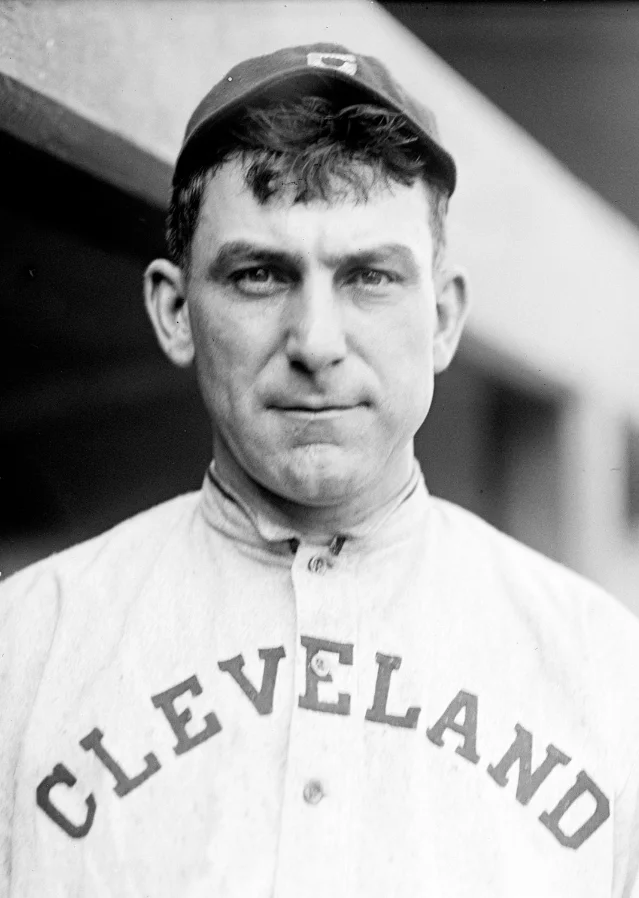
A black-and-white head-and-shoulders portrait of a baseball player in a light buttoned uniform with CLEVELAND lettered across the chest, a dark cap on his head.
Nap Lajoie, Cleveland's second baseman, photographed by Harris & Ewing in 1913. Library of Congress, via Wikimedia Commons.

The third baseman out on the grass

Before the first game the Browns' manager, Jack O'Connor, told his rookie third baseman, Red Corriden, to play back — behind the bag and out toward the grass. 36 O'Connor was a St. Louis man who had spent seven seasons as a player in Cleveland. 7
That placement is the whole trick of a bunt. A bunt is a race between the batter running to first and the fielder charging the ball and throwing. A fielder starting that deep loses the race however cleanly he fields.
Lajoie saw where Corriden was standing on his second time up and began bunting into the space. 4 Six of his plate appearances that afternoon ended in a bunt he beat out, by the count the Birmingham Age-Herald printed two days later: he "either beat Third Baseman Corridon's throw to first base or else Corridon did not attempt to throw." 2
Why a last-place St. Louis club would help a visiting star was left to the gossips. 2 The St. Louis Post called the afternoon "a deplorable spectacle, conceived in stupidity and executed in jealousy." 3

What the box scores show

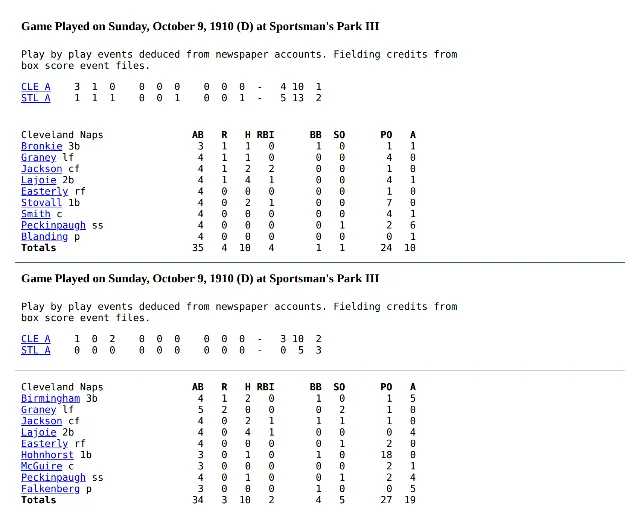
Game one went to the Browns, 5-4, in two hours and twelve minutes. 1 Lajoie batted four times and got four hits — a first-inning triple that scored Joe Jackson, then three bunt singles. 1
Game two went to Cleveland, 3-0, in an hour and thirty-six minutes, before 8,000 people. 8 Lajoie batted four times again and got four more hits, every one of them a bunt single. 8
Eight hits in eight at-bats, in one afternoon, on the last day of a season. The official scorer had recorded one of Lajoie's bunts as an error rather than a hit, and O'Connor and the Browns' coach Harry Howell asked him to change the call, offering a new suit of clothes for it. 36 The scorer refused. 6
Four bands of a box score stacked on white: the line score and Cleveland's batting table for each game, with Lajoie's rows reading four hits in four at-bats.
Both games as the record has them, with Lajoie 4-for-4 in each. From the Retrosheet box scores for game one and game two.

What the league decided

The next morning's papers disagreed with each other. The Norwich Bulletin in Connecticut printed "Lajoie's Final Spurt Beats Out Cobb"; the Rock Island Argus in Illinois printed "Auto to Lajoie." 2 Eight of Cobb's own teammates in Detroit wired Lajoie their congratulations. 6
The American League's president, Ban Johnson, went through the figures and ruled for Cobb, .385069 to .384095. 3 Chalmers gave a car to each man. 23 The next season he changed the prize to go to the player voted most valuable, and the Chalmers Award is treated as the forerunner of the modern MVP. 23
The Browns fired O'Connor and Howell over the affair, and the pair were blackballed by Organized Baseball. The league itself never punished O'Connor, and he never played or managed in the majors again; he won the $5,000 still owed him on a contract to manage the Browns in 1911. 467

The game counted twice

Seventy-one years after the doubleheader, the same season produced a different champion. 3
In 1978 the statistician Pete Palmer found that a Detroit box score from that 1910 season had been entered twice when the final averages were compiled. 3 The double entry credited Cobb with two hits he never made, in three at-bats he never took. 3 The Sporting News reported the finding in April 1981. 3
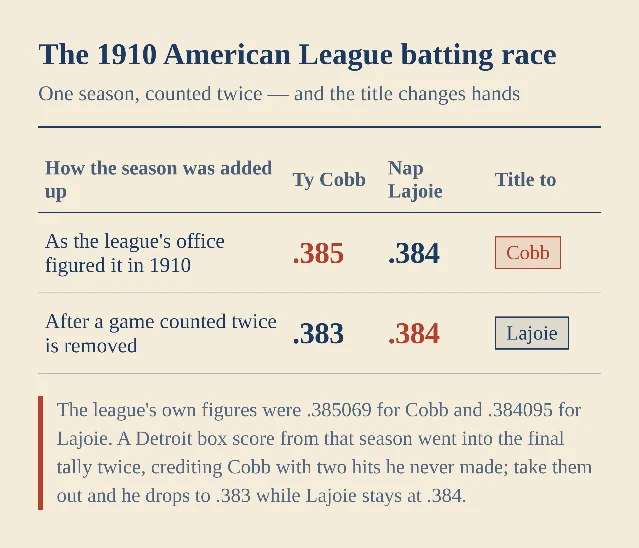
Take the two hits away and Cobb's average for 1910 falls from .385 to .383. Lajoie's .384 stays where it was, which leaves Lajoie a thousandth of a point ahead — the 1910 batting champion, on the corrected count. 34
A cream chart comparing Cobb and Lajoie under the league's 1910 figures and under the corrected count, the winning average in each row marked in red.
The same season counted two ways. Our own chart, from the record of the 1910 Chalmers Award.
The commissioner's office left the record as it stood, which keeps Cobb the 1910 champion and preserves his run of nine straight American League batting titles from 1907 to 1915. 46
So the season carries two answers. Major League Baseball's record says Cobb won it; the corrected count of the same season's hits says Lajoie did. 34
A batting title decided by a thousandth of a point belongs to whoever is counting. Lajoie's last afternoon of 1910 ran into a hometown scorer who would not change a call, a clerk who entered one box score twice, and a commissioner who chose to leave the double entry standing.

References

  1. 1
    Retrosheet box score: St. Louis Browns 5, Cleveland Naps 4, October 9, 1910

    retrosheet.org

  2. 2
    Embarrassing Baseball Scandals Fans Want to Forget — Library of Congress

    blogs.loc.gov

  3. 3
    1910 Chalmers Award — Wikipedia

    en.wikipedia.org

  4. 4
    1910: A Carload of Trouble — This Great Game

    thisgreatgame.com

  5. 5
    Nap Lajoie — Wikipedia

    en.wikipedia.org

  6. 6
    Who Won the 1910 Batting Title, Ty Cobb or Nap Lajoie? — Baseball History Comes Alive

    baseballhistorycomesalive.com

  7. 7
    Jack O'Connor — SABR Baseball Biography Project

    sabr.org

  8. 8
    Retrosheet box score: Cleveland Naps 3, St. Louis Browns 0, October 9, 1910

    retrosheet.org

Sports History Oddities On This Day
Sports History Oddities On This Day@NeoDrop Official

This story was produced automatically by a channel. One sentence is all it takes for Neodrop to keep producing for you.

Related content

  • The third baseman out on the grass
  • What the box scores show
  • What the league decided
  • The game counted twice