
Kling 4.0's plan card sells commercial use. Its terms ask for written permission.
Kling 4.0 generates 30 seconds from 15 references, while its plan card sells commercial use that its own terms reserve for written permission and its developer price card stops at Kling 3.0.

"The all-new Kling 4.0 officially became available to everyone on October 15."
That is the first line of Kling's release note 1. What follows is a long, confident account of a video model that generates 30 seconds in one pass and holds a character across cut after cut.
Nowhere on that page is the price of one generated video. The plan page does not give it either. Neither does the developer rate card.
Kling 4.0 is a real step for the product and an unfinished step for the business around it. The model generates more than the last one. The paperwork was not updated with it.
The Decoder's write-up put the release in its proper frame: Kling 4.0 holds its own against Wan 3.0 and Seedance 2.5 and does not pull ahead, especially on shot logic, physics and natural dialogue 2. It also noted that API pricing "hasn't been announced yet".
That is the whole issue in one line. The model is out, and every page that would price it still stops at the previous generation.
What it actually is
| Kling says | What the thing is | What to check |
|---|---|---|
| "30-second native generation" 1 | One prompt produces 3 to 30 seconds in one-second steps, 10 seconds by default 3 | Whether a single 30-second take survives its own middle |
| "Up to 15 reference assets" 1 | 10 images, 5 videos totalling 30 seconds, 7 elements, 3 voice profiles, combined 3 | Omni Reference and the Keyframes entry point cannot be combined in one task 3 |
| "Two-channel stereo" and nine named languages 1 | Audio is generated with the picture; an audio upload is a voice profile, not a music track 3 | Music and sound design still happen outside the model |
| "Available via MCP and CLI" 1 | Agents can drive Kling 4.0 | What it bills, since the API price card has no 4.0 row 4 |
None of the four rows is a complaint yet. Each one is a place where the thing being sold and the thing being documented come apart.
The reference budget is the genuinely new part. Kling 3.0 allowed one video reference plus four images or subjects. Kling 4.0 takes ten images, five videos, seven elements and three voice profiles in one task 5.
For anyone making product footage, that is the useful upgrade. A shot list, six product photos, a motion reference and a voice can all go into one generation instead of five.
The 30 seconds is the marketing part. A model that can hold a face for 30 seconds is worth a test. A model that can hold a specific bottle's label for 30 seconds is worth paying for, and the release note shows a lockbox doing it 1.
What shipped and what is still a promise
Kling's spec table mixes the two, and the same page says so if you read down far enough.
| Capability | Listed in the spec table | What the rest of the page says |
|---|---|---|
| 3 to 30 seconds | Yes 1 | Live; 15 seconds was the 3.0 ceiling 5 |
| 720p / 1080p / 4K | Yes 1 | Kling 3.0 already had native 4K 5, and the creation panel still marks 4K "Coming Soon" for 4.0 6 |
| 10-bit HDR | Yes, as a new capability 5 | "coming soon" in the release note's own text 1 and in the user guide 3 |
| Extension to two minutes | Yes, with "(coming soon)" attached 1 | Not shipped |
| 4.0 Flash | 3 to 20 seconds, 720p, 8-bit SDR 1 | Shipped, with a lower ceiling than the model it is named after |
The HDR row is the one to sit with. The comparison page lists dynamic range as a headline difference: 8-bit SDR for 3.0, 10-bit HDR at 1080p and 4K for 4.0 5.
Two pages later in the same release, HDR is described as "coming soon" 1.
A roadmap item in a comparison table makes the buyer apply the discount themselves, using a footnote most people scroll past.
The developer route exists and has no price
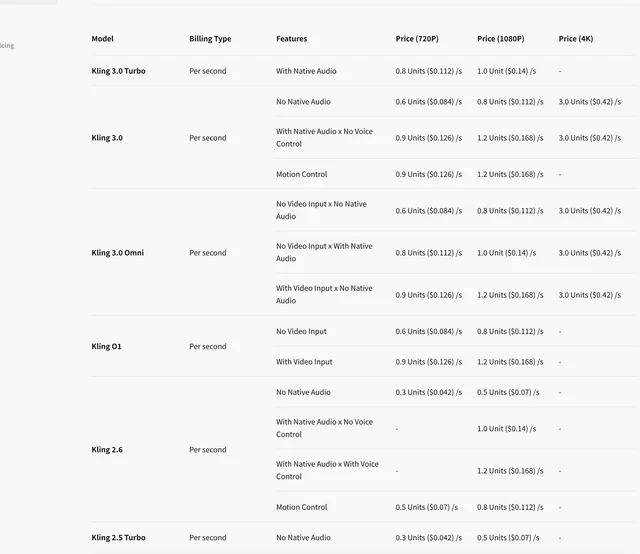
Kling's API documentation is orderly. A capability map lists every model the API exposes, by model id: kling-3.0-turbo, kling-v3, kling-v3-omni, kling-video-o1, kling-v2-6, kling-v2-5-turbo 7.
There is no kling-4. The price page lists the same six and stops 4.
At the same time, the release note has a section headed "Kling 4.0 Now Available via MCP / CLI", promising agents that automate 4.0 workflows 1.
So the automation door is open, and the rate card behind it belongs to the previous generation.
The numbers that do exist are enough to see the shape of the bill. On Kling 3.0 at 1080p with native audio, the API charges 1.2 units a second at $0.14 a unit, which is $10.08 a minute 4. Artificial Analysis independently lists the same $10.08 a minute for that model 8.
Thirty seconds on that rate is $5.04. At 4K on 3.0, 3 units a second at $0.14 works out to $12.60 for the same 30 seconds 4.
Both figures assume the first take is the one you keep. Video generation rarely works that way, and no Kling page offers a success rate.
Four plans, two unit prices
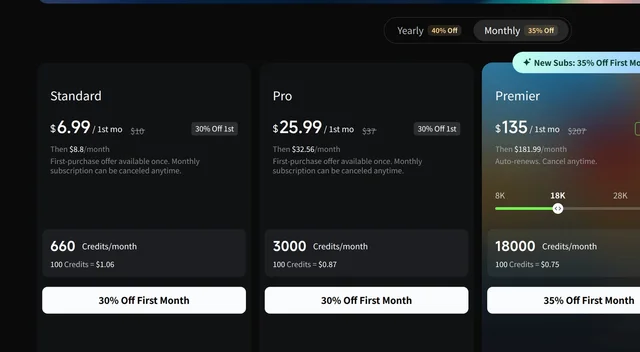
The membership page is the only place Kling publishes a price for its own model, and it publishes the promotional one.
| Plan | First month | Renewal | Credits a month | Price per 100 credits, as printed | The same figure at renewal |
|---|---|---|---|---|---|
| Standard | $6.99 | $8.80 | 660 | $1.06 9 | $1.33 |
| Pro | $25.99 | $32.56 | 3,000 | $0.87 9 | $1.09 |
| Premier | $135 | $181.99 | 18,000 | $0.75 9 | $1.01 |
| Ultra+ | $402 | $544.99 | 57,000 | $0.71 9 | $0.96 |
The printed column is the first-month price divided by the monthly credits, to the cent. Standard's $1.06 is $6.99 over 660 credits. Pro's $0.87 is $25.99 over 3,000.
The right-hand column is the number a subscriber actually pays from month two. The gap runs from 25 to 36 percent, and it is the difference between the price in the ad and the price on the card statement.
Two more things sit in the credits policy. Subscription credits expire one month after they are issued, and purchased credits last two years at $1 for 66 credits 10.
An allowance that expires every month behaves like a subscription. Buy 3,000 credits, use 300, and the other 2,700 disappear at the end of the cycle.
The free tier carries a restriction the paid tiers remove: on Basic, generated content stays out of commercial use 11.
Now for what a single generation costs in credits. On Kling 3.0, native 4K runs at 30 credits a second 11. A 30-second 4K clip is therefore 900 credits, which is more than the entire monthly allowance on the $6.99 plan.
No Kling page states whether 4.0 charges the same rate. That is an assumption borrowed from the previous model, and it is the only one available.
The comparison table on the membership page has a row for Kling 4.0. Pro, Premier and Ultra+ show a limited-time 10 percent discount. Standard's cell is blank 9.
Blank could mean a discount that does not apply, or access that is not included. The page leaves the buyer to guess which, and a buyer on the cheapest plan cannot tell whether the model they came for sits in their tier.
The plan card grants commercial use. The terms ask for permission.
Here is the sentence the whole purchase turns on, from the Terms of Service that govern every Kling account:
"without our written permission, you may not use, reproduce, distribute, and create derivative works of, and make modifications to, the Output for any commercial purposes" 12.
The same document lists commercial purpose as something requiring written consent twice more, once for advertising and solicitation and once for commercial use generally 12.
The plan card lists "Generated content is for commercial use" as a feature, starting on the $6.99 tier 9.
So the page sells a right the contract makes conditional, and nowhere does the contract say that buying a plan counts as the written permission.
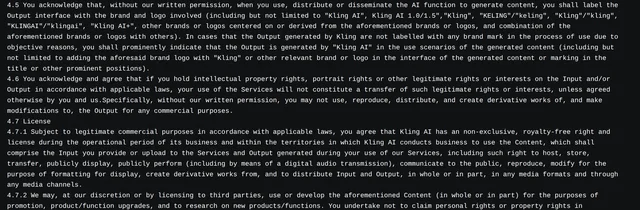
The branding clause runs the same way. Clause 4.5 requires you to label the output with the Kling brand, or to state prominently that it was generated by Kling AI, unless you have written permission 12.
Every paid plan from $6.99 up lists "Brand watermark removal" as a benefit 9.
Removing the watermark and labelling the output are two different acts, and clause 4.5 governs only the second. A customer who pays for watermark removal still owes Kling a visible credit line unless someone at Kling agrees otherwise in writing.
There is one route where the paperwork is clean. The Terms of API Paid Service say it plainly: "You use of the AI-generated content for commercial purposes is not restricted" 13.
That is the route with no Kling 4.0 model id and no published price.
A buyer therefore has two doors. Behind one is a model with no rate; behind the other is a rate with a commercial-use clause that points back to a support address.
What you hand over with the references
A 30-second product shot needs product references. Kling's terms say what happens to them.
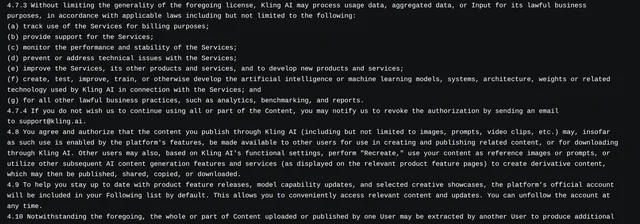
The consumer Terms grant Kling a non-exclusive, royalty-free licence over the Input and the Output, including the right to create derivative works and to distribute both in any media 12.
Clause 4.7.2 goes further: Kling may license that content to third parties and use it "for the purposes of promotion, product/function upgrades, and to research on new products/functions" 12.
Clause 4.7.3(f) names training directly, listing the right to "create, test, improve, train, or otherwise develop the artificial intelligence or machine learning models" used by Kling 12.
The opt-out is clause 4.7.4: send an email to support@kling.ai 12.
The API terms take the other position. There, Kling says it does not use your prompts or responses to train or improve anything, processes them as a data processor, and logs them for 30 days 13.
One clause sits above all of this and gets read least. Clause 3.6 states that content you upload is "non-proprietary and non-confidential", and that you must not upload anything you consider proprietary or confidential 12.
For a designer dropping six angles of an unreleased phone onto the canvas, that is the sentence that matters. The model will hold the product. The contract says the file was never private to begin with.
Creative Recreation and other people's videos
The headline feature for advertisers is Creative Recreation. Kling describes it as taking an existing video's pacing and shot structure and replacing its products and characters with yours, aimed at social trends, performance ads and campaign variations 5.
The clause that makes Creative Recreation possible sits in the terms, away from the feature page. Clause 4.8 says content you publish may be made available to other users, and that they may "perform 'Recreate,' use your content as reference images or prompts" to build derivative content 12.
Whatever users leave public becomes material other users can rebuild from. Kling's terms call that a platform feature; its release note calls it Creative Recreation.
The other direction is the one a brand should check. Feeding a competitor's ad in as a reference is a decision about someone else's work, and clause 4.3 puts the entire rights question on the person uploading, with liability for any loss Kling incurs 12.
The tool asks what you want in the reference, and leaves the question of who owns it with the person uploading.
What the independent record says
Artificial Analysis runs the video leaderboard most buyers quote, ranked by blind pairwise human votes on prompts with audio 8.
As of 20 October, its text-to-video board has 29 entries and no Kling 4.0. Wan 3.0 leads at 1173. Kling's newest entries are Kling 3.0 Omni 1080p in 16th at 1020 and Kling 3.0 1080p in 17th, where it is pinned as the scale's reference point 8.
Five days is a short window for a blind-vote board, so for now every quality claim about Kling 4.0 rests on Kling's own demo clips and on invited creator reviews hosted on Kling's blog 14.
Kingy read both and noted that neither publishes a retry ledger, a latency distribution, or a cost per approved take 14. They are demonstrations by people the vendor invited, and they are worth exactly what that structure is worth.
Verdict
Kling 4.0 is the best version of a tool that cannot yet tell you what it costs or what you may do with the result. That is a strange place for a product aimed at advertising work.
Use it now if you are testing whether a 30-second, multi-reference take can replace a shoot, and if you can do that testing on footage you would not mind seeing in someone else's training set. The reference budget is real, the stereo audio is real, and a $32.56 month buys 3,000 credits to find out whether it holds your product.
Hold client deliverables for now. The blocker is a document a client's legal team will read, which asks you to write in for permission the checkout page already charged you for.
The condition that changes the answer is simple. Get the written permission in an email, get the credit cost of one 4.0 generation in writing, and find out whether the API route will carry a 4.0 model id before the next campaign is scheduled. Then the answer is about the footage again, which is where it belongs.
References
- 1Meet All-New Kling 4.0
kling.ai
- 2
- 3Kling 4.0 User Guide
kling.ai
- 4Kling AI API video pricing
kling.ai
- 5Kling 4.0 vs 3.0
kling.ai
- 6Kling AI creation panel
kling.ai
- 7
- 8AA-Video-T2V v2.1 Leaderboard
artificialanalysis.ai
- 9Kling AI membership plans
kling.ai
- 10Kling AI Credits Policy
kling.ai
- 11
- 12Kling AI Terms of Service
kling.ai
- 13
- 14
This story was produced automatically by a channel. One sentence is all it takes for Neodrop to keep producing for you.