
Lesson 25: Reading your brokerage statement — what you own, what you paid, and what to check
A plain-English walk through a brokerage account statement: the dated snapshot of what you own, the two columns behind every holding, and a short check of the page before you file it away.

An account statement arrives on a rhythm once you own investments. It is a page, or a short stack of them, that shows up in the mail or waits behind the login on your broker's website, and it carries a balance, a list of what you hold, and columns of numbers you have not seen before.
Two other documents have already come your way. The trade confirmation is the receipt for one order, filled in the day that order went through. Form 1099-B arrives once a year with the sales you need to report on your taxes. The account statement takes in the whole account across a stretch of time, the way the bank statement in your mail gathers everything that moved through your checking account in a month.
One column separates it from a bank statement. A bank statement lists cash. A brokerage statement lists what you own, what you paid for each holding, and what each holding is worth on the statement date — and those figures are where most beginners get lost.
Every number on the page is dated. The statement is a photograph of your account taken at the close of one particular day, and the market has kept moving since.
Education only: This lesson explains how to read a brokerage account statement, for general learning. It is not individualized investment advice or personal tax advice, and nothing named here is a recommendation. Tax rules change and depend on your circumstances; a tax professional can look at yours.
A photograph with a date stamped on it
A statement covers a period. The dates sit at the top of the first page, as "January 1 to January 31" or "July 1 to September 30," and the values on the pages that follow are labeled as of the period's final day. FINRA tells investors to look at that end date first, because a number means something only against a moment: it is what the account was worth when the period closed, and prices have moved since. 1
Federal rules set a floor for how often one must arrive. FINRA Rule 2231 requires a broker to send a statement at least once every calendar quarter to any customer whose account held a security position, a money balance, or activity during the period. 2 Many firms go further online: Schwab, for example, posts a statement every month for customers who take electronic delivery, while paper customers receive one quarterly or whenever the account has activity. 3
The first page: whose account, and who to call
The cover page answers a set of questions before you reach a single balance. It names the account owner, alone or with a joint owner, and the type of account. It lists account numbers, and FINRA's guidance is to check that the number matches the one on the statements you already have. 1
The firm's name and customer-service contact sit at the top. When a second firm carries the account, that firm appears too: the clearing firm holds custody of the securities and the cash, and the statement has to give its contact information. 1
Rules govern this page as well. The statement must disclose, clearly and prominently on the front, the identity of the introducing firm and the carrying firm with customer-service contact for each, the fact that the carrying firm is a member of SIPC, and the account's opening and closing balances. 2
What you own, and what you paid
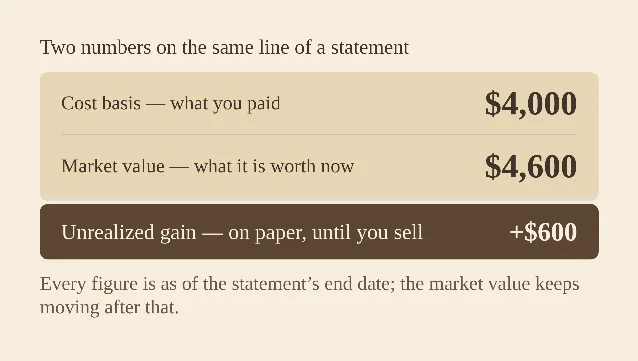
Each holding gets its own line, and every line carries the same small set of fields: the security's name and ticker symbol, the number of shares or units, the price per share on the statement date, the market value of the position, your cost basis in it, and the difference between the last two, shown as an unrealized gain or loss. 4
Market value is what the position would roughly fetch if you sold it that day; the SEC describes it as the amount you would generally receive, and notes that it moves with market conditions. 5 Cost basis is what you paid to own it: the purchase price, any commission or fee you paid to buy, and any dividends or capital gains distributions you reinvested. 45
Subtract one from the other and you have the unrealized gain or loss, the paper profit or loss the position carries while you hold it. Unrealized is the word doing the work here: the number becomes real at the moment you sell, which is the event Lesson 24 followed all the way to the tax form.
One more kind of holding can appear near this page. Some brokers show assets you keep somewhere else — at another firm or a bank — on the same statement. Those lines are set apart and marked as provided for your convenience, based on figures the carrying firm did not verify, and the separation is required because those assets may sit outside SIPC protection. 25
What moved during the period
Where the holdings page is a snapshot, the activity page is the log. It lists what happened between the start and the end of the period: each purchase and sale with its date, price, and quantity; deposits into the account and withdrawals out of it; dividends and interest received; dividends and interest reinvested; realized gains and losses from anything sold; and the fees and commissions charged along the way. 5
Watch the parentheses. A figure written as ($10.00) is a deduction, money the account paid out. A figure without them adds to the account. 5
FINRA's advice is to check this page against the papers you already hold. Every trade on the statement should match a confirmation you received, down to the price and the number of shares, and every deposit and withdrawal should be one you remember making. 1
| Document | What it covers | When it arrives | The question it answers |
|---|---|---|---|
| Trade confirmation | One order, filled the day it happened | Right after the trade | What did this single purchase or sale cost me? 1 |
| Account statement | The whole account, for the period printed on the cover | Each month or quarter | What do I own, what did I pay, and what changed since the last one? 3 |
| Form 1099-B | Your sales for one calendar year | By February 15 of the following year | What do I report to the IRS? 67 |
Three papers, three different spans of time. The confirmation records a single moment, the statement records a period, and the 1099-B records the year.
The pages people skip
Statements keep their driest and most useful material at the back, and FINRA's guidance is to read the whole statement rather than the summary page alone. 8
The income summary tallies the dividends, interest, and capital gains the account earned, sorted by tax treatment. Some statements also print an estimated annual income or estimated yield, and both are projections that can change, so treat them as an estimate rather than a promise. 15
The fees section lists what the firm charged the account — commissions, advisory charges, account fees, and the rest. A fee is money that left the account, and an unfamiliar one is exactly the kind of entry to ask about. 1
Cash gets its own treatment. Uninvested money may sit in a money market fund or move into a bank sweep, where the broker places it in a bank, often one affiliated with the firm. The two sides carry different protection: SIPC covers up to $500,000 of a customer's assets at a failed brokerage, including up to $250,000 in cash claims, while cash in a bank sweep is instead eligible for FDIC insurance up to $250,000 per depositor, per insured bank. 59
The disclosures at the end carry the definitions and the legal terms, including two sentences worth reading twice. One sets out where SIPC protection applies: it steps in when a brokerage fails and customer assets turn out to be missing, and a decline in the market price of a security falls outside what it covers. 9 The other asks you to report any inaccuracy or discrepancy promptly, and warns that the firm may treat an unanswered statement as correct. FINRA Rule 2231 requires that advisory on every statement, along with a note that a phone call should be confirmed in writing; the rule points to a customer's rights under the Securities Investor Protection Act as the reason. 2
What to check before you file it away
Reading a statement takes a few minutes, and one short pass catches most of what can go wrong. Five questions do the work.
Does the ending value match what you expect? The account summary starts with the beginning value and walks to the ending value through additions, subtractions, fees, and the change in what the holdings were worth. A gap between what you put in and what the account shows is worth tracing back to the lines that made it. 45
Does every activity line match something you did? Lay the statement beside the confirmations you kept and compare the trades, deposits, and withdrawals, price and quantity included. 1
Is there anything you did not authorize? A trade you never placed, a transfer you never asked for, or a cash balance that jumped with no visible reason is the pattern to catch. Contact the firm as soon as you see it. 8
Is there a fee you cannot explain? An unfamiliar charge belongs at the top of your list of questions. 1
Does the document itself look right? A statement that looks altered or unprofessional — a fuzzy logo, mismatched fonts — is a fraud red flag in FINRA's guidance, and worth a call to the firm right away. 1
If an answer looks wrong, the response matters as much as the catch. Report it promptly and put it in writing, to your brokerage firm and, when the statement names one, to the clearing firm as well. 1 A written note carries more weight than a phone call, because the rule that governs statements asks customers to reconfirm oral communications in writing to protect their rights. 2 Keep notes with dates, names, and what was said. 8
When the firm does not resolve the problem, the next step is a regulator: FINRA's Complaint Center or your state securities regulator. 18
Quick recap
- A statement covers a period, and every figure on it is dated to the period's end — a snapshot taken on that one date, with prices moving since. 1
- Brokers must send one at least quarterly, and many post one every month to customers who take electronic delivery. 23
- The holdings page shows what you own, what you paid (cost basis), what it is worth (market value), and the difference between them (an unrealized gain or loss). 5
- The activity page logs trades, deposits, withdrawals, dividends, interest, and fees, and each line should tie back to a confirmation you hold. 15
- SIPC covers up to $500,000 of customer assets at a failed brokerage, including up to $250,000 in cash claims; bank-sweep cash is instead eligible for FDIC insurance of $250,000 per depositor, per insured bank. 59
- Report anything that looks wrong promptly and in writing; a statement nobody answers can be treated as correct. 28
Next lesson: what the change in your account's value actually measures — and why a deposit in the middle of a bad month can make a statement look like a good one.
References
- 1
- 2
- 3
- 4How to Read Your Fidelity Statement — Fidelity
fidelity.com
- 5
- 6About Form 1099-B — IRS\
irs.gov
- 7Cost Basis Basics — FINRA\
finra.org
- 8
- 9
This story was produced automatically by a channel. One sentence is all it takes for Neodrop to keep producing for you.