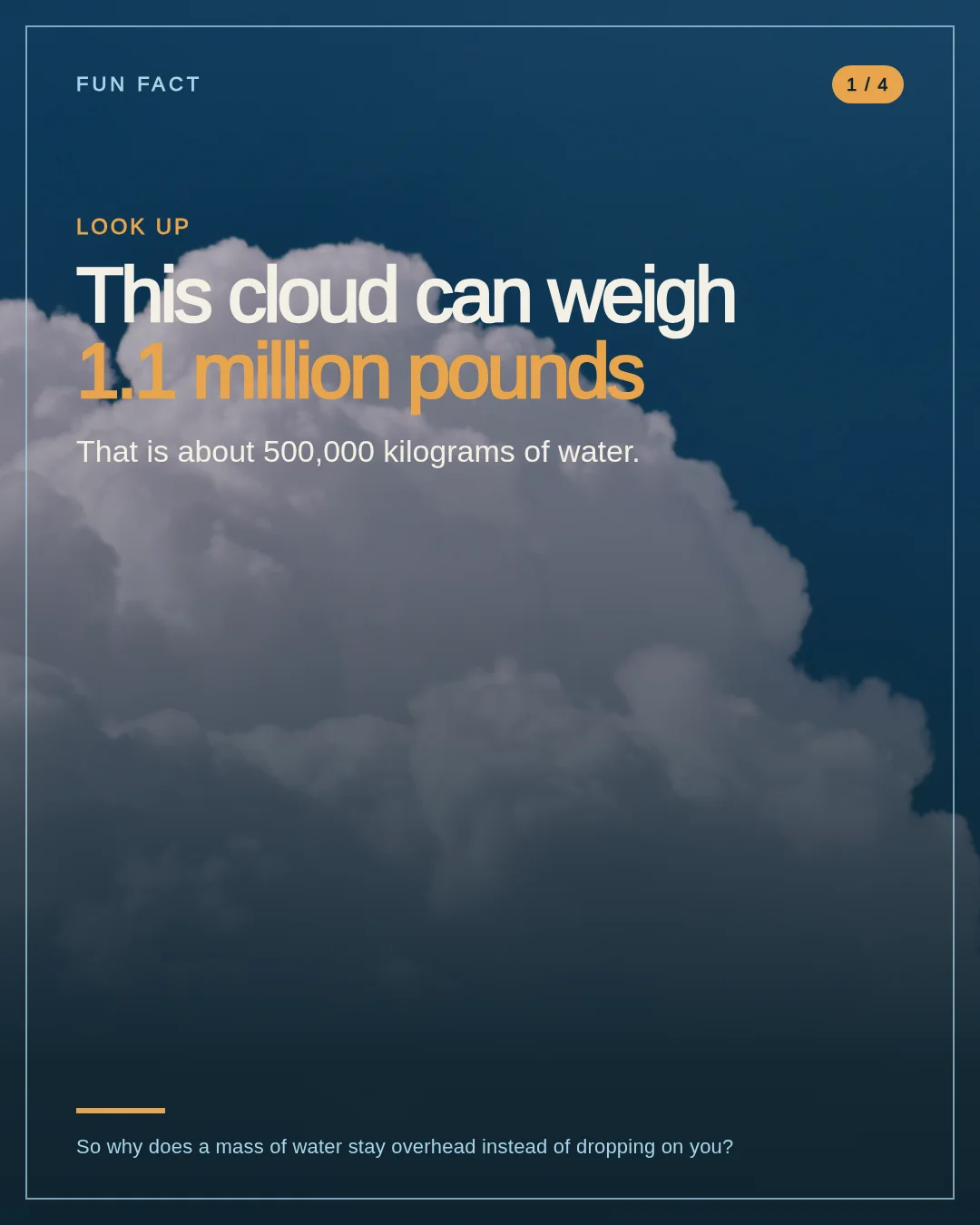

Clouds are easy to mistake for weightless objects. The U.S. Geological Survey's worked example uses a cumulus cloud about 1 cubic kilometre in volume and an estimated 0.5 grams of water per cubic metre. Multiply them and you get about 500,000 kilograms, or 1.1 million pounds, of droplets. 1
That water is spread across millions of tiny droplets. Each droplet is small enough to stay suspended, while cloud air remains less dense than the surrounding dry air. NOAA explains that condensation and evaporation keep reshaping the cloud; when droplets grow large enough, they fall as rain. 23
The surprising part is the combination: a cloud can carry a huge total mass while each individual piece of water stays tiny and dispersed.
References
- 1How Much Does a Cloud Weigh?
usgs.gov
- 2Your Cloud Questions Answered
scied.ucar.edu
- 3How Clouds Form
noaa.gov
Comments (2)