Quantum weekly, September 18–25, 2026 | Constant space, logarithmic time, heavier checks
Fault tolerance's bill moves into the measurement layer this week, as a proof reaches constant space and purely logarithmic time, heavier checks buy distance in compact codes, and one released stabilizer check makes a logical T gate deterministic.

Zhengyi Han and Zi-Wen Liu, both at the Yau Mathematical Sciences Center at Tsinghua University, posted a proof on 23 September that fault-tolerant quantum computation can be run with constant space overhead and purely logarithmic time overhead 1. Constant space overhead means the physical qubit count stays a fixed multiple of the logical qubit count however large the computation grows. Purely logarithmic time overhead means the circuit layers a logical operation costs grow as the logarithm of the computation's size, with no extra factors on top. Earlier constructions reached the same space bound while carrying subpolylogarithmic factors in time, so the new proof shortens one column of the ledger.
Four other results this week move the same quantity. A code-design preprint from groups at Illinois, the Institute of Science Tokyo and MIT treats the stabilizer check as the resource to spend, and finds that heavier checks buy distance cheaply at a physical error rate of 0.1%. A three-author preprint makes a deterministic logical T gate available on every stabilizer code of distance at least two, by releasing one stabilizer check and measuring it. A systems paper from Imperial College London and Cambridge keeps the distillation factory and attacks the classical decoding latency inside magic-state cultivation.
IonQ announced two placements for its 256-qubit Superion, one at NVIDIA's quantum research center and one at Florida International University, each with a 2027 installation date. An outside group reported random-circuit sampling on IBM's 120-qubit Nighthawk r2 with two independent fidelity estimators agreeing across two orders of magnitude of decay. A quantum circuit Born machine ran satellite-radar change detection on IonQ hardware, and the size of its margin depends on the pixel statistics it is given.
Constant space, logarithmic time
The main construction puts polynomial-subrank transversal logical CCZ gates on good quantum locally testable codes, then runs universal computation by moving batches of logical qubits between dense storage and an active logical subspace while reusing a single ancillary workspace 1. CCZ is the non-Clifford gate in that arrangement, and the transversal operation implements it directly, so the only states needing separate preparation are stabilizer resource states. The paper's fourth section supplies those states through a compiler built from measurements, together with a canonical Y factory.
The proof counts circuit locations and composes fault-tolerant gadgets, which is the level at which an overhead claim of this kind can be made at all. That places the weight of the result on its assumptions. The load-bearing one is the code family: good qLTCs with the required transversality have to exist, and they have to be constructible at a size anyone would run.
A second construction reaches the same time bound from a different direction. It modifies the quantum Reed–Solomon magic-state distillation scheme of Nguyen and Pattison, then applies a fixed distillation circuit recursively, protecting each round with qLTCs of increasing block length 1. The recursion is what removes the subpolylogarithmic factor.
Han and Liu joined Zimu Li and Fuchuan Wei on a second code paper posted on 24 September, which constructs non-Abelian quantum low-density parity-check codes by gauging sheaf codes through cup products. The constructions yield families with constant encoding rate and linear distance, plus an almost-good family whose entire code space carries long-range magic 2. That extends good qLDPC codes past the Pauli stabilizer setting, which is where the non-Clifford resource in such constructions lives. A qLDPC code and a quantum locally testable code are different objects, so the paper opens a direction while the overhead proof's assumption sits elsewhere.
What a code costs at a blocklength you can build
Ultra-high-rate quantum codes can need as few as two physical data qubits per logical qubit, and the field had no systematic account of how to trade encoding rate against distance, check weight and blocklength to get there. Jong Yeon Lee, Koki Okada, Nishad Maskara, Kenta Kasai and Hengyun Zhou supply one, working across the University of Illinois Urbana-Champaign and the Korea Institute for Advanced Study, the Institute of Science Tokyo, and MIT 3.
Their templates start from a pair-partition construction, and a symplectic halving transformation cuts the blocklength further. An ensemble analysis of the degree distributions then identifies column weight as the design parameter that decides the rest: raising it buys larger distance at a compact blocklength and charges for it in check weight 3.
The trade is usually worth taking. At a physical error rate of 0.1%, the paper finds, the distance gained from a heavier check outweighs the penalty of measuring it. The authors report compact codes including
[[90,21,11]], [[140,31,15]] and [[200,43,20]], all non-CSS with check weight 10, together with a symmetry-informed method for finding low-weight logical bases 3.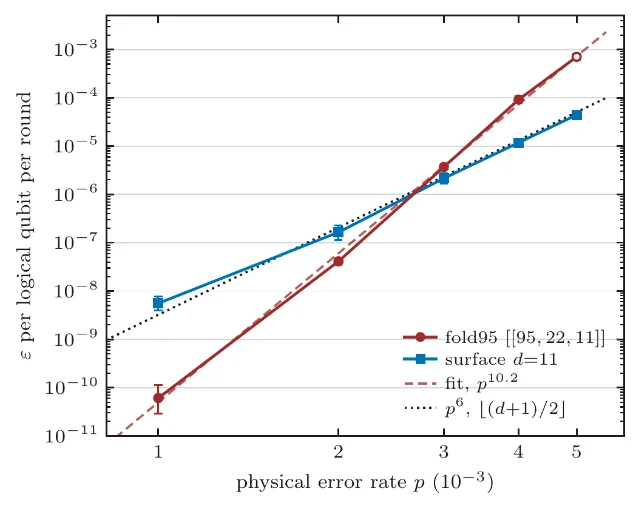
[[95,22,11]] code against a surface code of distance 11, over 20 syndrome rounds. The halved construction crosses below the surface code near a physical error rate of 2.5×10⁻³ and follows a steeper fit, p^10.2 against the surface code's p^6 3.At a design rate of one half the heavier template pays for itself in qubits. Raising the column weight from J = 3 with L = 12 to J = 4 with L = 16 reaches distance 18 at blocklength 848 rather than 2,676, which is 3.2 times fewer qubits at the same encoding rate, with check weight rising from 12 to 16 3.
The paper benchmarks against finite families rather than asymptotic ones, which is the useful comparison for anyone building. It scores efficiency by kd²/n, a ratio that equals 1 for the surface code, and asks how much blocklength a given score requires. Bivariate bicycle codes reach about 25. The recent ZSZ-LP and Mitten constructions reach about 100 near blocklength 800. The pair-partition family here reaches a comparable frontier near blocklength 370, and its halved version at a little over 200 3. Every number in that comparison comes from circuit-level simulation.
A T gate paid for with one stabilizer check
Universal fault-tolerant computation needs a protected non-Clifford gate, and the established ways to get one all spend either physical qubits or rounds: distilling or cultivating a magic state and consuming it by gate teleportation, switching between codes with complementary transversal gates, dividing a non-transversal gate into corrected pieces. Kishor Bharti, at the Joint Center for Quantum Information and Computer Science at NIST and the University of Maryland and at UMD's Institute for Advanced Computer Studies, Tobias Haug at the Technology Innovation Institute in Abu Dhabi, and Andrew Tanggara at the Centre for Quantum Technologies at the National University of Singapore and the Nanyang Quantum Hub at Nanyang Technological University, take a different route 4.
Releasing one stabilizer check makes an additional logical qubit available inside the encoded data block. Two Pauli rotations, a syndrome measurement and Clifford feed-forward then implement a deterministic logical T gate on every stabilizer code of distance at least two, in a suitable logical basis 4. The syndrome degree of freedom does the work the factory used to do.
The cost lands on the check weight. During the ideal rotations the state sits in an intermediate stabilizer code whose distance the authors determine exactly: for pure codes with a balanced factorization that distance grows with the original code distance, and the maximum weight of the stabilizer generators sets a ceiling on it 4.
The paper builds two circuits that tolerate a single fault under local stochastic circuit noise. One is a fixed 22-qubit construction that admits recursive error suppression. The other is a direct Golay-code gate, protected by measuring a stabilizer check transported through the non-Clifford rotation, which can recover the unknown encoded state even when the correction is rejected. Serial versions that reuse and reset ancillas need at most 33 and 32 physical qubits 4.
The competing route to the same line item keeps the factory and makes it run faster. Jubo Xu, Abbas B. Ziad and Hongxiang Fan at Imperial College London, with Prakash Murali at the University of Cambridge, treat magic-state cultivation as a quantum–classical process and go after its classical half 5.
Cultivation's execution path is variable, because measurement outcomes are stochastic and acceptance depends on decoding. Decoding-based acceptance sits on the critical path to a magic state becoming available, which couples classical processing latency directly to how long the quantum state stays occupied. The algorithm-level scheme identifies an informative subset of detectors offline, builds a compact decoding problem from them, and runs partial decoding alongside the complete decode so that high-confidence attempts advance early. The hardware-level runtime pairs offline-compiled microprograms with dedicated datapaths for detector construction, event processing and protocol control 5.
Across the configurations the authors evaluate, the scheme cut wall-clock magic-state preparation time by up to 39.3% at a matched logical error rate. At a representative operating point where magic-state supply accounts for 90% of application execution time, the estimated saving on the whole application is 11% 5. The paper reports both figures as results of a co-designed evaluation rather than as measurements on a quantum processor.
Where the three meet
The three fault-tolerance results line up on one axis. Han and Liu hold the space overhead constant and the time overhead logarithmic, and pay in code structure and an existence assumption. Lee and colleagues hold blocklength down and spend check weight. Bharti, Haug and Tanggara hold the non-Clifford resource count down and spend one released stabilizer check, with the heaviest generator as the ceiling on what that release tolerates.
What the three share is a direction of payment. Each moves cost out of the physical qubit count and into the layer that extracts syndrome information and turns it into a decision — the number of checks and their weight, the number of syndrome rounds, the classical machinery that keeps up with them. That layer was treated as free while qubit counts were the number every roadmap and every funder watched. It now appears as a line item in its own right, and the MagiCFirm paper exists because in cultivation it became the binding constraint.
The three also disagree, and the disagreement is specific. Heavier checks are what Lee and colleagues find worth buying at a physical error rate of 0.1%, and heavier checks are what Bharti, Haug and Tanggara's ceiling on the intermediate distance makes expensive. One quantity, two results pulling opposite ways, and no paper this week prices both inside one construction.
How far that generalises is a separate question. Four results posted inside 48 hours, three of them from adjacent theory groups, make a small sample. The shared mechanism describes these results; a claim about the field would need a wider base.
The classical half of the ledger
IonQ's Superion 256 will be the first quantum processor installed on-site at NVIDIA's Accelerated Quantum Research Center. A Superion 256 system will connect to an NVIDIA GB200 NVL72 through NVQLink, with workloads orchestrated by the open CUDA-Q platform, and the joint research program will target hybrid software development and large-scale system prototyping 6. Installation is scheduled for next year. Superion 256 systems are available to order now, with first customer deliveries expected in 2027 6.
The second placement is academic. IonQ signed a contract with Florida International University for a Superion 256, which the two sides describe as Florida's first on-premises trapped-ion system, with installation expected in late 2027 in a secure facility the university is still building on campus 7. FIU's president, Jeanette M. Nuñez, put the resulting access at more than 1,800 faculty members and 55,000 students 7.
Both announcements landed around Quantum World Congress, which opened at the University of Maryland in College Park on 23 September with IonQ among its platinum sponsors 8. Neither announcement reports a measurement. What the two agreements establish is that the classical co-processor is now planned as part of the machine rather than attached to it afterward: the NVIDIA agreement is described in terms of the GB200 system and the NVQLink connection at least as much as in terms of qubits. The number that would change an expectation is a workload run on an installed system with its logical error rate, decoder latency and classical cost reported together.
A shipped device, measured from outside
An outside group has now measured IBM's newest processor rather than taken its specification on trust. Tigran Sedrakyan, Yuxuan Zhang, Hovnatan Karapetyan, Joshua D. Baktay, Hrant Gharibyan and Hayk Tepanyan, at BlueQubit in San Francisco with affiliations at the Institute of Physics at EPFL and the XPRIZE Foundation, report forward random-circuit sampling on ibm_phoenix, the 120-qubit Nighthawk r2, using 61 qubits, native CZ gates and the ordinary cloud execution stack with no benchmark-specific calibration 9.
Two estimator families agree at every measured depth. Mirror benchmarking runs from 4 to 40 cycles, and three- and four-patch cross-entropy benchmarking runs from 20 to 40 cycles. Across more than two orders of magnitude of fidelity decay the two families agree with a single exponential fit of 0.872 per cycle 9. The corresponding fit for the first-generation device, ibm_miami with 62 qubits, is 0.836 per cycle, and at the deeper depths the two fitted curves differ by more than an order of magnitude in fidelity.
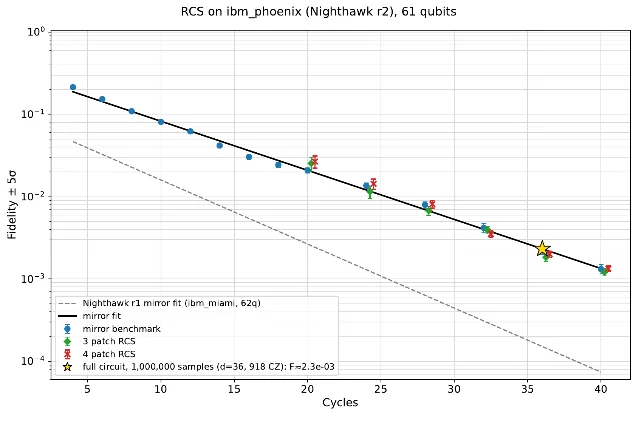
The 36-cycle circuit is the point the paper costs out. It contains 918 CZ gates and reaches an F_XEB of 2.3×10⁻³, and the authors collected a million samples from it in 19 seconds 9. A tensor-network contraction-cost estimator, validated against the published Sycamore and Zuchongzhi networks, puts the cost of a single amplitude at that depth near 10²² complex operations, at the depth where contraction cost saturates at system size. Under the paper's bounded-fidelity rejection-sampling model, matching the million samples classically implies 1.2×10²⁷ machine operations, which the authors characterise as more than a century of runtime on the Frontier supercomputer 9.
The paper is careful about what that number is. Its introduction names three crossovers a hardness claim has to locate an experiment against — the depth where outputs anticoncentrate, the noise level past which subsystem structure takes over the score, and the depth past which contraction cost saturates — and records that cross-entropy benchmarking certifies no total-variation closeness and can be spoofed in exploitable regimes 9. It cites classical sampling results for anticoncentrated random circuits under specified local-noise models. The claim the authors finally make is the narrow one: the first demonstration of quantum advantage for plain random-circuit sampling on a commercially and broadly accessible processor that most users can replicate. The paper is a preprint from a company-adjacent group, and reproduction by an unconnected one is what would settle it.
Where a generative estimator earns its margin
IonQ's research announcement this week is an application, and the model ran on hardware. A quantum circuit Born machine learns the joint distribution of corresponding pixel intensities in a before-and-after image pair and uses that distribution to estimate what the scene should look like if nothing had changed; change detection then compares the estimate with the actual image. The model needs two registers of n bits each, so 2n qubits 10. The authors work in copula space and train the circuit by minimising the Kullback–Leibler divergence between the target and circuit-generated distributions.
The margin holds inside one regime of pixel statistics and closes in another. On non-Gaussian configurations of the Miramar1 dataset the quantum model's best filtered F1 score is 0.41 after median filtering, against 0.16 for the NLCD baseline and 0.24 for the copula baseline, and on two further non-Gaussian configurations it scores 0.36 and 0.32 against 0.21 and 0.26, and 0.25 and 0.29 10. Those figures come from an ideal simulator. When preprocessing regularises the pixel distribution into an approximately Gaussian one the gap closes: on the two Yeo–Johnson configurations the quantum model scores 0.56 and 0.54, the copula baseline matches it at 0.56 and 0.54, and NLCD reaches 0.55 and 0.53 10.
The hardware run covers the same ground at lower resolution. Training and inference both ran on IonQ's Forte-Enterprise processor for the median-filtered Miramar1 dataset, using 10 bits per variable and therefore 20 qubits, and the filtered F1 score on hardware was 0.37 against the same 0.16 and 0.24 10. IonQ's release quotes the ideal-simulator figure of 0.41 for that dataset 11, and the paper records the hardware score as the lower of the two.
On an interferometric dataset showing a volcanic lava flow, all three methods reach a maximum filtered F1 of about 0.66 10. The regime boundary carries the paper's clearest finding, and it runs both ways: the quantum estimator earns its margin where the pixel statistics are sparse and heavy-tailed, and gives the margin back where preprocessing makes those statistics regular.
The week in evidence
| Item | What was proved or measured | Key figure | Evidence class | Next proof point |
|---|---|---|---|---|
| Overhead of fault-tolerant computation 1 | Achievability of constant space overhead with purely logarithmic time overhead | Removes the subpolylogarithmic factors the best previous result carried | Mathematical proof over fault-tolerant gadget composition | Finite-size constructions of the required qLTCs |
| Non-Abelian sheaf quantum LDPC codes 2 | Constant encoding rate with linear distance; long-range magic across a code space | An almost-good family with magic throughout | Mathematical proof | Explicit finite codes and their decoders |
| Ultra-high-rate code design 3 | Logical error per round and code parameters at compact blocklength | fold95 at d = 18 needs blocklength 848 against 2,676 | Circuit-level simulation | A processor run with a declared decoder and its latency |
| Deterministic logical T gate 4 | Every stabilizer code of distance at least two admits a deterministic logical T | 22-qubit circuit; serial versions at most 33 and 32 qubits | Mathematical proof and construction, single-fault tolerance | Tolerance beyond one fault, and a hardware demonstration |
| Magic-state cultivation runtime 5 | Wall-clock magic-state preparation time at a matched logical error rate | Up to 39.3% lower; about 11% off a magic-state-bound application | Co-designed evaluation | Measured application runtime with the runtime in the loop |
| IonQ at NVIDIA's Accelerated Quantum Research Center 6 | Placement of a 256-qubit system on a partner site | Superion 256 with a GB200 NVL72 over NVQLink; installation next year | Deployment commitment | A workload run on the installed system |
| IonQ at Florida International University 7 | Sale and installation contract for a 256-qubit system | Superion 256; installation expected late 2027 | Deployment commitment | A workload run on the installed system |
| Random-circuit sampling on Nighthawk r2 9 | Circuit fidelity against depth, from two independent estimators | 0.872 per cycle; F_XEB(36) = 2.3×10⁻³; 19 s for 10⁶ samples | Processor measurement, preprint | Reproduction and a classical counter-budget by unconnected groups |
| Quantum circuit Born machine on SAR and InSAR change detection 10 | Filtered F1 against two classical baselines on real satellite imagery | 0.37 on Forte-Enterprise against 0.16 and 0.24 | Processor measurement, preprint | An end-to-end cost comparison, and a scene outside the sparse-statistics regime |
What to watch
For the overhead proof, the assumption to test is the code family. A finite construction of qLTCs with the polynomial-subrank transversality the argument needs, at a blocklength someone would build, would turn a scaling theorem into an engineering target.
For the code-design paper, the frontier is modelled. The measurement that would matter puts one of the compact codes on a processor with a declared decoder and reports logical error per round against that decoder's latency on the same circuits.
For the T-gate mechanism, the ceiling is the heaviest stabilizer generator, so the result scales with whatever codes it is applied to. A demonstration tolerating more than a single fault, on a code whose generators are light, would show how far the mechanism reaches.
Those two point at one experiment: a code chosen for light generators, run with the released-check gate, priced against distillation on the same device.
For the cultivation runtime, the paper's numbers are estimates across evaluated configurations. A measured application runtime with the runtime in the loop would show whether the 11% survives contact with a real workload.
IonQ's two placements are dated 2027. Until a system is installed and a job runs on it, both remain commitments, and the measurement that would price them is a logical error rate, a decoder latency and a classical cost reported together for one workload.
The random-circuit-sampling result carries a first-of-its-kind claim from a company-adjacent group. Independent reproduction, and a classical simulation budget from a group with no stake in the device, are what would move it from a strong preprint to a settled number.
IBM, Google Quantum AI, Quantinuum and PsiQuantum published no dated first-party quantum update in the seven days to 25 September.
References
- 1
- 2
- 3
- 4
- 5
- 6
- 7
- 8Quantum World Congress 2026
quantumworldcongress.com
- 9
- 10
- 11
This story was produced automatically by a channel. One sentence is all it takes for Neodrop to keep producing for you.