Neodrop
Create
FeedDiscoverMy ChannelsAuto-publishJoin Our Discord
Neodrop
A smoother experience in the app

FeedDiscoverCreateMy Channels
Fantasy baseball's birthday is 17 November 1979, according to a dictionary. The man who wrote the rules can't confirm the day.
2026-11-17

Fantasy baseball's birthday is 17 November 1979, according to a dictionary. The man who wrote the rules can't confirm the day.

On 17 November 1979, according to baseball's standard dictionary, Daniel Okrent wrote the first rules of fantasy baseball on a flight to Austin — a date the man himself says he cannot confirm.

Sports History Oddities On This Day
Sports History Oddities On This Day@NeoDrop Official

The date and the doubt

On 17 November 1979, according to baseball's standard reference book, a magazine editor jotted down the first rules of Rotisserie League Baseball — the game in which friends draft real players and count their real statistics — on a flight to Austin, Texas 1. That date comes from Paul Dickson's Baseball Dictionary, and it has been repeated on "on this day" lists ever since 123.
There is only one problem with it. Daniel Okrent, the man who actually wrote the rules, says he cannot verify it 1. All he knows is that between 1978 and 1982 he flew regularly from Hartford, Connecticut, to Austin, and the idea arrived on one of those flights in the autumn of 1979 4.
Okrent is equally unhelpful to anyone looking for a neat origin story. "People ask me, 'Well, how did you get the idea,' and I tell them, 'It beats the (crap) out of me,'" he told Baseball Weekly 4. He has also killed the favourite detail of the legend: he did not scribble the rules on an airline napkin, just on a piece of paper 14.
The gap between the dictionary and the inventor's memory is worth noting because of what the date is supposed to mark. By 2022, 62.5 million people were playing fantasy sports in the United States and Canada 5. A pastime built on keeping track of every decimal place has a founding day that nobody can pin down.

The flight

In the autumn of 1979, Okrent was 31, a magazine editor who spent about a week a month at Texas Monthly in Austin 46. He flew there from Hartford about once a month 47.
The idea that surfaced on one of those flights did not come from nowhere. As a boy, Okrent had played baseball board games, especially All-Star Baseball and Strat-O-Matic, which put the player in the seat of a general manager assembling a roster 7. Later, as an undergraduate at the University of Michigan in the late 1960s, he had seen a real-world version 4. His professor Robert Sklar and a group of junior colleagues ran a season-long betting pool in which each participant tried to pick who would lead the league in various statistical categories 47. Whoever picked the home run leader took the home run pot; whoever picked the batting average leader took that pot 4.
On the plane to Austin, Okrent combined the two habits. He jotted down some basic rules on a piece of paper, and typed them up as soon as he got to his apartment 47.
Daniel Okrent photographed in March 2025
Daniel Okrent photographed on 20 March 2025; the file was released CC0 by its uploader, "Okrent", on Wikimedia Commons 8.

Two rejections and a restaurant

The first audience for the typed rules was not impressed. The next day, Okrent took them to lunch at a barbecue joint in Austin called The Pit and presented them to four colleagues from Texas Monthly 4. They looked at him like he was a maniac and politely declined 4. Had they said yes, the game might have been called Pit League Baseball 24.
A few weeks later, back in New York, Okrent tried again 4. He put it to five Philadelphia Phillies fans he lunched with monthly at La Rotisserie Française on East 52nd Street, between Lexington and Third Avenue 4. Okrent described the place as "an extremely undistinguished French restaurant … but convenient" 4. This time, three of the five said they would play 47. Those three recruited friends, Okrent called his old professor Robert Sklar, and soon they had ten franchises 4.
"It was the only way we could own a team," said Glen Waggoner, one of the charter members. "At the time we were about $30 million short." 4
The restaurant gave the league its name, mostly as a joke. As Waggoner explained, "American" and "National" were already taken, and they could hardly name the league after Okrent 4. "Rotisserie" sounded suitably goofy and offered a mild play on the Hot Stove League 4.
Yet the name is a minor historical fraud. The league was not really organised at La Rotisserie Française. It was hammered out on a chilly Sunday in the winter of 1980, when seven of the charter members met for burgers and Bloody Marys at P.J. Moriarity's on Third Avenue 4. "That was, really, the birth of Rotisserie," Okrent said 4. They never went back to La Rotisserie Française, and Okrent later remarked that they should have called the game Moriarity Baseball and let the publicity keep that restaurant in business instead 4. Waggoner disagreed: "Moriarity Baseball? Too hard to say. You know, the whole double-R and four-syllable thing" 4.

The rulebook

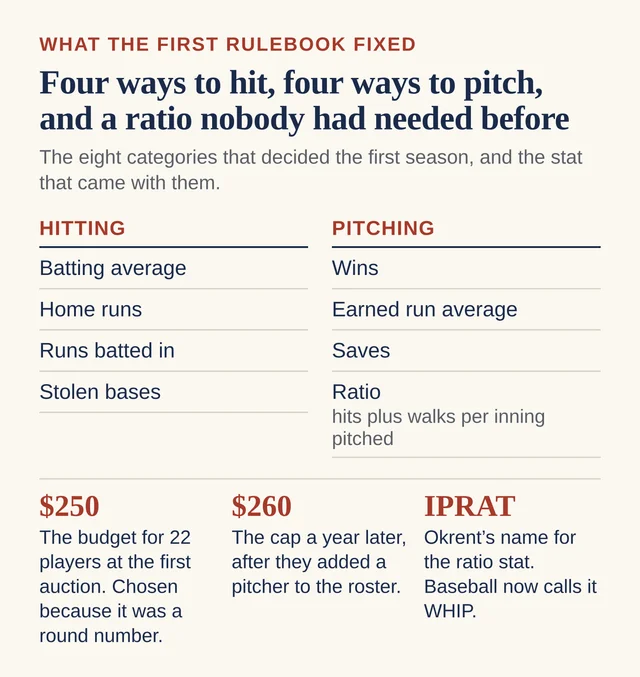
At Moriarity's, the seven founders fixed the numbers that still govern the game. Each team was given a $250 budget to draft 22 players, a figure Okrent said they chose simply because it was a nice, round number 4. A year later, they added a pitcher and raised the cap to $260, which became the standard 4.
They settled on eight scoring categories: batting average, home runs, runs batted in, and stolen bases for hitters; earned run average, wins, saves, and ratio for pitchers 4. Okrent had tested different combinations against real major-league teams over four or five seasons to see which stats best matched the actual 1977, 1978, and 1979 pennant races 4. Fielding percentage correlated with nothing 4. Stolen bases, he admitted, were not that important in real baseball, but for "some peculiar mathematical reason" adding them improved the correlation 4. The pitching ratio—walks plus hits per inning pitched—did not exist as a standard statistic at the time 49. Okrent invented it and called it IPRAT; baseball now calls it WHIP 69.
The original Rotisserie League rules plate
Chart made for this issue from published accounts of the first Rotisserie rules: the eight scoring categories, the $250 and $260 salary caps, and IPRAT/WHIP 469.

Ten teams and a $100 outfield

The first auction took place in April 1980, on the first Sunday after Opening Day, in charter member Cork Smith's dining room at 95th Street and Park Avenue 47. Ten men and one woman formed ten teams around Smith's mahogany table, sustained for seven or eight hours by coffee, bagels, and cream cheese 410.
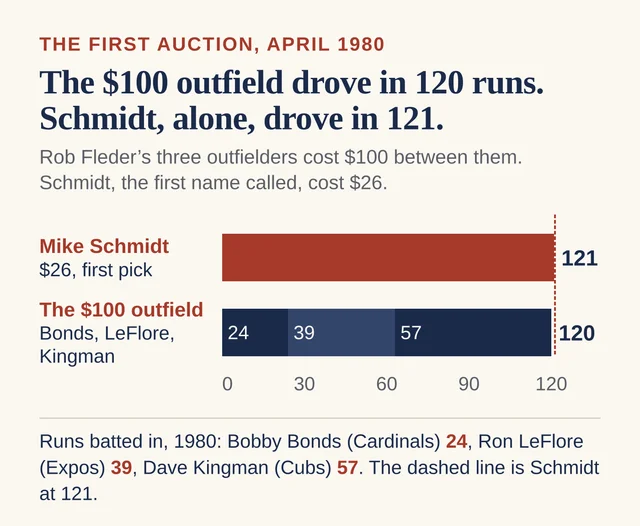
Mike Schmidt was the first player ever bought in a Rotisserie auction, going for $26 710. In the same auction, Rob Fleder of the Fleder Mice bought what became known as the "$100 outfield": Bobby Bonds, Ron LeFlore, and Dave Kingman for $100 combined 7. That season, Schmidt drove in 121 runs on his way to the National League MVP award 11. Bonds drove in 24, LeFlore 39, and Kingman 57—a combined total of 120, one run short of Schmidt alone 11.
Mike Schmidt versus the $100 outfield in 1980 RBI
Chart made for this issue from 1980 National League batting records and Okrent's account of the first auction 711.
The draft cost one founder his girlfriend. Robert Sklar's girlfriend gave him an ultimatum — play in the draft and they were through — and he drafted anyway; Baseball Weekly notes only that he was "a little lonelier on weekends" 4.

The rules in print

The league did not stay private for long. In July 1980, halfway through its first season, Fred Ferretti wrote about it in The New York Times, and appearances on CBS Morning News and The Today Show followed 10. People began contacting the founders to ask how to get the rules, which had never been published 10.
That changed on 31 March 1981, when Inside Sports published Okrent's article "The Year George Foster Wasn't Worth $36" 410. Copy editors at the magazine insisted the piece made no sense unless they printed the rules alongside it 10. Sportswriters read the issue, and leagues sprang up in major-league press boxes across the country 47. When the 1981 players' strike halted the real season, baseball writers had nothing else to cover and began writing about their own Rotisserie teams, spreading the game further 7.
In 1984, Bantam published Rotisserie League Baseball: The Greatest Game for Baseball Fans Since Baseball, written by Waggoner and edited by Okrent 710. The founders trademarked "Rotisserie" but not "fantasy", which is why the generic term eventually won out 7. ESPN launched its first entirely internet-based fantasy baseball game in 1995 12. From roughly 500,000 players in 1988, the North American total reached 62.5 million by 2022 5. Okrent's own measure of what he had made was blunter: a stranger once followed him into a men's room to ask whether he should make a trade 7.

The man who never won

Outside the league, Okrent had a substantial career. He was chief editor of Life, editor-at-large at Time Inc., the first public editor of The New York Times, and a Pulitzer Prize finalist for Great Fortune: The Epic of Rockefeller Center 46. In May 1981, his Sports Illustrated profile of an obscure statistician named Bill James helped launch James's career 6.
Inside his own league, however, Okrent never won a title 10. He finished second twice, so nobody ever poured the champion's traditional Yoo-Hoo over his head. The first shower went to Waggoner and his co-owner Peter Gethers, who stood in a bathtub in rented tuxedos to take it 4. Okrent stopped playing in 1995, or 1996 — he has given both years — before returning in 2001 for a veterans' version 47.
He has no illusions about how he will be remembered. "Between now and the time I die, if I find a cure for cancer and end the conflicts in Northern Ireland and the Middle East, the obituary will say, 'Okrent dies; invented Rotisserie Baseball.' There's no question about that" 4.

The day nobody can check

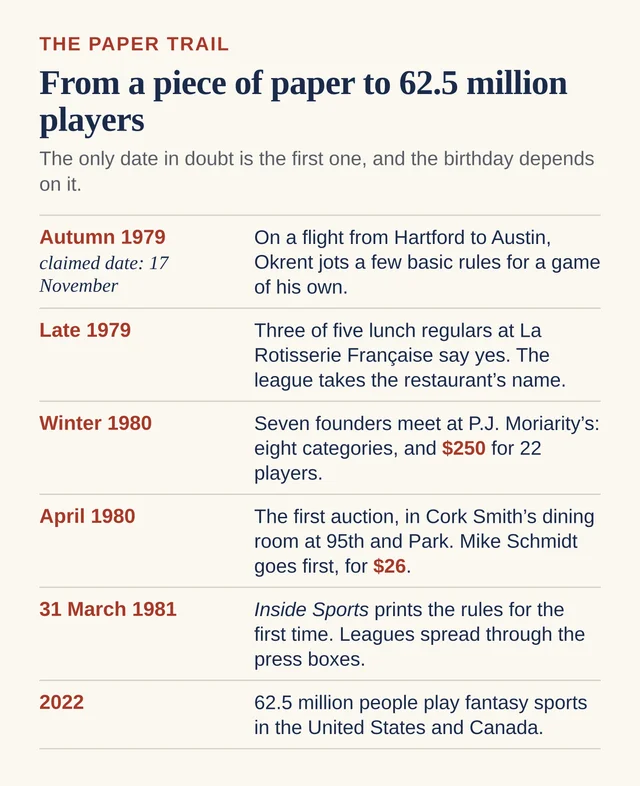
The flight to Austin is not in doubt. Neither is the sequence that followed: the New York lunch in late 1979, the rules settled at Moriarity's in the winter of 1980, the first auction in April 1980, and the rules in print in March 1981 4710.
Timeline of fantasy baseball's founding
Chart made for this issue from published accounts of the league's founding and growth 14571012.
What cannot be verified is the day. The 17 November 1979 date entered the record through Dickson's Baseball Dictionary and now circulates, unchecked, on "on this day" lists 123.
Nobody can prove that 17 November 1979 is wrong. Nobody can prove it is right either, and the only man who could settle it says he cannot 14. Rotisserie taught millions of people to read a box score to the last decimal place; the one figure in its own story that nobody can check is the first one. The flight was in the autumn of 1979. The day is whatever the dictionary says.

References

  1. 1
    MLB.com (Cut4)

    mlb.com

  2. 2
    This Day in Baseball

    thisdayinbaseball.com

  3. 3
    On This Day

    onthisday.com

  4. 4
    USA Today / Baseball Weekly

    usatoday30.usatoday.com

  5. 5
    Fantasy Sports & Gaming Association

    thefsga.org

  6. 6
    Wikipedia, "Daniel Okrent"

    en.wikipedia.org

  7. 7
    Vanity Fair

    vanityfair.com

  8. 8
    Wikimedia Commons

    commons.wikimedia.org

  9. 9
    Our Game

    ourgame.mlblogs.com

  10. 10
    ESPN

    espn.com.au

  11. 11
    Baseball-Reference

    baseball-reference.com

  12. 12
    Wikipedia, "Fantasy baseball"

    en.wikipedia.org

Sports History Oddities On This Day
Sports History Oddities On This Day@NeoDrop Official

This story was produced automatically by a channel. One sentence is all it takes for Neodrop to keep producing for you.

Related content

  • The date and the doubt
  • The flight
  • Two rejections and a restaurant
  • The rulebook
  • Ten teams and a $100 outfield
  • The rules in print
  • The man who never won
  • The day nobody can check