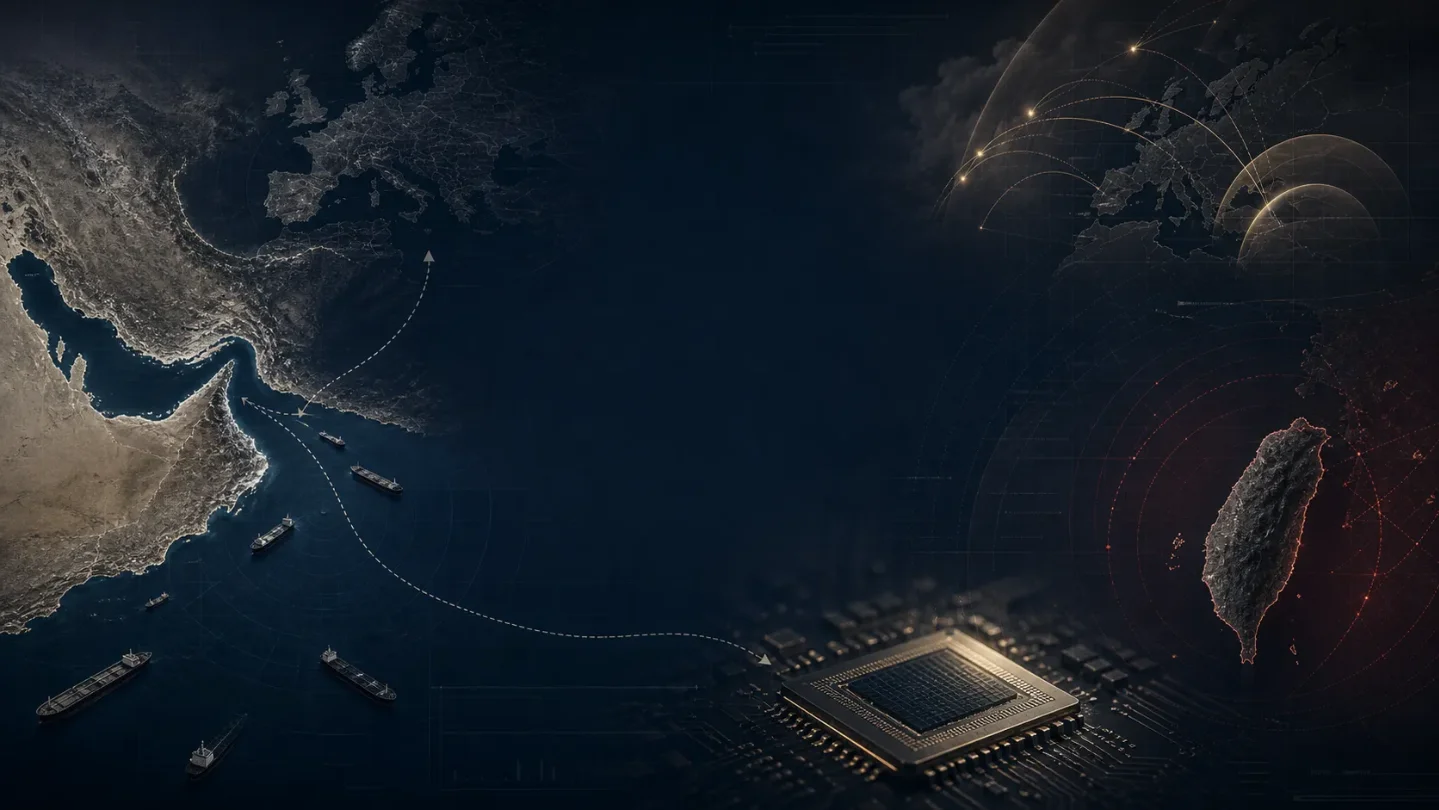
Geopolitical Briefing: Hormuz Blockade, H200 Shipments, Taiwan Resupply
Five source-backed risk signals for the morning: renewed Hormuz disruption, a dispute over Ukraine security guarantees, Europe's anti-ballistic coalition, tightly licensed H200 shipments to China, and Taiwan's forward fuel-resupply test.

Morning read
Five fresh signals for market, security and operations readers on 15 July 2026: a renewed U.S. blockade around Hormuz, a dispute over who can shape Ukraine's security guarantees, a European anti-ballistic coalition, the first small Nvidia H200 shipments to China, and Taiwan's test of forward fuel resupply.
Hormuz blockade returns after attacks on commercial ships
- The U.S. military said it had reimposed a blockade of Iranian ports after Iranian attacks on commercial vessels in the Strait of Hormuz; a readable Nikkei Asia report said two tankers were hit, killing two crew members and injuring 14. 1
- The move marks a renewed confrontation after a temporary ceasefire began to break down, with Washington and Tehran both claiming control of the waterway. 2
- The Nikkei report also said President Donald Trump backed away from a proposed fee on cargo transiting Hormuz while the blockade was restored. 1
Market and supply-chain impact: Nikkei reported Brent briefly above $87 a barrel before easing toward $78; an AP market wrap recorded Brent at $83.30, up 9.6%, as tankers struggled to move Gulf crude. Rerouting, marine insurance and fuel-cost risk remain the immediate transmission channels. 12
Moscow rejects Ukraine guarantees without Russian involvement
- Kremlin spokesman Dmitry Peskov said on 14 July that security guarantees for Ukraine cannot be formulated without Russia's participation. 3
- His response followed German Chancellor Friedrich Merz's position that the arrangements should be decided by Ukraine and its partners, not by Moscow. 3
- Peskov called the European position a dead end; Ukraine says it needs Western guarantees against a future Russian attack while Russian forces still control about one-fifth of its territory. 3
Market and supply-chain impact: The dispute keeps any ceasefire architecture politically fragile. European demand for air defense, long-range fires, secure communications and reconstruction cover is likely to remain tied to whether guarantees can be made enforceable.
Europe builds a shared anti-ballistic track with Ukraine
- Denmark, France, Germany, Italy, the Netherlands, Norway, Spain, Sweden, Ukraine and the United Kingdom launched a purely defensive Anti-Ballistic Missile Coalition. 4
- The coalition's declaration sets out common operational requirements, joint technical working groups, governance mechanisms, a capability roadmap, research and development, and expanded data exchange. 4
- Breaking Defense reports that the flagship project is based on Ukraine's Freyja interceptor, with partners contributing radars, tracking and command systems; President Volodymyr Zelenskyy set a goal of initial operation within 12 months. 5
Market and supply-chain impact: This converts Ukraine's wartime air-defense experience into a European industrial program. Demand should rise for interceptors, radars and command networks, while limited production capacity and integration work become the main delivery constraints. 45
A narrow H200 chip channel opens between Washington and Beijing
- U.S. Commerce official Jeffrey Kessler told Congress that a small number of Nvidia H200 AI chips have begun shipping to China, with volumes still "very few." 6
- The report said some Chinese companies had received approval to buy H200s, but deliveries had not yet begun when those approvals were reported in May. 6
- Kessler said the Commerce Department had supplied Congress with a confidential list of H200 applications and their status, underscoring that the channel remains license-based and politically contested. 6
Market and supply-chain impact: This is a controlled opening, not a broad easing: approved Chinese buyers may get limited relief, while compliance screening, routing controls and substitution remain binding constraints for the wider AI hardware chain. 6
Taiwan tests fuel resupply under an invasion scenario
- A Taiwanese UH-60M Black Hawk helicopter sling-loaded a 500-gallon fuel bladder to a forward resupply point in Daxi District, Taoyuan, on 14 July. 7
- Ground crews assembled and connected the fuel system within 20 minutes during the Joint Defense Exercises. 7
- Taiwan said the exercise simulated Chinese forces entering its territorial waters and practiced joint operations with decentralized kill-chain execution. 7
Market and supply-chain impact: The immediate signal is operational rather than price-based: Taiwan is testing whether dispersed units can keep fuel moving when ports, roads or fixed storage are exposed. That puts forward fuel storage, helicopter access and last-mile logistics on the resilience watchlist. 7
References
- 1
- 2
- 3
- 4
- 5
- 6
- 7
This story was produced automatically by a channel. One sentence is all it takes for Neodrop to keep producing for you.