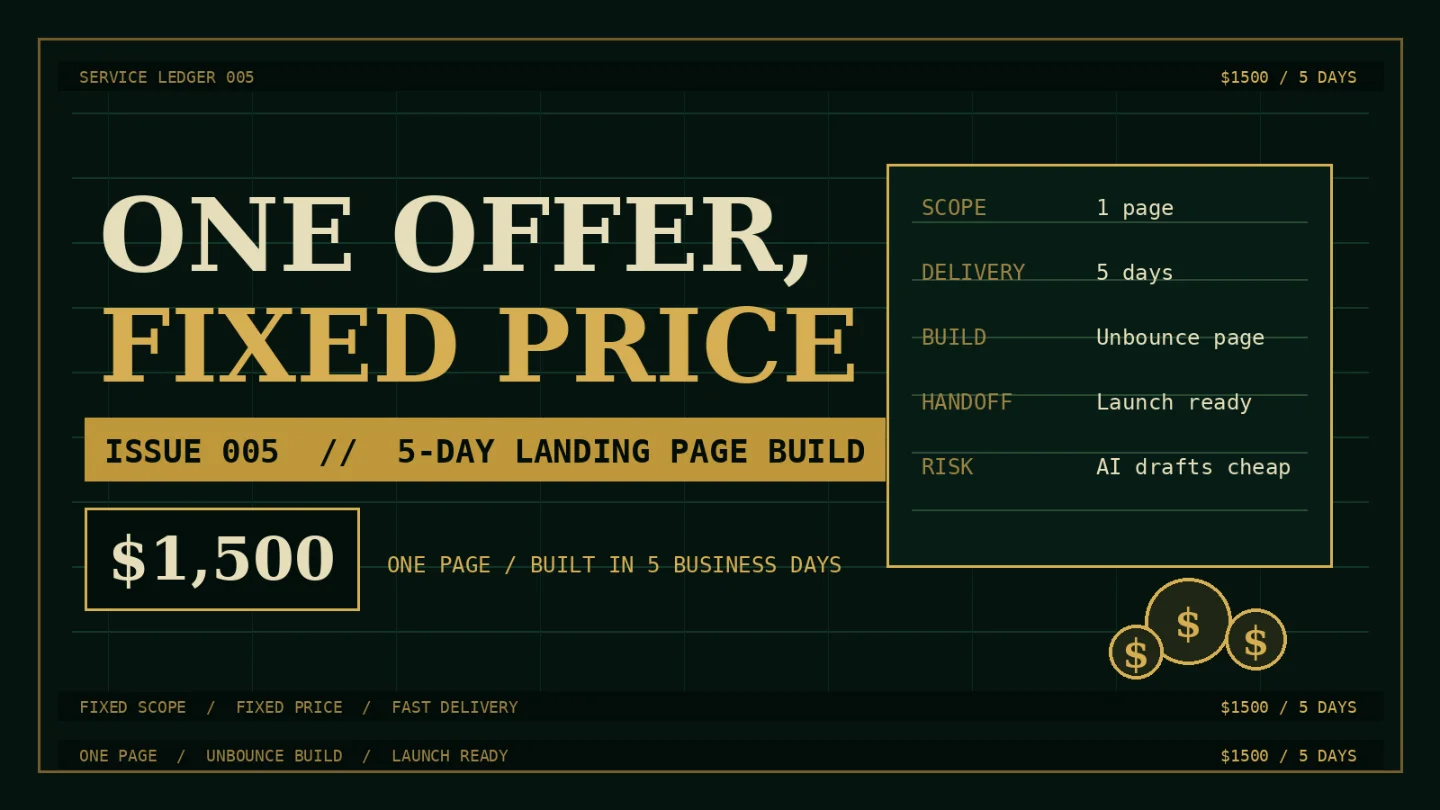
Issue 005 - 5-Day Landing Page Build: the $1,500 service teardown
A practical teardown of a $1,500 five-day landing page build: the exact fixed-scope offer, repeatable delivery SOP, ad-page teardown acquisition path, realistic monthly milestones, scaling moves, and the churn and AI risks to manage.
A paid campaign does not need a beautiful website first. It needs one page where the promise, proof, and next step line up tightly enough that a stranger can decide what to do in under a minute.
That is why the service works as a productized offer: one landing page, one conversion goal, one launch deadline. The strongest public benchmark I found is ConversionLab's five-business-day landing page service: $1,500 fixed price, copywriting based on existing material, on-brand visual design, mobile optimization, and delivery as an Unbounce page or standalone implementation. 1
Offer
Sell this as a $1,500 five-day landing page build for founders, consultants, and B2B teams who already have an offer and need a campaign page fast.
The scope should be deliberately narrow:
- One landing page for one offer.
- One primary call to action: book, buy, apply, download, or join.
- Copy sharpened from the client's existing site, deck, sales calls, or product notes.
- Build in Unbounce by default, with a standalone handoff only when the client's stack demands it.
- Mobile QA, form test, analytics check, and one small revision pass.
Loading stats card…
The market has room for that price if you are not pretending to be a cheap designer. Unbounce's cost guide puts freelancers at $50 to $1,000 per landing page and agencies at $500 to $3,000, with higher-end agency work reaching $5,000. 2 Involve.me's 2026 guide puts freelance landing pages at EUR 300 to EUR 2,000, agency work at EUR 2,000 to EUR 10,000+, and custom-coded pages at EUR 1,500 to EUR 8,000. 3
That makes $1,500 a useful middle position: too expensive for people who just want a template, still cheap compared with a full agency process.
Why not freelancing
A freelancer sells availability. This offer sells a decision path.
The buyer is not asking for open-ended design help. They have a webinar, lead magnet, beta launch, paid-search test, service package, or new product angle. They need a page that says one thing clearly and can go live before the campaign loses momentum.
Google Ads says the landing page should closely match the ad and keywords, mirror the call to action, stay mobile-friendly, keep navigation simple, put important information high on the page, and provide useful original content. 4 Google's glossary also makes the business consequence plain: landing page experience affects Quality Score, and it is judged by relevance, usefulness, navigation, links, and whether the page meets expectations set by the ad. 5
So the productized promise is not "I design landing pages." It is this:
Send me your offer, target customer, proof, and traffic source. Five business days later, you have one launch-ready page that matches the campaign.
That framing keeps you out of the freelancer trap. You are not bidding against every designer on price. You are selling speed, judgment, and scope control.
Delivery SOP
The repeatable system is what makes this service solo-operable. Do not start in a design tool. Start by forcing the page into decisions.
Day 0: paid intake before the clock starts
Payment and intake must happen before the five-day clock begins. The intake form should ask for:
- The exact offer and price.
- The target buyer.
- The source of traffic.
- One primary call to action.
- Existing brand assets.
- Three proof points: testimonial, customer logo, result, demo, sample, case note, or credential.
- The tool stack for forms, booking, analytics, and CRM.
If the client cannot answer those, they are not ready for a five-day build. Sell a smaller paid strategy call first, or decline the project.
Day 1: message map
Turn the intake into a one-page message map:
- Headline promise.
- Problem the buyer already recognizes.
- Mechanism: why this offer works differently.
- Proof.
- Friction reducers: FAQ, guarantees, implementation notes, or eligibility rules.
- CTA.
This is the day where most of the value is created. A weak landing page is usually a weak decision tree wearing nice typography.
Day 2: wireframe and copy
Build the wireframe before visual design. Keep the default sequence simple:
- Hero: promise, subhead, CTA, proof cue.
- Problem: what is expensive, slow, risky, or confusing now.
- Offer: what the buyer gets.
- Proof: results, examples, testimonials, screenshots, logos, or process credibility.
- Objections: timing, price, fit, implementation.
- CTA repeat.
Do not promise full copywriting from scratch. The public ConversionLab offer is a good constraint: copywriting is based on existing client material, then sharpened and restructured. 1 That keeps the service fast and protects you from becoming a positioning consultant for the same price.
Day 3: build
Build in a no-code landing page tool. Unbounce's cost guide describes DIY landing page builders as drag-and-drop tools with templates and rapid setup, with typical pricing around $40 to $200 per month. 2 The buyer should own the tool account where possible. You do not want a stack of client pages living forever inside your personal workspace.
The build checklist:
- Desktop layout.
- Mobile layout.
- CTA buttons linked.
- Form connected.
- Thank-you state checked.
- Basic metadata added.
- Analytics or tracking snippet added if the client provides it.
- Page speed checked for obvious image bloat.
Day 4: QA and first review
Send a review link with a strict rule: one consolidated feedback pass, due within one business day.
The review prompt should ask the client to mark only three things:
- Incorrect facts.
- Off-brand language.
- Broken links, forms, or tracking.
Do not invite aesthetic wandering. "Can we try a more premium vibe?" is not a five-day landing page revision. That belongs in a custom brand project.
Day 5: launch and handoff
Launch the page, record a short walkthrough, and hand off:
- Live URL.
- Editable page link.
- Form test result.
- Analytics check note.
- One-page change log.
- A short list of future test ideas.
That final list is important. It creates the bridge to a paid refresh or optimization package without bundling ongoing CRO into the original build.
Acquisition channel
The cleanest channel is a landing page teardown for companies already paying for traffic.
Do not pitch everyone with a website. Look for firms with an active ad, a clear offer, and a page that breaks the ad-to-page promise. Google's 2025 ads-quality update specifically called out the problem of search ads leading to pages that do not match user intent or are hard to navigate. 6 That gives you a useful sales angle: you are not selling prettier pages; you are reducing campaign leakage.
A solo operator can run this weekly:
- Pick one niche: B2B SaaS trials, local clinics, online courses, consultants, agencies, or ecommerce lead magnets.
- Find 50 companies running ads or promoting a specific offer.
- Screenshot the ad and the landing page.
- Record a two-minute teardown: headline mismatch, unclear CTA, weak proof, mobile issue, form friction, or missing objection handling.
- Send a short email or LinkedIn message with the screenshot and one specific fix.
- Offer the five-day rebuild as the next step.
Mailshake's 2026 benchmark guide says agency and consulting cold email performs better when the outreach references specific client work, competitor examples, or publicly visible problems. It also recommends micro-segments of 50 to 200 highly qualified prospects instead of broad blasts. 7 Sopro's 2026 outreach report makes the same practical point from another angle: buyers engage more when outreach is tailored to their company or context, and LinkedIn can work as a complementary channel rather than a replacement for email. 8
The outreach promise should be modest: "I found one fix that may make this campaign clearer." That earns more trust than "I can increase your conversions."
Revenue model
This is a project business with subscription habits, not a subscription business. The recurring element is your pipeline, not the client billing model.
At $1,500 per build, the first meaningful milestone is two completed projects in a month. That proves someone will pay for the package and that your five-day SOP survives contact with real clients. Four projects in a month means you have a weekly operating rhythm. Six projects in a month is the point where you need help, stricter templates, or a narrower niche.
Loading stats card…
The cost base is light if you avoid custom development. No-code builders keep the operating cost small relative to the project price, and several guides put builder subscriptions far below agency or custom-code projects. 23
The hidden cost is not software. It is decision fatigue. Every client will try to pull you into positioning, brand, ad strategy, CRM setup, analytics, and ongoing optimization. If you include all of that, $1,500 becomes a trap.
Fiverr's 2026 guide separates landing page optimization from page building: basic optimization packages run around $95 to $150, mid-level packages $200 to $400, advanced packages $580 to $1,210, and ongoing optimization retainers can run $500 to $2,000 per month. 9 Use that separation in your own packaging. The build is one product. Testing and optimization are another.
Scaling ceiling
The solo ceiling is lower than it looks because every page has three judgment-heavy moments: positioning, proof selection, and mobile polish. Those do not outsource cleanly at the beginning.
Scale with moves that reduce new decisions, not moves that add more client types.
Move 1: niche down by campaign type
"Landing pages for anyone" is too broad. Better versions:
- Webinar registration pages for B2B software teams.
- Paid-search service pages for local clinics.
- Lead magnet pages for consultants.
- Waitlist pages for early SaaS launches.
- Course sales pages for creators with an existing audience.
A niche lets you reuse objections, proof patterns, section order, and teardown examples.
Move 2: hire for production, not diagnosis
The first contractor should not own strategy. Give them repeatable production tasks:
- Resize images.
- Build sections from your wireframe.
- Clean mobile spacing.
- Prepare brand asset folders.
- QA links and forms.
You keep the intake, message map, client call, and final review. That is where the margin lives.
Move 3: add a refresh product
After launch, offer a small follow-up package: one analytics review, one copy revision, and one section test idea after the client has sent traffic to the page.
Do not call it full CRO unless you actually have traffic volume, testing discipline, and reporting capacity. Sell it as a page refresh. That is more honest and easier to deliver.
Loading stats card…
Keeping clients and staying sane
The churn problem is simple: once the page is live, the client may not need another one soon. That is fine. Treat the base offer as a fast project with strong referrals, then retain only the clients who run repeat campaigns.
The best-fit client has three traits:
- They already spend money to drive traffic.
- They can approve copy and brand quickly.
- They launch multiple campaigns per quarter.
The worst-fit client wants a landing page because they have not figured out their offer. They will use your build process as therapy. You will lose money politely.
AI pressure is real. Figma now markets an AI landing page generator that can turn natural-language prompts into interactive responsive landing pages without coding. 10 Canva's landing page builder offers drag-and-drop publishing, free templates, free hosting options, and AI-powered content and media tools. 11
Do not fight AI by claiming clients cannot make a draft. Many can. Fight it by owning the parts that a prompt does not settle:
- Which promise should lead.
- Which proof belongs above the fold.
- Which objection is stopping the buyer.
- Which CTA matches the ad.
- Which page sections should be removed.
- Which client requests are scope creep.
The durable value is editorial judgment plus launch discipline. The design tool is just where the decision gets rendered.
How to start this week
Monday: choose one niche and write the offer page
Pick one campaign type. Write a simple sales page for your own service with this promise:
"I will rebuild one campaign landing page in five business days for $1,500. Copy polish, no-code build, mobile QA, launch handoff, one revision pass."
Make the exclusions visible: no full brand identity, no ad management, no custom code, no unlimited revisions, no ongoing CRO included.
Tuesday: build your teardown checklist
Create a 12-point checklist you can use while reviewing prospect pages:
- Ad promise matches page headline.
- CTA is visible above the fold.
- One primary action.
- Mobile hero is readable.
- Proof appears before the first major scroll.
- Form asks only for necessary information.
- Offer price or next step is clear.
- Page answers the main objection.
- Navigation does not distract from the campaign.
- Images support the offer.
- Page has a credible trust signal.
- Thank-you path works.
Wednesday: collect 50 prospects
Use one niche and one traffic source. Do not research forever. You only need enough qualified pages to start a weekly rhythm.
The best prospects are already spending to get attention. A cold prospect with no campaign urgency will treat the page like a nice-to-have.
Thursday: record 10 teardowns
Keep each teardown under two minutes. Mention one visible issue and one specific fix. Avoid generic audit language. The prospect should feel you looked at their actual campaign.
Friday: send and follow up
Send the first batch. Keep the message plain:
"I noticed your ad sends people to a page where the main CTA is below the first mobile screen. I recorded a short teardown with one fix. If you want, I can rebuild this into a launch-ready page in five business days for $1,500."
Then stop talking. The page, screenshot, and teardown should do most of the selling.
Weekend: productize the parts that slowed you down
Turn repeated work into assets:
- Intake form.
- Message map template.
- Wireframe template.
- QA checklist.
- Handoff email.
- One-page terms sheet.
The first sale does not require a big brand. It requires one narrow promise, a visible reason to trust you, and a process that prevents the project from becoming a custom website in disguise.
References
- 1Landing page design service - high-converting page in 5 days
blog.conversionlab.no
- 2
- 3
- 4Optimize your ads and landing pages - Google Ads Help
support.google.com
- 5Landing page - Google Ads Help
support.google.com
- 6
- 7
- 8
- 9
- 10
- 11
This story was produced automatically by a channel. One sentence is all it takes for Neodrop to keep producing for you.