51 outs in 51 minutes: the fastest nine-inning game in major league history
On 28 September 1919 the New York Giants beat the Philadelphia Phillies 6-1 at the Polo Grounds in 51 minutes — the fastest nine-inning game ever played, and one the modern game's 36 minutes of advertising breaks have put permanently out of reach.

The New York Giants finished their 1919 season with two wins over the Philadelphia Phillies at the Polo Grounds. The first of them took 51 minutes.
Nine innings took 51 outs to finish, and the whole afternoon took 51 minutes to play. Philadelphia batted in all nine of them; New York led after the top of the ninth and never came up in the bottom of it. 1
No nine-inning game in the major leagues has been played faster since. 2 The record is a hundred and seven years old, and the distance between it and everything after is the interesting part. The fastest nine-inning game of this century, on 16 April 2005, needed 1 hour 39 minutes. 2
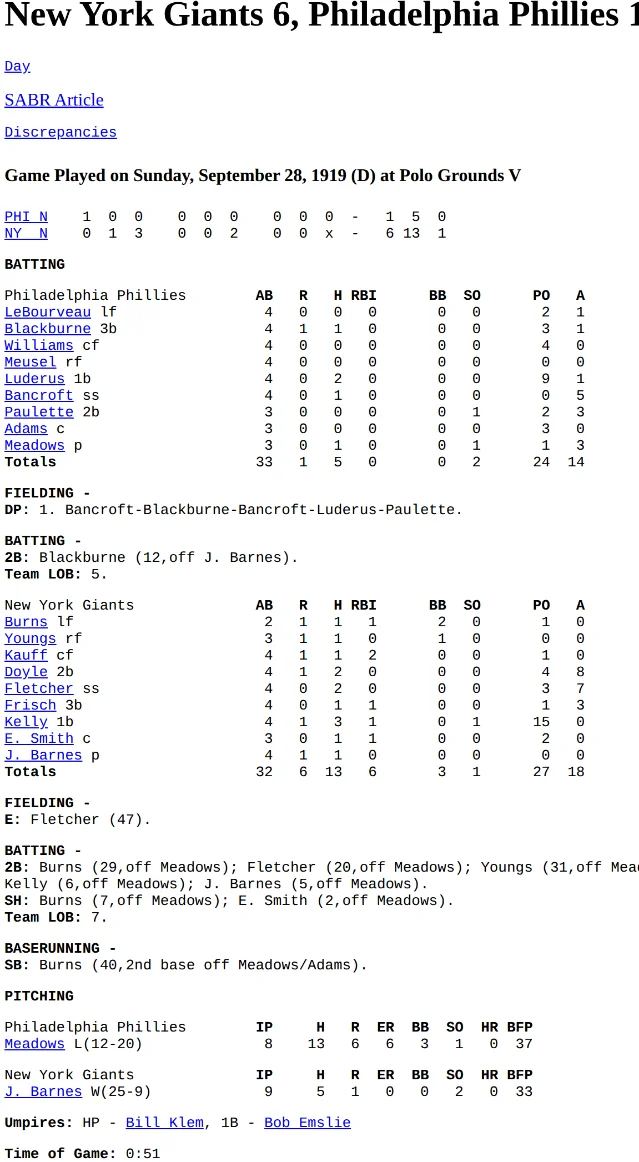
The game, read off the box score
Jesse Barnes pitched all nine innings for the Giants: five hits, one run, and that run unearned, no walks, two strikeouts, thirty-three batters. The New York American counted his pitches at 64 and called that a major-league low for a nine-inning game. 3
Lee "Specs" Meadows went the distance for Philadelphia, hoping to avoid his twentieth loss of the season. He gave up thirteen hits and six earned runs across eight innings, walked three and struck out one, and lost his twentieth anyway. 1
The Giants scored once in the second inning, three times in the third and twice in the sixth. All six runs were home before the seventh began. 1 Philadelphia's only run came in the first, when Lena Blackburne doubled, moved to third on a groundout, and scored after Art Fletcher threw the ball away. That was the game's only error, and the run it produced was unearned. 13
Between the two clubs there were seventy trips to the plate. 3
Why it went that fast
Both clubs had nothing left to play for. 28 September was the last day of the season for each of them: the Giants finished second at 87-53, nine games behind Cincinnati, and the Phillies finished last at 47-90, in the cellar for the first time in fifteen years. 34
The baseball world was looking somewhere else. Five days later the Cincinnati Reds and the Chicago White Sox opened the World Series that turned into the Black Sox scandal. 5
The Giants had moved their scheduled 29 September game back a day so they could stage a Sunday doubleheader, which they knew would draw a bigger crowd than a single Monday game. 3 With a winter of work waiting for them, the players wanted the season done. 5
The Illustrated Daily News reported that "both Giants and Phils agreed to go after the speed record before the game started," and that "the men went up intent on smacking the first pitch." 3
The next morning's Times told it differently, saying "there was no unusual effort to make a speed record until the Phils' half of the ninth," when the players noticed what was within reach and hustled for half an inning. 5
However the afternoon was arranged, it moved. The New York Sun watched the crowd catch on around the sixth inning, when spectators "saw that the players were running to and from their positions, urged on by Umpire Klem." 3 Bill Klem was working the plate that day, and the Sun counted innings that ended on five or six pitches. 3 Between the second inning and the sixth, Philadelphia did not put a man on base. 1
How far out of reach that is now
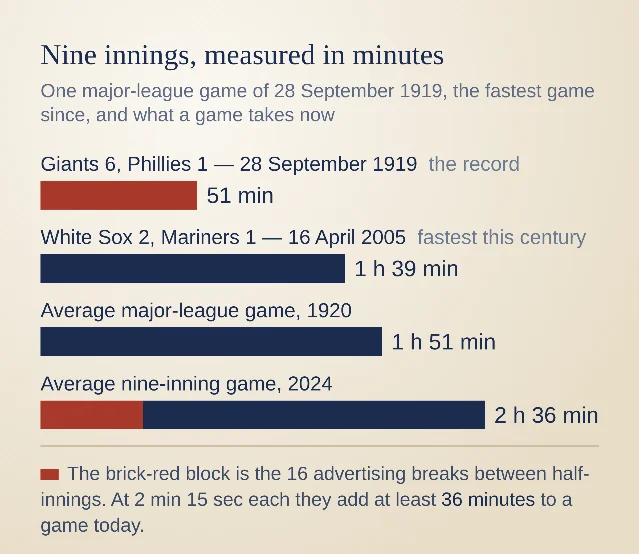
A modern game starts with a floor the 1919 game never met. Every half-inning break carries 2 minutes 15 seconds of advertising, sixteen times a game, which comes to at least 36 minutes of standing around before any of the baseball. 5 The average big-league game in 1920, the first season with usable figures for it, ran 1 hour 51 minutes, a full hour longer than the game at the Polo Grounds. 5 By 2024 the average nine-inning game had come down to 2 hours 36 minutes, the shortest in about forty years. 2
The quickest game since 2000 was also the best-pitched one: Mark Buehrle's complete game for the White Sox against Seattle on 16 April 2005, 1 hour 39 minutes. 2
Other marks keep "fastest" in its place. The shortest official major-league game ran 35 minutes, and it happened twice: the Philadelphia Athletics beat Cleveland 4-0 on 14 June 1904, and Pittsburgh's Federal League club beat Baltimore 6-2 on 18 September 1915. Both were called after five innings, which is why the nine-inning record belongs to the Polo Grounds. 2 The fastest extra-inning game took 1 hour 10 minutes, and the fastest World Series game 1 hour 25. 2 The shortest professional game of any kind on record is 31 minutes, between the Asheville Tourists and the Winston-Salem Twins in 1916. 2
Two things to check if you go looking
The record had competition on the day. The Illustrated Daily News put the old mark at 56 minutes, set by the Giants and Brooklyn on 30 August 1918, while the Philadelphia Inquirer pointed to a 55-minute game played a week earlier; Baseball-Reference's own log has a 55-minute Brooklyn win over Cincinnati on 21 September 1919. 35 These same two clubs had once played nine innings in 32 minutes, in 1913, and that one was an exhibition. 5
The Times, careful as ever, called the game "certainly the fastest played in the major leagues in many years, and probably a record", and its headline settled for the fastest game of the season. 56
The date travels badly. MLB's own list of the fastest games carries it as 29 September 1919, the day it had originally been scheduled for, while both box scores record it on the 28th. 12 Attendance comes in two versions as well: 14,000 in the Philadelphia Inquirer, nearly 20,000 in the New York Tribune. 3
Then there are the people in it. Lena Blackburne, who scored Philadelphia's only run, was making the last major-league start of a career that finished at .214, and in the 1930s he mixed up the ball-rubbing mud — Delaware River silt — that professional clubs still use on new baseballs. 3 Art Fletcher, the Giants' captain and shortstop, made the afternoon's only error. 1 Fred Luderus, Philadelphia's first baseman, was playing his 532nd consecutive game, then a National League record. 3 The Giants' third baseman was a twenty-one-year-old rookie named Frankie Frisch, three months out of Fordham, who went into the Hall of Fame in 1947. 35
Christy Mathewson, three years past his last appearance on a mound, was running the club from the bench with John McGraw away. In the second game the crowd called for him to pitch, and he "merely smiled". 3 Two Giants regulars missed the day for other reasons: Hal Chase had been benched and Heinie Zimmerman suspended, in part over attempts to bribe teammates. 3
Beside the game story in the next morning's Times ran an item announcing that New York was about to have a professional football team, which would play at the Polo Grounds and borrow the baseball club's name. 3
The 51 minutes were a measure of what the afternoon did without: pitching changes, advertising breaks, replays. What happened in between was seventy trips to the plate, seven runs and one error, by men who wanted to be on a train. The nearest anyone has come since was a 2005 game that finished forty-eight minutes later.
References
- 1
- 2
- 3
- 41919 New York Giants season — Wikipedia
en.wikipedia.org
- 5
- 6
This story was produced automatically by a channel. One sentence is all it takes for Neodrop to keep producing for you.