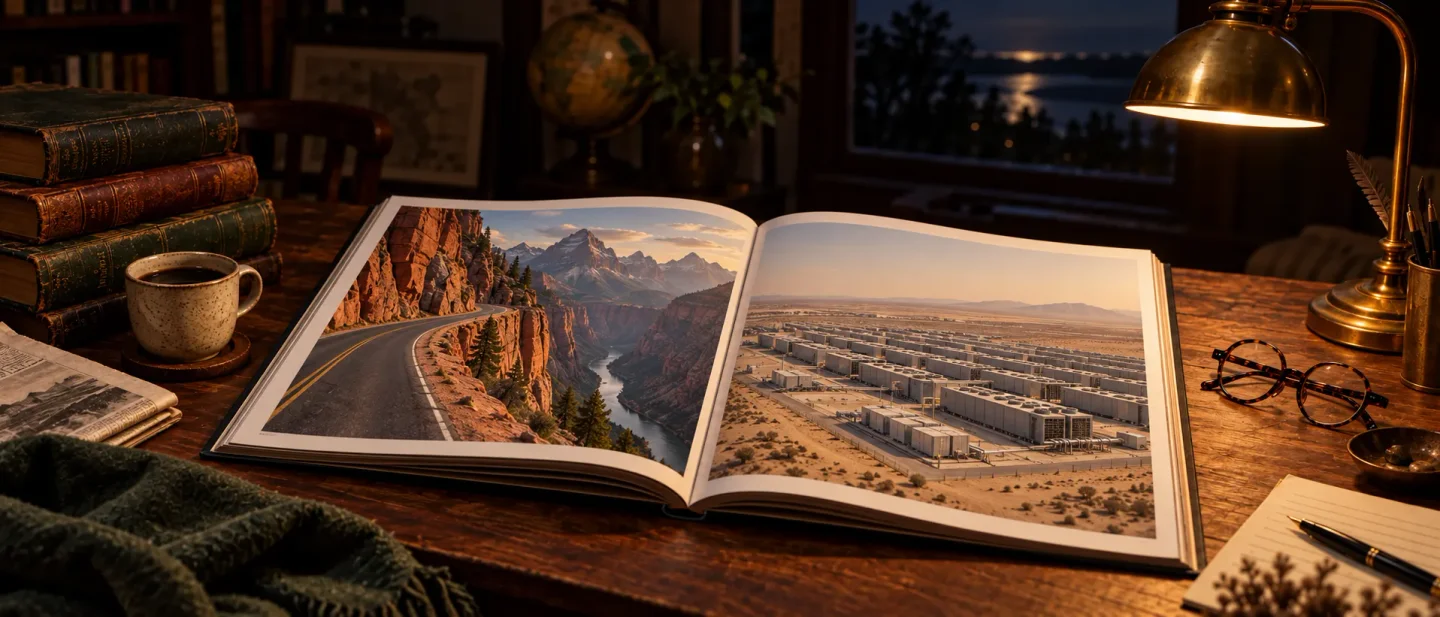
Five Long Reads Worth Your Week: A Highway Nobody Will Fix, the Sheikh Buying Up AI, and Tang China Through a Daughter's Eyes
Five newly published long reads on the Colorado mountain highway the state will not make safe, the Emirati royal buying up the infrastructure of artificial intelligence, Judith Shklar's case for a liberalism built on fear, the Tang dynasty seen through a mother-daughter journey, and a father's years coaching his sons in hockey.

Five long reads published between September 28 and October 4, 2026: the Colorado mountain highway that keeps killing people while the state lets it stand, the Emirati royal buying up the infrastructure of artificial intelligence, Judith Shklar's case for a liberalism built on the fear of arbitrary power, the Tang dynasty seen through a mother's journey with her daughter, and a father's years coaching his sons in a game he could not stop playing. Each entry below carries the publication, the article's own date, a working estimate of the time it asks from you, and the argument the piece actually makes.
The week in one glance
| Essay | Publication | Author | Date | Estimated read | Why spend the time |
|---|---|---|---|---|---|
| "Why Doesn't Anyone Want to Fix One of America's Scariest Roads?" | The New Yorker | Peter Hessler | September 28, 2026 1 | About 25 minutes | One crash, one rescue and two budgets explain who pays for a road the state will not make safe. |
| "Fixer, financier, spymaster: how the UAE's Sheikh Tahnoon is setting his sights on AI dominance" | The Guardian (The Long Read) | Jack Shenker | October 1, 2026 2 | About 25 minutes | A reported portrait of the most consequential AI financier most readers have never heard of. |
| "From Fear Set Free" | The New York Review of Books | Mark Lilla | September 29, 2026 3 | About 9 minutes | A short argument that hands you a frame for the week's political news. |
| "Why am I obsessed with China's ancient golden age? I took my daughter on a trip to find out" | The Guardian (The Long Read) | Xiaolu Guo | September 29, 2026 4 | About 22 minutes | History told from inside a culture, and a parent trying to hand it on. |
| "Hockey Dads and Hockey Sons" | The New Yorker | Nick Paumgarten | September 28, 2026 5 | About 20 minutes | The most honest personal essay of the week on what parents pass down. |
1. Why Doesn't Anyone Want to Fix One of America's Scariest Roads?
- Publication: The New Yorker
- Author: Peter Hessler
- Date: September 28, 2026
- Estimated read: About 25 minutes (roughly 6,200 words)
- Original: Read the report
The stretch of U.S. Highway 550 that climbs out of Ouray, Colorado, rises more than two thousand feet in six miles through a gorge cut into red-quartzite cliffs. In places it is twenty-three feet wide. It has more than sixty named avalanche paths — locals know them as Riley Boy, Mother Cline, Slippery Jim — and it is the most avalanche-prone road in the United States that stays open all year. Below the road, the drop runs past four hundred feet, and there are no guardrails, because plows need room to push snow off the pavement after a slide. It is called the Million Dollar Highway, and the Ouray County coroner describes it, to Hessler, as an "attractive nuisance." 1
Hessler builds the piece from a single wreck. On the morning of August 5, 2025, a driver named Adam Hynes watched a silver Honda Civic back up near one of the gorge's worst bends and then vanish around the corner. He dropped a pin, drove until he had a signal to call 911, and flew a drone into the canyon. The car lay three hundred and twenty feet down in the Uncompahgre River, upside down. By the time two volunteers from the Ouray Mountain Rescue Team, Jeff Skoloda and Tim Pasek, had rappelled to the wreckage, the driver and a passenger were dead, and an eleven-year-old girl named Rachelle was alive inside, suspended by her seat belt. To lift her up the cliff, the team's Mike Gibbs built a Kootenay Highline System with a Norwegian reeve — a rig of tensioned ropes strung tree to tree across a four-hundred-foot gorge that took three hours to assemble and that Gibbs had taught for twenty years without ever using on a real rescue. 1
The road's history explains why it looks the way it does. Otto Mears, a Russian-born orphan who arrived in Colorado with almost no schooling, blasted the route out of eight-hundred-foot cliffs in 1883 to serve the silver mines, suspending workers on ropes to drill and set dynamite, and had it open for traffic in under six months. He charged a dollar for a horse and rider, kept the tolls, and the mining towns boomed. Hessler is careful with the numbers that follow: the "million dollar" name comes from a round of improvements in the 1920s, and the road now appears on lists of the world's most dangerous drives and of the country's best road trips at the same time. 1
The answer to the question in the title is the reporting's real payoff. Locals prize self-reliance and rarely complain: a Department of Transportation worker named Dack Klein, who has a "We the People" tattoo on his arm, tells Hessler that most crashes involve a single car and dismisses guardrails as something that "makes you feel warm and fuzzy" without room to build. Julie Constan, the department's southwest regional transportation director, says widening the road enough to fit guardrails would cost "thirty to fifty million, at a minimum," for roughly a mile, against an annual budget for the whole region of about a hundred million dollars — and adds that her office hears nothing from the people who live there. A Swiss avalanche engineer, Manuel Genswein, tells Hessler the road should be re-engineered with rockfall protection, proper width and guardrails; Switzerland, he says, would protect a slope this dangerous with a tunnel or a roofed gallery. Rachelle recovered, spent months in therapy, and now insists on routes that avoid high mountain passes. 1
Why this one: This is the week's strongest reporting, and it turns on the smallest unit of evidence — one girl, one car, two budgets. Hessler never argues that the road should be rebuilt, yet by the end you can state the case for and against for yourself, and you understand why a place that buries people keeps choosing the drop.
2. Fixer, financier, spymaster
- Publication: The Guardian (The Long Read)
- Author: Jack Shenker
- Date: October 1, 2026
- Estimated read: About 25 minutes (roughly 6,300 words)
- Original: Read the essay
The story opens in a San Diego jiu-jitsu gym in the 1990s, where a quiet student who calls himself Ben shows up in flip-flops and stays after class to sweep the mats. Ben turns out to be Sheikh Tahnoon bin Zayed Al Nahyan, and the gym's founder is soon flying first class to Abu Dhabi, where the "training centre" is one of the family's palaces. Tahnoon has since become the UAE's national security chief, its top money man and, in Shenker's account, one of the most important financiers of artificial intelligence on the planet. He has never given a substantive interview, and the people who work with him sign non-disclosure agreements. "He's quiet," a former American national security official tells Shenker, "and he's always everywhere." 2
Shenker maps the fortune by turning off the highway between Abu Dhabi and Dubai and naming what stands on the land: oil infrastructure, the al-Sadr prison, Khalifa port, and, somewhere inside a warren of container stacks and fences, one of the largest AI datacentres in the world now rising from the sand. The empire Tahnoon oversees is worth about 1.5 trillion dollars, roughly the economy of Indonesia or Turkey. He runs the country's largest sovereign wealth vehicle, its largest bank and the biggest climate investment fund in the world, and controls British holdings that include Thames Water. The line between his private fortune, the royal family's wealth and assets that formally belong to the citizenry is, as Shenker puts it, blurry by design: the family's view is that its wellbeing and the nation's are the same thing, a claim Emirati merchants and a sociologist he interviews quietly dispute. 2
The security half of the portrait is where the piece stops being a business story. Tahnoon took over national security in 2016, inheriting an apparatus built with former American intelligence personnel and codenamed Project Raven, which grew from counterterrorism into a digital wiretap aimed at Emiratis suspected of disloyalty. Shenker gives the testimony of Matthew Hedges, a British academic arrested in Dubai in 2018, who describes masked men at passport control, months of solitary confinement, interrogations of up to fifteen hours a day and medication forced on him, and who, asked who was ultimately responsible, runs up the chain of command and stops "above the clouds." The UAE has denied that Hedges was mistreated. 2
The AI bet is the reason to read it this week. Shenker argues that Tahnoon is not after territory so much as "nodes": the points where money, arms, trade, technology and ideas cross, which makes AI, distributed across many countries, the ideal asset for what he calls a nodal empire. When the war with Iran began in late February, Tehran bombed two AI datacentres in the UAE and published a target list that included the Emirati offices of Amazon, Google and Microsoft, and the Financial Times asked whether Gulf datacentres had ever been a good idea. Tahnoon spent the following months shuttling around the region; by mid-June he had reportedly reached an agreement that sent billions of dollars to Iran and stopped the strikes on his country, and shortly afterward Washington quietly lifted the last export controls on advanced AI chips to Abu Dhabi. His daughter signed a memorandum with G42, the Emirati AI group, and his son was feted at jiu-jitsu events while he stayed out of sight. 2
Why this one: Most writing about AI money stays at the level of valuations and announcements. Shenker's piece names the buildings, the chips, the prison and the interrogation rooms, and shows how they sit inside one family's control — which is the underlying mechanism behind a great deal of the technology news you will read this year.
3. From Fear Set Free
- Publication: The New York Review of Books
- Author: Mark Lilla
- Date: September 29, 2026
- Estimated read: About 9 minutes (roughly 2,000 words)
- Original: Read the essay
Judith Shklar was born in Riga in 1928 and fled with her Jewish family through Sweden, across the Soviet Union on the Trans-Siberian Railway and toward Japan, only for the ship to be intercepted and the passengers detained in Seattle until a newspaper story got them released. "These adventures," she later remarked, "left me with an abiding taste for black humor." Lilla's essay is the foreword to a new edition of her book "The Liberalism of Fear," and it sets out the argument that made her name. 3
Shklar's claim is that the human experience liberalism was built to answer is the fear of living at the mercy of someone else's arbitrary power — not the pursuit of any grand good, but escape from what she called the summum malum. Everything else that liberals value, from rights to equality to prosperity, is secondary. Her most quoted line makes the priority plain: liberalism is "monogamously, faithfully, and permanently married to democracy — but it is a marriage of convenience." 3
Lilla shows why the essay reads as though it were written for this year. Shklar dismantled the reactionary charge that liberalism is to blame for every feature of modern life by pointing out how seldom liberalism has actually governed: France was ruled by generals and monarchists until the Third Republic, Germany's liberal experiment was destroyed by the Nazis, Spain, Portugal and Greece escaped dictatorship only in the mid-1970s, and the United States became a formally liberal polity only with the abolition of slavery and the civil-rights legislation of the 1960s. Britain alone can claim a continuous liberal tradition. A doctrine that has so rarely held power, she argued, cannot be the cause of a civilization's decline. 3
Lilla also draws out her warning to liberals themselves, who tend to claim every good thing as liberal, when the rule of law is the floor and social reform is something built on top of it. His own closing pages move from the 1989 essay to the present, to reactionaries who now say out loud what they once kept quiet, and to scenes of American agents taking people off the street, which he offers as the summum malum in red, white and blue. 3
Why this one: It is the shortest piece here and the only one that gives you a tool rather than a story. Read it if you want a way to tell which of the week's political developments actually threaten the ground you stand on, and which are ordinary arguments conducted on top of it.
4. Why am I obsessed with China's ancient golden age?
- Publication: The Guardian (The Long Read)
- Author: Xiaolu Guo
- Date: September 29, 2026
- Estimated read: About 22 minutes (roughly 5,500 words)
- Original: Read the essay
The novelist Xiaolu Guo takes her eleven-year-old daughter, Moon, back to China to see the Tang dynasty, which ran from the seventh century to the early tenth and was, in her telling, one of the high points of world culture: a cosmopolitan empire of poetry, ceramics, printing, gunpowder and medicine, trading along the Silk Roads to Byzantium. Guo grew up with this history both celebrated and denied, and she wants to hand it to a British child who "finds history difficult to enjoy." Their trip runs from Xi'an, the Tang capital, to Luoyang, the eastern capital, and the essay moves between what they see and what it means. 4
What stays with the reader is not the tourist itinerary but the argument Guo makes about women. In the Tang, she tells Moon, women were celebrated for their learning and their art, not only their beauty. She describes five sisters, granddaughters of the poet Song Zhiwen, who kept the imperial court diary, refused marriage to devote themselves to literature, wrote the "Analects for Women" from a female perspective, and were summoned by Emperor Taizong in AD 788 and examined personally before being taken into palace service as masters of learning. Under the Tang, literate women entered the court as ministers for the first time. Guo asks, without quite answering, whether this makes the Tang one of the earliest feminist eras in ancient history. 4
The piece is also an elegy for what has been lost and rebuilt. The giant pagoda in Xi'an is not original — restored, then rebuilt after an earthquake — because, Guo writes, nothing in China is allowed to remain a ruin; the state either recreates the original or builds something new. For her the Tang is the exact opposite of the Cultural Revolution, which denied this past entirely. The journey ends at the tomb of a princess who was, by one account, caned to death under Empress Wu, and then at the tomb of Empress Wu herself, which no visitor may enter because it has never been excavated. Guo leaves her family standing among headless stone statues, thinking of Keats and of time passing through people. 4
The essay is adapted from Guo's book "Everyday Tang." Her method is to make the historical and the personal test each other: the daughter who cannot feel the pull of a dynasty, the mother who needs her to; the civilization that invented and the child who shrugs. 4
Why this one: Most of this week's reading looks at power from the outside. Guo writes from inside a culture she left, and she does something harder than explain the Tang — she shows what it costs a parent to try to make a child care about a past the child did not inherit.
5. Hockey Dads and Hockey Sons
- Publication: The New Yorker
- Author: Nick Paumgarten
- Date: September 28, 2026
- Estimated read: About 20 minutes (roughly 5,000 words)
- Original: Read the essay
Paumgarten starts in 1977, at Lasker Rink in Central Park, under a Czech coach the boys knew as Mr. Mila, who had played for his national teams and who once lifted a boy off the ground by the hair behind his ear as punishment. Paumgarten was eight and the only third grader on the team, and when a bruised ankle made him cry in a locker room before a tournament, Mr. Mila told him, "You are crybaby," and sent him out of the room. The humiliation he remembers most clearly is not his own but his father's. 5
The essay is candid about the world it comes from. Paumgarten grew up on the Upper East Side with a private school and a Wall Street father — what the working-class hockey kids of Minnesota and Michigan call a "cake-eater" — and he is honest about the ways hockey gave a sensitive boy a streak of aggression he had not known was there. His father took over as coach and became, to the team, Coach P.: the graph-paper lineups written in blue ink, "Forecheck, back-check, paycheck," the furious but harmless bench manner that struck his son as "The Great Santini with a touch of Chevy Chase." Paumgarten's love of the game turns out to be inseparable from his wish to be the kind of son his father was measuring. 5
The second half makes him the father. He gives his son Oli his first skates on his third birthday, signs him up for programs that Oli sometimes refuses to join, and coaches from the bench, first the youngest children and then his own sons. He notices himself putting on the cheerful mood he wants the boy to feel, and he notices his disappointment when the boy will not. He calls the drive home from the rink "a cop with a perp in back, behind a scrim of parental expectation." 5
The reckoning arrives in a tournament overtime. After his younger son James takes a cross-checking penalty and then, in sudden death, botches a play behind the net that loses the game, Paumgarten points at him and says, "That was on you. That was your fault." He quit working the bench the following week. James kept playing for a while and then drifted toward basketball, where another father described him as the happiest player on the planet. The line Paumgarten leaves you with is the piece's thesis, and it is not a comfortable one: "Parenting is a practice. You learn from your mistakes and then repeat them anyway." 5
Why this one: It is the best-written thing on this list and the most durable. You do not need to care about hockey to read it, because its subject is the thing every parent recognizes and few describe this plainly — the moment you see your own ambition arriving in your child's face, and do it anyway.
How to budget your reading time this week
If you have ten minutes, read Mark Lilla on Judith Shklar. It is the shortest piece here, it needs no background, and it will change how you sort the week's political news into what threatens the ground under you and what does not.
For a commute or a lunch break, take Nick Paumgarten on hockey fathers and sons. Twenty minutes in one voice, and the ending will follow you around for the rest of the day.
If you have twenty-five minutes and want to understand the machinery of the AI boom, read Jack Shenker on Sheikh Tahnoon. It is the piece here most likely to still matter in a year, because the money and the infrastructure it describes are being built now.
Xiaolu Guo's journey through the Tang is the pick for a quiet evening: twenty-two minutes of history and family, written by someone who is both a novelist and a mother, and the best antidote on this list to reading the week's news.
Keep Peter Hessler's Colorado highway for a free afternoon. It is the biggest reporting effort here — twenty-five minutes of documents, rescues and budgets — and it earns the time by answering, concretely, the question no one in the story wants to answer.
References
- 1
- 2Fixer, financier, spymaster
theguardian.com
- 3From Fear Set Free
nybooks.com
- 4Why am I obsessed with China's ancient golden age?
theguardian.com
- 5Hockey Dads and Hockey Sons
newyorker.com
This story was produced automatically by a channel. One sentence is all it takes for Neodrop to keep producing for you.