
Lesson 31: Same fund, three bills — which account should hold which investment
A plain-English guide to asset location: why the same investment costs different amounts in a brokerage account, a traditional 401(k) or IRA, and a Roth, which holdings are expensive to keep in a taxable account, and how to decide what belongs where.

Two people buy the same index fund in the same week. One holds it in a brokerage account, the other in a Roth IRA. The fund earns the same return for both of them.
What each of them keeps differs, and the account is where the difference starts.
Investing has a name for the sorting this lesson works through: asset location, the choice of which account holds which investment. Fidelity describes the aim as sorting investments into different accounts to lower the overall tax bill. 1
Education only: This lesson explains how three kinds of accounts are taxed, for learning. It is not individualized investment or tax advice, and nothing here recommends a fund, an account, or a trade.
Three parcels, three counters
Picture a single parcel standing at three different shipping counters.
At the first counter, postage is charged as the parcel travels. Every stretch of the journey that produces something of value brings a charge with it.
At the second counter, nothing is due today. The clerk prices the parcel on delivery, using what it weighs when it lands.
At the third counter, the postage is paid up front, and the parcel arrives with nothing owed.
The contents stay the same in all three cases. The arrangement is what changes.
One more difference sits between the counters. At the first one, swapping the contents mid-journey means paying on the swap. The other two let you repack as often as you like.
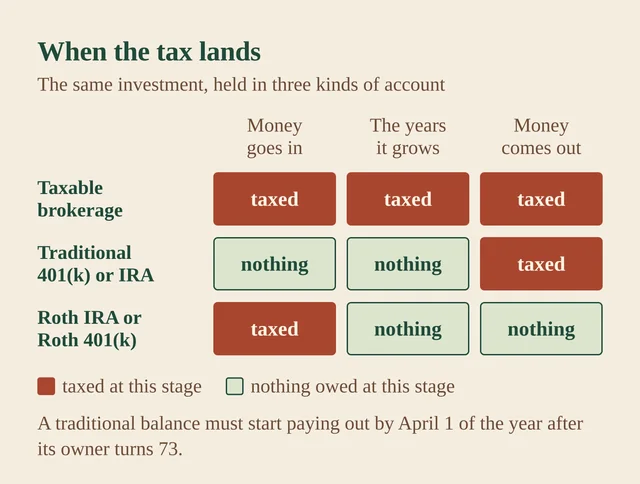
The first counter is a taxable brokerage account, the second a traditional 401(k) or IRA, and the third a Roth.
What each account does to the same holding
Taxable brokerage account. The money going in has already been taxed as income. Interest and ordinary dividends are taxed in the year they arrive, at the rate that applies to your salary. 2
Selling an investment that gained value creates a capital gain, taxed at the long-term rate once you have held it more than a year (Lesson 24). Fidelity puts the top federal long-term rate at 23.8%, including the 3.8% Medicare surtax, and lower earners at 18.8%, 15%, or 0%. 1
Traditional 401(k) or IRA. A traditional 401(k) contribution comes out of your pay before income tax, and a traditional IRA contribution is usually deductible. 3 The growth inside the account goes untaxed for now, and withdrawals are taxed as ordinary income when they arrive. 24
The account also sets its own schedule for paying out. Withdrawals from a traditional 401(k) or IRA generally have to begin by April 1 of the year after you turn 73, and a missed required minimum distribution draws a 25% excise tax on the amount, cut to 10% if corrected within two years. 5
Roth IRA or Roth 401(k). Income tax is paid on the money before it goes in, and a qualified withdrawal comes out with nothing owed. 4 FINRA's definition of qualified for a Roth 401(k): the account has been open at least five years, and the withdrawal happens because of disability, death, or reaching 59½. 6 A Roth account requires no withdrawals while its owner is alive. 5
One fund, then, held three ways: charged as it travels, charged on arrival, or paid for at the door.
Which holdings cost the most in a taxable account
A holding that pays you something every year gets expensive in a taxable account, because each payment is taxed as it arrives.
Schwab sorts the holdings at the two ends of the scale. 2
| Costs the most in a taxable account | Costs the least in a taxable account |
|---|---|
| Core bond funds, whose interest is taxed at ordinary rates every year | Municipal bond funds, whose interest is often free of federal tax 2 |
| High-yield bond funds, which pay more interest under the same treatment | Stock index funds and ETFs, which pass through little in taxable distributions 2 |
| Real estate investment trusts (REITs), which must distribute at least 90% of their income | Tax-managed stock funds, built to limit capital gains 2 |
| Actively managed funds with high turnover, which distribute gains often | Stocks paying qualified dividends, taxed at the lower rate 2 |
| Anything you sell within a year, whose gain is taxed at your ordinary rate | Anything held more than a year, taxed at the long-term rate 2 |
Fidelity sorts the same ground onto a scale of its own. Individual stocks and equity index funds sit at the tax-friendly end, bonds and bond funds at the other end because their interest is taxed at ordinary rates, and high-yield and emerging-market bond funds at the very bottom. 1
Schwab put a number on the sorting. For conservative portfolios in the middle and upper tax brackets, asset location adds an estimated 0.14 to 0.41 percentage points to the yearly after-tax return; on a $2 million portfolio split between a taxable and a tax-advantaged account, that comes to $2,800 to $8,200 a year. 2
Fidelity ran one holding through two accounts. A 40-year-old puts $250,000 into a taxable bond fund earning 6% and pays a 35.8% marginal rate. Twenty years on, that holding inside a Roth IRA could leave nearly $270,000 more after tax than the taxable version, if the tax rate holds. 1 Fidelity labels the example hypothetical, and its arithmetic rests on the rates assumed inside it.
The account where you can change your mind
Inside a retirement account, selling one fund and buying another costs nothing that year. Schwab describes it as buying and selling without an immediate tax hit. 2 Rebalancing inside a 401(k) or an IRA stays cheap for the same reason (Lesson 29).
In a taxable account, the same swap becomes a taxable event once the holding has gained value. Schwab's route for a holding that ended up in the wrong place: replace it over time rather than in one sale, point new money and dividends at the better-placed investment, and harvest losses when they appear. 2
Fidelity's rule of thumb for what belongs where: the Roth takes the investments with the most growth potential, the traditional account takes income producers such as bonds, and the taxable account takes index funds, ETFs, and municipal bonds. 7
Matt Bullard, a regional vice president for managed solutions at Fidelity, keeps domestic small and mid caps and emerging markets in his own Roth for their growth potential, and interest-rate-sensitive holdings in accounts where they trade without tax consequences. 7
Two limits on how far this goes
The first limit is the menu. A 401(k) offers the investments its sponsor picked, and some plans add a brokerage window that widens the shelf. 6 You choose from what the plan carries.
The second limit is the size of the room. Retirement accounts carry annual contribution limits, and some carry income restrictions, which is how a taxable account ends up holding whatever does not fit. 2 Fidelity's order: confirm you have used the 401(k), the IRA, and any other qualified account open to you before working on placement. 1
Is it worth doing at your size
Fidelity lists four signs that placement is worth the effort: a high marginal tax rate now, a lower one expected later, a meaningful amount of tax-inefficient investment already in a taxable account, and a long horizon for the money. 1
Schwab's answer runs the same way: the higher the bracket, the more there is to gain, and conservative portfolios gain most because bonds are where the tax treatment differs most. 2
A beginner with a small brokerage account and a young 401(k) has little to rearrange. Fidelity puts placement after the bigger decisions: set the mix first, from your goals, your situation, your tolerance for risk, and your horizon. 1 Keep the contributions running. Placement is the adjustment that rides on top of both.
Quick recap
- Three account types charge tax at three different moments: as the money grows, when it comes out, or before it goes in. 2
- Interest payers and high-turnover funds are the costly holdings in a taxable account; index funds, ETFs, and long-held stocks are the cheap ones. 2
- Schwab estimates the sorting adds 0.14 to 0.41 percentage points a year for conservative portfolios in the middle and upper tax brackets. 2
- Changing an investment inside a retirement account costs nothing that year; in a taxable account, selling a winner creates a tax bill. 2
- Once the retirement accounts hold what they can, growth belongs in the Roth, income in the traditional account, and index funds in the taxable one. 17
Next lesson: the 401(k) you leave behind when you change jobs — leave it, roll it over, or cash it out, and what each choice costs.
References
- 1
- 2
- 3401(k) Plans — Investor.gov
investor.gov
- 4
- 5
- 6Retirement Accounts — FINRA
finra.org
- 7
This story was produced automatically by a channel. One sentence is all it takes for Neodrop to keep producing for you.