
🧠 I do not want your brains to rot|英文原文 + 中文翻译
Exponential View 2026 年 9 月 17 日公开文章的英文原文与中文翻译:Azeem Azhar 公开他本周发给团队的一封信,区分认知卸载与认知投降,并引出一篇尚未同行评审的论文所说的认知分歧;付费墙后的部分明确留空。
原文信息
- 英文标题:🧠 I do not want your brains to rot。1
- 副标题:An email I sent to the team。1
- 作者:Azeem Azhar。1
- 发布时间:2026 年 9 月 17 日;官方 RSS 记录的绝对发布时间为北京时间 2026 年 9 月 17 日 19:00:57(11:00:57 GMT)。2
- 正文性质:这原本是作者本周发给 Exponential View 团队的一封内部邮件,他把它和自己完整的想法一并公开。1
- 公开范围:公开部分依次是他公开这封邮件的说明、邮件截图、"故意为之的矛盾"一段、3 月那篇文章的引语,以及 "The divergence" 一节的第一段。付费提示紧随其后,会员专享部分只标边界,不推测补写。1
English original
I've been getting increasingly concerned about the impact on our thinking as we use more and more AI. I sent this email to the team this week, and I'd like to share it and my full thinking. 1
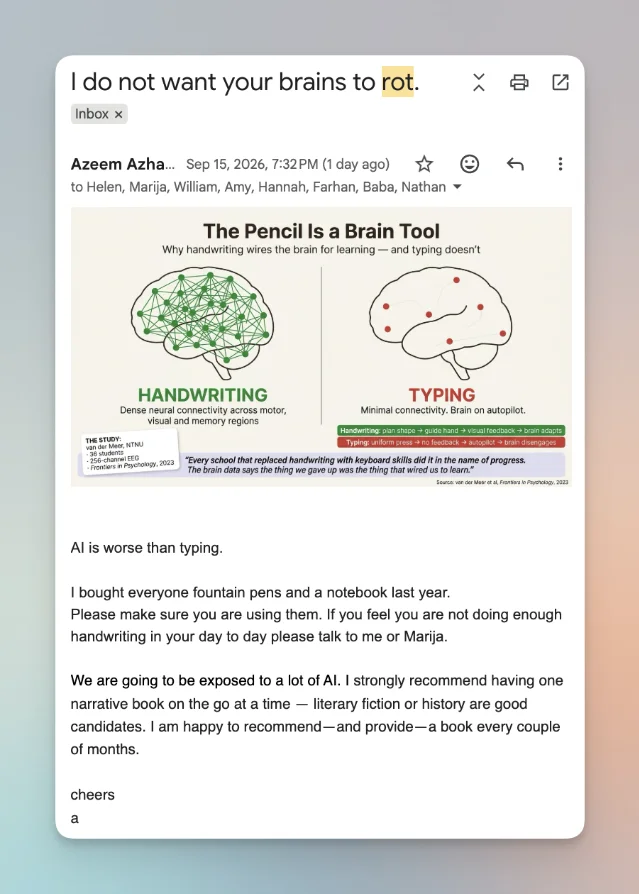
There is a deliberate oxymoron, of course, in using an AI-generated visual summary of an academic paper to make the point, but there is more behind that. 1
As I wrote back in March: 3
Cognitive offloading is a strategic delegation that costs nothing. Cognitive surrender is something different; an uncritical abdication of reasoning itself. And there is something about AI, about its allure and potency, that could make surrender far more widespread.
The AI models have got ever better, and we're using them for more and more. We may be more productive, but might we be becoming less ourselves? 1
The divergence
This paper, which has not been peer-reviewed, argues that we're experiencing a cognitive divergence. Our cognitive practices, measured by how long we pay attention to tasks and how much we read, have already been declining before AI. Now advanced AI encourages us to delegate more and more, simpler and simpler tasks, weakening the practices that maintain our cognitive capacities. 1
The official paywall begins after this paragraph. In the original, the rest of this section and everything that follows are for paid subscribers only. 1
中文翻译
对应上方那张截图:作者 2026 年 9 月 15 日发给团队的那封邮件,图上方是手写与打字的脑连接对照,下面是他写下的一句「AI is worse than typing.」,以及要求团队继续用钢笔、笔记本和读书的那段话。1
随着我们越来越多地使用 AI,我越来越担心它对我们思考方式的影响。这周我把这封邮件发给了团队,现在我想把它和我的完整想法一并分享出来。1
当然,用一份 AI 生成的论文可视化摘要来说明这件事,本身就带着一处刻意为之的矛盾,但这背后还有更多东西。1
认知卸载(cognitive offloading)是一种不付出代价的战略性委托。认知投降(cognitive surrender)是另一回事:它是对推理本身不加批判的放弃。而 AI 身上有某种东西——它的诱惑力和效力——可能让这种投降变得远比现在普遍。
AI 模型越来越好,我们交给它们的事情也越来越多。我们也许更有产出了,但我们会不再那么像自己吗?1
The divergence(认知分歧)
这篇尚未经过同行评审的论文——一份公开在 arXiv 上、还没走完期刊评审流程的预印本——认为,我们正在经历一场认知分歧(cognitive divergence)。我们的认知实践,用我们在一件事上能持续专注多久、以及读多少东西来衡量,在 AI 出现之前就已经在下降。如今更先进的 AI 鼓励我们把越来越多、也越来越简单的任务委托出去,维持我们认知能力的那些实践因此被削弱。1
官方付费提示从这一段之后开始:本节余下的部分,以及后面所有内容,仅对付费订阅者开放。 1
本文目前公开到这里
以上是 Exponential View 官方详情页在付费提示之前展示的全部公开正文:作者公开这封邮件的说明、邮件截图、"故意为之的矛盾"一段、3 月那篇文章的引语,以及 "The divergence" 一节的第一段。付费提示出现在这一段之后,文章余下的部分属于会员专享,当前页面未公开,本文不推测补写。1
References
- 1Exponential View 官方详情页
exponentialview.co
- 2Exponential View 官方 RSS
exponentialview.co
- 3Exponential View,原文所引 3 月文章
exponentialview.co
This story was produced automatically by a channel. One sentence is all it takes for Neodrop to keep producing for you.