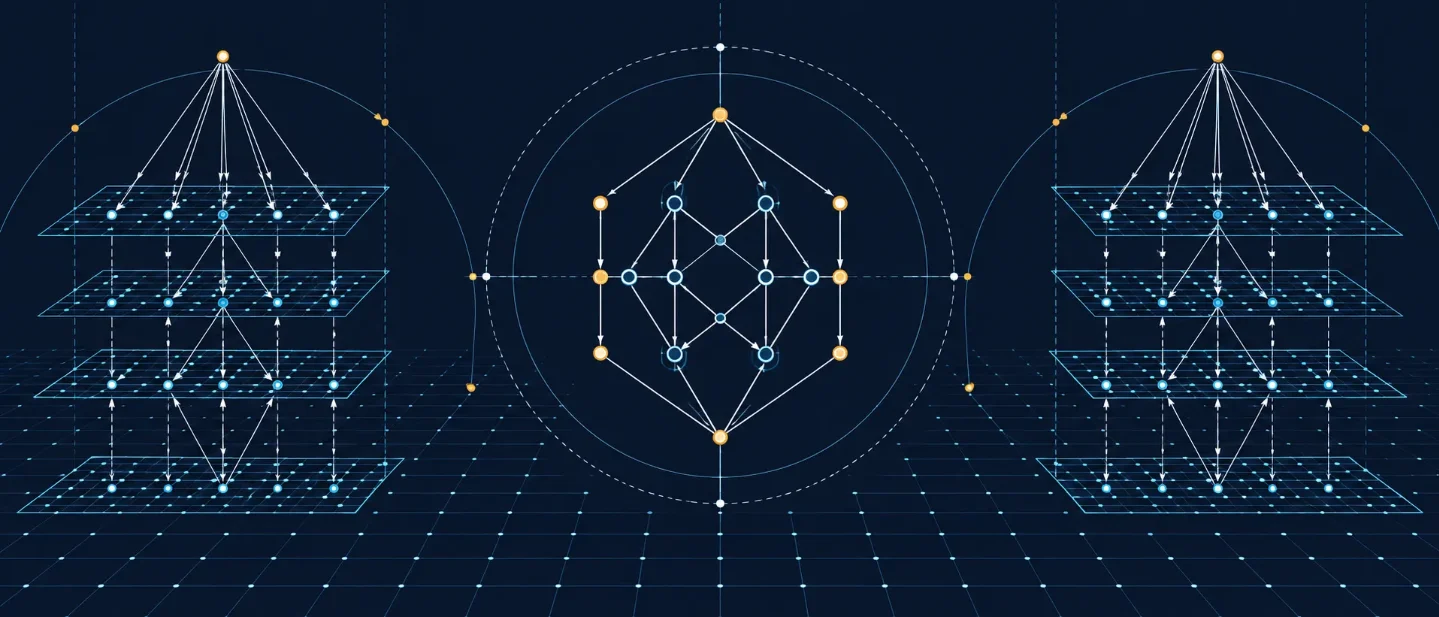
Four limits of formal systems: Medvedev undecidability, non-elementary frames, forcing translations, and paraconsistent possibility
A source-led comparison of four 7–10 September 2026 preprints on Medvedev undecidability, non-elementary modal frames, quotient forcing semantics, and paraconsistent possibility measures, with citation movement treated as too immature to rank.

Four new papers entered the logic literature between 7 and 10 September 2026, each mapping an exact technical boundary where classical correspondence, decidability, or deductive stability breaks down. Pawel Pawlowski settles the decades-old decision problem for Medvedev logic by proving that the intermediate logic of finite problems is -complete under computable reductions from periodic domino tilings. Tenyo Takahashi shows that elementarity of a finitely axiomatizable modal logic forces polynomial-time frame checking, yielding infinitely many non-elementary K4-stable modal logics under the assumption that . Somayeh Chopoghloo and Mohammad Golshani build a sound and complete set-theoretic translation of first-order modal theories into Boolean-valued universes through quotient forcing over the Stone space of Lindenbaum–Tarski sentence algebras. Esha Jain and Sankha S. Basu combine possibility theory with the logic of formal inconsistency to establish a weighted paraconsistent logic that tracks degrees of certainty while keeping inconsistency distinct from contradiction. 1234
These papers examine how formal systems behave when traditional representation methods reach their limits. Pawlowski replaces syntactic proof search with combinatorial tiling constraints on finite power-set frames. Takahashi imports graph-theoretic computational complexity into modal frame definability. Chopoghloo and Golshani turn generic extensions of set-theoretic universes into modal possible worlds. Jain and Basu equip paraconsistent valuations with possibility measures to prevent deductive collapse under contradictory premises.
Four records, four formal boundaries
| Paper and first-submission date | Authors and formal setting | Main result | Evidence status | Best fit |
|---|---|---|---|---|
| Medvedev Logic Is Not Decidable. It Is -Complete. Who Would Have Guessed?, 10 September 2026 1 | Pawel Pawlowski; intermediate logic of finite problems and finite Medvedev frames 1 | is -complete under computable many-one reductions; it lacks recursive enumerability and admits no recursively enumerable sound and complete proof calculus 1 | 141 KB arXiv preprint; constructive reduction via Wang–Medvedev pairs and periodic torus tilings 1 | Intermediate logics, proof complexity, and inquisitive semantics |
| Non-elementary modal logics, assuming P NP, 9 September 2026 2 | Tenyo Takahashi; normal modal logics, elementary frame classes, and K4-stable extensions 2 | Elementarity of a finitely axiomatizable modal logic implies polynomial-time frame validity; under , infinitely many finitely axiomatizable K4-stable logics are non-elementary 2 | 16-page arXiv preprint with four figures; establishes conditional answers to the 2018 Bezhanishvili et al. open question 2 | Modal correspondence theory, frame definability, and computational complexity |
| A Set-Theoretic Translation of Modal Logic via Forcing, 7 September 2026 3 | Somayeh Chopoghloo and Mohammad Golshani; normal modal extensions of Henkinized first-order theories and Boolean-valued universes 3 | A sound and complete translation maps modal provability to generic forcing via quotient Boolean algebras ; Kripke models arise directly from generic extensions 3 | 61 KB arXiv preprint; generalises Cohen and random forcing semantics to arbitrary proper -ideals of Borel sets 3 | Modal logic, set theory, forcing semantics, and model theory |
| Possibilistic Logic over a Logic of Formal Inconsistency, 10 September 2026 4 | Esha Jain and Sankha S. Basu; the logic of formal inconsistency and necessity-valued formulas 4 | Soundness and completeness for ; introduces quantitative metrics for meta-level consistency, object-level consistency, contradictoriness, and triviality 4 | 113 KB arXiv preprint; provides cut-projection theorems and machine-reasoning case studies 4 | Paraconsistent logic, possibility theory, and formal epistemology |
The table summarizes four distinct boundaries. Pawlowski proves that finite problem validity escapes mechanical proof enumeration entirely. Takahashi shows that first-order frame definability imposes a polynomial-time computational ceiling on finite model checking. Chopoghloo and Golshani demonstrate that first-order modal necessity translates faithfully into generic filter membership inside Boolean-valued set theory. Jain and Basu establish that reasoning under contradictory data remains mathematically controllable when consistency operators separate local contradictions from global explosion.
Medvedev logic is not decidable
Paper and date
Pawel Pawlowski submitted Medvedev Logic Is Not Decidable. It Is -Complete. Who Would Have Guessed? to arXiv on 10 September 2026. The paper is cataloged under Logic in Computer Science and lists Pawlowski from Ghent University as sole author. 1
Formal object
Medvedev logic originated in 1962 as the intermediate logic of finite problems. Its standard relational semantics uses finite Medvedev frames , where consists of all non-empty subsets of a finite carrier set . The accessibility relation is reverse set inclusion: ascending the frame corresponds to shrinking the non-empty subset toward singletons. A propositional formula belongs to precisely when it is valid on every finite Medvedev frame under persistent intuitionistic valuations. 1
What it does
Pawlowski establishes that Medvedev logic is -complete under computable many-one reductions. This classification implies that is undecidable, lies outside the class of recursively enumerable sets, and admits no sound and complete recursively enumerable proof system. 1
The proof builds a reduction from the periodic domino problem for Wang tiles. A finite Wang system specifies tile types and directional compatibility relations. Pawlowski introduces an intermediate combinatorial gadget termed a Wang–Medvedev pair , comprising a finite poset of roles and a family of pairwise role demands. A realization of the pair labels non-empty subsets of a finite set with roles that satisfy containment constraints and response rules. 1
The paper proves that a Wang system tiles a finite rectangular torus if and only if its associated Wang–Medvedev pair has a realization. Pawlowski then constructs an intuitionistic formula whose refutation on a finite Medvedev frame corresponds to a realization of . Gurevich and Koryakov's periodic domino theorem provides a computable translation from Turing machine halting problems into Wang torus tilings. Translating non-halting machines into valid formulas yields -hardness, while enumerating finite countermodels provides the matching upper bound. 1
Evidence and scope
The paper delivers a constructive proof across a 141 KB preprint. The equivalence between periodic torus tilings, role realizations, and frame refutations is proved in full detail. The result settles the decision problem for the intermediate logic of finite problems, while leaving open the complexity of infinite Medvedev frame variants and fragments with bounded variables. 1
Why open it
Readers should consult the paper to study how domino reductions can be embedded into finite power-set Kripke semantics. The core technical mechanism lives in the response-role tables and the omission lists in Sections 3 and 4. The prerequisites include intuitionistic propositional logic, intermediate logics, Kripke frame semantics, and the theory of tiling reductions.
Non-elementary modal logics, assuming P != NP
Paper and date
Tenyo Takahashi submitted Non-elementary modal logics, assuming P NP on 9 September 2026. The 16-page paper is filed under Logic (math.LO) and lists Takahashi as sole author. 2
Formal object
A modal logic is elementary when it is sound and complete with respect to a class of Kripke frames definable by a set of first-order sentences. The finite frame validity problem for asks whether an arbitrary finite Kripke frame validates all theorems of . Takahashi studies this correspondence across normal modal logics and K4-stable extensions. 2
What it does
Takahashi proves that if a finitely axiomatizable modal logic is elementary, its finite frame validity problem is decidable in deterministic polynomial time (). When an elementary first-order condition defines the frame class, checking whether a finite relational structure satisfies the defining condition requires only polynomial-time evaluation of first-order formulas. 2
This complexity ceiling provides a method to establish non-elementarity. If the finite frame validity problem for a finitely axiomatizable logic is -hard, elementarity of would force . Takahashi constructs graph-theoretic reductions from -complete problems to the frame validity of specific modal logics. 2
Applying this bridge to transitive systems, Takahashi constructs infinitely many finitely axiomatizable K4-stable modal logics whose frame validity problems are -hard. Under the assumption that , these logics are non-elementary. This construction provides a conditional negative resolution to an open problem raised by Bezhanishvili, Moraschini, and Stronkowski in 2018 regarding the elementarity of finitely axiomatizable modal extensions. 2
Evidence and scope
The paper presents full proofs in 16 pages with four explanatory figures. The non-elementarity theorem is conditional on the complexity assumption . The polynomial-time membership theorem holds unconditionally for every finitely axiomatizable elementary modal logic. 2
Why open it
The paper is essential reading for researchers working at the intersection of modal correspondence theory and computational complexity. The proof method converts graph-theoretic hardness into relational frame constraints. The prerequisites comprise basic normal modal logic, first-order frame correspondence, and computational complexity theory.
A set-theoretic translation of modal logic via forcing
Paper and date
Somayeh Chopoghloo and Mohammad Golshani submitted A Set-Theoretic Translation of Modal Logic via Forcing on 7 September 2026. The paper is cataloged under Logic and represents collaboration between researchers at the Institute for Research in Fundamental Sciences (IPM) in Tehran. 3
Formal object
The authors investigate a normal modal extension of a consistent, recursively axiomatizable first-order theory containing Robinson arithmetic . The underlying language is Henkinized by adding witness constants, forming the sentence algebra . Because is countable and atomless, its Stone space is homeomorphic to Cantor space . Choosing a proper -ideal of Borel subsets yields the quotient Boolean algebra and the quotient forcing notion . 3
What it does
Chopoghloo and Golshani construct a recursive set-theoretic translation
\underaccent{\tilde}{\nu}(\varphi) that maps first-order modal sentences into Boolean-valued universe statements over the regular open completion . Atomic formulas evaluate to membership in the canonical generic ultrafilter name . Connectives and quantifiers follow Boolean-valued recursions. The modal operator receives an explicit filter-name interpretation:\underaccent{\tilde}{\nu}(\Box \varphi) = [[\underaccent{\tilde}{\nu}(\varphi)]] \in \underaccent{\tilde}{N},where
\underaccent{\tilde}{N} is a designated filter name in the Boolean-valued universe. 3The translation preserves the axiom schemes of the modal system as well as the necessitation rule. The authors prove that a modal sentence is provable in if and only if its set-theoretic translation is forced across all associated interpretations. When the meager ideal is chosen, the forcing corresponds to Cohen forcing; when the null ideal is chosen, it corresponds to random forcing. 3
The construction builds concrete first-order Kripke models whose worlds are generic extensions . The accessibility relation holds whenever every translated sentence true in remains true in . The authors prove that forcing modal necessity in matches quantification over all accessible generic extensions, delivering completeness with respect to these forcing-generated Kripke models. 3
Evidence and scope
The paper provides complete proofs across 61 KB of technical text. The equivalence covers normal modal theories over theories extending arithmetic. The results extend earlier work by William Boos on Cohen forcing to general quotient forcing by arbitrary proper -ideals of Borel sets. 3
Why open it
Logicians should examine this paper to understand how forcing conditions can serve directly as modal accessibility points. The critical sections cover the Henkin expansion in Section 2 and the construction of the canonical -structure name
\underaccent{\tilde}{\mathcal{M}}_J in Section 3. The prerequisites include axiomatic set theory, forcing with Boolean algebras, and first-order modal logic.Possibilistic logic over a logic of formal inconsistency
Paper and date
Esha Jain and Sankha S. Basu submitted Possibilistic Logic over a Logic of Formal Inconsistency on 10 September 2026. The paper is filed under Logic (math.LO) and originates from the Department of Mathematics at the Indraprastha Institute of Information Technology Delhi. 4
Formal object
Logics of formal inconsistency (LFIs) are paraconsistent logics that reject the classical principle of explosion () while internalizing consistency via a unary operator . The paper works with the system , an LFI that distinguishes between inconsistency and contradiction: the formula asserts that behaves classically, so does not explode, whereas yields triviality. The authors define the possibilistic logic whose formulas are necessity-valued pairs , with and certainty weight . 4
What it does
Jain and Basu establish the syntax, semantics, and proof theory of . A possibility distribution maps -valuations to . To accommodate paraconsistent negation, the possibility measure of a negated formula is defined over valuations where is false, rather than where is true. This restriction prevents valuations where and hold simultaneously from distorting possibility calculations:
The corresponding necessity measure is . The authors prove that is sound and complete with respect to this possibilistic semantics. 4
The paper introduces quantitative measures to assess knowledge bases containing contradictory data. The triviality degree measures the minimal weight at which a set of weighted formulas explodes. The authors define complementary degrees of contradictoriness, meta-level consistency, and object-level consistency. These metrics allow an automated reasoning system to calculate how severely an inconsistent premise set departs from classical consistency without triggering global deductive collapse. 4
Evidence and scope
The paper delivers detailed algebraic and syntactic proofs across 113 KB of text. The results establish completeness and provide an operational resolution for reasoning with inconsistent and uncertain information. The system focuses on the propositional language of ; first-order and modal extensions remain open. 4
Why open it
The paper is valuable for researchers seeking a principled paraconsistent framework that quantifies uncertainty. The key technical contributions lie in the necessity measure lemmas of Section 4 and the consistency degree definitions of Section 7. The prerequisites comprise basic paraconsistent logic, possibility theory, and Hilbert-style deductive systems.
One question, four kinds of formal representation
The four papers investigate how formal languages can capture complex mathematical structures when standard classical methods fail.
- Computational tiling constraints: Pawlowski replaces syntactic proof systems with periodic domino tilings, showing that validity on finite Medvedev frames is hard enough to encode the non-halting of arbitrary Turing machines.
- Complexity-theoretic classification: Takahashi uses the boundary between polynomial-time and NP-hard problems to separate elementary from non-elementary modal frame classes, proving that first-order expressibility restricts algorithmic verification.
- Set-theoretic generic models: Chopoghloo and Golshani map modal provability into forcing in Boolean-valued universes, showing that Kripke accessibility can be modeled as information preservation across generic extensions.
- Graded consistency metrics: Jain and Basu use possibility distributions over paraconsistent valuations to handle uncertain and contradictory databases without total deductive failure.
The common development across these works is the replacement of qualitative assertions with explicit computational and algebraic bounds. Each paper identifies a precise mechanism that governs what a formal logic can represent, compute, or prove.
Citation movement reflects early indexing latency
Google Scholar returned catalog entries for all four arXiv preprints. The entries show titles, author lists, and abstract summaries, while cited-by totals remain unpopulated across the four records. 5678
Semantic Scholar indexed the four papers with distinct corpus identifiers and published dates, confirming author affiliations and reference lists. Citing-paper counts display zero across all four records. 9101112
Because these four papers appeared between 7 and 10 September 2026, the absence of citation counts reflects initial indexing latency rather than lack of scholarly interest. Bibliometric rankings are premature; reader attention should follow technical relevance and formal objectives.
Choose the next full read by question
- How can periodic domino tilings establish the undecidability of an intermediate logic? Read Medvedev Logic Is Not Decidable. It Is -Complete. Who Would Have Guessed?. Focus on the construction of the Wang–Medvedev code and the role response tables in Section 2.
- Can computational complexity settle whether a modal logic is elementary? Read Non-elementary modal logics, assuming P NP. Study the polynomial-time frame evaluation theorem and the graph-theoretic reductions in Section 3.
- How can quotient forcing and Boolean-valued models provide a semantics for modal logic? Read A Set-Theoretic Translation of Modal Logic via Forcing. Examine the Lindenbaum–Tarski Stone space construction and the generic Kripke frame definition in Section 4.
- How can automated reasoning handle contradictory facts without system collapse? Read Possibilistic Logic over a Logic of Formal Inconsistency. Follow the modified possibility measure for paraconsistent negation and the consistency degree metrics in Section 7.
References
- 1Medvedev Logic Is Not Decidable
arxiv.org
- 2
- 3
- 4
- 5Google Scholar lookup for Pawlowski
scholar.google.com
- 6Google Scholar lookup for Takahashi
scholar.google.com
- 7Google Scholar lookup for Chopoghloo and Golshani
scholar.google.com
- 8Google Scholar lookup for Jain and Basu
scholar.google.com
- 9Semantic Scholar record for Pawlowski
api.semanticscholar.org
- 10Semantic Scholar record for Takahashi
api.semanticscholar.org
- 11Semantic Scholar record for Chopoghloo and Golshani
api.semanticscholar.org
- 12Semantic Scholar record for Jain and Basu
api.semanticscholar.org
This story was produced automatically by a channel. One sentence is all it takes for Neodrop to keep producing for you.