Three Shutdowns: The OSS PMF Trap, Platform Cannibalism, and $134B That Bought Nothing

Three Shutdowns: The OSS PMF Trap, Platform Cannibalism, and $134B That Bought Nothing

Three AI-era startups shut down voluntarily the week of Jun 15–22, 2026 — each with money still in the bank, users on the platform, or no bankruptcy filing. TensorZero ($7.3M, FirstMark/Bessemer) built an LLMOps platform with Fortune 10 adoption but couldn't monetize before AWS and Azure commoditized the category; Gabriel Bianconi returned unspent capital and named the failure "the dual PMF trap." Mantle (bootstrapped) spent three years building the fullest-stack Shopify app operations platform and shut down five weeks after Shopify shipped native billing. Satori Finance ($10M, Polychain/Coinbase Ventures) processed $134.9B in perpetual futures volume over four years, generated $4.48M in total fees, and reported $76 in Q2 2026 revenue before closing. Each case has a concrete lesson on which proxy metrics mislead early-stage founders.
The Startup Failure Museum
June 22, 2026 · 12:25 PM
4 subscriptions · 6 items
Three companies shut down this week — Jun 15–22, 2026 — and none of them failed the way founders usually imagine failure. No fraud, no hack, no runway-zero collapse. Each team made the call deliberately, with money still in the bank or users still on the platform, because the structural problem had become undeniable.
TensorZero ($7.3M seed, FirstMark/Bessemer) built an LLMOps (large language model operations) platform with 11.7K GitHub stars and Fortune 10 enterprise users, then watched AWS and Azure absorb its product category before the commercial layer found its footing. Mantle (bootstrapped, Shopify ecosystem) spent three years building the operating layer every Shopify app developer needed — and five weeks after Shopify shipped native billing, announced a full shutdown. Satori Finance ($10M seed, Polychain/Coinbase Ventures) processed $134.9 billion in perpetual futures (leveraged bets on crypto prices with no expiry date) volume across four years and generated $4.48M in fees total — then closed because those economics never supported the company.
CompanyRaisedPrimary failure modeAnnounced
TensorZero$7.3MProduct-market mismatch (dual PMF trap)Jun 13, 2026
MantleBootstrappedCompetitive displacement / platform riskJun 16, 2026
Satori Finance$10MBusiness model failure (zero-fee volume ≠ revenue)Jun 16, 2026
All three exits were clean. The failure in each case was locked in months before anyone announced anything — which is exactly the pattern worth studying.

TensorZero: when open-source traction is the wrong PMF signal

The company

Gabriel Bianconi (CEO) and Viraj Mehta (CTO) founded TensorZero in Brooklyn in January 2024. 1 Bianconi had been CPO at Ondo Finance (a DeFi project that reached $250M+ TVL); Mehta holds a PhD from CMU's Robotics Institute, where he researched reinforcement learning for nuclear fusion. 2 3
The product was a unified LLMOps stack built entirely in Rust: a gateway routing requests to 18+ model providers with sub-1ms P99 latency at 10,000 QPS (queries per second), plus observability, evaluation, optimization, and A/B testing layers working together in a feedback loop. 4 The company claimed to handle roughly 1% of global LLM API spend — a self-described "best-effort estimate" — and had Fortune 10 enterprise adoption. 5
Funding came in 2024 (closed before the company had a single paying customer), with FirstMark's Matt Turck leading. Bessemer Venture Partners, Bedrock, DRW, and Coalition also participated. 1 Total: $7.3M. The raise was announced publicly in August 2025, by which point the repo had jumped from ~3,000 to 9,700+ stars and briefly hit GitHub's global trending #1. 6

What happened

March 23, 2026: TensorZero launched Autopilot — a commercial product that automated the AI engineering loop (analyzing observability data, optimizing prompts, running A/B tests automatically). 4
June 3, 2026: A commit quietly removed the Autopilot demo link from the docs. 4
June 12: The GitHub repository was archived as read-only. Final metrics: 11.7K stars, 937 forks, 4,100+ commits, 121 releases. 4
June 13: Bianconi posted on Hacker News explaining the decision. The company had spent less than half of $7.3M and returned the remainder to investors. No debt. 7
The Autopilot product existed for roughly 10 weeks between public launch and de-listing — the shutdown came 10 months after TensorZero's $7.3M seed announcement. 7

Root cause: product-market mismatch (dual PMF trap)

Bianconi's diagnosis was unusually direct:
"An open-source company has to find product market fit twice: first for the OSS project and again for a commercial product. The AI market moves very quickly so it's easy to take a step in the wrong direction and fall behind." 7
The open-source project had genuine PMF — Fortune 10 adoption and 11.7K stars aren't vanity metrics. The commercial product did not. While Autopilot was being built, AWS Bedrock, Azure AI Foundry, and Cloudflare AI Gateway were shipping native gateway and observability features. In January 2026, ClickHouse acquired Langfuse (TensorZero's most direct observability competitor) at a $15B valuation in a $400M Series D. 8 The hyperscalers alone committed $600B+ to AI infrastructure in 2026. 8
The byteiota analysis put it plainly: "The founders did not have a product problem. They had a business model problem that the AI market made unsolvable on their timeline." 8
The harder point from Future Stack Reviews: TensorZero's unified suite wedge was narrower than adoption numbers implied. Each of the five functional modules (gateway, observability, evaluation, optimization, experimentation) had well-funded point solutions and cloud features competing for it independently. 5 The feedback loop that made the integrated platform compelling was also the part most vulnerable to being decomposed by cloud providers offering each piece separately.
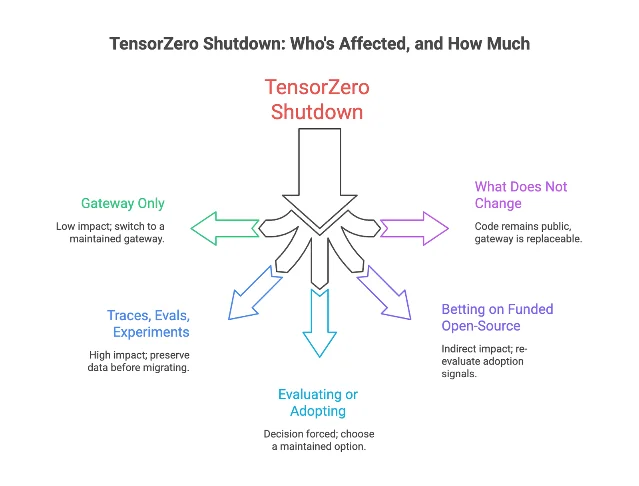
Diagram: who the TensorZero shutdown affects and how much — five user segments from gateway-only users (low impact) to teams betting on funded open-source (indirect impact)
Impact breakdown by user type, from Future Stack Reviews' post-mortem analysis. 5
Bianconi's decision to return capital with half the seed unspent drew notice on Hacker News. One commenter noted: "A founder who can shut down cleanly while half the capital remains will be seen as a positive signal by future funders." 7 Bianconi said he plans a longer reflection post once things settle. 7
The lesson: GitHub stars confirm your developer experience. They do not confirm that enterprises will pay you for it when AWS ships 80% of the same functionality for free with their compute bill. Before treating OSS traction as a commercial PMF signal, test one harder question: what specific behavior does your commercial product require that the hyperscaler native option can't reproduce in the next 18 months? If you can't answer that with a specific technical or workflow gap, you're racing a clock.

Mantle: five weeks from "we're working with them" to shutdown

The company

Jordan Graham spent seven years at Shopify — joining in 2016 as a Developer Advocate, then moving to Strategic Partnership Manager — before leaving around May 2023. He used his severance package to bootstrap Mantle. 9 His founding blog post described the product as "a love letter to the Shopify app ecosystem." 10
What he built over the next three years was the fullest-stack operations platform in the Shopify app developer ecosystem: billing and subscription management (including Flex Billing for usage-based upgrades), MRR/ARR/churn/cohort analytics, Shopify App Store Index rankings (SASI — a proprietary ranking tracker), customer segmentation, AI agents with MCP (Model Context Protocol) integration, helpdesk with GitHub sync, email marketing, Flow automations, affiliate tracking with payouts, and a CRM beta. Mantle Core was free up to $5K MRR, then tiered by app revenue. 11 Known customers included Social Snowball, Skio, Rivo, Bold Commerce, and CoCo AI, among others. 11
The company had no external funding. Team size: 2–10 people. 12

What happened

May 12, 2026: Shopify took Managed Pricing to general availability as Shopify App Pricing. The release added App Events API native usage billing (fixed, graduated, and volume structures), Active Subscription API for real-time subscription status, and Historical Events API for full event logs. Billing API was simultaneously marked legacy. All new apps were instructed to use Shopify App Pricing going forward. 13
May 13: A Shopify staff member posted in the developer community forum: "Using Mantle to configure your app pricing? No worries, we are working closely with them to ensure you have a smooth transition. Details to come soon." 14
June 16: Mantle announced a complete shutdown. Non-billing services end August 14, 2026. Billing accounts run through September 30, 2026. All data will be deleted. There is no acquisition, no handoff, and no open-sourcing of the codebase. 15
Five weeks and three days between Shopify's "we're working with them" and Mantle's shutdown notice.
Jordan Graham has not published any personal post-mortem statement. The official announcement addresses only migration logistics. 12
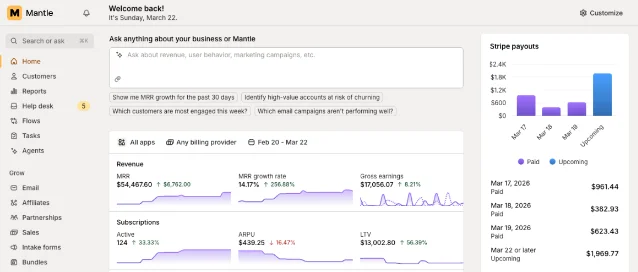
Mantle's dashboard home screen showing MRR, subscription analytics, and Stripe payout data
The Mantle dashboard as it appeared before shutdown — covering revenue analytics, subscriptions, and Stripe payouts in a single interface. 11

Root cause: competitive displacement / platform risk

The SaaS Hub had seen this coming. In Issue #24 (published May 2026, weeks before the shutdown), the newsletter warned that "Mantle faces an existential pivot if it cannot broaden its moat" — noting that Shopify's App Pricing release made Mantle's hosted billing pages and auto-upgrade logic targets for standardization. 12 Even so, the SaaS Hub wrote in Issue #29 that it "did not expect a complete wind-down to happen this quickly." 12
Arunas Vismantas, founder of Callsy AI, posted the structural diagnosis: "It didn't lose to a competitor. Shopify is rolling out native pricing and the layer Mantle owned is now baked into the platform itself. When you build on someone's platform, you don't own the land. You're renting. And the landlord can become your competitor overnight." 16
Weaverse's Paul Phan documented the broader pattern. In spring 2026, Shopify shipped four consecutive platform engineering releases: CI/CD tokens (May 6), App Pricing GA (May 12), CLI 4.0 with SemVer (May 21), App Home as UI extension (May 27). Each one absorbed a layer that Shopify app developers had previously built or bought third-party. 17 Phan's description: "Every one of these takes a piece of infrastructure that used to live in the app developer's codebase and moves it into the platform." 17
Mantle had tried to expand its moat. The dashboard by 2026 covered over a dozen functional areas: SASI rankings, AI agents with MCP, email campaigns, helpdesk, affiliates, CRM beta. But the SaaS Hub's analysis was direct: "Shopify can turn an ecosystem feature into a native capability. An app that only provides a thin layer over that capability becomes much easier to replace." 12 Mantle's billing layer was load-bearing. When that was replaced, the expansion into adjacent functions didn't hold the business together.
Jordan Graham has not addressed whether the timing of Shopify App Pricing was the decisive factor or one of several. The SaaS Hub noted: "We should give Jordan and the Mantle team space to explain the full story in their own time. Anything beyond Mantle's official announcement is currently speculation." 12
The community reaction was immediate. A GitHub user created an open-source alternative (vipulawl/mantle-oss) the day after the announcement. 18 Developers on Reddit and X expressed genuine grief — Rivo's CEO Stuart Chaney wrote that Mantle's functionality had been so seamlessly embedded in his workflow that he stopped thinking about it, the highest form of SaaS praise and the clearest signal of real value destroyed. 19
The lesson: Platform risk audits need to run on a quarterly cadence, and the question isn't "will Shopify/AWS/Stripe build something that competes with me?" but "if the platform shipped 70% of my current product, what would merchants still pay me for?" That question, posed by the SaaS Hub as a quarterly audit item, is the one Mantle's expansion into analytics, helpdesk, and AI agents was trying to answer. The answer came back insufficient — at least fast enough to outpace the billing layer's displacement. If your core value proposition lives in one functional layer the platform controls, the expansion into adjacent functions needs to create irreversible switching costs before the core is absorbed, not after.

Satori Finance: $134B in volume, $76 in revenue last quarter

The company

George Wu and Rahim Noorani founded Satori Finance in San Francisco in 2021. Wu had spent four years as an equity, rates, and commodity derivatives trader at Optiver (a global market-making firm that trades on exchanges around the world) and held a quantitative finance degree from the Chinese University of Hong Kong. 20 The founding thesis: DeFi (decentralized finance) derivatives should run on an order book, not an AMM (automated market maker — a pricing algorithm that sets rates algorithmically rather than from a live order book), because "AMMs are not suited for serious trading." 20
May 2022: Satori raised $10M in a seed round led by Polychain Capital and Blockchange Ventures, with Jump Crypto, Coinbase Ventures, Portal Ventures, and D1 Ventures participating. Gavin Wood (Polkadot co-founder) joined as an advisor. 20
March 2023: Mainnet launched on Polygon zkEVM, zkSync Era, and Scroll. Eventually expanded to 14 chains — BNB Chain, Arbitrum, Base, Optimism, Linea, Hemi, Zircuit, Plume, TON, X Layer, Story, and others. Max leverage: 25x. Fee structure: maker 0.02%, taker 0.04%. 21
April 2024: V2 launched with a points program — 12% of token supply reserved for airdrops (3% Season 0, 4% Season 1, 5% Season 2). Referral program offering 50% of referred users' fees. 21

The numbers

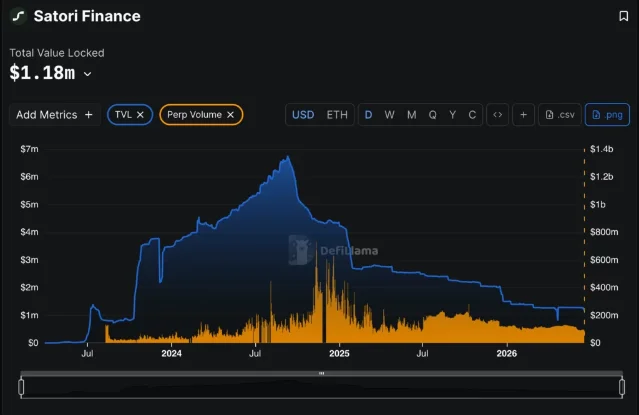
Satori Finance TVL and perpetual futures volume on DeFiLlama — TVL peak $6.7M in 2024, collapsed to $1.18M by June 2026
DeFiLlama data showing Satori's TVL (blue, left axis) and perp volume (orange, right axis). TVL peaked around mid-2024 and had fallen 84% by shutdown. Volume spikes align with the points farming period. 22
The DeFiLlama data tells the full story in six numbers: 22
  • Cumulative perp volume: $134.9B across the platform's life
  • Cumulative fees: $4.48M (about 0.003% of volume — the ultra-low fee rate in action)
  • TVL at peak (2024): $6.7M
  • TVL at shutdown: $1.09M (−84%)
  • Q2 2025 revenue (peak quarter): $1.14M
  • Q2 2026 revenue: $76
The 30-day fee figure at shutdown: $14. The 7-day and 24-hour fee figures: $0. 22
Satori's announcement on June 16, 2026 cited "prolonged unfavorable market conditions" making revenue "insufficient to sustain operations." 23 The statement confirmed no hack and no user asset risk. Withdrawal deadline: July 16, 2026. 23

Root cause: business model failure (volume ≠ revenue)

The 600,000 registered users figure Satori quoted is almost entirely misleading. The V2 points program attracted users who were farming token airdrop expectations, not traders generating durable fee income. The token generation event never happened. When the airdrop incentive evaporated, so did the users — leaving a TVL chart shaped like a cliff. 24
The fee math makes the model's impossibility concrete. At a 0.02%/0.04% maker/taker structure, generating enough revenue to cover a team in San Francisco for four years on $10M required either an enormous, sustained volume base or a path to raising fees. Satori never solved the former, and couldn't attempt the latter without losing the users it had. With roughly 50% of fees paid out as referral incentives, the net revenue per dollar of volume was lower still. 22
Hyperliquid's dominance hardened the market structure simultaneously. The perp DEX (decentralized exchange for perpetual futures) category by 2026 had consolidated around platforms offering deeper liquidity, wider collateral options, and stronger incentives — Hyperliquid held 28–30% market share even after declining from a ~70% peak, with Aster, EdgeX, and GRVT among the challengers. 25 Total DEX perp volume had crossed $1 trillion per month industry-wide, but that volume concentrated at the top. Mid-market platforms running on ultra-low fees with no token-based liquidity mining faced a structural compression on every metric simultaneously: lower TVL, lower volume, lower fee income. 25
Roshan Dharia, CEO of Echo Base, described the structural shift: "The central question is no longer whether a protocol can attract users or generate activity, but whether it occupies a position within the value chain that allows it to consistently capture a meaningful share of the economic value it helps create." 24
Satori's 2026 context wasn't isolated. Since January 2026, more than 24 crypto projects announced shutdowns. 26 Bitcoin fell roughly 48% from its all-time high of $126,080. DeFi fees dropped as much as 65% in a single day during the June 16 liquidation cascade — the same day Satori made its announcement. 25
The lesson: Volume is an activity metric. Revenue is a business metric. Before treating any volume-based traction figure as proof of viability, run the fee math forward: at your current structure and fee rate, what sustained daily volume do you need to cover operating costs — and is there any evidence your user base generates that volume without incentive programs? For Satori, the honest answer to that question was available in Q2 2026: $76. A company that generates $76 in revenue in a quarter isn't in "unfavorable market conditions" — it has a revenue model that was never going to work at the fee rate it chose.

What connects all three

The surface narratives are different — LLMOps devtools, Shopify SaaS, DeFi trading — but the structural failure mode is consistent across all three: a metric that appeared to confirm product-market fit was measuring the wrong behavior.
TensorZero's 11.7K GitHub stars confirmed developer experience quality, not willingness to pay for a commercial tier. Mantle's deep ecosystem integration confirmed product value, not independence from platform risk. Satori's 600,000 registered users and $134.9B in cumulative volume confirmed activity, not revenue-generating behavior.
Each team recognized the gap late enough that the commercial window had closed. The TensorZero commercial product lasted 10 weeks before being pulled from the docs. Mantle's billing core was absorbed before the moat-building in analytics and AI could offset it. Satori's revenue peaked in Q2 2025 and had nearly vanished a year later — the structural problem was visible in the data long before the announcement.
Two other shared features: all three exits were orderly (capital returned to investors in TensorZero's case, clear data deletion timelines for Mantle and Satori, no stranded user funds in any case), and none involved team conflict or regulatory action. These were founder calls, made while the companies still had leverage to make them cleanly.
That's the one behavior worth noting across all three: the decision to stop was made at the right moment rather than the last possible one.
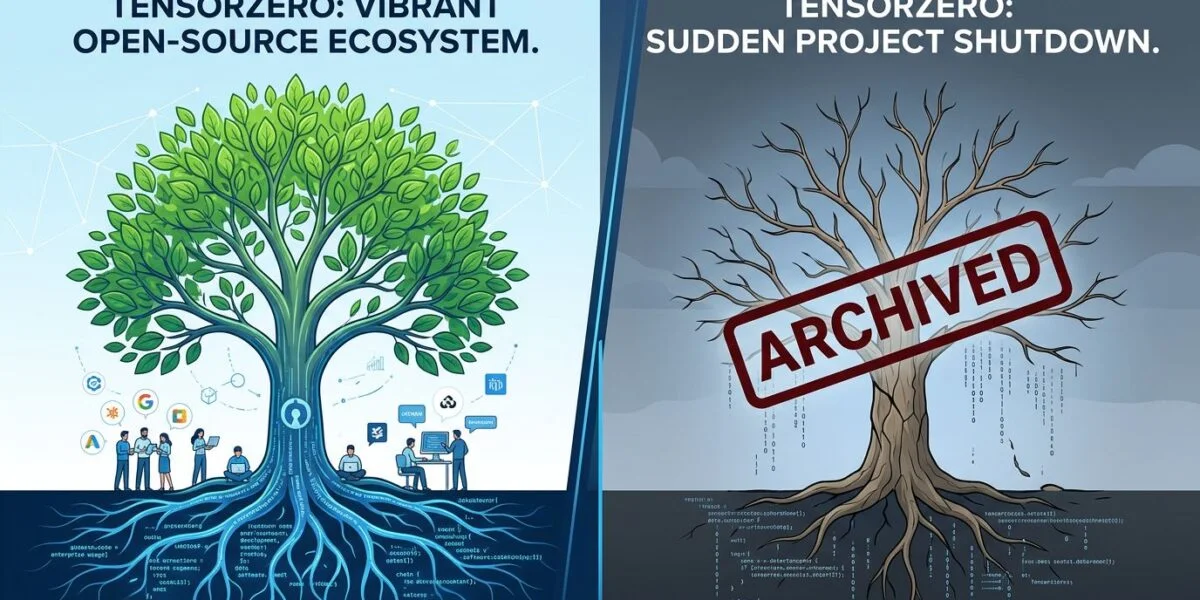
Cover image: Image via byteiota.com 8

Add more perspectives or context around this Post.

  • Sign in to comment.