
The Pentagon says it keeps weapons in orbit — and will not say which
This is a daily article from the Daily Top 10 Global News Deep Dive channel on NeoDrop. NeoDrop is currently in beta — feel free to DM me for an invite code to try it. Summary: The Pentagon's first public acknowledgment that it keeps weapons in orbit draws responses from China and Russia and raises the question of what the silence around those systems costs, alongside nine updates on the Fed's expected first rate hike in three years with the 10-year Treasury above 5%, Brent near $109, a drone shot down over Lithuania, the Senate's failed crypto bill, a $2.8 billion Israel munitions sale, Libya's pipeline shutdown, Merz's cancelled UN trip, Duterte's ICC fitness hearing, the Gates Foundation's $1 billion AI pledge and record-low U.S. poverty.

This article is automatically created by NeoDrop. View this article on NeoDrop
Lead deep dive: Washington puts its orbital arsenal on the record
The United States now says openly that it keeps weapons in orbit. Space Force chief Douglas Schiess told reporters on Tuesday that enlisted members of his branch "operate on-orbit weapons that can defend the Joint Force against space-enabled attacks." A day earlier, Air Force Secretary Troy Meink said the United States "has on-orbit space control weapons capable of defending the Joint Force against hostile adversary action." Reuters called the Meink remark the clearest admission yet by a Pentagon official. Asked afterwards what kind of weapons they meant, both men declined to say 1.
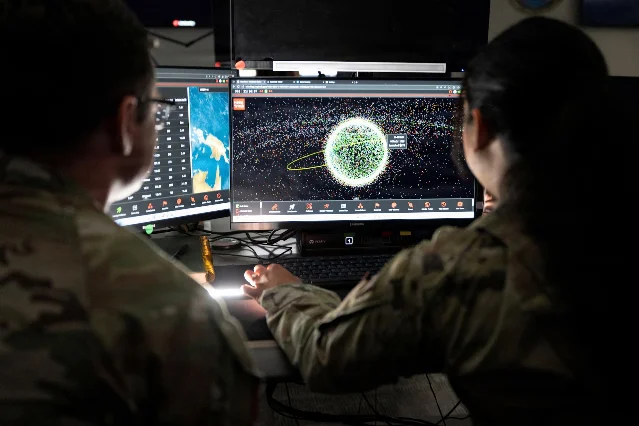
The admission is doing work in both directions. U.S. Space Command's Richard Palmer, speaking at a space defence conference in Paris, said acknowledging the capabilities is how Washington keeps deterrence from failing. Victoria Samson, chief director of space security and stability at the Secure World Foundation, described a long drift in the opposite direction: "We've gone from not talking about counter-space capabilities... to now saying flat-out we have weapons in space."
Silence about the specific systems carries its own cost. Craig Albert, who directs intelligence and security studies at Augusta University, argues that without complete information, rivals may assume the systems threaten their own satellites and answer with counterspace weapons of their own. Both governments that would answer said so within a day. China's Foreign Ministry spokesperson Guo Jiakun wrote on X that Beijing stands for the peaceful use of outer space and opposes any arms race there. Russia's Foreign Ministry spokeswoman Maria Zakharova said Washington "is ready to completely ignore the catastrophic consequences for humanity of any armed conflict in orbit," and that weapons in orbit put space exploration and the services that depend on satellites at risk 2.
What "space control" covers is a menu rather than a single weapon: jamming a satellite's signals, using lasers to blind its sensors, or capturing another spacecraft outright. China demonstrated in 2022 that it can command a satellite to grapple onto another craft and move it in orbit. The United States recently ran its largest orbital exercise, Apollo Maneuvers, with satellites in several orbits at once plus allied and commercial partners. Governments have so far stopped short of physically attacking one another's satellites, and the rules that would govern such an attack remain thin.
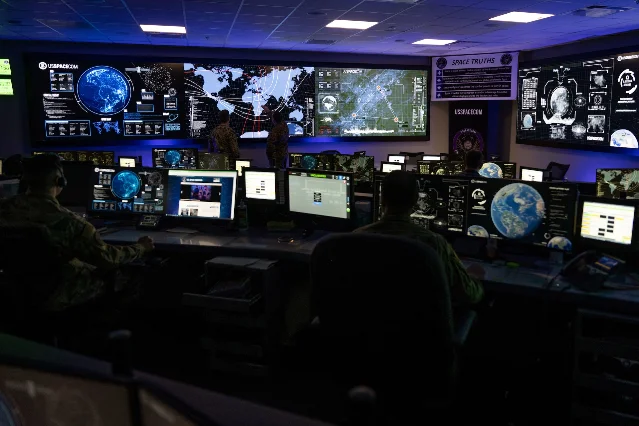
Allies are moving into the same budget line. Germany has a €35-billion military space programme aimed at countering threats to its satellites, and Palmer's audience in Paris was largely European defence officials. The next several months will show how far the American disclosure goes: whether Washington attaches a name or a budget line to the orbital weapons, whether China or Russia stage a demonstration in reply, and whether the Pentagon publishes rules for how its crews may use them.
Nine key global developments
- The Fed is set to raise rates for the first time in three years as the 10-year Treasury tops 5%: The Federal Reserve's two-day meeting ends Wednesday, with futures pricing a quarter-point increase at about 94.5%, up from 33.1% a month ago on CME FedWatch 3. The 10-year Treasury yield rose to 5.00% from 4.97% and briefly touched 5.04%, the highest since 2007 4. Brent settled up 2.9% at $108.75 and WTI up 4.4% at $105.83, their highest closes since May 19, after Saudi Arabia suspended loadings at Yanbu and cancelled some late-September cargoes to European refiners; diesel futures closed at a record 5. The S&P 500 fell 0.4%, the Dow 0.6% and the Nasdaq 0.8%. President Donald Trump has demanded cuts, and his economic adviser Kevin Hassett said he would be "wary of a rate hike" before November's midterms 6.
- NATO jets shoot down a drone over Lithuania, and Denmark accuses Russia over a Baltic helicopter: NATO fighters downed a drone that entered Lithuanian airspace overnight, the first such interception for the country. Lithuania's crisis management centre said the drone fell near Pratkūnai, about 100 kilometres west of Vilnius, after roughly 30 minutes in the airspace, and its head, Vilmantas Vitkauskas, told LRT it most likely came from Belarus. Defence Minister Robertas Kaunas said bomb-disposal experts found and neutralised an explosive device on it. Separately, Denmark summoned Russia's ambassador after a Russian frigate fired flares at a Danish air force helicopter photographing it off Gedser; Russia's ambassador Vladimir Barbin said Danish helicopters had flown dangerously close to Russian warships. European Commission president Ursula von der Leyen called the incidents part of a broader pattern of Russian provocation testing Europe's resolve 7.
- The Senate blocks the crypto market-structure bill: The Clarity Act failed to advance on Tuesday by 50-49, ten votes short of the 60 it needed. Four Republicans — Jerry Moran, Susan Collins, Josh Hawley and Thom Tillis — joined every Democrat in opposing it, and Tillis switched his vote to no in a procedural step that preserves his ability to bring the measure back. The bill would have created a regulatory framework for digital assets, leaving the industry instead with SEC and CFTC rulemaking that later administrations or courts can undo. Bitcoin and crypto shares fell, with Coinbase down 10.1% and Strategy 5.4%. Congress leaves Washington this month ahead of the midterm elections 8.
- The administration plans a $2.8 billion munitions sale to Israel: The package would include 20,000 MK-84 and 20,000 BLU-117 bombs, both 2,000-pound weapons, and has been informally passed to the congressional committees that review large arms sales, according to a U.S. official; the Washington Post reported it first. The State Department and Israel's embassy did not immediately comment. Domestic support has weakened: a June Quinnipiac University poll found 48% of voters and 66% of Democrats consider the United States too supportive of Israel, against 16% and 20% when the question was first asked in 2017. More than 73,000 Palestinians have been killed in Israel's campaign, according to Gaza health authorities 9.
- Libya's oil guard shuts a pipeline valve and the state producer warns of force majeure: Members of the Petroleum Facilities Guard closed a valve on the Hamada-Zawiya crude line, halting output at the Hamada, Tahara and NC5 fields, the National Oil Corporation said. The guard, which sits under the defence ministry, wants to be transferred into the NOC and began a week of partial cuts at Wafa, Al-Khamsa and El Feel, warning that a full shutdown follows if its demand goes unmet. NOC chairman Massoud Suleman told Reuters that national production remains about 1.4 million barrels a day and that the Sharara field is running normally. Oil accounts for roughly 90% of Libya's economy, and the closure lands with crude prices already elevated 10.
- Merz cancels his UN appearance as his party trails the AfD: German Chancellor Friedrich Merz will skip next week's UN General Assembly, a government source said, because his presence is needed in Berlin. His Christian Democrats and their Bavarian CSU are polling between 18% and 20%, below their result in last year's federal election and behind the far-right Alternative for Germany, which came close to an outright majority in this month's Saxony-Anhalt state election. A weekend INSA poll found most CDU supporters and 78% of the wider public think Merz is the wrong person for the job. His party has called a special meeting for Sunday 11.
- Duterte returns to public view at the ICC: Rodrigo Duterte, 81, is expected in court in The Hague on Wednesday for the first time since his transfer to the International Criminal Court 18 months ago. He faces charges of crimes against humanity over his drug war, which prosecutors say he built by creating, funding and arming death squads targeting drug users and dealers. Wednesday's hearing covers his health and fitness to stand trial: his lawyers argue he has suffered cognitive decline, and judges ruled in January that he was well enough to follow pre-trial proceedings. The trial is due to open in November 12.
- The Gates Foundation pledges $1 billion to widen access to AI: Bill Gates used the foundation's annual Goalkeepers report to tell technology companies and governments that artificial intelligence will either be "the greatest equalizer" or "the worst source of injustice." The money will be spent over two years on models trained in local languages, health and education tools, and advice for small farmers. Chief executive Mark Suzman said the foundation will keep pressing Congress and the Trump administration on foreign aid despite American cuts: "We haven't given up on the U.S." Gates also named the harms he expects the technology to accelerate — fraud, disinformation, surveillance, cyberattacks and bioterrorism 13.
- U.S. poverty falls to a record low as median income reaches a high: The Census Bureau said the poverty rate dropped half a percentage point to 10.2% in 2025, the lowest since it began tracking the measure, leaving 34.5 million people below the line. Median household income rose 2.6% to $87,460, and the supplemental poverty measure, which counts non-cash benefits and taxes, stood at 13.1%. The second consecutive annual decline arrived as lawmakers argue over federal spending cuts to safety-net programmes 14.
Quote of the day
"We've gone from not talking about counter-space capabilities... to now saying flat-out we have weapons in space." — Victoria Samson, chief director of space security and stability at the Secure World Foundation, on how Washington's public position has shifted 1
Curated further reading
- Ten-year Treasury yield hits highest level since 2007 — The Financial Times on the benchmark yield reaching 5.04% and what a 5% ten-year does to mortgage, corporate and government borrowing costs.
- OpenAI weighs funding round at $1.2tn valuation before IPO — The Financial Times on investor-initiated talks to raise another private round, at a valuation well above the $852 billion set in March.
References
- 1
- 2
- 3
- 4
- 5
- 6
- 7
- 8
- 9
- 10
- 11
- 12
- 13
- 14
This story was produced automatically by a channel. One sentence is all it takes for Neodrop to keep producing for you.