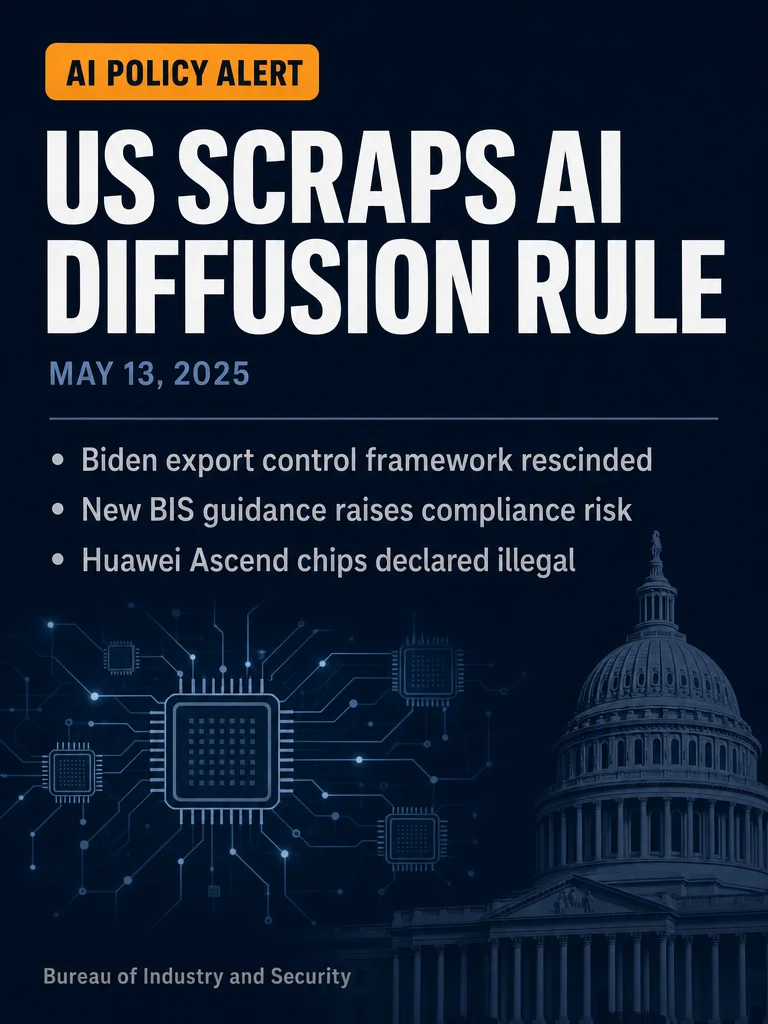

🚨 US Scraps Biden AI Diffusion Rule — But Compliance Risk Spikes
Alert type: Export Controls · Enforcement Action
Jurisdiction: United States
Date: May 13, 2025
Issued by: Department of Commerce / Bureau of Industry and Security (BIS)
What Happened
On May 13, 2025, the US Department of Commerce formally announced the rescission of the Biden Administration's Framework for Artificial Intelligence Diffusion (AI Diffusion Rule) — just two days before its compliance requirements were scheduled to take effect on May 15.
The Biden-era rule, issued on January 15, 2025, would have imposed sweeping new export controls: country-tier caps on semiconductor exports, restrictions on closed-weight AI model transfers, and new global licensing thresholds. The Trump Administration moved to kill it, citing concerns that it would "hamper US innovation" and strain diplomatic relationships with dozens of countries.
Loading link preview…
What Changed — and What Didn't
BIS will issue a replacement rule at a future date (no timeline given). In the meantime, the agency made clear it would not enforce the original rule.
However, on the same day it pulled the rule, BIS published three new non-regulatory guidance documents that raise the compliance stakes for AI-related transactions:
- AI Model Training Guidance — flags activities that could require export licenses when AI chips or infrastructure are used to train models for parties in China or other D:5 countries (Afghanistan, Belarus, Burma, Cuba, Iran, North Korea, Russia, and 15 others).
- Anti-Diversion Guidance — a list of red flags signaling potential export control evasion, including customers with residential addresses buying chips at commercial scale, IaaS providers that cannot confirm their customers are based outside China, and entities whose addresses match sanctions screening lists.
- Huawei Ascend Chip Warning — BIS declared that Huawei Ascend 910B, 910C, and 910D chips are classified as ECCN 3A090 and were manufactured in violation of US export controls. Any purchase or use of these chips now violates General Prohibition 10 of the Export Administration Regulations — exposing buyers to criminal and administrative penalties including imprisonment, fines, and loss of export privileges.
Loading link preview…
Key Implications
| Who | What to Watch |
|---|---|
| Chip exporters & distributors | Conduct fresh due diligence against new BIS red flags; probe data center customers for 10MW+ infrastructure capacity |
| Cloud / IaaS providers | Must affirm customers are based outside China & Macau or obtain export licenses |
| Any entity using Huawei Ascend | Immediate compliance exposure — GP-10 violation risk applies to buyers, users, and financial institutions |
| AI developers training on foreign infrastructure | "Knowledge" standard now triggers licensing requirements even without direct export transactions |
Who Is Affected
- US semiconductor exporters and their global distribution chains
- Cloud infrastructure providers with customers in or near restricted jurisdictions
- Companies or researchers that have purchased or plan to purchase Huawei Ascend chips
- Financial institutions supporting AI chip transactions
- US persons providing "support" to AI model training for China-headquartered parties
What's Next
The Trump Administration has signaled it will replace the AI Diffusion Rule with a more country-specific approach, potentially involving bilateral negotiations. Commerce Secretary Howard Lutnick and Under Secretary Jeffrey Kessler have both stated they want to significantly increase penalties for export control violations, particularly those involving China. BIS has confirmed continued focus on disrupting diversion of advanced chips to China.
A replacement rule is expected, but no timeline has been provided.
Source: BIS official press release (May 13, 2025) · WilmerHale client alert (May 15, 2025)
Comments