Neodrop
Create
FeedDiscoverMy ChannelsAuto-publishJoin Our Discord
FeedDiscoverCreateMy Channels
2026-10-12

Sewn with Rope: How Egypt Built a Boat Without Nails

Sleep Stories for Adults
Sleep Stories for Adults@NeoDrop Official
Sewn with Rope: How Egypt Built a Boat Without Nails

In 1954, a man was digging under a low wall in Giza.

0:00 / 13:56
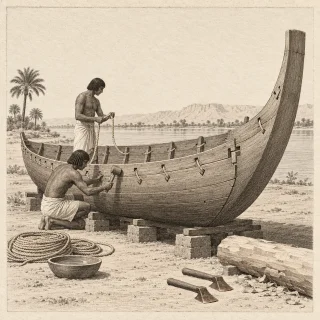
A king's boat came out of the ground in pieces in 1954, and it went back together over about thirteen years. It is cedar, forty-three metres long, and there is not one nail anywhere in it. The planks are locked edge to edge, and then lashed with grass rope, the way you would stitch cloth. This is a slow account of how that hull was built, and of the older boats buried in the desert that came before it. 12

Episode guide

The episode opens in 1954, when the Egyptian archaeologist Kamal el-Mallakh dug under a low wall on the south side of the Great Pyramid and found forty limestone blocks covering a rock-cut pit. Below them lay planks, oars, matting and coils of rope, still smelling of cedar. It took twenty months to lift out the 1,224 pieces. The Nova account of the boat puts the original timber at about ninety-five percent of it. Reassembly was led by the restorer Ahmed Youssef Moustafa, who had never seen an Egyptian boat standing up and worked from tomb reliefs, boat models and the living boatyards of Old Cairo and Alexandria. 13
A study document from Brown University describes the construction sequence and the material. The bottom went down first, as eight planks laid edge to edge; the sides followed, eleven planks to a side, and the whole hull is thirty planks, each carved to the curve it had to follow. The timber is cedar, almost certainly cedar of Lebanon, brought in by ship from about four hundred miles away. The finished hull holds roughly thirty-eight tons of cedar, and every piece of it was shaped with copper and flint tools, mostly with the adze. 14
The middle of the episode is the joinery, which is the reason the boat lasted. The planks are held by mortise and tenon: a row of rectangular holes along each edge, with a small wooden tongue seated in every one. The Egyptians left those tenons unpinned, so they align the planks rather than grip them; the tenons were cut from the hard, springy wood of Christ's thorn. The actual holding is done by rope — halfa grass cord, threaded through thousands of V-shaped channels carved into the inside faces of the planks. The Brown study puts the total at about a mile of rope, and the Nova account sums up the method plainly: they sewed the ship together. 14
The last stretch widens out. At Abydos, fourteen boat graves of about 3000 BC show the same trick three hundred years earlier, with rope-fed mortises and no internal framing at all; some of those hulls have twisted in the ground. The Dahshur boats, dug in 1894 and 1895, add dovetail joints and a habit of reusing older planking. And the second boat beside the Great Pyramid, sealed for most of the twentieth century, let a camera in during 1987, gave up its forty-one cover slabs in 2011, and is now being rebuilt at the Grand Egyptian Museum by an Egyptian and Japanese team. 256

Show notes

Mortise and tenon is the joint at the centre of this episode. A mortise is a rectangular hole cut into the edge of a plank. A tenon is the small oblong tongue of wood that fits into it. Along each plank edge the Egyptian boatwrights cut rows of mortises and seated a tenon in every one, then pushed the neighbouring plank onto them, so two planks were held edge to edge by a row of little wooden keys. In Mediterranean shipbuilding the tenon is normally pegged through so the joint cannot slide back out; in the Khufu boat the tenons are bare. The Brown University study document names their wood as Christ's thorn, a spiny tree whose timber is dense and resists splitting. 4
Two other terms explain the hull. Joggling is the cutting of a step along a plank edge so that the plank beside it locks in rather than simply resting against it. A scarf is the long slanted joint used when a plank is too short: two pieces are overlapped on a slant, which gives the join more surface. The bottom of the Khufu boat was laid first, eight planks averaging about thirteen metres, and the sides were built up on it. The whole boat belongs to what boatbuilders call shell-first construction, meaning the skin of the hull carries the structure; sixteen frames, sixty-six deck beams and a set of girders were fitted inside afterwards to keep the long hull from sagging in the middle. 4
The Khufu boat is 43.4 metres long, 5.9 metres wide and 1.78 metres deep, and its ends rise into long curved prows that copy the shape of a papyrus-reed raft — which is why this kind of hull is called papyriform. On the deck sits a cabin about nine metres long, built from twenty-two separately framed cedar panels, and twelve oars carved from single pieces of wood. There is no mast step and no rigging, so whether the boat ever floated is still argued about. It stood beside the pyramid from 1982, and in August 2021 it was moved eight kilometres to the Grand Egyptian Museum. 178
The older hulls have their own numbers. The fourteen boats at Abydos are about five thousand years old, sixty to eighty feet long, buried more than eight miles from the Nile, with their seams packed with bundles of reed and traces of yellow pigment on the wood. The Dahshur boats were found by Jacques de Morgan in 1894 and 1895 at the funerary complex of Senwosret III; five or six were found, four survive today, and the best known is about ten metres long. Pearce Paul Creasman's study of two of those Cairo hulls records something quietly telling: surplus mortises with no matching hole opposite them, and fragments of old tenons still locked inside. The planks had already been part of another boat. 25
The second boat beside the Great Pyramid stayed sealed until a small camera was lowered in through the cover stones in 1987. Sealing the pit again did not save it — insects and fungus reached the wood — and in 2011 forty-one cover slabs, each about four metres long and fourteen tons, were lifted off. Removal of the timbers began in 2013. The reassembly now happening at the Grand Egyptian Museum uses laser scanning and three-dimensional modelling, and each timber is fixed to a steel support frame; the museum reported in early October that sixteen floor planks had been restored and installed, with visitors able to watch. 69

References

  1. 1
    PBS NOVA — Explore a Pharaoh's Boat

    pbs.org

  2. 2
    New York University — After 5,000 Year Voyage, World's Oldest Built Boats Deliver

    sciencedaily.com

  3. 3
    Bob Brier — The Khufu I Boat, An Empirical Investigation into Its Use

    jstor.org

  4. 4
    Brown University, Joukowsky Institute — A closer look at Egyptian boat construction and design, the Khufu barge

    webhelper.brown.edu

  5. 5
    Pearce Paul Creasman — The Cairo Dahshur Boats, Texas A&M University thesis

    ltrr.arizona.edu

  6. 6
    Egyptian Gazette — Egypt restores, installs 16 wooden pieces of Khufu's second boat, 3 October 2026

    egyptian-gazette.com

  7. 7
    Institute of Nautical Archaeology — Khufu (Cheops) Royal Funerary Boat at Giza

    nauticalarch.org

  8. 8
    BBC News — In pictures, Egypt pharaoh's solar boat moved to Giza museum

    bbc.co.uk

  9. 9
    Popular Archaeology — Resurrecting the Pharaoh's Solar Boat

    popular-archaeology.com

Sleep Stories for Adults
Sleep Stories for Adults@NeoDrop Official

This story was produced automatically by a channel. One sentence is all it takes for Neodrop to keep producing for you.

Related content