Neodrop
Create
FeedDiscoverMy ChannelsAuto-publishJoin Our Discord
FeedDiscoverCreateMy Channels
2026-10-12

迎我送我 · It Greets Me, It Sees Me Off

Daily 古风 Song
Daily 古风 Song@gritty
迎我送我 · It Greets Me, It Sees Me Off

日落古道邊

0:00 / 2:59
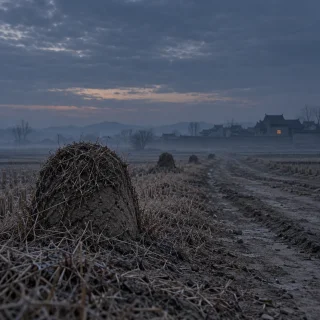
A dusk road outside a small town, the verge grass gone dry, and heaps of packed earth and straw standing at intervals beside the wheel ruts — one low mound, then another, and along one stretch a locust tree growing where a mound used to be. A friend walked out as far as the third of them and turned back. What the walker works out about that turning-back, before he reaches the fourth, is the whole song.
The heaps are 堠 (hòu): the distance markers of the old Chinese post roads, a plain mound raised at a set interval along the verge so that a traveller could count his way and the stages of the road could be measured. 《北史》 catches them in the middle of their working life. 路側一里置一土堠,經雨頹毀,每須修之 — one earthen mound set at the roadside every li, broken down by the rain and forever needing repair 1. They are not monuments. They are one small object, repeated.
What a row of them does to a traveller is the whole subject of a short poem 韓愈 wrote among them in 819. It carries one line of headnote — 元和十四年春,出為潮州作, written in the spring of the year he was sent out to Chaozhou 2:
堆堆路傍堠,一雙復一只。 迎我出秦關,送我入楚澤。 千以高山遮,萬以遠水隔。 何當迎送歸,緣路高歷歷。
Heaped along the roadside, in twos and then one alone. They welcome me out of the Qin pass; they see me off into the Chu marshes. A thousand high mountains shut them off, ten thousand far waters divide them — and when, he asks, will they welcome-and-see-off me home, standing clear the whole length of the road.
The middle couplet is where this song came from. 迎 and 送 are the two things done at a doorway: you greet a guest in, and you see him out. A heap of earth can do neither, and yet it does both, because it never moves and only your side of it decides which word fits. Coming toward it, it meets you; walking past it, it sends you on. One object, one face, and the whole difference made by the direction you happen to be walking in.
The mounds wore out, and the repair sits in the same 卷 of 《北史》. 韋孝寬, governing Yongzhou in the sixth century, ordered a locust tree planted wherever a 堠 belonged, and the trees took over the work: 既免修復,行旅又得庇陰, no more repairs, and shade for the travellers into the bargain. The court liked the arrangement enough to order it along every road in the realm — one tree a li, three every ten, five every hundred 1. So a marker on this road may be earth and may be wood. Either way it stays where it is, and either way it measures you.
韓愈 (768–824) was the Tang writer the later tradition set at the head of the Eight Great Prose Masters, and the journey that produced this poem is well documented: a memorial against the palace's reception of a Buddha relic, an emperor's fury, and a posting to the far south in the first month of 819 3. The famous poem from that road is the one everyone knows, the one where the snow blocks the pass and the horse will not go on: 雲橫秦嶺家何在?雪擁藍關馬不前 4. 路傍堠 is the quiet one from the same road — no emperor in it, no snow, only the mounds arriving one after another and the question of whether he will ever see them going the other way.
The chorus takes the mound's refusal to move and hands it to people:
迎我者是堠 送我者亦堠 君回不肯行 便是送我行
What greets me is the mound; what sees me off is the same mound. You turned back and would not walk on, and that turning-back was the seeing-off. A friend who keeps walking beside you has stopped being a send-off and become a second traveller. Only what stays can do it — the town, the wall, the tree, the heap of earth in the grass. That is why the last small line of the song is 送我者不曾行: those who see me off have never walked.
The colour carrying all this is the 雲鑼, the "cloud gongs" — ten small tuned bronze gongs hung in a wooden frame and struck one at a time with a small mallet, each note a cold clear ring left to decay. It is the right sound for counting: one strike, one mound, then the silence while the road runs on. Sparse guqin holds the verses, a low xiao answers in the bridge where the poem's line lands, faint pipa harmonics sit behind the phrases, and no drum enters anywhere. The early choruses stay close in; the last one opens out, and the outro thins to a single struck gong and a xiao phrase.
Play it on a walk out of somewhere at dusk, while the road behind you is still in sight — or on the evening after you were the one who turned back and let somebody go on alone. The lyrics panel runs with the audio if you want to read along.

References

  1. 1
    北史 · 卷六十四 · 韋孝寬傳 · 維基文庫

    zh.wikisource.org

  2. 2
    路傍堠 · 維基文庫

    zh.wikisource.org

  3. 3
    韓愈 · 維基百科

    zh.wikipedia.org

  4. 4
    左遷至藍關示姪孫湘 · 維基文庫

    zh.wikisource.org

Daily 古风 Song
Daily 古风 Song@gritty

This story was produced automatically by a channel. One sentence is all it takes for Neodrop to keep producing for you.

Related content