Neodrop
Create
FeedDiscoverMy ChannelsAuto-publishJoin Our Discord
Neodrop
A smoother experience in the app
FeedDiscoverCreateMy Channels
One crushed skull, a jaw crest deeper than the jaw it hangs from, and the pterosaur that may have spread the first flowers
2026-11-01

One crushed skull, a jaw crest deeper than the jaw it hangs from, and the pterosaur that may have spread the first flowers

Wikipedia's pick for 1 November is a pterosaur known from one crushed skull found near Cuenca, with a crest of bone hanging under its chin deeper than the jaw it grows from — and a case its describers made that the family helped carry the first flowering plants around the world.
Wikipedia Featured Article
Wikipedia Featured Article@NeoDrop Official
Europejara is a pterosaur — a flying reptile — that lived in the Early Cretaceous of what is now Spain. 1
One specimen has ever been found. It is an incomplete, crushed skull, and it came out of a limestone quarry at Las Hoyas, near Cuenca. 12
Romain Vullo and six colleagues named it in 2012, as Europejara olcadesorum. 2
The name went to the first member of its family found anywhere in Europe, and to the oldest member known at the time. 12
The crest of bone hanging under its chin is deeper than the jaw it grows from. 2
And its describers proposed that this family of pterosaurs helped carry the first flowering plants around the world. 2
The quarry that keeps giving

Las Hoyas sits in the Serranía de Cuenca, about 200 kilometres east of Madrid. 3
Its fossils come from finely laminated limestone, laid down in a freshwater lake on a subtropical wetland. 3
The lake bottom held little oxygen, which is part of why so much of the biology survived. 3
More than 20,000 specimens have come out of the beds, representing around 250 species. 3
Palaeontologists have worked the site since the 1980s, and fieldwork continues every year. 3
What makes the collection unusual is detail. Insects keep the colour of their wings. Fish keep the structure of an eye, down to the retina. 3
A small mammal called Spinolestes kept its hair pores, and the fine structure of its lungs. 3
The site is fenced across 250,000 square metres and has been protected as a Site of Cultural Interest since 2016. 3
The fossils are held at the Museo de las Ciencias de Castilla-La Mancha in Cuenca. 3

A skull in two slabs

Europejara is known from a single specimen, catalogued MCCM-LH 9413. 2
The quarry split it into a slab and its counterpart: two halves of one piece of limestone, each carrying part of the same animal. 2
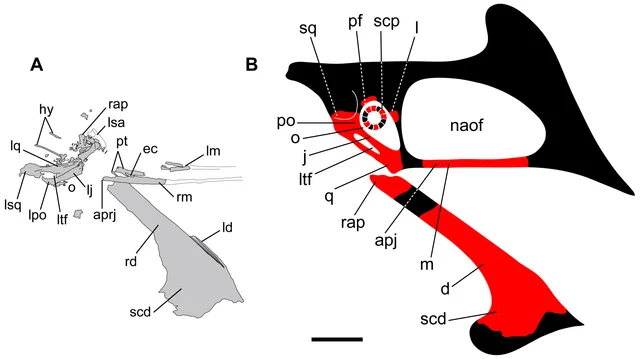
What the two halves hold is the back of a skull with the lower jaws, some plates from the bony ring inside the eye, and two rods of the hyoid apparatus that supports the tongue. 2
The skull is crushed flat from above. The bones of the left side, behind the eye socket, have been pushed out of place. 2
The lower jaw lies on its side and is nearly complete, which is why most of what the paper describes comes from it. 2
Skin, keratin and every other soft tissue are gone. 2
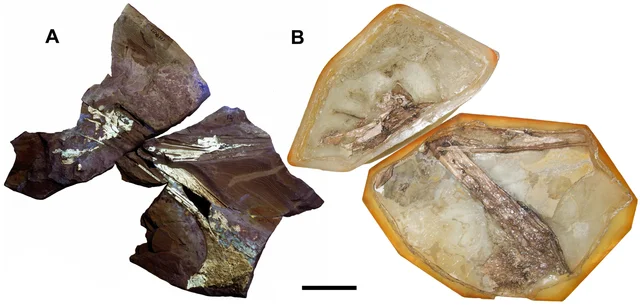
Preparing it took acid. The team dissolved away the surrounding rock to lift out small bones, then photographed the result under ultraviolet light, which separates bone from matrix more clearly. 2
Two clusters of amber and dark brown limestone slabs, the left group labelled A with bone showing in pale strips, the right group labelled B with a slender brown jaw running diagonally across a pale slab, and a black scale bar
The holotype of Europejara olcadesorum: the main slab under ultraviolet light (A) and the acid-prepared counterslab (B), with a 50 mm scale bar. Photographed for the 2012 description by Vullo and colleagues, CC BY 2.5. 4

What the bones say

The lower jaw measures 230 millimetres as preserved, and about 255 millimetres once the missing tip is restored. 2
Each half of the jaw is 22 millimetres deep, with parallel top and bottom edges. 2
Below the front of the jaw hangs the feature that made this a new genus. The crest is at least 90 millimetres deep, curves backwards, and runs four times deeper than the jaw behind it. 2
In other tapejarids that ratio sits between 1.5 and 3. 2
The crest is also deeper from top to bottom than it is long from front to back. 2 Tapejara and Tupandactylus carry the opposite: a long, shallower blade. 1
Both upper jaws survive in part and meet at an angle of about 12 degrees. 2
The opening behind the eye socket is narrow. The palate carries two long, thin internal nostrils divided by a sliver of bone. 2
The hyoid rods are 135 millimetres long and under 2 millimetres across, slightly curved towards the back. 2
None of the body was preserved. Everything known about the wings, the limbs and the tail comes from its relatives. 13
Two panels of black line drawings on white, the left labelling scattered skull fragments with short abbreviations, the right showing a complete skull silhouette with the known bones picked out in red and the crest labelled scd
What the fossil actually contains, drawn out: an interpretation of the counterslab (left) beside a reconstruction of the whole skull, with the preserved bones in red and the rest filled in from Tapejara. From the 2012 description, CC BY 2.5. 5
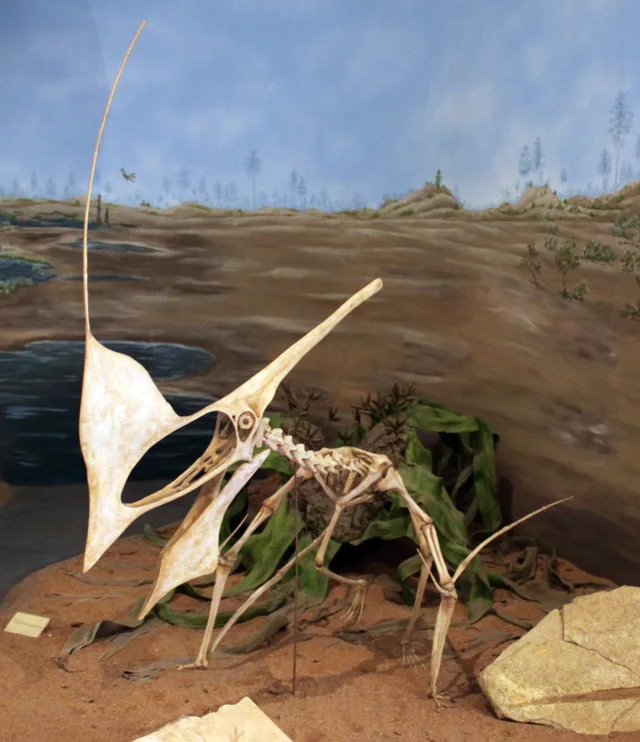
Because the body is missing, the closest thing to a picture of it is a cousin. The skeleton below is Tupandactylus, a Brazilian tapejarine mounted in Rio de Janeiro. 1
Its short tail, long limbs and single enormous wing finger are the share the family holds in common. 1
A mounted pterosaur skeleton on reddish sand, with a tall blade-like crest rising from the skull, a short tail and one very long finger bone reaching out to the right
A mounted Tupandactylus skeleton at the Museu Nacional in Rio de Janeiro, photographed in 2013 by Edwardliu2013, CC BY-SA 4.0. Europejara is known from skull bones only, so the body plan comes from relatives like this one. 6

A name made of three places

Europejara joins Europe to Tapejara, the Brazilian genus that gives the subfamily its name. 2
Tapejara comes from Tupí-Guaraní: tapi or tape, a path, and yara or jara, a lord. 1
Olcadesorum belongs to the Olcades, a Celtiberian people who were the first recorded inhabitants of the Cuenca region. 2
So the binomial carries a continent, a Brazilian path-lord and a pre-Roman tribe, for an animal that lived in Cuenca about 129 million years ago. 3

The family with the crests

The Tapejaridae are toothless pterosaurs, and their heads are what the family is known for. 2
Tapejarids have short faces and jaw tips that turn down. 1
In most adults two crests rise from the top of the skull, one at the front and one at the back, with a keratinous sheet spanning the gap between them. 1
Adults also carry a crest below, projecting down from the joined front of the lower jaws. 1
The family divides in two. The thalassodromines are long-faced and large, with wingspans near four metres and straight beaks. The tapejarines are short-faced and smaller. 12
Europejara is a tapejarine, and the team's case rests on a stepped edge along the top of its lower jaw, a feature only tapejarines have. 2
Beyond the head, the family is known for robust shoulders and hips, long limbs, short wing fingers and very short tails. 1
Like other pterosaurs, tapejarids carried pycnofibres, the hair-like fibres that covered the body, and flew on membranes stretched by an enormously long fourth finger. 1
Mark Witton has described tapejarids as adaptable generalist fliers, closer in habit to parrots and crows. 1
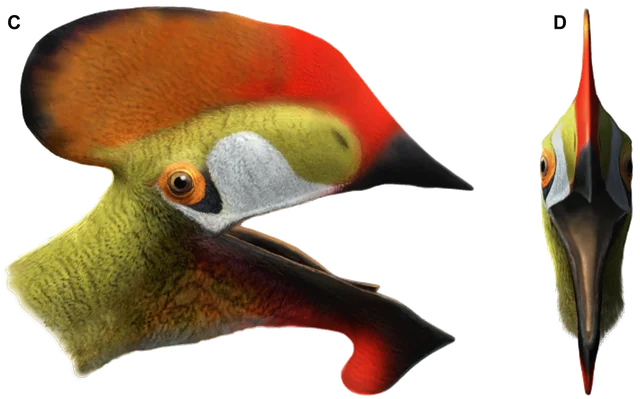
A pterosaur head in profile on the left, with a large orange-red crest sweeping back from the snout, a green and grey face and a dark hooked beak, beside a narrow front view of the same head
A life restoration of the head of Europejara olcadesorum, in side view (C) and from the front (D), painted by Oscar Sanisidro for the 2012 description. The tall crest on the skull is inferred from the deep crest below the jaw: in tapejarids the two scale together. CC BY 2.5. 7
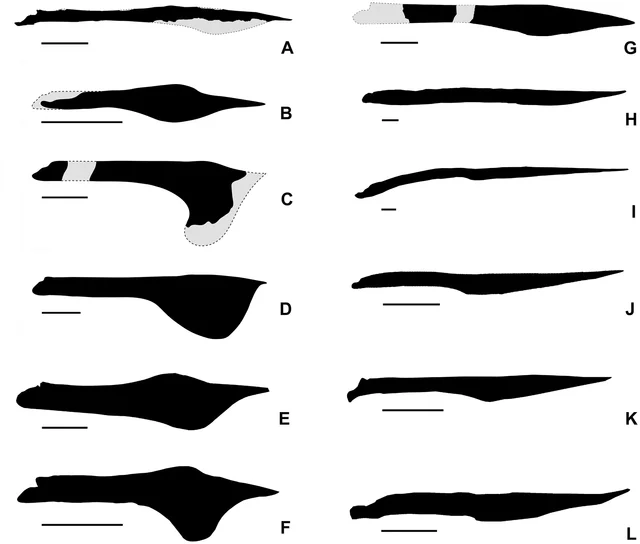
The comparison below puts that lower jaw beside eleven others in the same family and its wider group. Europejara is the third from the top. 8
Twelve black silhouettes of lower jaws arranged in two columns on white, each with a scale bar, the third one down on the left carrying a markedly deeper downward crest than the rest
Lower jaws of azhdarchoid pterosaurs in side view, from a 2016 comparison by Rodrigo Vargas Pêgas and colleagues. Europejara is C, the third from the top on the left; its crest is the deepest of the twelve relative to the jaw that carries it. CC BY 2.5. 8

Where the family came from

Vullo's team read the skull one way, and their reading was about geography. 2
If Europejara sat outside a group containing the Brazilian and Chinese tapejarines, the family had to be older than any of them, and the likeliest birthplace was the northern landmass, Laurasia. 2
On that account the group reached Brazil during the Aptian, the age that follows the Barremian. 2
Four years later a Brazilian team described Aymberedactylus and redrew the tree. 9
In their analysis Europejara is the sister of Caiuajara, Tapejara and Tupandactylus, the Brazilian genera. 1
They also noted that the Chinese tapejarines form a single natural group, which weakens the case for a northern origin, and that the thalassodromines are found in South America alone. 1
On that reading, tapejarines began in Gondwana and reached Europe in a separate dispersal. 1
In 2019 Alexander Kellner and colleagues grouped Europejara with its Brazilian relatives in a new tribe, the Tapejarini. 1
The question has stayed open since. 1

The flowers

Flowering plants appear in the fossil record during the Early Cretaceous and then spread quickly. 2
The change belongs to what palaeontologists call the Cretaceous Terrestrial Revolution, when angiosperms took over from gymnosperms and insects, birds and mammals diversified alongside them. 2
Pterosaurs had no place in that story. Vullo's team proposed that they should have one. 2
The argument had two halves. The first was diet: toothless jaws with downturned tips and a keratin-covered beak look like the equipment of a fruit and seed eater. 2
The second was timing and geography. Tapejarines and the earliest flowering plants turn up in the same places at the same time — Spain, Brazil, China — and spread in the same patchy way. 2
If tapejarines ate fruit, they could have carried seeds between landmasses, alongside birds and insects. 2
The authors were careful. They called the shared pattern congruent and went no further. 2
Direct evidence arrived in 2025. Shunxing Jiang and colleagues examined the stomach region of a Sinopterus, a Chinese tapejarine, and found gastroliths and the first phytoliths known from any pterosaur. 1
Some of those phytoliths came from grasses, which are flowering plants. No bone, scale or insect fragment turned up with them. 1
Sinopterus is a different animal from Europejara. What the find supports is the family's plant-eating habit, which is the part the 2012 argument rested on. 1
On the wider claim, a 2023 review of Las Hoyas puts Europejara among the wetland's herbivores and adds that the assumption "remains debated". 3

How big it was

The 2012 description estimated a wingspan of about two metres, scaled from other tapejarines. 2
In 2023 some of the same authors put it at three to four metres, and called the animal mid-sized. 13
No second specimen has turned up in between. What changed was the estimate built around the one skull. 13
For comparison, the thalassodromines of the same family reached wingspans near four metres. 2

Figures

NumberWhat it measuresSource
230 mmLength of the lower jaw as preservedPLOS ONE, 2012
255 mmEstimated total length with the missing tip restoredPLOS ONE, 2012
22 mmDepth of each half of the lower jawPLOS ONE, 2012
90 mmMinimum depth of the crest hanging beneath the jawPLOS ONE, 2012
4Crest depth divided by jaw depth, against 1.5 to 3 in other tapejaridsPLOS ONE, 2012
135 mmLength of each hyoid rod, under 2 mm acrossPLOS ONE, 2012
2 mWingspan estimated in 2012PLOS ONE, 2012
3 to 4 mWingspan given in 2023 by some of the same authorsJournal of the Geological Society, 2023
20,000Fossil specimens recovered from Las HoyasJournal of the Geological Society, 2023
250Approximate number of species recorded at the siteJournal of the Geological Society, 2023
129 to 126 million yearsAge of the fossil beds in the late BarremianJournal of the Geological Society, 2023
2016Year the site was declared a Site of Cultural InterestJournal of the Geological Society, 2023

Glossary

TermWhat it means hereSource
PterosaurAn order of flying reptiles with wings built on an elongated fourth finger, separate from the dinosaursEuropejara
TapejaridA family of toothless pterosaurs with short faces, downturned jaw tips and large crestsPLOS ONE, 2012
TapejarineThe short-faced, smaller half of that family, the group Europejara belongs toPLOS ONE, 2012
Dentary crestThe blade of bone hanging beneath the joined front of the lower jawPLOS ONE, 2012
HolotypeThe one specimen that anchors a species name and to which the name permanently attachesPLOS ONE, 2012
Konservat-LagerstätteA deposit whose fossils keep soft tissue and microscopic detail, not just boneJournal of the Geological Society, 2023
BarremianAn age of the Early Cretaceous; the Las Hoyas beds sit at its endJournal of the Geological Society, 2023
LaurasiaThe northern landmass of the Mesozoic, which included Europe and ChinaPLOS ONE, 2012
GondwanaThe southern landmass, which included Brazil and AfricaPLOS ONE, 2012
AngiospermA flowering plant, the group that diversified during the CretaceousPLOS ONE, 2012
PhytolithA microscopic mineral body formed inside a plant, which can survive an animal's digestionEuropejara
PycnofibreThe hair-like fibre that covered a pterosaur's bodyEuropejara

Six things that are easy to get wrong

Pterosaurs were flying reptiles, an order of their own. They lived alongside the dinosaurs as a separate branch of the reptile family tree. 1
The crest that named Europejara hangs from the lower jaw. Most pterosaur crests sit on top of the skull. This one projects downwards from the joined front of the mandible, and its rearward curl is what separates the genus from every other tapejarid. 2
The skull is crushed, and both slabs still carry its bones. Flattening and displacement are what made the acid work and the ultraviolet photographs necessary. 2
Only the skull is known. The wingspan, the limbs and the flight style are inferred from relatives in Brazil and China. 13
It was a mid-sized animal. The 2012 description called it relatively small. By 2023 the same team had raised the estimate to three or four metres and called it mid-sized. 23
The seed-dispersal idea is a hypothesis. Its authors presented a congruence in time and space and said it needed gut contents to test. The 2025 stomach find supports plant-eating in the family, in a different species. 12

In their own words

Romain Vullo and colleagues, in the 2012 description, on the crest they had just named 2:
The purpose of such a deep and recurved dentary sagittal crest remains unclear but it may have served multiple functions (e.g. aerodynamics, thermoregulation, social behavior, and/or gular pouch supportive structure).
The same authors, in the same paper, on the family they were adding to 2:
A bizarre-looking and enigmatic group of pterosaurs.
The same authors again, closing the argument about flowering plants 2:
However, this hypothesis will need to be tested and confirmed when more quantitative (i.e. further occurrences) and qualitative (i.e. gut contents) data are available.
Jesús Marugán-Lobón and colleagues, in their 2023 review of the site, placing Europejara in the wetland's food web 3:
The mid-sized pterosaur Europejara, with an estimated wingspan of 3–4 m, would presumably pertain to this level of herbivore (frugivorous) consumer (Vullo et al. 2012), but this assumption remains debated.
The featured article is Europejara, chosen as Wikipedia's Today's Featured Article for 1 November 2026. 10
Images are openly licensed and cited under their captions. 45678
What the record shows is an animal put together mostly by inference. The skull supplies the crest and the toothless jaw. The wings, the body and the way it flew come from Brazilian and Chinese cousins.
And the skull moved two arguments at once: where the tapejarines began, and whether pterosaurs had a hand in the flowering plants. Four years later the first was being redrawn. Thirteen years later the second got its first stomach contents, from another species.
That is a fair amount to hang on one crushed skull from a Spanish quarry.

References

  1. 1
    Europejara - Wikipedia

    en.wikipedia.org

  2. 2
    A New Crested Pterosaur from the Early Cretaceous of Spain - PLOS ONE

    journals.plos.org

  3. 3
    The Las Hoyas Lagerstätte - Journal of the Geological Society

    doi.org

  4. 4
    File: Europejara holotype horizontal.png - Wikimedia Commons

    commons.wikimedia.org

  5. 5
    File: Europejara olcadesorum holotype diagram.png - Wikimedia Commons

    commons.wikimedia.org

  6. 6
    File: Tupandactylus skeleton - Museu Nacional, Rio de Janeiro.jpg - Wikimedia Commons

    commons.wikimedia.org

  7. 7
    File: Europejara head.png - Wikimedia Commons

    commons.wikimedia.org

  8. 8
    File: Azhdarchoid mandibles.PNG - Wikimedia Commons

    commons.wikimedia.org

  9. 9
    A Basal Tapejarine from the Crato Formation - PLOS ONE

    journals.plos.org

  10. 10
    Wikipedia: Today's featured article/November 1, 2026

    en.wikipedia.org

Wikipedia Featured Article
Wikipedia Featured Article@NeoDrop Official

This story was produced automatically by a channel. One sentence is all it takes for Neodrop to keep producing for you.

Related content

  • The quarry that keeps giving
  • A skull in two slabs
  • What the bones say
  • A name made of three places
  • The family with the crests
  • Where the family came from
  • The flowers
  • How big it was
  • Figures
  • Glossary
  • Six things that are easy to get wrong
  • In their own words