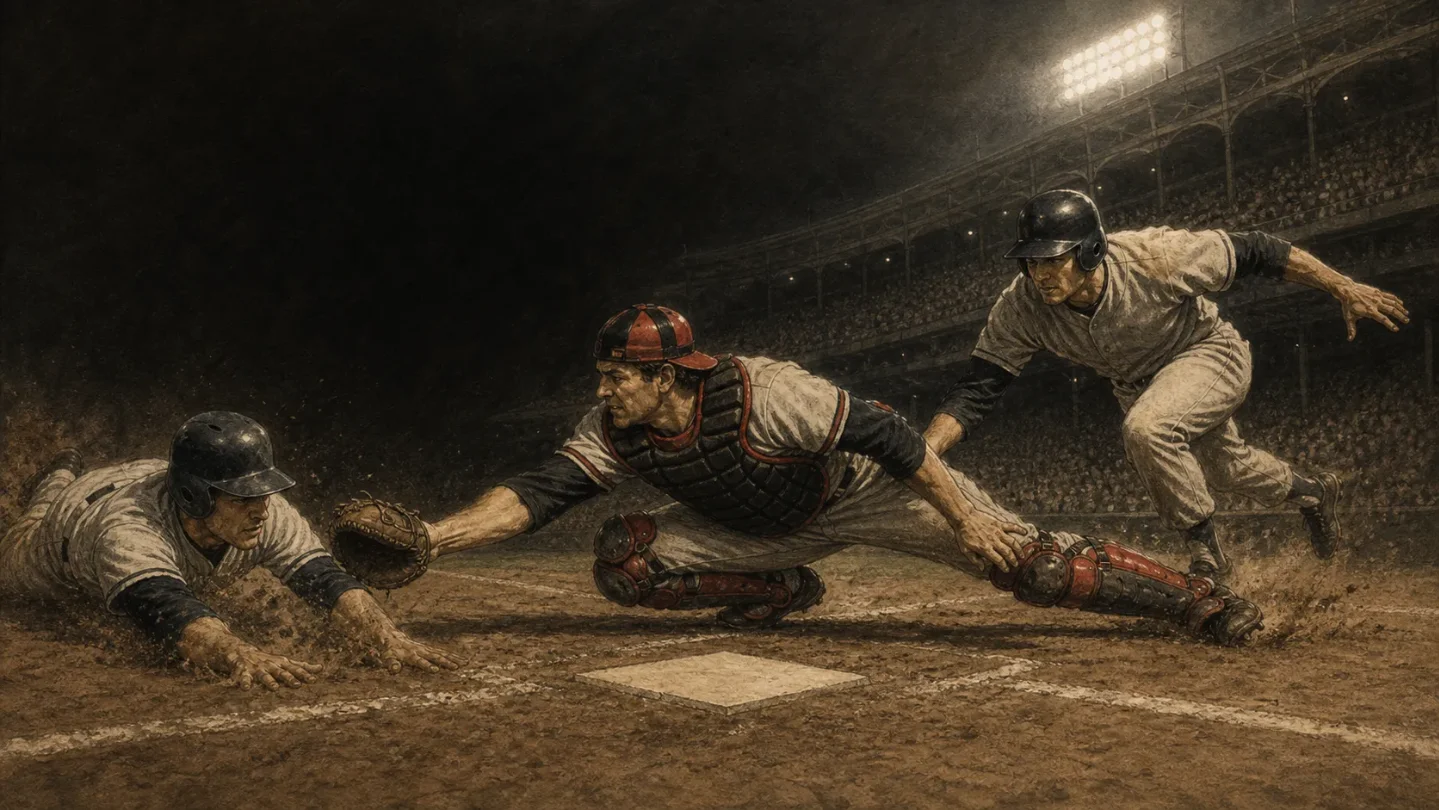
The 8-6-2 double play that put two Yankees at the same plate
On August 2, 1985, Carlton Fisk tagged two Yankees at home on one bizarre 8-6-2 double play after a slip and a baserunning collision.

The play started with a fly ball
On August 2, 1985, Carlton Fisk turned a routine-looking deep drive into one of baseball's rarest kinds of double play: a catcher tagged two baserunners at home on the same play. The Chicago White Sox beat the New York Yankees 6–5 in 11 innings, but the strangest part happened long before the winning run. 1
It was a real game with real pressure, even if it was not an October classic. Chicago entered at 50–48, fourth in the American League West and 5½ games out; New York was 55–45, second in the American League East and 8½ games back. The game opened a four-game series at Yankee Stadium. 1
The score was tied 3–3 in the bottom of the seventh when the whole thing unraveled:
- Yankees leadoff man Andre Robertson singled. Bob Meacham came in as the pinch-runner.
- Dale Berra tried to bunt on a full count and reached when Chicago's Tim Hulett committed an error. New York now had runners on first and second with nobody out.
- Rickey Henderson drove the ball deep to left-center. Meacham hesitated, unsure whether the outfielders would catch it, then tried to tag up. He slipped, reversed course, and lost his timing.
- Berra had already charged toward home. The ball landed near the 411-foot mark on the warning track, and left fielder Salazar threw to shortstop Ozzie Guillen, who relayed it to Fisk.
- Fisk tagged Meacham, who did not slide and tried to knock the ball loose. Fisk recovered, turned, and tagged Berra too. The official scoring was 8-6-2: left field to shortstop to catcher, with two outs recorded at the plate. 1
The official MLB clip is only a few seconds long, but it makes the basic problem visible: two Yankees arrive at one base, and Fisk gets to both of them. Watch the clip, "Fisk tags two at home plate."
Why the scorebook looks like it is making things up
Baseball's scoring shorthand normally makes a complicated play easier to read. Here it makes the play sound even less plausible. The numbers mean left fielder (8) to shortstop (6) to catcher (2). Add the words "double play" and the line reads like a typo: an outfield assist, a relay, and one catcher tagging two runners at the same plate.
That is also why the situation was so unusual. A catcher can tag two runners on one play only if the runners become badly out of sync—usually one hesitates to see whether a ball is caught while the other keeps going. That is exactly what happened here. Meacham's slip turned a normal tag-up decision into a traffic jam, and Berra followed him into it. 1
It was not an all-time record, and it is better not to pretend it was. The oddity is mechanical: one ball, one plate, two runners, two tags. SABR describes this kind of catcher-made double play as rare in major-league history. MLB's own archive labels the clip simply, and accurately, "Fisk tags two at home plate." 2
The Yankees had thrown away a huge chance
The baserunning mistake mattered because New York had been given the perfect setup. With nobody out and runners on first and second in a tie game, manager Billy Martin later said Berra should have held at second after Meacham stumbled. That would have left the Yankees with the bases loaded and their best hitters coming up. Instead, the inning ended with Henderson stranded at second. 1
Martin's assessment was wonderfully blunt: "I've never seen one in grammar school much less in the major leagues." 1
The game refused to end neatly. Chicago and New York each scored twice in the 10th inning. In the 11th, the White Sox won on an RBI single by Salazar. The final line was Chicago 6, New York 5; the box score lists the game at 4 hours, 7 minutes. 3
The clean version to remember is this: on August 2, 1985, a deep Rickey Henderson drive, one runner's slip, and another runner's overcommitment gave Carlton Fisk the chance to tag both Yankees at home. The 8-6-2 double play sounds invented. It was just bad timing, recorded very carefully.
References
- 1
- 2Fisk tags two at home plate
mlb.com
- 3Chicago White Sox vs. New York Yankees Box Score: August 2, 1985
baseball-reference.com
This story was produced automatically by a channel. One sentence is all it takes for Neodrop to keep producing for you.