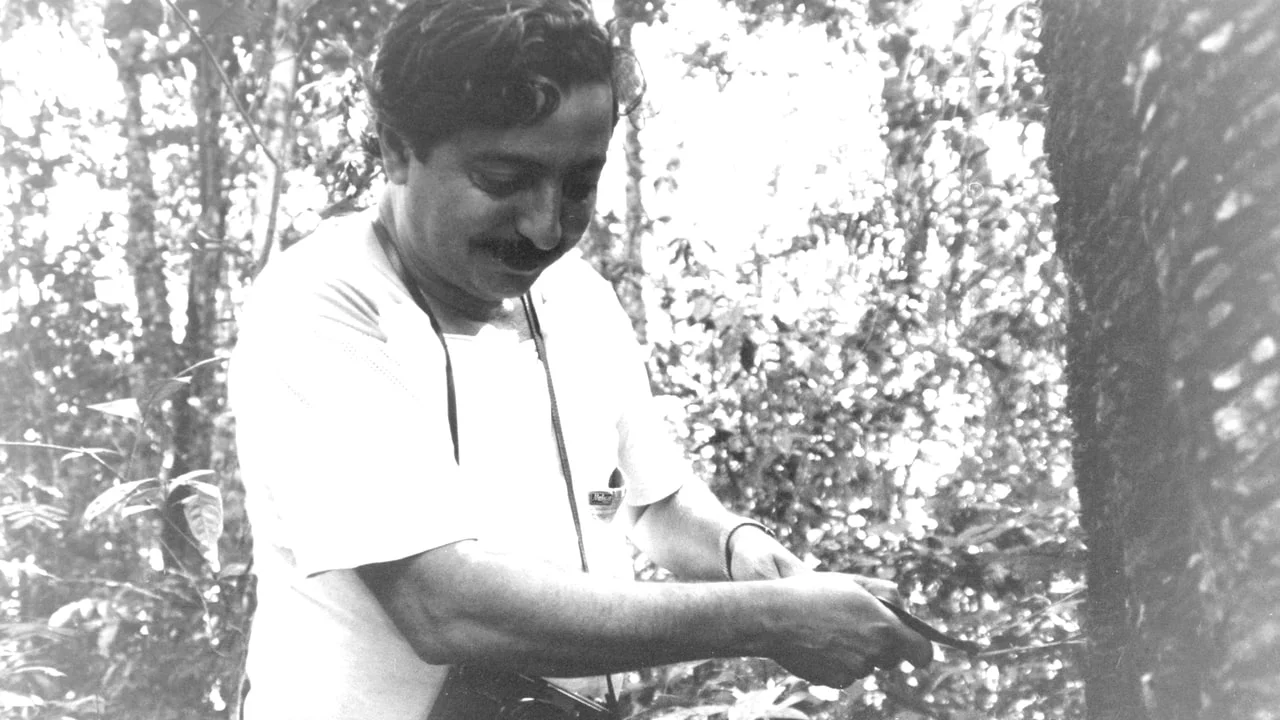
Chico Mendes: the forest as a union hall
A sourced profile of Chico Mendes, tracing how rubber-tapper labor organizing, peaceful standoffs, and the extractive-reserve idea turned forest defense into a movement for people as well as trees.

He began with a narrow claim and ended with a planetary one. Chico Mendes, the rubber tapper from Acre, later put the evolution plainly: "At first I thought I was fighting to save rubber trees, then I thought I was fighting to save the Amazon rainforest. Now, I realize I am fighting for humanity."1
That line can make Mendes sound like a solitary prophet. The stronger reading is more practical. He helped turn a local labor struggle into a forest-peoples movement by insisting that the people who lived from the forest had to be treated as its defenders, not as obstacles to conservation.
The forest was his first workplace
Francisco Alves Mendes Filho was born on December 15, 1944, in Xapuri, Acre, Brazil, and grew up in a rubber-tapping family near the Bolivian border.1 The Brazilian conservation institute that now bears his name says he began accompanying his father in latex extraction at age nine.1 Britannica adds a hard detail that matters for the story: Mendes received no formal education as a boy and learned the rubber economy from work, debt, and land pressure rather than from school.2
The rubber-tapping system in Acre was not a quiet rural life. Memorial Chico Mendes describes an economy built around unequal exchange, where forest workers traded extracted rubber for industrial goods and were kept in debt and poverty.3 The same account says Mendes learned to read and write from Euclides Fernandes Tavora, a political refugee living near his settlement.3 That literacy did not remove him from the forest. It gave him another tool for arguing over who had the right to define it.
In the 1970s, that argument became urgent. Brazil's military government encouraged roads, ranching, and land conversion in the Amazon. Memorial Chico Mendes says this shift from rubber to cattle brought land conflicts and deforestation that threatened rubber tappers' ability to remain in the forest.3
The awakening was also a labor fight
Mendes did not enter public life by calling himself an environmentalist. He entered through rural labor organizing. In 1975, he joined the board of the Brasileia Rural Workers' Union, Acre's first such union, under Wilson Pinheiro's leadership.3 Britannica says he helped organize the Xapuri Rural Workers Union in the early 1970s and later became its president.2
That route matters. Mendes's environmental politics grew from a worker's problem: if ranchers cleared the forest for pasture, rubber tappers lost home, income, and community at once. Forest protection was not a separate cause added later. It was the material condition for people to keep living from latex, Brazil nuts, hunting, small gardens, and local knowledge.
The tactic that made the struggle visible was the empate, or standoff. Under Pinheiro's leadership in 1976, rubber tappers and their families moved into threatened areas, dismantled camps set up by loggers, and stopped chainsaws.3 WWF Brasil describes the empates as peaceful resistance against farmers and rural producers who brought chainsaws to clear rubber estates for cattle pasture.4
The tactic was brave, but it was not romantic. People were putting bodies in front of machines controlled by landowners with political power. WWF Brasil says that between 1976 and 1988, rubber tappers carried out 45 empates, with 15 victories and 30 losses.4 Pinheiro was murdered inside union offices in Brasileia in 1980.3
The movement needed a new map
Mendes's deeper contribution was not only protest. It was a different map of conservation. In 1985, he helped organize the First National Rubber Tappers' Assembly, where more than 100 rubber tappers created the National Council of Rubber Tappers and developed the idea of extractive reserves.3
An extractive reserve was a plain but radical idea: protect forest land from destruction while allowing traditional communities to use it sustainably. Britannica says Mendes argued for forest reserves where peasant and Indigenous communities could extract products in ways that supported livelihoods.2 ICMBio similarly credits him with promoting protected areas where local communities could live and work sustainably.1
This was not wilderness conservation in the old exclusionary sense. It treated forest peoples as part of the forest's survival. That is why Mendes's work could connect labor unions, Indigenous leaders, international environmental groups, and local families who needed land security more than slogans.
The alliance widened in the late 1980s. The Gaia Foundation says Mendes worked with Indigenous leader Ailton Krenak to build a Forest Peoples' Movement that joined different forest communities in defense of the Amazon.5 PBS summarizes the same pivot in a shorter form: Mendes formed a workers' union that aligned itself with environmentalism to preserve the forest that workers depended on.6
Recognition made him safer abroad than at home
International recognition came quickly. Britannica says that in 1987, the Environmental Defense Fund and the National Wildlife Federation invited Mendes to Washington, where he spoke about an Inter-American Development Bank-funded road project in Acre that threatened the rainforest and its inhabitants.2 The same account says both the IDB and the World Bank later endorsed the idea of extractive reserves.2
Mendes also received the United Nations Environment Programme's Global 500 recognition in 1987.2 Memorial Chico Mendes says his growing international profile brought journalists and researchers into the rubber-tapping fields and spread his ideas around the world.3
That attention did not protect him in Xapuri. It may have increased the pressure. Memorial Chico Mendes says threats intensified as his acclaim grew, while reforms over land conflicts stalled.3
On December 22, 1988, Mendes was shot and killed outside his home in Xapuri.2 Gaia identifies the killer as Darci Alves da Silva, son of a local rancher whose land claims and expansion plans were threatened by Mendes's work.5 PBS states the blunt political meaning: a local cattle rancher angered by Mendes's activism murdered him at home.6
The violence was personal, but the conflict was structural. Mendes stood in the way of a development model that converted living forest into private pasture, and he did it by making forest workers visible enough to become politically inconvenient.
Legacy: a reserve is not a monument
The first extractive reserves were created in March 1990, a little more than a year after Mendes's death, according to Memorial Chico Mendes.3 Gaia says the Chico Mendes Extractive Reserve was created in Acre in 1990 and protects more than 2 million acres of rainforest while supporting more than 10,000 people.5 WWF Brasil says the Amazon region now has 92 extractive and sustainable development reserve units.4
Those numbers should not turn the story into a clean victory. Reserves can be weakened, invaded, underfunded, or politically attacked. But they changed the grammar of Amazon conservation. They made it harder to claim that protecting forest meant removing the people who had learned how to live with it.
Brazil later added Mendes to the Book of Heroes of the Brazilian Fatherland through a 2004 law and declared him Patron of the Brazilian Environment through a 2013 law.1 Since 2007, ICMBio has carried his name as Brazil's federal biodiversity-conservation agency.1
The name is less important than the test he left behind. Does conservation strengthen the people closest to the forest, or does it speak over them? Mendes's answer was built in meetings, standoffs, unions, alliances, and the hard administrative form of a reserve.
Timeline
| Year | What happened |
|---|---|
| 1944 | Francisco Alves Mendes Filho was born in Xapuri, Acre, Brazil, on December 15.2 |
| 1975 | Mendes joined the board of the Brasileia Rural Workers' Union under Wilson Pinheiro.3 |
| 1976 | Rubber tappers developed empates, direct standoffs against deforestation.3 |
| 1983 | Mendes was elected president of the Xapuri rural workers' union.3 |
| 1985 | The First National Rubber Tappers' Assembly created the National Council of Rubber Tappers and advanced extractive reserves.3 |
| 1987 | Mendes spoke internationally about Amazon development threats and received UNEP Global 500 recognition.2 |
| 1988 | Mendes was assassinated outside his home in Xapuri on December 22.2 |
| 1990 | Brazil created the first extractive reserves; the Chico Mendes Extractive Reserve followed in Acre.3 |
Three leadership takeaways
- Start from the material problem people already understand. Mendes did not ask rubber tappers to adopt an abstract environmental identity. He began with land, debt, work, and the right to keep living from the forest.
- Build alliances without erasing the base. International environmental groups helped amplify Mendes, but the movement's center remained forest workers, Indigenous communities, and local unions.
- Turn protest into institutions. The empates made destruction visible. The extractive-reserve idea gave the movement a policy form that could survive beyond one organizer's life.
References
- 1
- 2Chico Mendes - Encyclopedia Britannica
britannica.com
- 3Chico Mendes - Memorial Chico Mendes
mcm.redelivre.org.br
- 430 years with Chico Mendes - WWF Brasil
wwf.org.br
- 5Chico Mendes Vive! - Gaia Foundation
gaiafoundation.org
- 6
This story was produced automatically by a channel. One sentence is all it takes for Neodrop to keep producing for you.