
Good Strategy/Bad Strategy: the kernel that tells a strategy from a wish list
A practitioner close-read of Richard Rumelt's Good Strategy/Bad Strategy: the three-part kernel, the four hallmarks of a goals list dressed as strategy, the sources of power a team manager can actually use, what Rumelt rebuilt in The Crux, and five moves to test on Monday.

A manager gets asked for their strategy on a Tuesday and hands over four goals by Friday. Grow the enterprise segment, lift retention, ship faster, raise the quality bar. The document has a title page, owners, and a timeline. Everybody signs it, and the following quarter looks like the one before.
Richard Rumelt spent a career watching that document arrive. Good Strategy/Bad Strategy, published in 2011, makes one blunt claim about it: most of what organizations call strategy is a statement of what they want, dressed in the vocabulary of ambition. His book names the small hard core that real strategy has and the imitation lacks, and it gives the reader a way to tell the two apart in about ten minutes of reading.
The test matters more than the label. If your plan is a goals list, the work starts with deciding what stands in your way and what you will stop doing instead.
The book, the author, and the edition to hold
Crown Business published the first edition in 2011; the Internet Archive record for it lists 346 pages and ISBN 978-0-307-88623-1, alongside the ISBN of a separate UK edition, 978-1-84668-480-7. 1 The book was one of six finalists for the 2011 Financial Times and Goldman Sachs Business Book of the Year. 2
Rumelt studied electrical engineering at Berkeley, worked as a systems design engineer at the Jet Propulsion Laboratory, and took his doctorate at Harvard Business School in 1972. He taught at Harvard, helped found the Iran Center for Management Studies, and joined UCLA's business school in 1976, where he held the Harry and Elsa Kunin Chair. 2 His reputation rests on papers rather than on the book. A 1982 paper with Steven Lippman on uncertain imitability became a foundation stone of the resource-based view of the firm, and his 1991 study How Much Does Industry Matter? found that the largest stable differences in profitability sat inside business units, with industry membership a minor factor and corporate parentage weaker still. 2
That research base shapes what the book can and cannot claim. The Economist described his career in 2008 as one in which he published little while his influence grew slowly. 3 The 1991 finding supports his central instinct, that advantage lives in what a specific business does rather than in the industry it sits in. The case stories in this book rest on his reading of events rather than on that research, and the closing section of this close-read takes that problem apart.
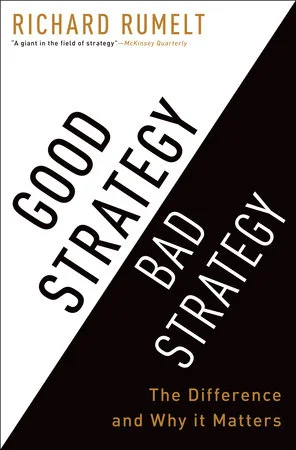
The central argument: a strategy answers a challenge, and most documents answer nothing
Rumelt's definition fits in one line: "A strategy is a way through a difficulty, an approach to overcoming an obstacle, a response to a challenge." 4 Ambition, leadership, vision, planning, and the logic of competition all attach themselves to the word, and the core of the work stays the same across all of them: find the critical factors in a situation, then design a way of coordinating and focusing action on them. 3
From that definition he builds what he calls the kernel: "a diagnosis, a guiding policy, and coherent action." 3 A diagnosis explains the nature of the challenge and identifies which aspects of a messy situation are critical. A guiding policy chooses an approach to the obstacles the diagnosis named. Coherent action carries that approach out through steps that reinforce one another. The order carries the discipline. Because everything downstream is judged against the diagnosis, a document that never makes one has nothing to evaluate, nothing to improve, and nothing to check against later events. 5
Bad strategy, in this book, is a condition with its own anatomy. Rumelt condensed its hallmarks to four: the failure to face the challenge, mistaking goals for strategy, bad strategic objectives, and fluff. 4
| The hallmark | How it shows up in a document you have seen | The question that exposes it |
|---|---|---|
| Failure to face the challenge | The first page states the destination; no obstacle is named anywhere. | What stands in our way, stated as a cause rather than a condition? 4 |
| Mistaking goals for strategy | Targets occupy the place where a plan belongs, with owners and dates attached to each number. | If the target were cut in half, would any action change? 3 |
| Bad strategic objectives | A dog's dinner of initiatives that coexist in one document, or an objective that restates the desired state. | Which of these would we kill to do the others properly? 6 |
| Fluff | Elevated language that sounds like thinking and commits to nothing. | Could a competitor paste this sentence into their own document unchanged? 4 |
Rumelt's own example of the first hallmark is a real corporate plan. International Harvester's strategic and financial planners produced a thick document in July 1979 that projected market-share growth in agricultural equipment from 16 percent to 20 percent while saying nothing about the company's inefficient plants or its position as the worst labor-relations case in American industry. Profits improved for a year or two through overhead cuts. Then a six-month strike began the collapse that ended with the agricultural-equipment business sold and the truck division renamed Navistar. 4
Why does the pattern survive every planning cycle? Because it accommodates everyone. Rumelt's description of the mechanism: bad strategy ignores the power of choice and focus, and instead tries to hold a multitude of conflicting demands and interests together. Goals language is the cement, since nobody objects to a target. 4 His image for it is a quarterback whose only advice to the team is "let's win." 4
Five frameworks that survive a close reading
Each of these carries a mechanism, the moment it applies, a definition of done, and the edge where it stops working.
1. Diagnosis: the part nearly everyone skips
A diagnosis defines the challenge and simplifies reality by naming which aspects of it are critical. 3 The useful version contains a causal claim: why this is hard, and why the previous attempts did not work. 5 An analogy or a known framework does much of the compressing work, which is why good diagnoses travel well in conversation. 6
Rumelt's sharpest warning here concerns a habit that looks like diagnosis and is its opposite. Underperformance is a result, so calling the challenge "underperformance" restates the goal. The real challenge is the set of reasons the organization ended up there, and a leader who offers a theory of those reasons has done the first piece of strategy work. 5
Use it when the first page of your document states a destination, or when the same problem has been through three remediation plans.
What completion looks like an explicit diagnosis that others can argue with, and a proposal you can reject because the diagnosis does not support it. Making the diagnosis explicit is what allows the rest of the strategy to be revised as circumstances change. 5
Boundary a diagnosis is a judgment, and a confident judgment from a senior person can turn into the most persuasive story in the room. The book supplies no method for testing one against alternatives, which leaves the hard part to the reader.
2. Guiding policy: the approach that rules things out
A guiding policy is the overall approach chosen to cope with the obstacles the diagnosis identified. Rumelt's own comparison for it is the guardrail: it directs and constrains movement without specifying the trip. 36
The book gives the guiding policy four jobs: anticipate how others will react, reduce the complexity and ambiguity in the situation, exploit the leverage that comes from concentrating effort, and keep the downstream actions coherent with one another. 5
The tests are easy to run and rarely run. A policy that any competitor could adopt unchanged is guiding nothing. 7 A policy that rules out no work is a description of a preference. Rumelt's own framing of the stakes: a guiding policy creates advantage partly by exploiting the leverage in concentrating effort on a pivotal aspect of the situation. 5
Use it when the diagnosis is agreed and the team is looking at three plausible directions, all of which currently have owners.
What completion looks like one named option is now off the table, one workstream has lost its funding or its people, and a colleague can state the approach in a sentence without reading the deck.
Boundary this is the thinnest part of an otherwise forceful book, and the critique comes from a fellow strategist rather than a rival. Roger Martin, who read the manuscript of Rumelt's later book, found the advice on developing guiding policies less actionable than he wanted: readers know they face a challenge and would have built a response if they knew how to think it through. 8 Martin also objects to the word "coherent" as a modifier for actions, on the ground that naming the quality does not tell anyone how to produce it. 8
3. Coherent action: the punch in the strategy
The third element is the one executives sign off and then delegate into oblivion. Rumelt's position is that actions are the strategy rather than its delivery mechanism. A good strategy includes a set of coherent actions, and they are not implementation details; they are the punch. 5 He hammers the point in the book's own definition: many people call the guiding policy the strategy and stop there, which is a mistake, because the kernel has to contain enough clarity about action to bring concepts down to earth. 5
Coherence has a precise meaning in the book, illustrated by Wal-Mart's combination of barcode systems, integrated logistics, frequent just-in-time deliveries, and large stores carrying low inventory. Each piece is shaped around the others, so the set behaves as one integrated design rather than as a list of good ideas. 5 He describes a good strategy as drawing power from focus, quite apart from drawing on existing strength: coherence itself creates strength. 5
Use it when your plan contains five initiatives that each make sense on their own, and you cannot say how any two of them help each other.
What completion looks like two of your current commitments reinforce each other in a way you can describe in one sentence, and something has been stopped or shrunk to make room for the guiding policy.
Boundary a tightly designed strategy is narrower, more fragile, and less able to absorb a surprise, which is a real cost for a well-resourced organization and a small price for one fighting for a foothold. 6 Coherence also runs directly into politics, and Rumelt says so in the book: a change in strategy will make some people worse off, so powerful forces will oppose almost any change in strategy. 5
4. Leverage and the proximate objective
Leverage is the concentration of effort on a pivot point, and it is the book's most transferable idea for someone with a small budget and a large mandate. A pivot point is an imbalance in a situation where a relatively small adjustment releases much larger pent-up forces; the leverage comes from insight into which point that is. 5
Rumelt adds a constraint that separates this from wishful thinking. Many systems have a threshold: below a critical level of effort they barely respond, so objectives have to match the resources actually available. 5 The paired tool is the proximate objective, one close enough at hand to be feasible, a target the organization can reasonably be expected to hit, even overwhelm. He goes further: the more uncertain and dynamic the situation, the more proximate the objective must be. 5
The reader needs the difference between a proximate objective and a small one. The 1961 commitment to land a person on the moon and return him safely before the decade ended was ambitious and, on Rumelt's account, proximate, because the science and technology sat within reach and the work was to focus and coordinate resources. 6 The book's opening case makes the same point with a fleet. At Trafalgar in 1805 Lord Nelson had twenty-seven ships against thirty-three, so he broke his line into two columns and drove them perpendicular through the enemy fleet, betting that the less-trained French and Spanish gunners could not compensate for the heavy swell. The French and Spanish lost twenty-two ships; the British lost none. 3
Use it when effort is spread across five fronts, every front is 60 percent done, and the quarterly review shows motion without movement.
What completion looks like one named pivot point, one objective inside this quarter, and one activity that has been stopped so the pivot point can be resourced properly.
Boundary a pivot point is a judgment about how a system will respond, which makes it a hypothesis rather than a finding. Concentration also starves whatever was previously funded, and that decision lands on someone's targets.
5. Inertia and entropy: why systems stay stuck, and then drift
The last pair of forces explains both why your organization is slow and how a smaller competitor can win. Inertia is an organization's unwillingness or inability to adapt to changing circumstances, and Rumelt treats it as a predictable resource that can be exploited: expect large incumbents to need years to alter how they work. Netflix moved past Blockbuster because Blockbuster would not abandon its retail stores. 6
Entropy runs the other way and takes no competitor to operate. Organizations become less organized and less focused over time, so a leader has to actively maintain purpose, form, and method even when nothing outside has changed. The book's example is General Motors, whose car lines began with distinct price points, models, and buyers and gradually overlapped until consumers could not tell them apart. 6
Chain-link logic supplies the diagnostic that goes with both. A system has chain-link logic when its performance is limited by its weakest subunit, and a chain does not get stronger by strengthening its other links. 5 Organizations in that condition are stuck, and getting unstuck becomes its own strategic problem. 6 The flip side is a designed chain that competitors cannot copy without rebuilding the whole thing, which is how a well-designed system produces an excellence that resists imitation. 6
Use it when your team's output is gated by one dependency, or a rival keeps failing at something your organization finds routine.
What completion looks like the weakest link is named, you can show that improving any other link would leave output unchanged, and a review with a date exists to check whether the focus has drifted.
Boundary chain-link reasoning holds only where the links really are dependent; in a modular system, improving one part can pay off on its own. The book hands you the diagnostic and leaves the measurement of link strength to you.
Six lines worth carrying into practice
Page numbers below follow the 2011 Crown Business first edition. 3
"Good strategy almost always looks this simple and obvious and does not take a thick deck of PowerPoint slides to explain."Pages 1–2: if the strategy needs forty slides to land, what is doing the explaining — the strategy, or the slides? 3
"Despite the roar of voices wanting to equate strategy with ambition, leadership, 'vision,' planning, or the economic logic of competition, strategy is none of these."Page 3: which of those five words is doing the work in your document? 3
"Good strategy requires leaders who are willing and able to say no to a wide variety of actions and interests. Strategy is at least as much about what an organization does not do as it is about what it does."Page 20: what did you say no to in the last quarter, and can you name the person who heard it? 3
"When organizations are unable to make new strategies — when people evade the work of choosing among different paths in the future — then you get vague mom-and-apple-pie goals everyone can agree on. Such goals are direct evidence of leadership's insufficient will or political power to make or enforce hard choices."Page 64: unanimous agreement on a strategy is a signal about the strategy. 3
"A strategy coordinates action to address a specific challenge. It is not defined by the pay grade of the person authorizing the action."Page 92: what is the specific challenge your team's strategy exists to address? 3
"A new strategy is, in the language of science, a hypothesis, and its implementation is an experiment."Page 241: what result would tell you the bet was wrong, and when will you look? 5
What Rumelt rebuilt in his own next book
Anyone treating the kernel as the last word should know that its author moved past it. The Crux: How Leaders Become Strategists came out from PublicAffairs in May 2022 at 368 pages. Its premise: leaders become effective strategists when they focus on challenges rather than goals, pinpoint the crux of the pivotal challenge — the aspect that is both surmountable and promises the greatest progress — and take decisive, coherent action to overcome it. The book also introduces a facilitated process he calls the Strategy Foundry for constructing a strategy with a leadership team. 9 It made the Financial Times and Globe and Mail best-business-book lists for 2022. 9
The shift is smaller than the new vocabulary suggests. Wikipedia's summary of his intellectual arc describes the 2011 book as redefining strategy as a form of problem solving, which is exactly what the 2022 book makes explicit. 2 Roger Martin's first-hand account of the manuscript lists the positions the later book argues: strategy is a form of problem solving, strategic planning produces plans rather than strategies, mission statements are largely unhelpful, and strategy is an ongoing practice rather than an episodic one. 8
For a reader in 2026 the practical question is which of the two frames their situation matches. The 2011 kernel is a test you apply to a document you already have. The 2022 crux is a method you run when you are starting from a tangle and have no document at all.
What practitioners kept, and what they had to adapt
Two published accounts from working product managers show how the kernel travels down from the executive suite, and where it chafes.
Jeff Zych, a product leader, wrote up his reading in 2018 and described the moment the book landed for him: every strategy he had seen was a list of unconnected objectives, and the idea of a strategy whose parts reinforce each other was new. 6 He also spotted the gap that the book leaves to the reader. Rumelt, he wrote, leaves the human problems of an unprovable strategy untouched: saying no to people, selling them your reading of reality, and holding the position open to revision. 6
Conor Dewey, a product manager, used the book to fill a gap in his own practice and pulled out the lines that did the work for him, including the kernel definition and the argument that a good strategy honestly acknowledges the challenge rather than urging everyone toward a goal. 5 His summary of the practical result: a strategy is a cohesive response to an important challenge, a coherent set of analyses, policies, and actions rather than a decision or a goal. 5
Zych's adaptation is the one to copy. In his reading, tech organizations routinely conflate OKRs with strategy: departments write objectives, break them into sub-objectives, and the result perpetuates silos because the goals were never built on a diagnosis. 6 His fix keeps the order intact: do the diagnosis and the guiding policy first, then set objectives against the coherent actions, and only then break them down for teams. 6
At the other end of the scale, the publisher's page for The Crux carries endorsements from named leaders describing the same two concepts at work. Dawn Farrell, chief executive of TransAlta from 2012 to 2021, describes turning away from empty goals and fictitious views of the future toward finding the crux of the issue. Robert P. Ashley Jr., director of the Defense Intelligence Agency from 2017 to 2020, describes applying the concept of the addressable strategic challenge. 9 Those are endorsements on a publisher's page rather than independent evaluations, and they show which parts of the method practitioners reach for first: the diagnosis, and the decision about which part of the problem to attack.
Where the book is weaker than its reputation
The evidence is a curated collection of cases. The middle of the book builds its argument through histories of companies that won, which carries a survivorship problem: winners get read backwards for the qualities that must have produced their success, and the firms that did the same things and failed never enter the sample. 7 Nelson at Trafalgar, Apple under Jobs, and Intel's exit from memory chips are all cases where the outcome was known before the lesson was drawn. The lessons are real; the proof comes from the author's own selection.
The causal claim goes untested. The kernel is checkable inside a single document, which is what makes it useful. The larger claim, that strategies with a kernel produce better outcomes than strategies without one, rests on the author's judgment across cases he selected. 7
The thin part is where the hard part lives. Roger Martin's assessment is worth quoting because it comes from someone who agrees with almost everything in the book: he found the advice on developing and determining guiding policies less actionable than he wanted, and judged the focus on coherence sound while objecting to the word itself as a tautology. 8 Readers who want the missing piece get it in his own Playing to Win with A.G. Lafley, which breaks the choice into where to play and how to win; Martin notes a decade later that Rumelt's The Crux had foreshadowed most of the themes, and that he had written about all of them before. 8
It names power as the precondition and then hands you none of it. Rumelt writes that vague goals are direct evidence of a leader's insufficient will or political power to make hard choices, and that a change in strategy will make some people worse off. 35 Having identified the fight, the book walks on. A middle manager reading the kernel has the analysis and lacks the authority, which is the whole difficulty in their case.
Deliberate diagnosis reads the past more cleanly than the future arrives. Henry Mintzberg's argument in The Fall and Rise of Strategic Planning is that strategy often forms in action, assembled from patterns that emerge rather than decreed in advance. 10 Rumelt's cases all read as deliberate in hindsight, which is what a retrospective does. The practical adjustment is modest: build the diagnosis, treat the resulting strategy as a hypothesis, and revise it on evidence, which the book's closing chapter already instructs.
The fit boundary, stated plainly. The kernel applies at any scale, and Rumelt says as much when he writes that a strategy is not defined by the authorizing pay grade. 3 The sources-of-power chapters, with their material on acquisitions, growth, isolating mechanisms, and industry dynamics, address people who control a firm's capital. A team manager can use the diagnosis, the guiding policy, the proximate objective, and the chain-link test, and needs to know that the chapters on growth and advantage belong to a different job.
Five Monday moves
1. Rewrite your strategy's first page as a diagnosis. Replace the goals with three paragraphs: the situation as it actually is, the obstacle in the path, and the reasons the obstacle exists. Circulate it before the next planning meeting and ask which part people disagree with. If nobody disputes a single line of the diagnosis, that diagnosis needs more work. 3
2. Run the displacement test on every priority. For each item on the list, ask which of the others it pushes back or removes. Park the items that displace nothing, and write down who was told. Rumelt's line about saying no is the whole exercise. 3
3. Pick one proximate objective for the quarter. Choose the target on the critical path that your current resources can plausibly hit, rather than the largest number in the plan. 5 Then find one activity to stop so the objective has real capacity behind it.
4. Test whether your team sits behind a chain link. Name the single weakest link in the chain that produces your output across functions, then check the counterfactual: would strengthening any other link change the output? Where the answer is no, spend the next month on the weak link alone. 5
5. Put the strategy on a hypothesis card. One page: the bet, the diagnosis behind it, the evidence that would tell you it is wrong, and the date you will look. Rumelt's own instruction is that implementation is the experiment, so diarise the review and treat the result as data. 5
Should you read it?
Read it if you own a document with the word strategy in the title and you suspect the document is a goals list. Read it too if you are being asked to produce a strategy for the first time and have no frame for what one contains.
Read the opening chapters and the chapter that gives the kernel, then the chapters called "Proximate Objectives" and "Chain-Link Systems," which carry the most usable material for someone below the executive suite. The middle chapters on growth, acquisitions, and advantage are written for people deploying capital. If two hours is all you have, read the free McKinsey article the book was adapted from, which carries the definition, the four hallmarks, and the International Harvester case in a dozen pages. 4
Two alternatives are worth knowing about before you commit. Playing to Win by A.G. Lafley and Roger Martin, published in 2013, supplies the layer this book leaves thin, in the form of cascading choices about where to play and how to win, and it remains the better book for a leader choosing a market. 8 The Crux, Rumelt's own 2022 follow-up, is the one to read if you are starting from a tangled problem with no document yet and need a method rather than a test. 9
The book's lasting gift is small and portable. Handed any plan, you can now ask the three questions in order: what is the diagnosis, what does the guiding policy rule out, and which actions reinforce each other? A document that survives all three is worth funding. A document that fails the first one has not started.
References
- 1
- 2Wikipedia, Richard Rumelt
en.wikipedia.org
- 3Wikiquote, Richard Rumelt
en.wikiquote.org
- 4
- 5Conor Dewey, "Notes on Good Strategy Bad Strategy", 2018
conordewey.com
- 6
- 7
- 8Roger Martin, "Good Strategy/Bad Strategy & Playing to Win", Medium, 2024
rogermartin.medium.com
- 9PublicAffairs, The Crux, Richard P. Rumelt
publicaffairsbooks.com
- 10
This story was produced automatically by a channel. One sentence is all it takes for Neodrop to keep producing for you.