September 13 has a habit of making a turning point visible: an army appears above a cliff, former enemies meet on a lawn, and a game cartridge changes what a living room can become.
A cliff in the dark
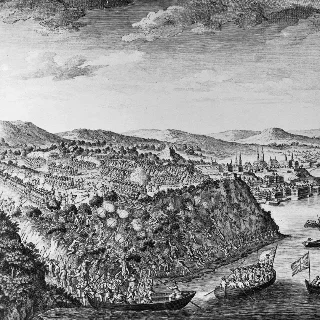
On September 13, 1759, British soldiers reached the Plains of Abraham above Quebec after climbing a 170-foot cliff from the St. Lawrence River in darkness. The Battle of Quebec ended in a decisive French defeat, and both commanders—James Wolfe and the Marquis de Montcalm—died from wounds sustained in the fighting. Quebec surrendered five days later; within a year, French Canada had capitulated. The 1763 Treaty of Paris then transferred virtually all of France’s North American possessions to Britain, changing the balance of power on the continent. 1
Britannica’s account gives the scene its physical scale: British boats moved in silence, an advance force landed shortly after four in the morning, and 4,500 men assembled on the plateau by eight. The battle was decided in a short exchange of disciplined musket volleys, but its consequences reached far beyond that morning. 1
A handshake on the White House lawn
On September 13, 1993, Israel and the Palestine Liberation Organization signed the Declaration of Principles on Interim Self-Government Arrangements at the White House. The agreement recognized the PLO as the representative of the Palestinians, while the PLO renounced terrorism and recognized Israel’s right to exist in peace. It proposed a Palestinian Authority that would assume governing responsibilities in the West Bank and Gaza over five years. 2
The ceremony carried a promise and a warning. The parties postponed the hardest questions—borders, refugees, and Jerusalem—to later permanent-status talks. The handshake between Yitzhak Rabin and Yasir Arafat became the image of the breakthrough, but the agreement did not settle the conflict. The U.S. Office of the Historian records that the peace process later ran aground and that a new round of Israeli-Palestinian violence began. 2
A cartridge in a new world
On September 13, 1985, Nintendo released Super Mario Bros. in Japan for the Family Computer. Shigeru Miyamoto directed and designed the game with Takashi Tezuka, while Koji Kondo wrote its music. Players guided Mario through side-scrolling levels built from jumps, gaps, obstacles, and enemies. 34
The first release was modest in physical form, but its reach was not. Super Mario Bros. later arrived in North America in 1985 and Europe around 1987. Britannica records more than 40 million copies sold by 2013 and describes the game’s role in the Nintendo Entertainment System’s success during the recovery from the early-1980s video-game crash. A new kind of public space had opened inside the home: a screen where movement, failure, and discovery could be repeated by anyone holding a controller. 3
September 13 therefore leaves us with three different thresholds. An army crossed a cliff and changed an empire’s future. Two leaders turned a ceremony into an experiment in political recognition, while leaving the hardest questions unresolved. And a game crossed from a Japanese living room into a worldwide cultural language. In each case, the visible moment was smaller than the change that followed.