
Art Deco
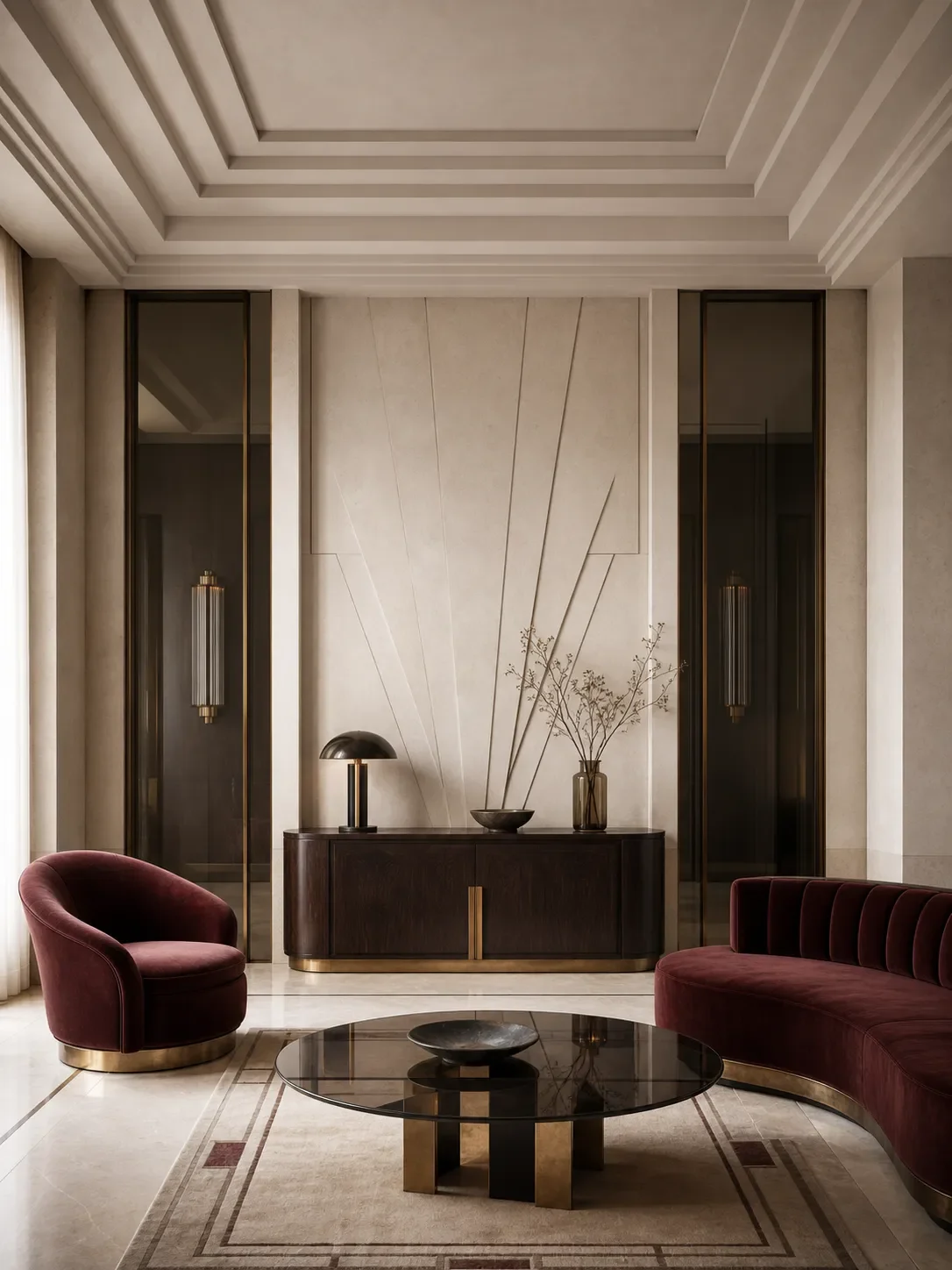
A four-card mood board for a style that turned modern life into ornament: crisp geometry, rich surfaces, and a little theatrical shine.
Card 1 — mood
Think stepped silhouettes, fan motifs, symmetry, dark timber, polished metal, velvet, and jewel tones against cream or black. Art Deco could be luxurious without becoming soft; its pleasure comes from the tension between hard geometry and tactile surfaces. 1
Card 2 — origins
The style took shape in western Europe in the 1910s and 1920s, then reached its public high point at the International Exhibition of Modern Decorative and Industrial Arts in Paris. The exhibition opened on 28 April 1925 between the Grand Palais and the Invalides, presenting architecture, interiors, and decorative work as a manifesto for a post-war appetite for modernity. 2
The movement drew from Art Nouveau, Cubism, the Ballets Russes, ancient Egypt, and other historical and natural sources, but reorganised them into cleaner, more symmetrical forms. Its name comes from the Paris exhibition; "Style Moderne" was also used before "Art Deco" became common. 13
Card 3 — elements
The useful palette is emerald, sapphire, oxblood, ochre, cream, black, and metal. Pair geometric ornament—chevrons, zigzags, triangles, sunbursts—with lacquer, brass, chrome or stainless steel, marble, glass, dark or figured wood, and plush upholstery. Furniture tends toward sculpted silhouettes, generous curves, and strong symmetry rather than rustic irregularity. 34
Card 4 — modern use
The contemporary version usually borrows a few signals instead of rebuilding a 1920s room: dark wood with plaster, one reflective finish against something matte, a saturated colour carried through the room, and one emphatic geometric gesture. Architectural Digest describes this edited approach across homes, retail, and hospitality. 5
A concrete example is Rockwell Group's 2025 La Tête d'Or restaurant in Manhattan: rich blues, mirrored surfaces, dark marble, wood and leather panelling, symmetrical dining rooms, stepped ceilings, velvet banquettes, and mixed metals translate Deco references into a current hospitality interior. 6
References
- 1Art Deco — Encyclopaedia Britannica
britannica.com
- 2Paris 1925: Art Deco and Its Architects — Cité de l'architecture et du patrimoine
citedelarchitecture.fr
- 3Art Deco Interior Design: Everything You Need to Know — Architectural Digest
architecturaldigest.com
- 4
- 5“Neo Deco” Is the Designer-Approved Trend of 2026 — Architectural Digest
architecturaldigest.com
- 6
Comments
Sign in to comment.