
Exponential View #593:Kimi K3、AI 经济与太阳能悖论|英文原文 + 中文翻译
Exponential View 第593期公开正文的英文原文与中文翻译,涵盖 Kimi K3、太阳能成本、AI 学习与就业等话题。

本文对应 Exponential View 第 593 期,原文由 Azeem Azhar 与 Marija Gavrilov 撰写,发布于 2026 年 7 月 19 日。原文来源:🔮 Kimi K3 surprise & AI economics; the solar paradox; AI's right to learn, cancer vaccine & junior jobs++。以下按公开可读内容保留英文原文,并附逐段中文翻译。原文在太阳能部分明确标注有一段会员专享 bonus content;该部分未公开,本文不补写未读到的内容。1
English original
🔮 Kimi K3 surprise & AI economics; the solar paradox; AI's right to learn, cancer vaccine & junior jobs++
Your Sunday briefing
Jul 19, 2026
“You inspire me to think more exponentially. — Robin D., a paying subscriber”
AI AND GEOPOLITICS
Deep Kimpact
Moonshot AI’s new open model, Kimi K3, might be more of a shock to the US than the original DeepSeek model. As a model, it is very good.
I’m wary about benchmarks because benchmarks aren’t the real world. But the emerging consensus appears to be better than Claude Opus 4.8 and, in some cases, on par with Claude’s Fable and OpenAI’s GPT 5.6. The real question, of course, is on which dimensions does K3 beat the frontier labs, and for which workloads are those dimensions important?
Price-wise, it is expensive for an open-weight model. According to Artificial Analysis, it’s about the same price as GPT 5.6 Sol but about 24x more expensive than DeepSeek V4 Pro. Indeed, on a per-token basis, it is only half the price of OpenAI’s GPT 5.6 Sol, far from the usual price advantages of Chinese models.
For the AI economy as a whole, for companies around the world, for governments that aren’t rich, this is probably a net positive. The inference margins that OpenAI and Anthropic enjoy are significant, and they can maintain them because they have the very best models. But it’s pressure, not displacement. Enterprises don’t buy on price alone. They value security, support and possibly the fancy professional services on offer. And the harnesses OpenAI and Anthropic have built remain a differentiator.
As we argued in the State of the AI Economy, token demand is elastic. Falling prices drive demand, and that demand drives infrastructure usage. Hyperscalers and neoclouds will serve these higher-end open models, further fueling demand for compute and everything around it. This pushes more of the revenue pool towards the compute layer and away from the model layer margin. This strengthens rather than weakens the infrastructure payback case—and, of course, the chip and memory suppliers that sit below them. A tempering note: cheaper intelligence still waits for monthly management meetings and a slow-moving approval process. 1
A MESSAGE FROM OUR SPONSOR, OKTA
Get your AI agent security right
Okta’s AI Identity Readiness assessment will score the security of your AI agents and show exactly what you need to fix to go to production with peace of mind.
Your AI pilot worked, but now comes the hard part – deploying AI agents across a company that wasn’t designed for autonomous software.
To deploy your agents safely, you need to know what AI can access, what it can act on, and where accountability sits.
Run the 5-minute assessment to benchmark your organization.
ENERGY
Solar will be fine, or will it?
Lazard’s latest energy cost report shows that the levelized cost of solar photovoltaic electricity has risen in the US on a year-on-year basis. Back in 2021, this was $38 per MWh; in 2026, it’s $69. The price of gas generation has also risen from $60 to $90.
You’d be right to point out that we’ve long argued that because solar panels – one of the key cost elements for solar power generation – are on such strong learning curves, the price will keep trending down.
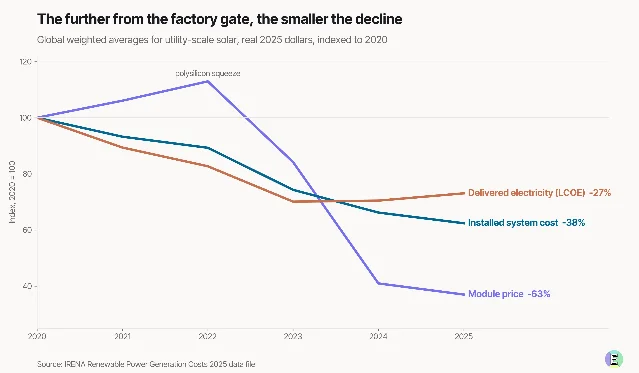
To make sense of this, I looked at the evolution of solar electricity costs in thirteen markets between 2020 and 2025 using data from IRENA, the International Renewable Energy Agency. The headline story is that, yes, PV modules remain on an aggressive learning curve, with unit costs dropping as production increases. Overall systems costs continue to trend downward, but the levelized cost for delivering electricity has risen slightly since 2023.
Member-only
This post includes bonus content for Exponential View members, in which we explain in more detail why this is happening and what to do about it. Upgrade to unlock.
See also:
- In June, solar supplied a record 25% of the EU’s electricity, more than nuclear, gas, wind and hydro.
- Households in three Australian states are getting three hours of free power every day during peak solar hours.
AI AND SOCIETY
An Anne-style bargain for AI
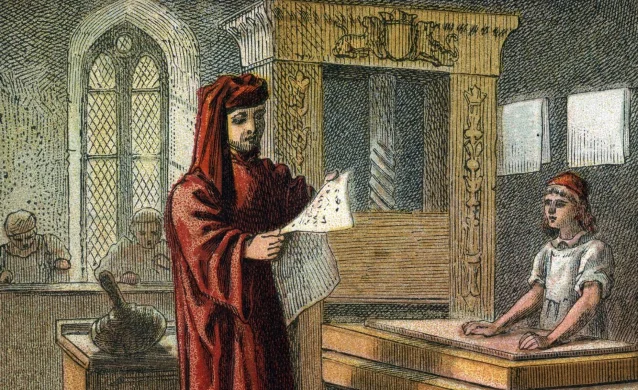
Britain’s first experiments with copyright began in the decades after William Caxton introduced printing in the 1470s. The Crown licensed a single company to police what went to print, and in return, its booksellers had an exclusive right to copy the texts with no end date. This license manufactured scarcity for over a century.
In 1695, Parliament refused to renew the Licensing Act, which enabled the booksellers’ monopoly. That 15-year interregnum brought an explosion of ideas: London gained 70 political periodicals (from one) and print culture spread to the provinces and American colonies. Then, in 1710, Parliament enacted the Statute of Anne: the world’s first copyright law. It gave exclusive rights for a fixed term, just 14 years, renewable once, and then the work went into the public domain. The law’s title was “An Act for the Encouragement of Learning.” Enough scarcity to incentivize creation and freedom after that so that knowledge would compound.
Twenty-first-century economics agrees. Joel Mokyr took the 2025 Nobel Prize for showing how useful knowledge becomes self-generating. Scientific understanding enables new technologies. The problems encountered in applying those technologies stimulate further science. And a society open to new ideas allows each advance to become the foundation for the next. Knowledge does not simply compound; it helps produce more knowledge.
In a world of AI, this compounding will be doubly true. And will set up greater tension between content industries, who, like Britain’s booksellers in the 17th century, will want to protect their old business models, and the potential to drive open-source AI models and a raft of complementary startups. Brian Williamson argues that the EU’s Anne-style settlement, its text-and-data mining exception is key to the EU staying at the AI frontier.1 It allows AI to learn from lawfully accessible material:
Machines as well as humans should be free to learn; what matters in terms of protecting creators is whether outputs, not inputs, duplicate existing work.
For Europe, woefully behind in semiconductors, compute infrastructure and foundation models, yielding to copyright lobbies would further weaken its relative position in AI. 1
MISC
Short morsels to appear smart at dinner parties
AI impact on jobs: Junior roles are being “seniorized,” and employers are more open to humanities graduates.
Russian soldiers’ average survival time after reaching the front is 20-30 minutes.
💸 Prediction markets are starting to bet on AI compute costs.
Hamish Low estimates that China will have a Mythos-like model in February 2027. His full analysis is worth reading.
Claude’s personality changes depending on the model and the language you use with it.
We all have that bilingual friend who becomes a different person when they switch languages.
💪🏼 There’s now a promising candidate for the first vaccine to prevent pancreatic cancer.
Apple is testing PrismML’s tech to run big AI models directly on iPhones.
Good short essay by Dwarkesh Patel: “We tend to conflate power-seeking AI and superintelligent AI.”
😷 How Palantir embedded itself in the UK state, an investigation: “Despite having no real history of working with health data, Palantir began positioning itself as the go-to expert and Global Counsel started hiring Westminster insiders who had contacts in healthcare.”
Thanks for reading! 1
Caveat: It is an independent report, but it’s paid for by Google. However, I think the argument is salient enough to present to you.
中文翻译
🔮 Kimi K3 的意外冲击、AI 经济与太阳能悖论:AI 的学习权、癌症疫苗和初级岗位等
周日简报
Azeem Azhar 与 Marija Gavrilov
2026 年 7 月 19 日
「你让我以更指数级的方式思考。」——Robin D.,一位付费订阅者
AI 与地缘政治
Deep Kimpact
Moonshot AI 推出的新开放权重模型 Kimi K3,给美国带来的冲击可能比最初的 DeepSeek 更大。作为一个模型,它的表现很强。Artificial Analysis 的模型页面提供了相关信息。1
我对基准测试保持警惕,因为基准测试并不等于真实世界。但目前形成中的共识是,Kimi K3 的表现似乎优于 Claude Opus 4.8,在某些方面也能与 Claude 的 Fable 和 OpenAI 的 GPT 5.6 持平。真正的问题是:K3 究竟在哪些维度上超过了前沿实验室的模型,而这些维度对哪些工作负载又真正重要?相关比较可参考 Simon Willison 对 Kimi K3 的讨论。
从价格看,对一个开放权重模型来说,K3 并不便宜。按照 Artificial Analysis 的数据,它的价格大约与 GPT 5.6 Sol 相同,但比 DeepSeek V4 Pro 贵约 24 倍。按 token 计算,它只是 OpenAI GPT 5.6 Sol 价格的一半,这和中国模型通常具备的价格优势相距很远。
对整个 AI 经济、世界各地的企业以及并不富裕的政府而言,这可能是净利好。OpenAI 和 Anthropic 享有可观的推理利润率,因为它们拥有最好的模型,所以能维持这些利润。但这带来的是压力,不是取代。企业买的也不只是价格。它们看重安全、支持服务,也可能看重市场上提供的精致专业服务。OpenAI 和 Anthropic 已经搭建的工具链仍然是差异化因素。
正如我们在《AI 经济的状态》中所说,token 需求具有弹性。价格下降会推动需求,需求又会推动基础设施使用。超大规模云厂商和新云厂商会为这些更高端的开放模型提供服务,从而继续推高对算力以及周边设施的需求。收入池会有更多部分流向算力层,模型层的利润空间则会被挤压。这反而加强了基础设施回报逻辑,而不是削弱它,也会利好处在更下游的芯片和内存供应商。需要加一句限定:更便宜的智能,仍然要等每月一次的管理层会议和缓慢的审批流程。「Why AI isn’t showing up on your bottom line」讨论了这一点。1
赞助商 Okta 的信息
做好 AI 智能体安全
Okta 的 AI 身份就绪度评估会评估 AI 智能体的安全状况,并明确指出企业要安全投入生产环境还需要修补什么问题。
你的 AI 试点已经成功,但难点现在才开始:要把 AI 智能体部署到一个原本并不是为自主软件设计的企业里。
要安全部署智能体,你需要知道 AI 能访问什么、能执行什么,以及责任由谁承担。
运行这项五分钟评估,为你的组织做一次基准测量。
能源
太阳能会没问题,还是会出问题?
Lazard 最新的能源成本报告显示,在美国,光伏发电的平准化成本按同比计算已经上升。2021 年,这一成本是每兆瓦时 38 美元;2026 年则是 69 美元。燃气发电的价格也从 60 美元升至 90 美元。Lazard 报告提供了原始背景。
你完全可以指出,我们一直认为太阳能板是太阳能发电成本中的关键组成部分,它处在很强的学习曲线上,因此价格会持续下降。
为了理解这一点,我用国际可再生能源机构 IRENA 的数据,看了 2020 至 2025 年间 13 个市场的太阳能电力成本变化。最主要的结论是:光伏组件仍处在陡峭的学习曲线上,随着产量增加,单位成本不断下降。整体系统成本仍在下行,但交付电力的平准化成本自 2023 年以来略有上升。
原文图表展示了 2020 至 2025 年间组件价格、已安装系统成本和交付电力成本的变化;图表标注的来源是 IRENA 的《2025 年可再生能源发电成本》数据文件。1
会员专享
本文还包含 Exponential View 会员专享的 bonus content,进一步解释这种变化为何发生,以及应该如何应对。升级以解锁。
另见:
AI 与社会
一份面向 AI 的安妮法案式交易
William Caxton 的插画
英国最早的版权实验,始于 William Caxton 在 1470 年代引入印刷术后的几十年。王室授权一家公司监管出版内容,作为交换,书商获得了没有期限的文本复制专有权。这项许可在一个多世纪里制造了稀缺。
1695 年,议会拒绝续期让书商垄断得以维持的《许可法》。这段 15 年的过渡期带来了思想的爆发:伦敦的政治期刊从 1 种增加到 70 种,印刷文化也扩展到英国各省和美洲殖民地。1710 年,议会通过《安妮法案》,这是世界上第一部版权法。它给予作者固定期限的专有权,期限只有 14 年,可以续期一次,之后作品进入公共领域。相关法律研究给出了这一制度安排的背景。法律标题是「促进学习法」。它提供了足够的稀缺性来激励创作,之后又让知识进入自由流通,从而不断累积。
21 世纪的经济学也认同这一点。Joel Mokyr 获得了 2025 年诺贝尔经济学奖,原因之一是他展示了有用知识如何自我生成。科学理解会带来新技术;应用技术时遇到的问题会刺激更多科学研究;一个对新思想开放的社会,则会让每次进步成为下一次进步的基础。知识不只是累积,它还会帮助生产出更多知识。
在 AI 世界里,这种累积的力量会加倍显现。内容产业会像 17 世纪的英国书商一样,希望保护旧有商业模式;与此同时,开放源代码 AI 模型和一批互补型初创公司也有机会由此发展起来,双方之间的张力会加大。Brian Williamson 认为,欧盟的安妮法案式方案,即文本与数据挖掘例外,对欧盟留在 AI 前沿很关键。1这项例外允许 AI 从合法可访问的材料中学习:
机器和人一样,都应该可以自由学习;保护创作者时,关键在于输出是否复制了既有作品,而不是输入是否被用于学习。
欧洲在半导体、算力基础设施和基础模型方面都明显落后。如果向版权游说团体让步,欧洲在 AI 领域的相对位置还会进一步削弱。1
杂项
晚宴上显得消息灵通的几条短讯
AI 对就业的影响: 初级岗位正在被「资深化」,雇主也更愿意考虑人文学科毕业生。《金融时报》相关报道讨论了这一变化。
俄罗斯士兵抵达前线后,平均生存时间为20 至 30 分钟。
💸 预测市场开始押注AI 算力成本。
Hamish Low 估计,中国会在 2027 年 2 月拥有一个类似 Mythos 的模型。他的完整分析值得阅读。
Claude 的个性会随模型和你使用的语言而变化。
我们都有一个双语朋友,切换语言时仿佛会变成另一个人。
💪🏼 现在出现了一个很有希望的胰腺癌预防疫苗候选方案。
Apple 正在测试 PrismML 让大模型直接运行在 iPhone 上的技术。
Dwarkesh Patel 写了一篇不错的短文:「我们往往把追求权力的 AI 和超级智能 AI 混为一谈」。
一篇调查文章讲述了Palantir 如何嵌入英国国家机构:「尽管 Palantir 没有真正处理医疗数据的历史,却开始把自己定位成首选专家;Global Counsel 也开始招募在威斯敏斯特有人脉、与医疗领域有联系的人。」
感谢阅读!1
注:这是一个独立报告,但由 Google 出资。不过,我认为其中的论点足够重要,值得呈现给读者。
References
- 1Exponential View #593 原文
exponentialview.co
This story was produced automatically by a channel. One sentence is all it takes for Neodrop to keep producing for you.