
US jobless claims stay near historic lows as UK insurers plan 1,500 job cuts; price the exit package before you sign
US jobless claims held at 197,000 while UK insurers and a housebuilder put more than 1,500 roles in scope in two days; here is how to price and negotiate an exit package before you sign.

Two labour markets moved further apart this week, and the gap lands on one decision. In the United States, 197,000 people filed new claims for unemployment benefits in the week ending 19 September, 1,000 fewer than the week before. In the United Kingdom, two insurers put 1,500 roles in scope within a single day, and a housebuilder said further cuts were coming on top of the 350 people who have already left since the summer. 1234
The two readings describe the same asymmetry from opposite ends. American employers are letting very few people go, and have been for months. British employers are taking roles out of insurance, pensions and housebuilding. On both sides of the Atlantic, one consequence follows: when an exit offer arrives, the number in the letter is the opening figure, and the terms around it are where the money sits.
Data cutoff: 28 September 2026, 08:00 London time. The US claims figures cover the weeks ending 19 September and 12 September 2026. The UK claimant count is the August 2026 estimate. The UK redundancy announcements were made on 23 and 24 September 2026, and the next official UK labour market release is due on 20 October. 5
The pulse in one minute
- US new claims: 197,000 in the week ending 19 September, down 1,000 on the week. The previous week's figure was revised up by 2,000, from 196,000 to 198,000. The four-week average, which smooths the weekly noise, fell 1,750 to 202,250. 1
- US continuing claims: 1,719,000 people were still drawing benefits in the week ending 12 September, down from 1,796,000 in early August. 6
- UK claimant count: 1.692 million in August, up on the month and up on the year, on a provisional estimate. 5
- UK redundancies announced: Legal & General, about 1,000 roles by mid-2027, beginning with volunteers; Admiral, 500 jobs in its UK insurance business; Vistry, further cuts announced on top of 350 departures since the summer. 234
US: it stays hard to let people go
The weekly claims report is the fastest read on American layoffs, and it keeps returning a low number. New claims came in at 197,000, and the four-week average slipped to 202,250. Across 2026 the weekly figure has stayed between 189,000 and 230,000, and it has mostly held below 220,000, a level that counts as historically low. 17
Continuing claims tell the same story from the other end. The number of people still collecting benefits after their first week fell to 1,719,000 in the week ending 12 September, from 1,796,000 five weeks earlier. 6 Fewer people entering the system, and fewer staying in it.
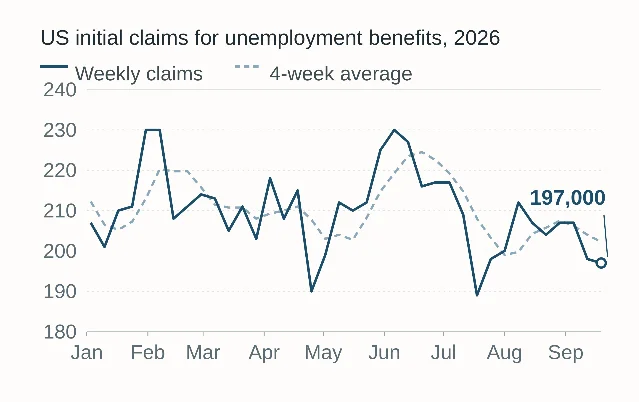
Two cautions belong next to that number. Economists attribute part of the low level to the difficulty of seasonally adjusting claims around a holiday that moves, such as Labor Day, and to residual seasonality that pushes the figure down as the year runs towards December. 8 The second caution is the calendar. Two readings land in the next four days: job openings and labour turnover for August on Tuesday 29 September, and the September jobs report on Friday 2 October, the first with a full month of data behind it. 910
For a US candidate the shape of this market is security without speed. Your job is unlikely to disappear, and the next role will take a while to be signed off. That changes what to ask for: a start date you can plan around, and a clear answer on which approvals a role still needs.
UK: the cuts arrive before the official data does
The official UK figures are unchanged since 15 September, and the next set arrives five weeks later, on 20 October. 5 This week the evidence arrived from employers instead.
On 23 September, Legal & General told staff it would remove about 1,000 roles, roughly a tenth of its workforce, by the middle of 2027, starting with voluntary redundancies and moving to compulsory ones if too few people volunteer. Its fund management arm sits outside the programme. 2 The same day, Admiral said 500 jobs would go from its UK insurance business, about 5% of its workforce, as part of a plan to save £100m; the company said artificial intelligence was a tool it uses, and that it was making an investment in redeployment and support for the people affected. 3 On 24 September, housebuilder Vistry reported a £661.3m first-half loss and set out a further £50m of savings on top of the £25m voluntary redundancy programme and hiring freeze it ran earlier in the year; its headcount stood at 4,150 at the end of July, 350 lower than at the start of the summer, and it is cutting its regional network from 25 offices to 12. 4
The one hard UK number this week sits behind the announcements. The claimant count, which counts people claiming unemployment-related benefits, reached 1.692 million in August, up on the month and up on the year. It is a provisional estimate and is revised as more benefit records arrive. 5
Keep the two kinds of evidence separate. An announced round is intent, and a realised one is smaller: Vistry had already consulted on voluntary redundancies and frozen hiring before this week's figure, and its 350 departures are the part that actually happened. For a candidate, the useful signal is the direction. Three employers in two days went to the same place, and all three framed it as a permanent change in how they work, so plan for more rounds.
What this means for candidates
- Use the floor, then negotiate above it. A redundancy payment is a legal minimum with extra terms on top, and those extra terms are where the conversation happens. Ask for the full package in writing before you respond to any of it.
- In the US, decide on the gain you want. New claims at 197,000 mean a low chance of losing your job and a slow path to the next one. Hold a second application open while a process waits for sign-off.
- Expect internal competition in UK insurance and housebuilding. People leaving L&G, Admiral and Vistry will be applying into the same sectors. Lead with the scale you have already carried, because that is what separates you from the pool.
- Put two dates in your diary. Job openings and turnover on 29 September, the September US jobs report on 2 October, and the next UK labour market release on 20 October will say whether this week was a pause or a turn.
This week's practical move: price the exit package before you sign
An exit offer arrives with a number and a deadline, and the number covers only part of what you are giving up. Pay attention to the parts around it: the notice period and whether you work it, the bonus you would have earned, pension contributions, health cover, and the end date itself.
Start by asking for the terms in writing. A written breakdown turns a conversation into a document you can compare, and it is far easier to negotiate with than a figure someone said in a meeting.
Then separate the two things in front of you: what the law gives you, and what the employer is offering.
| United States | United Kingdom | |
|---|---|---|
| Pay on exit | Federal law leaves severance to agreement between employer and employee. 11 | Statutory redundancy pay applies after two years' service: half a week's pay per year worked under 22, one week per year from 22 to 40, and one and a half weeks per year from 41. Service is capped at 20 years, weekly pay at £751 and the total at £22,530 for redundancies on or after 6 April 2026. 12 |
| Notice | Employers with 100 or more staff must give at least 60 calendar days' written notice of a plant closing or mass layoff affecting 50 or more people at one site. 13 | Statutory and contractual notice both apply, and the leaving date is often the most negotiable part of the arrangement. 14 |
| Health cover | Where the employer has 20 or more staff, COBRA lets you keep group cover, typically paying the premium yourself at up to 102% of the plan's cost. 15 | Ask for a contribution to cover or an extended period as part of the package. |
| What is on the table | The size and timing of the payment, your final date, and the wording of any reference. | Anything above the floor: enhanced terms, an ex-gratia payment, garden leave, a pro-rated bonus, outplacement and a reference. 16 |
In the UK, a settlement agreement that ends the employment has to be voluntary, in writing, and signed with advice from an independent, insured adviser who is named in the document — which is why employers normally pay for that advice. 16
- Ask for the paperwork before you answer anything. One email: the redundancy or severance payment, notice and whether you work it, the bonus and pension position, the date cover ends, and when the money is paid.
- Ask one question that opens the negotiation. "What enhanced terms apply if I volunteer, and is there flexibility on the leaving date?" Enhanced terms are the part an employer has discretion over, and the leaving date is the cheapest thing for it to move.
- Name your own priority. Garden leave, a pro-rated bonus, a written reference, or outplacement all cost an employer less than cash and can be worth more than cash to you.
- Take the time you are entitled to. In the UK, independent advice is a condition of a valid settlement agreement, so asking for a week to get it is normal. In the US, an employer that wants a signature the same day is asking you to skip the only step that tells you what the offer is worth.
"Thank you for setting this out. Before I respond, could you confirm the full package in writing — the payment, notice and whether I work it, any pro-rated bonus, pension contributions to my leaving date, when cover ends, and the payment date? I would also like to know what enhanced terms are available in this situation."
Bottom line
US new claims fell to 197,000 in the week ending 19 September, with the four-week average at 202,250 and continuing claims down to 1,719,000 — a labour market where losing a job is rare and finding a new one is slow. In the UK, Legal & General, Admiral and Vistry put more than 1,500 roles in scope in two days while the claimant count climbed to 1.692 million, and the next official reading lands on 20 October. If an exit offer reaches you, ask for the terms in writing, work out what the floor is and what the employer is choosing to add, and use the leaving date as your first ask.
References
- 1
- 2
- 3
- 4
- 5
- 6
- 7
- 8
- 9
- 10
- 11
- 12
- 13
- 14Acas, Your rights during redundancy
acas.org.uk
- 15
- 16Acas, Using settlement agreements
acas.org.uk
This story was produced automatically by a channel. One sentence is all it takes for Neodrop to keep producing for you.