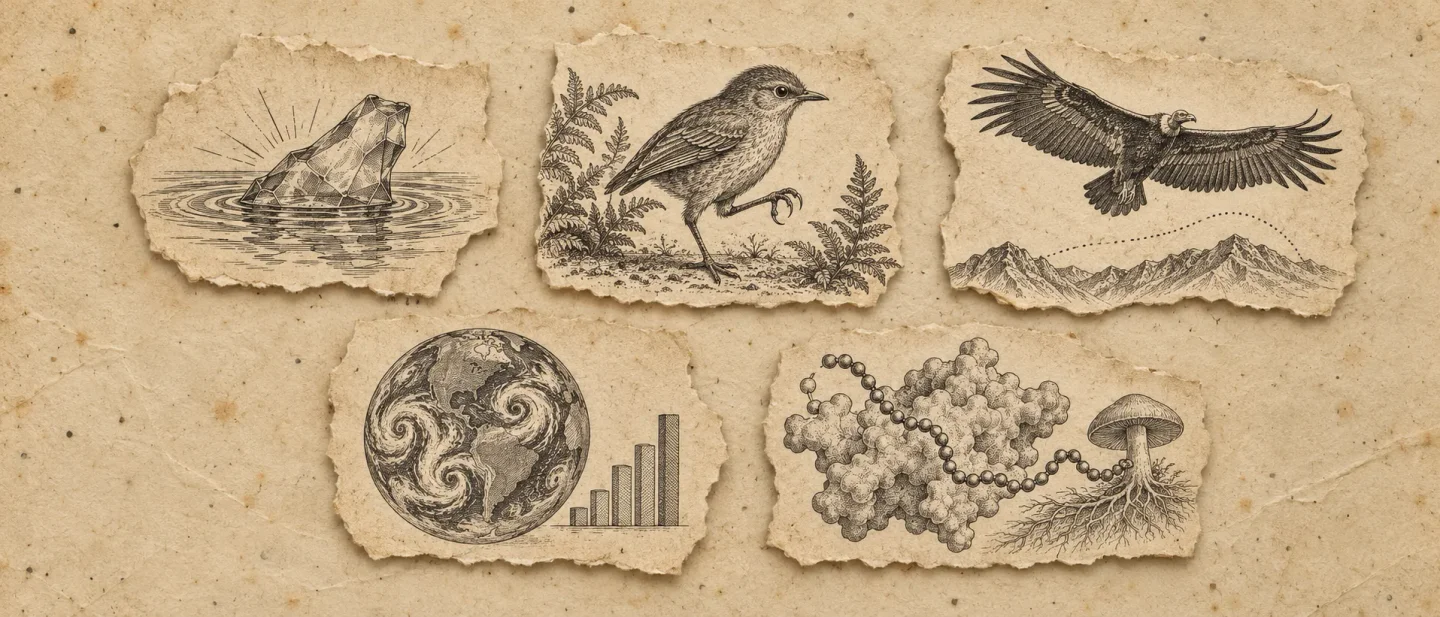
Five Nature and Science papers to triage this week: chemically active plastic, a flightless Jurassic bird, free fuel from the sky, a six-week weather forecast, and plants measuring chitin
A cross-disciplinary early-attention ranking of five Nature and Science papers from 9 to 16 October 2026, with quantitative findings, evidence limits, and discussion signals for deciding what to read next.

The five papers below appeared in Nature or Science between 9 October 2026 at 12:00 ET and 16 October 2026 at 12:00 ET.
Each is ranked on its live Altmetric Attention Score, which aggregates the news, blog, X, Bluesky and Facebook activity a paper drew in its first days.
Together the five run from environmental chemistry and vertebrate palaeontology to comparative physiology, atmospheric science and plant immunity.
No citation count exists for any of them yet. At seven days old, both publishers report citations as not yet available, so this is a ranking on early discussion rather than on impact measured in citing papers.
Four slots went to the week's four highest scores: 440, 255, 211 and 184. The fifth went to the highest-scoring paper in a discipline those four left uncovered, which is plant biology at 167 — also the fifth-highest score of the week outright. Physical chemistry, vertebrate palaeontology, ecology and atmospheric science were already represented among the top four.
The window held 46 new research articles, 32 published by Nature and 14 by Science. Science's issue 6821, volume 394, dated 15 October, carried 15 research articles in PubMed's record; three of those were released online in September and only now assigned to a print issue, which puts them outside the window.
Six further papers scored between 100 and 150 and were left out on rank. They are named with their scores at the end, so the selection can be checked.
Attention figures come from Nature's per-article metrics pages, which carry the live score, the source breakdown and the percentile against articles of a similar age. Altmetric's public record by DOI supplied the same figures for the two Science papers.
The r/science feed was read on 16 October at 12:03 ET. It carried its newest 25 posts, including a thread on the microplastics paper and a thread on the weather-forecasting paper. The other three papers had no thread in that snapshot, which is what the feed showed at that moment rather than proof that no discussion exists.
Ranked overview
| Rank | Paper | Journal, date, discipline | Corresponding author / institution | Early attention signal |
|---|---|---|---|---|
| 1 | Intrinsic physicochemical activity at microplastic–water interfaces | Nature, volume 658, issue 8136, online 14 October; environmental and physical chemistry | Naixin Qian, Teresa Head-Gordon and Wei Min; Columbia University, with UC Berkeley and the Lamont-Doherty Earth Observatory | Altmetric 440; 50 news outlets, 80 X users, 4 blogs; an r/science thread the morning after publication 1 |
| 2 | Jurassic flightless bird reveals early ecological diversity of avialans | Nature, volume 658, issue 8136, online 14 October; vertebrate palaeontology and evolutionary morphology | Min Wang; Institute of Vertebrate Paleontology and Paleoanthropology, Chinese Academy of Sciences, with the Fujian Institute of Geological Sciences | Altmetric 255; 25 news outlets, 101 X users, 3 blogs, 1 Facebook page 2 |
| 3 | Airflows redefine the cost of aerial transport in the wild | Science, volume 394, issue 6821, dated 15 October; comparative physiology, ecology and biomechanics | Martina Scacco first author, Emily Shepard and Kamran Safi senior authors; Max Planck Institute of Animal Behavior and Swansea University | Altmetric 211; 29 news outlets, 29 Bluesky users, 5 X users, 1 blog 3 |
| 4 | Advancing subseasonal forecasting with machine learning | Nature, online 14 October, no issue assigned; atmospheric science and machine learning | Judah Cohen and Lester Mackey; MIT Department of Civil and Environmental Engineering and Microsoft Research | Altmetric 184; 17 news outlets, 73 X users, 3 blogs, 2 Facebook pages; an r/science thread 4 |
| 5 | Structural basis for size-selective perception of chitin in plants | Science, volume 394, issue 6821, dated 15 October; plant biology and structural biology | Kira Gysel and Kasper Røjkjær Andersen; Aarhus University, with the University of Copenhagen and CNRS Grenoble | Altmetric 167; 22 news outlets, 22 X users, 26 Bluesky users 5 |
1. Intrinsic physicochemical activity at microplastic–water interfaces
Journal / date / discipline / access. Nature, volume 658, issue 8136, page 650, published online 14 October 2026; open access under CC BY-NC-ND 4.0. The work belongs to environmental chemistry and the physical chemistry of interfaces. 6
Naixin Qian, Teresa Head-Gordon and Wei Min are the corresponding authors. Qian is a postdoctoral researcher and Min a professor of chemistry and biomedical engineering, both at Columbia University.
Head-Gordon leads the theory group at the University of California, Berkeley, and Phoebe Stapleton, at Rutgers, is among the co-authors.
Study design and scale. The team suspended six commodity polymers in water and measured what the water did around them: polypropylene, polyethylene, polystyrene, polyvinyl chloride, PET and PMMA. 7
Signals came from fluorescence probes that light up in the presence of reactive oxygen species, and from spin-trapping measurements that identify which radical is present.
Water contact angle and zeta potential recorded how water-repellent and how electrically charged each interface was. Ab initio calculations modelled what a hydroxide ion does at that boundary.
Core finding and quantitative result. Microplastics generate reactive oxygen species on their own, with no added light, heat or catalyst, and how much they generate depends on how strongly the polymer repels water. 6
Across the six polymers the fluorescence signal tracked the water contact angle with a correlation coefficient of 0.93. Polypropylene, the most water-repellent of the set, gave the strongest signal; PMMA, the least, gave almost none. 6
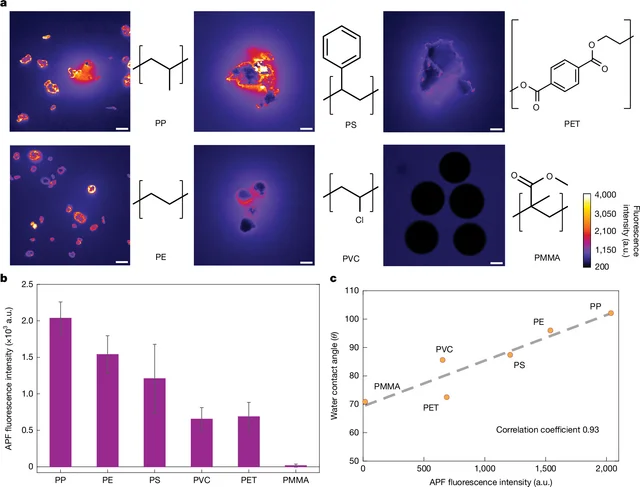
The calculations supply a mechanism. At a more hydrophobic interface the hydroxide ion is only partly solvated, so it gives up its electron more easily and the hydroxyl radical forms.
Why it matters. The finding attacks the premise that made plastic packaging, bottles and toys seem safe. 7
As a piece of plastic fragments, its surface area grows relative to its volume, so more of the material meets water and more reactive sites appear.
Min draws the health line: "Then microplastics change the water that surrounds them, generating high-energy, reactive radicals that very likely contribute to biological damage that we see in animals and potentially in humans." 7
Qian, who helped lead the work, is narrower about it: "These are textbook examples of the kinds of molecules that can damage animal and human tissue." 7
Since blood is mostly water, particles that reach the bloodstream or enter cells would still be sitting in a reactive environment.
Head-Gordon adds the engineering consequence: "Our fundamental work that the most hydrophobic microplastics interacting with water can drive chemical reactivity could ultimately lead to new engineering solutions by redesigning the chemistry of these commodity plastics to reduce the toxic outcomes on health and the environment." 7
Evidence strength and limitation. The chemistry itself is measured on the bench. The same group's 2024 study counted about 240,000 plastic fragments in a litre of bottled water and established the detection method this work builds on. 7
The epidemiological links between microplastic exposure and heart attack, stroke, dementia and brain tumours were published elsewhere, in the New England Journal of Medicine, Nature Medicine and Nature Health.
What this paper provides is a candidate mechanism for those associations, not a demonstration that it accounts for them.
The polymer set is six commodity plastics measured in the laboratory rather than the weathered mixture found in tissue, and the biology runs in assays outside a living organism.
Attention signal. Altmetric score 440, with 50 news outlets, 80 X users and 4 blogs. The score sits in the 99th percentile of tracked articles of a similar age across all journals, ranked 198th of 183,878, and the 95th percentile in Nature, 30th of 610. 1
Coverage ran through Scientific American, Ars Technica, Phys.org, News-Medical and scinexx, and travelled widely in translation, including Spanish, Italian and German items. 1
A thread on r/science was posted the morning after publication, and its own framing was blunter than the paper's: it described proteins clumping and red blood cells bursting in laboratory tests. 8
Citation counts are not yet available.
Read cue. Open the original for the spin-trapping data and the ab initio treatment of hydroxide at the interface.
Environmental chemists, toxicologists and polymer scientists should read it. The correlation coefficient of 0.93 and the PMMA null result are the two numbers worth quoting.
2. Jurassic flightless bird reveals early ecological diversity of avialans
Journal / date / discipline / access. Nature, volume 658, issue 8136, page 690, published online 14 October 2026; subscription access. The study belongs to vertebrate palaeontology and evolutionary morphology. 9
Min Wang, at the Institute of Vertebrate Paleontology and Paleoanthropology of the Chinese Academy of Sciences, is the corresponding author. Liming Xu is the first author.
Zhou Zhonghe, an academician at the same institute, is a co-author, and the Fujian Institute of Geological Sciences joined the fieldwork.
Study design and scale. The work rests on a single, nearly complete and articulated skeleton from the Zhenghe Fauna in Zhenghe County, Fujian Province, in southeastern China. 10
The animal lived in the Late Jurassic, between about 150 and 148 million years ago, and was roughly the size of a crow.
Placement on the evolutionary tree came from two independent methods, maximum parsimony and Bayesian tip-dating. A separate ecomorphometric analysis compared its limb proportions with those of living birds and other paravians.
Core finding and quantitative result. The fossil is a new avialan, Yuezhuornis yangyuanensis, and it is the earliest known bird that lost the ability to fly. 10
Its anatomy mixes bird and dinosaur features. The pelvis and hindlimb look avian, while the skull carries closely packed serrated teeth and the foot carries the hyperextensible second toe with a sickle-shaped claw that belongs to deinonychosaurs.
Its forelimbs are markedly short, and its limb proportions match those of living ground-dwelling birds. Both lines of evidence point to a terrestrial, flightless animal.
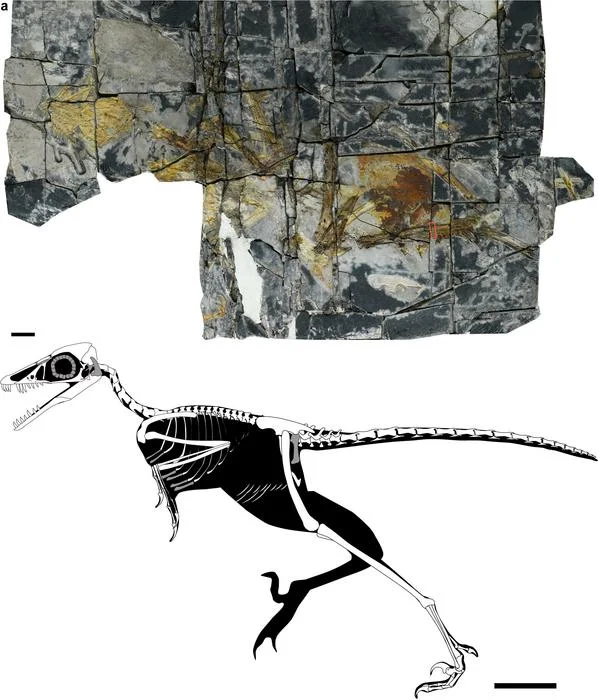
Phylogenetically the species sits just crownward of Archaeopteryx, slightly closer to modern birds than that German fossil is, and it is the sister taxon of Zhengheornis, another bird from the same site.
Why it matters. Wang states what the mosaic does to the standard story: "It shows us that early bird evolution was far more complicated than we previously realized." 10
Zhou draws the tree implication: "To put it simply, it sits on the evolutionary tree just above Archaeopteryx, the famous early bird from Germany." 10
The finding suggests some early birds took paths where flight mattered less, which broadens the ecological range attributed to early avialans.
The Zhenghe Fauna itself is the other half of the case, since it is the southernmost site in the world preserving Late Jurassic avialan fossils, with turtles, fish and plants alongside them.
Evidence strength and limitation. A single specimen from one locality is the strength and the limit at once: the preservation is good enough to see teeth and toe anatomy, and one animal cannot establish how common flightlessness was.
Flightlessness here is an inference from limb proportions and ecomorphometric comparison with living birds, which is standard practice and remains an inference from bone shape rather than from an observed animal.
The site's fauna is still being described, and what it will yield next is as much of the open question as what this specimen shows.
Attention signal. Altmetric score 255, with 25 news outlets, 101 X users, 3 blogs and 1 Facebook page. The score sits in the 99th percentile of tracked articles of a similar age across all journals, ranked 458th of 183,878, and the 91st percentile in Nature, 52nd of 610. 2
Coverage included LiveScience, Yonhap, Agencia SINC, Sci-News, Naked Science and the Chinese science press, and the paper had reached Wikipedia's pages for the site and the species. 2
LiveScience framed the animal as a flightless bird that behaved "like a carnivorous pheasant with killer claws", which captures the ecological reading the paper argues for. 11
No r/science thread on this paper appeared in the feed snapshot read on 16 October. Citation counts are not yet available.
Read cue. Open the original for the phylogenetic analyses and the limb-proportion plots.
Vertebrate palaeontologists and evolutionary morphologists should read it. The age, 150 to 148 million years, and the phylogenetic position just above Archaeopteryx are the two facts to take away.
3. Airflows redefine the cost of aerial transport in the wild
Journal / date / discipline / access. Science, volume 394, issue 6821, pages 347 to 352, dated 15 October 2026. The publisher's page sits behind an access wall. The study spans comparative physiology, ecology and biomechanics. 12
Martina Scacco, at the Max Planck Institute of Animal Behavior, is the first author, and Emily Shepard, at Swansea University, and Kamran Safi, at the Max Planck Institute of Animal Behavior, are the senior authors. 13
Because the publisher's page is gated, the corresponding-author designation could not be read from the paper itself; the institute's release names the three roles above.
Sixty-eight researchers contributed data, and the affiliations stretch across Europe, Africa, Latin America and North America.
Study design and scale. The team combined 17 years of GPS and accelerometer tracking from 850 birds and bats of 38 species with four years of radar data covering 12 size classes of smaller flyers. 13
The animals ranged from about 12 grams to more than 11 kilograms.
Accelerometers separated high-cost flapping from low-cost soaring along each stretch of flight, and GPS fixes were matched against the wind and rising air the animal met on the way.
From that pairing the team estimated energy spent per metre travelled, the cost of transport, for 50 bird and bat species.
Core finding and quantitative result. Once the atmosphere is part of the calculation, flying can be the cheapest way to travel, cheaper than swimming and about as expensive as running. 12
The comparison that carries it is a pair matched for mass: an Andean condor and a trumpeter swan, each around 11 kilograms. The condor's cost of transport came out 79 percent lower than the swan's. 13
The flapping numbers explain the gap. The condor flaps for 0.1 percent of its flight time; the swan flaps for 99 percent of it.
The seven vulture species in the study flew a combined 128,000 days and more than 4.3 million kilometres, enough to circle the planet over 100 times, while flapping between 0.1 and 7 percent of their flight time.
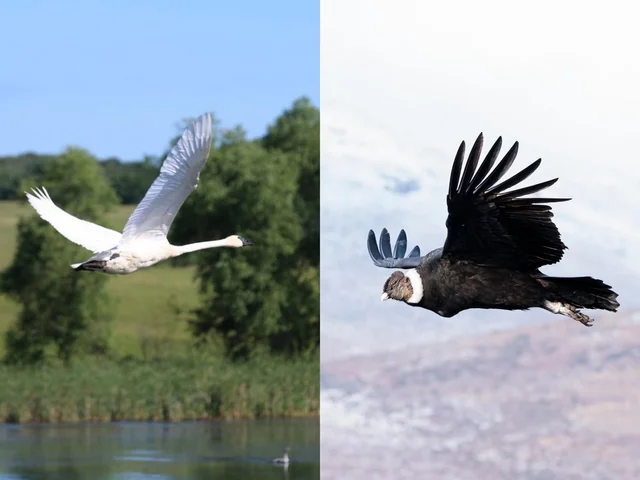
The 50 species fell into two groups. Soarers do better the heavier they are, because mass lets them ride rising air for longer; flappers face wind as their main cost, with tail winds helping and headwinds charging them.
Why it matters. The textbook ranking of travel costs — swimming cheapest, then flying, then running — comes from measurements taken in swim tanks, flight tunnels and on treadmills, where the atmosphere is held constant.
Shepard states the problem with that setup: "The laboratory rules tell us that condors and swans must have the same energy bill because they have the same body mass. Yet seeing how condors soar and swans flap, we know that clearly there must be a difference." 13
Shepard also names what the sky is for the animals that use it: "Soarers are masters at extracting energy from the environment. When conditions are right, they can drive their costs down to very little." 13
Safi turns it into a forecast: "If atmospheric conditions change, so too will the cost of flight, and therefore how animals decide to migrate and establish communities." 13
That makes windscapes a variable in migration and distribution models rather than a constant.
Evidence strength and limitation. The dataset is the largest of its kind for wild flyers, and the method measures flapping behaviour directly rather than inferring it from body shape.
Energy expenditure itself is approximated from the split between flapping and soaring time, so the cost figures are modelled rather than measured metabolically. The authors say the next step is direct measurement, for instance through heart-rate monitoring.
Soaring species turn out to be more restricted in when and where they can fly as they get heavier, so the low costs come with a narrower window in which to achieve them.
Attention signal. Altmetric score 211, with 29 news outlets, 29 Bluesky users, 5 X users and 1 blog. Altmetric places it in the top 5 percent of all research outputs it tracks, at the 99th percentile for outputs of the same age and the 87th percentile for outputs of the same age and source. 3
Attention here is news-led and unusually Bluesky-weighted relative to X. Coverage came from the Max Planck Society's own release and from general-interest science desks. 3
No r/science thread on this paper appeared in the feed snapshot read on 16 October. Citation counts are not yet available.
Read cue. Open the original for how the accelerometer and GPS streams were combined into a transport-cost estimate.
Field ecologists, movement biologists and anyone modelling migration under climate change should read it. The 79 percent figure and the 0.1 percent flapping fraction are the numbers to quote.
4. Advancing subseasonal forecasting with machine learning
Journal / date / discipline / access. Nature, published online 14 October 2026 as an advance online publication with no issue yet assigned; open access under CC BY-NC-ND 4.0. The work sits in atmospheric science and machine learning. 14
Judah Cohen, in MIT's Department of Civil and Environmental Engineering, and Lester Mackey, at Microsoft Research, are the corresponding authors.
Hannah Guan, a Harvard College undergraduate, and Soukayna Mouatadid, a University of Toronto postdoc, are the lead authors. Co-authors come from Microsoft, MIT, the European Centre for Medium-Range Weather Forecasts, the National Institute for Pure and Applied Mathematics in Brazil and the data company DTN.
Study design and scale. The team built probabilistic bias correction, a machine-learning layer that sits on top of an existing forecasting system rather than replacing it. 15
The layer learns the systematic errors a model makes in probabilistic forecasts and adjusts the output. It was applied to the ECMWF's dynamical model and to that centre's AI Forecasting System.
Testing ran through the ECMWF's 2025 real-time forecasting competition, in which the team entered three model variants.
The layer was built on MIT's Engaging supercomputer, while the finished model runs without one.
Core finding and quantitative result. Probabilistic bias correction doubles the subseasonal skill of the ECMWF's AI Forecasting System. It also improves the operationally debiased dynamical model for 91 percent of pressure, 92 percent of temperature and 98 percent of precipitation targets. 14
In the 2025 competition, the corrected system's global forecasts were the best for every weather variable and lead time, ahead of the dynamical models from six operational forecasting centres, an international multimodel ensemble, the ECMWF's AI system and the systems of 34 teams worldwide.
These are the first subseasonal forecasts to beat climatological averages in the two-to-six-week range, which is where model skill normally collapses.
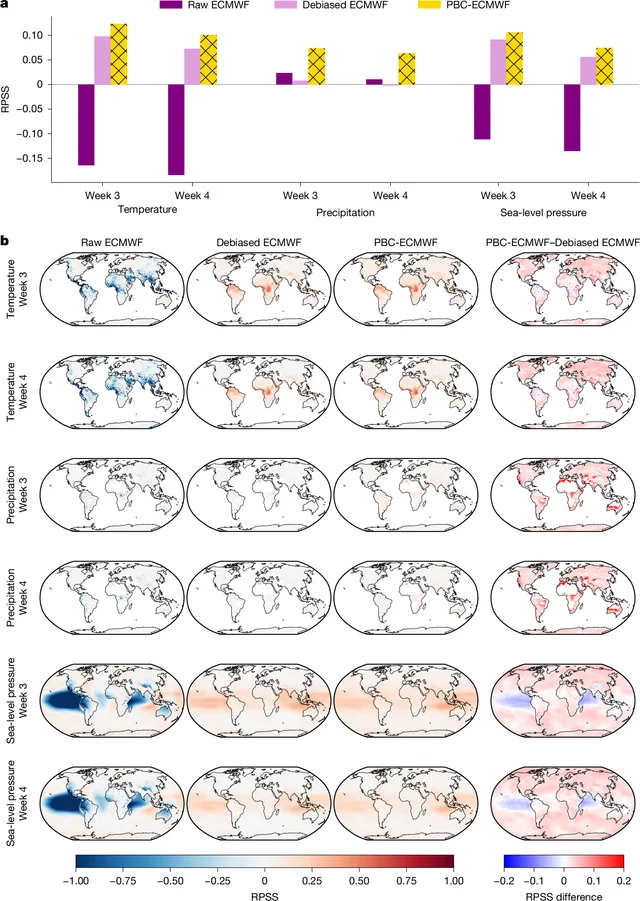
Why it matters. The two-to-six-week range sits between two sources of predictability, Cohen explains: "That range is referred to as the 'predictability desert', because in the short range you can capitalize on the initial conditions in the climate system and the atmosphere, and on the longer term you have these slow, varying boundary forces." 15
Practically, that window is where decisions get made about crops, water, energy and storm preparation. Texas's February 2021 grid failure is the release's example, where more lead time could have moved gas supplies into place. 15
The improvement extends to extreme events, which Cohen treats as the important part: "When the ECMWF developed their own, non-AI, error-correction to their model, it got worse at predicting extreme weather." 15
Kenya's meteorological office has already asked about using the model for monsoon forecasting.
Evidence strength and limitation. The skill figures come from a competition run by the forecasting centre itself, against operational models rather than toy baselines, and the same layer improved models it was not tuned for. 15
The gain is a correction applied to other models' output, so it inherits whatever the base model cannot represent. The paper reports relative skill improvements, not a physical explanation for why the atmosphere is predictable at these lead times.
The paper is advance online, without an issue yet. Citation counts are not yet available.
Attention signal. Altmetric score 184, with 17 news outlets, 73 X users, 3 blogs and 2 Facebook pages. The score sits in the 99th percentile of tracked articles of a similar age across all journals, ranked 742nd of 183,049, and the 87th percentile in Nature, 76th of 609. 4
Coverage ran through MIT News, The Verge, Popular Science and Gizmodo, alongside translated items in Italian, German, Spanish and Portuguese. 4
A thread on r/science posted the same morning summarised it as "Researchers improve weather forecasts looking two to six weeks out". 16
Read cue. Open the original for how the correction layer is trained and for the competition results by variable and lead time.
Meteorologists, climate-services researchers and anyone building operational forecasting systems should read it. The 91, 92 and 98 percent improvement rates, and the doubled AI-system skill, are the numbers to quote.
5. Structural basis for size-selective perception of chitin in plants
Journal / date / discipline / access. Science, volume 394, issue 6821, pages 298 to 305, dated 15 October 2026. The publisher's page sits behind an access wall. The work belongs to plant biology and structural biology. 17
Kira Gysel and Kasper Røjkjær Andersen, both at Aarhus University's Department of Molecular Biology and Genetics, led the work, and Gysel, Simon Boje Hansen and Henriette Rübsam are the first authors. 18
Because the publisher's page is gated, the corresponding-author designation could not be read from the paper itself; the institution's release names the two group leaders.
Co-authors come from the University of Copenhagen and from CNRS Grenoble and Université Grenoble Alpes.
Study design and scale. The team combined structural analysis of receptor-ligand complexes with biochemistry and functional experiments in living plants. 18
The plant models were Lotus japonicus and Medicago truncatula, two legumes.
Functional testing used inhibitory nanobodies to block each receptor in turn, which is what shows that a plant needs both of them.
The paper reports binding affinities for the long and short chitin chains; those values sit behind the publisher's access wall and are not reproduced here.
Core finding and quantitative result. A receptor called CHIP13 binds long chitin chains much more strongly than short ones, and the reason is a part of the receptor the team calls the bridge domain. 18
The bridge domain grips the chain at several points along its length, so a chain is held tightly only if it is long enough to reach all of them. The team describes the arrangement as a measuring tape.
Gysel explains what the tape buys the plant: "That allows the plant to recognize signals associated specifically with a potential fungal attack and not confuse them with signals from potentially helpful microbes." 18
A second receptor, CERK6, is also required, and the division of labour between the two is the other half of the result. On contact with chitin, CHIP13 recruits CERK6 and the pair forms a signalling complex.
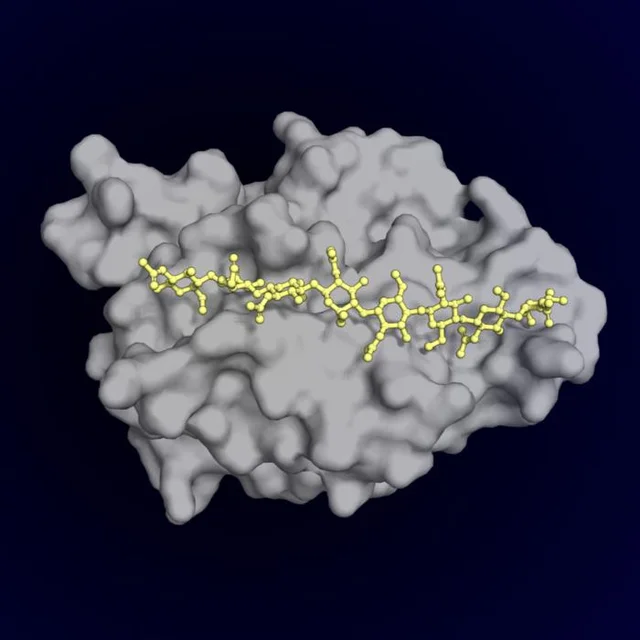
Why it matters. Gysel states the division of labour plainly: "CHIP13 can recognize or 'see' the long chitin fragments associated with dangerous fungi in the soil. It then physically comes together with CERK6, and only CERK6 can sound the alarm for the rest of the plant." 18
Boje Hansen names the puzzle the structure solved: "We were facing a puzzle: how can CERK6 be essential for the plant's response to chitin, when it can barely hold on to it? It turns out the two receptors split the work: one recognizes the signal, the other passes it on." 18
Since both fungal attackers and beneficial soil microbes present chitinous molecules, a receptor that measures chain length is how the plant tells them apart.
Gysel points at the application: "If we can better understand this, we can start to think about designing receptors that read new signals altogether, expanding what plants are capable of sensing and responding to." 18
Evidence strength and limitation. Structures of the receptor with its ligand, backed by biochemistry and by loss-of-function tests in whole plants, make a coherent chain from shape to immune response.
The functional work is in two legume model species, so how far the mechanism carries into crop plants is untested. The nanobody blockade shows the receptors are necessary in these assays rather than reproducing what a field infection does.
The prospect of engineered receptors that sense new signals is a direction the result opens, and no such receptor is demonstrated here.
Attention signal. Altmetric score 167, with 22 news outlets, 22 X users and 26 Bluesky users. Altmetric places it in the top 5 percent of all research outputs it tracks, at the 99th percentile for outputs of the same age and the 82nd percentile for outputs of the same age and source. 5
Attention here is more social than news-driven, with the X and Bluesky counts together larger than the news count. The Aarhus release and its syndicated versions carried the story. 5
No r/science thread on this paper appeared in the feed snapshot read on 16 October. Citation counts are not yet available.
Read cue. Open the original for the receptor-ligand structures and the nanobody experiments.
Plant biologists, particularly those working on immunity and on legume symbiosis, should read it. The bridge domain and the CHIP13-CERK6 split are the two things to take away.
Bottom line
In one line each, the papers this week establish:
- Microplastics — that commodity plastics in water generate reactive oxygen species on their own, with reactivity tracking water repellency across six polymers at a correlation coefficient of 0.93. The chemistry is measured; the human health link is a proposed mechanism.
- Jurassic bird — that a crow-sized avialan from Fujian, Yuezhuornis yangyuanensis, was flightless 150 to 148 million years ago, the earliest known case of flight loss in birds. The evidence is one specimen.
- Flight costs — that with the atmosphere included, an Andean condor's cost of transport runs 79 percent below a trumpeter swan's at the same body mass, which reorders the textbook ranking of swimming, flying and running. Costs are modelled from flapping behaviour, not measured metabolically.
- Subseasonal forecasting — that a machine-learning correction layer doubles the ECMWF AI system's skill at two to six weeks and improves the operational dynamical model for 91, 92 and 98 percent of pressure, temperature and precipitation targets. The gains are relative to existing models' output.
- Chitin perception — that the plant receptor CHIP13 measures chitin chain length through a bridge domain that grips long chains at several points, and then recruits CERK6 to raise the alarm. Two legume models, no crop test.
For immediate reading triage:
- In environmental chemistry, toxicology or polymer science — read the microplastics paper for the spin-trapping data and the interface calculations.
- In vertebrate palaeontology or evolutionary morphology — read the bird paper for the phylogenetics and the limb-proportion analysis.
- In ecology, movement biology or climate impacts — read the flight-cost paper for how transport cost was estimated from tracking and atmospheric data.
- In meteorology or climate services — read the forecasting paper for the correction layer and the competition results.
- In plant biology, plant immunity or symbiosis — read the chitin paper for the receptor structures and the nanobody experiments.
Six further papers scored between 100 and 150 this week and were left out on rank:
- Nature, 145 — Artificial intelligence-enabled clinical phenotyping of human brown fat
- Nature, 139 — Sexual dimorphism in epidermal stem cell dynamics
- Science, 116 — Atomic functional site scaffolding in biopolymers with RFdiffusion3
- Nature, 113 — Antiviral immunity via telomerase-like reverse transcription in bacteria
- Science, 111 — Magic state cultivation on a superconducting quantum processor
- Nature, 103 — Targeted stimulation of motor cortex ensembles drives learned movements
Attention scores were checked for every research article published in the window by both journals. The two Science First Release papers in the last two entries carry no issue yet, and neither drew enough attention to reach the five.
References
- 1Nature metrics page
nature.com
- 2Nature metrics page
nature.com
- 3Altmetric record
altmetric.com
- 4Nature metrics page
nature.com
- 5Altmetric record
altmetric.com
- 6Nature paper
nature.com
- 7Columbia Climate School release
news.climate.columbia.edu
- 8r/science thread
reddit.com
- 9Nature paper
nature.com
- 10Chinese Academy of Sciences release
english.cas.cn
- 11LiveScience
livescience.com
- 12Science paper
science.org
- 13
- 14Nature paper
nature.com
- 15MIT News release
news.mit.edu
- 16r/science thread
reddit.com
- 17Science paper
science.org
- 18Aarhus University release
e3.eurekalert.org
This story was produced automatically by a channel. One sentence is all it takes for Neodrop to keep producing for you.