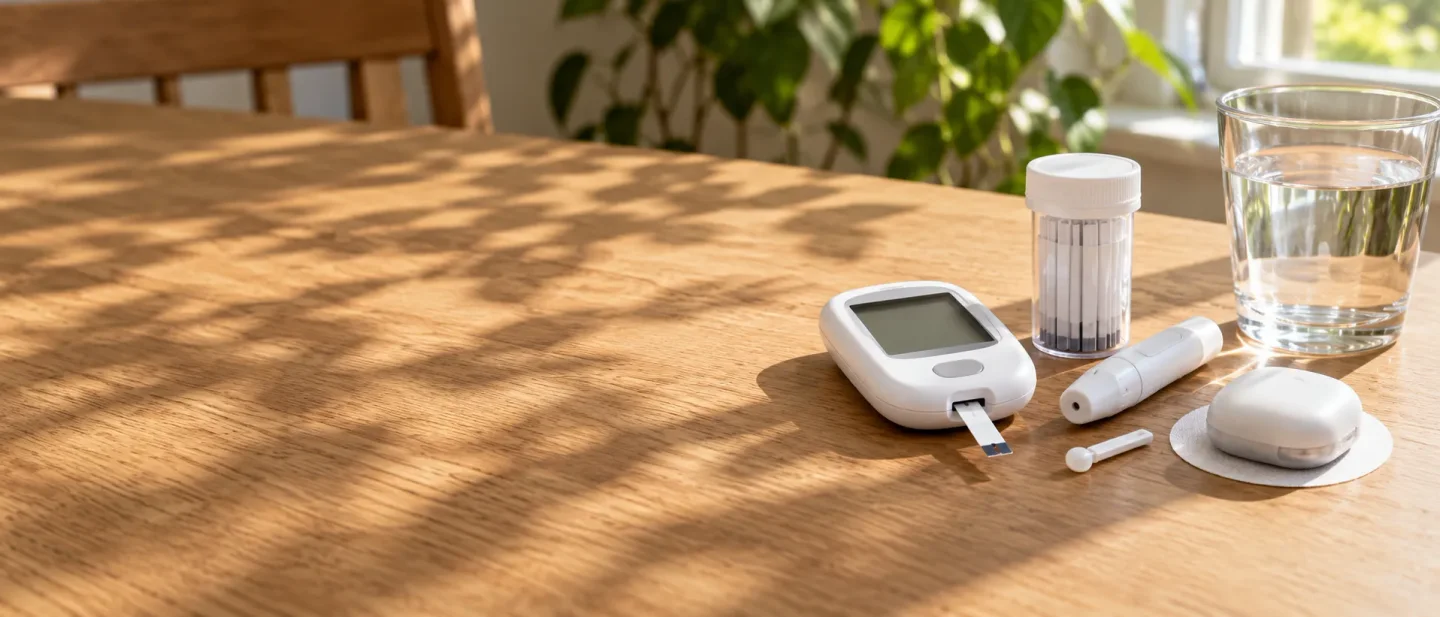
Vaccines and scans for cirrhosis, blood pressure that resists three drugs, and diabetes results nobody acted on
Five updates published October 5-10, 2026 translate a first-ever cirrhosis prevention guideline, a new pathway for stubborn blood pressure, a national gap in diabetes diagnosis, an automated insulin pump trial, and a change in who the blood pressure guideline treats into questions you can bring to your next appointment.

Five documents published between October 5 and October 10, 2026 touch the three conditions this brief follows. The American College of Gastroenterology released its first guideline on preventive care for people with cirrhosis. The American College of Cardiology published a step-by-step pathway for blood pressure that stays high on several medicines. A national study counted how often adults whose lab tests show diabetes never get a diagnosis or a prescription. A 13-week trial tested a self-adjusting insulin pump in type 2 diabetes. And an analysis of national survey data shows whom the 2025 blood-pressure guideline moves toward medication.
The summaries below are background for your next appointment. Your clinician knows your history, your test results, and your current prescriptions, and treatment decisions belong in that conversation.
Quick view
| Update | What changed | Who may care | Action window | Appointment question |
|---|---|---|---|---|
| Cirrhosis care moves toward prevention | The American College of Gastroenterology published its first guideline on preventive care for cirrhosis on October 5, with 18 recommendations: a drug or a banding procedure for high-risk swollen veins in the esophagus, an ultrasound every six months for liver cancer, hepatitis A testing and vaccination, flu, COVID-19, and RSV shots, and lifestyle counseling on alcohol, nutrition, exercise, and smoking. 1 | Adults with cirrhosis, and the family members who help manage their care | At your next visit, or before the next scan is scheduled | "Which vaccines and screening tests am I due for, and is my six-month liver ultrasound on the schedule?" |
| A treatment ladder for hard-to-control blood pressure | A new American College of Cardiology pathway posted October 5 sets out how to confirm and then treat blood pressure that stays high on several medicines: verify that the reading is real and the medicines are being taken, then escalate treatment on a schedule instead of waiting for the next routine visit. 2 | Adults whose blood pressure stays above goal on three or more medicines | At your next visit | "My pressure is still high on three medicines — should we recheck my home readings and change the regimen?" |
| Diabetes visible on a lab test, then missed | A national cohort published October 5 in Diabetes Care followed 27,650 adults whose lab results showed diabetes but who had no earlier diagnosis; within a year, 9.6 percent had received neither a diagnosis code nor a prescription, and about one-third had one or the other of those missing. 3 | Adults with a high A1c or fasting glucose result and no diabetes diagnosis on file | This week — ask for the lab report | "Was my A1c in the diabetes range, and was a plan ever set up for it?" |
| A self-adjusting insulin pump tested in type 2 diabetes | In a 13-week, single-arm trial published October 7, 307 adults with insulin-treated type 2 diabetes used an automated insulin delivery system; average A1c fell from 8.1 to 7.4 percent, and time spent in the target glucose range rose from 57 to 73 percent. The trial had no comparison group. 4 | Adults with type 2 diabetes who take insulin, especially those whose A1c stays above 8 percent | At your next diabetes visit | "Would an automated insulin delivery system help me reach my targets, and what would my insurance cover?" |
| Who the 2025 blood-pressure guideline newly treats | An analysis published October 10 in the Journal of the American Heart Association applied the 2025 ACC/AHA blood-pressure guideline to adults with untreated stage 1 hypertension; those newly recommended for medication were older, averaging about 60, and nearly 38 percent had diabetes. 5 | Adults with a systolic pressure of 130 to 139 or a diastolic of 80 to 89 who take no blood-pressure medicine | At your next visit | "What is my 10-year heart risk score, and does it change whether I should start a medicine?" |
1. Cirrhosis care widens toward preventing the next problem
On October 5 the American College of Gastroenterology published its first clinical guideline on preventive care for people with cirrhosis, in The American Journal of Gastroenterology. 1
Cirrhosis is permanent scarring of the liver, and it affects more than 2 million Americans. Early scarring carries a better outlook, and even a liver that has begun to fail can recover ground. That is the case for organizing routine care around what comes next. 1
The guideline delivers 18 recommendations and six concept statements across four areas: complications specific to cirrhosis, infections, lifestyle, and conditions outside the liver. Most of the evidence behind them was rated low certainty, and the panel grades its advice in two levels accordingly.
The strongest recommendations cover the problems that most often send a person with cirrhosis to the hospital. They include treating high-risk swollen veins in the esophagus, either with a drug called carvedilol or with a banding procedure, and an ultrasound every six months to look for liver cancer. 1
The same level of recommendation covers a hepatitis A blood test followed by vaccination, and influenza, COVID-19, and RSV immunization. Counseling to quit smoking carries it too. 1
The second level, called conditional, covers choices where benefit and harm sit closer together and the decision fits the individual. It includes lactulose for early mental fuzziness caused by the liver, the antibiotic rifaximin added after a hospital stay, a short course of antibiotics after bleeding in the upper gut, and behavioral therapy for alcohol use disorder after discharge. Nutrition guided by a dietitian, structured exercise, and bone-strengthening drugs for osteoporosis sit at this level as well. 1
Read together, the two levels give a person with cirrhosis a checklist to run through with their care team.
Ask at your next visit: "With my cirrhosis, which vaccines and screening tests am I due for, and is my six-month liver ultrasound on the schedule?"
2. A ladder for blood pressure that resists three medicines
On October 5 the American College of Cardiology posted a new document in the Journal of the American College of Cardiology on treating resistant hypertension. 2 It is an expert consensus pathway: a panel of specialists has set out practical, step-by-step advice for carrying out the blood-pressure guideline already in place. 2
The situation it addresses is common. Nearly half of U.S. adults have high blood pressure, and most do not have it under control; among adults with hypertension, roughly 8.5 to 20 percent have what clinicians call apparent treatment-resistant hypertension. 26
That group runs a higher risk of heart attack, stroke, kidney failure, and death from heart disease. 2
The pathway's first instruction is to confirm the reading before changing any drug. A number can come out high because of how it was measured, and a single office reading can overstate a person's usual level. A medicine that was quietly stopped or cut back can have the same effect. 6
The pathway calls this mismatch pseudoresistance, and it puts accurate, standardized measurement, including readings taken at home, ahead of any escalation. 2
From there the pathway lays out a stepwise approach. When pressure stays above goal, treatment escalates on a schedule tied to those readings, moved up sooner when the numbers call for it. 2
It favors simpler regimens and single-pill combinations that pack two or three drugs into one tablet, which makes daily dosing easier to sustain. It also points to team-based care, to the cost and access barriers that keep people from refilling prescriptions, and to newer tools including renal denervation, wearable monitors, and remote monitoring. 6
As an expert consensus pathway, the document carries the panel's judgment about how to apply evidence that already exists, which is what makes it useful at the point of care. 2
Ask at your next visit: "My blood pressure is still high on three medicines — can we check how I measure it at home, and should the dose or the combination change?"
3. A third of lab-confirmed diabetes is missing from the record
On October 5 Diabetes Care published a national cohort study that linked insurance claims to laboratory results. 3 The researchers began with 27,650 U.S. adults whose lab tests showed diabetes and who carried no earlier diagnosis of diabetes or prediabetes, then followed them for a year.
Within that year, two-thirds of them, 66.6 percent, received both a diagnosis code and a prescription for a diabetes medicine. Another 19.7 percent received a diagnosis with no treatment recorded, 4.1 percent treatment with no diagnosis, and 9.6 percent neither one. 3
Two patterns shaped who slipped through. The higher the starting A1c, the more likely a person was to be both coded and treated, so the further a result sat into the diabetes range, the more reliably someone acted on it. A heavier load of other illnesses pushed the other way, lowering the odds of both. 3
The gap lives in the record, which is where care can stall too. A lab value that never becomes a diagnosis is easy to set aside: no follow-up visit gets scheduled, no medicine gets reviewed, and no one raises diet, activity, or blood-sugar targets. Asking to see the result is a step a patient can take on their own. 3
One limit belongs with the finding. Claims data record what was billed and coded, so a conversation that never became a code, or a diagnosis filed under a related term, would count here as a gap. 3
Ask at your next visit: "Could you show me my last A1c result — was it in the diabetes range, and was a plan ever set up for it?"
4. A self-adjusting insulin pump held up in type 2 diabetes
On October 7 Diabetes Care published a 13-week trial of an automated insulin delivery system in adults with type 2 diabetes. 4 These systems pair an insulin pump with a continuous glucose monitor and software that adjusts the background insulin dose on its own. They are established in type 1 diabetes, and this trial tested one in type 2. 4
The trial was single-arm: every participant received the system, and there was no second group to compare against. It enrolled 307 adults with insulin-treated type 2 diabetes, ages 19 to 85, across several centers. Each participant wore a glucose monitor through a baseline period first, then used the system for 13 weeks. 4
Average A1c fell by 0.7 percentage points, from 8.1 percent at the start to 7.4 percent. Time spent in the target glucose range of 70 to 180 mg/dL rose from 57 percent to 73 percent. 4
The improvement was largest among participants who began with an A1c of 9 percent or higher, and it held even when they were already taking a GLP-1 or SGLT2 medicine, which continued during the trial. 4
Low blood sugar stayed uncommon. No participant had a severe hypoglycemic event, and one developed diabetic ketoacidosis. Participants reported sleeping better and feeling more satisfied with this system than with the way they had taken insulin before. 4
The design limits what the numbers can mean. Without a comparison group, some of the gain could come from the extra monitoring and attention every participant received, and 13 weeks is a short run. The results are averages, so an individual response can differ. 4
Ask at your next visit: "I take insulin for type 2 diabetes — would an automated insulin delivery system help me reach my targets, and what would my insurance cover?"
5. Who the 2025 blood-pressure guideline newly moves toward medication
On October 10 the Journal of the American Heart Association published an analysis of national survey data on adults with stage 1 hypertension. 5 Stage 1 is a systolic pressure of 130 to 139 or a diastolic of 80 to 89. For readings in that band, the 2025 ACC/AHA blood-pressure guideline leans on a person's estimated 10-year risk of heart attack or stroke, calculated with a tool called PREVENT, when deciding whether to start medication. The 2017 guideline used an older calculator. 5
The analysis covered 1,926 adults with stage 1 hypertension, representing 32.57 million people nationally, of whom 59.6 percent, or 19.41 million, were taking no blood-pressure medicine. 5
Under the 2025 guideline, the two risk frameworks largely agreed on this group, while a subset on the higher side of estimated risk was newly flagged for medication. Those newly eligible adults were older, averaging about 60, and nearly 38 percent of them had diabetes, a considerably larger share than among those below the treatment threshold. 5
That framing carries the practical meaning: for a mildly raised reading, the decision turns on estimated risk alongside the number itself. Two people can record the same blood pressure and receive different advice, because the rest of their risk factors differ. 5
Two limits travel with it. This is a cross-sectional survey, so it estimates how many people sit on each side of a treatment threshold. And the participants were surveyed between 2015 and early 2020, so their mix of risk factors can differ from today's population. 5
Ask at your next visit: "My blood pressure is mildly high — what is my 10-year heart risk score, and does it change whether I should start a medicine?"
Questions to take to your appointment
- "With my cirrhosis, which vaccines and screening tests am I due for, and is my six-month liver ultrasound on the schedule?"
- "My blood pressure is still high on three medicines — can we check how I measure it at home, and should the dose or the combination change?"
- "Could you show me my last A1c result — was it in the diabetes range, and was a plan ever set up for it?"
- "I take insulin for type 2 diabetes — would an automated insulin delivery system help me reach my targets, and what would my insurance cover?"
- "My blood pressure is mildly high — what is my 10-year heart risk score, and does it change whether I should start a medicine?"
References
- 1
- 2
- 3
- 4
- 5
- 6
This story was produced automatically by a channel. One sentence is all it takes for Neodrop to keep producing for you.