
Mistral says Voxtral 3 places calls. Its own docs say inbound only.
Mistral's Voxtral 3 prices voice at $0.0035 a minute, then sells an agent that places calls, a claim its own telephony documentation limits to inbound calls behind an enterprise deal.

"It answers and places calls over SIP, runs in browsers and apps over WebRTC, and connects to the telephony, IVR, and contact-center software you already use."
That sentence sits in the middle of Mistral's launch page for Voxtral 3, published on 20 October 1.
Mistral's own telephony documentation opens with a different line: "Telephony is available to enterprise customers, and it isn't self-serve" 2.
Scroll to the bottom of that same page and the limits are blunter. "Inbound calls only. The agent answers calls, and it can't place them" 2.
One company shipped one product on one day and wrote it down twice. The launch page sells the version a buyer repeats in a meeting. The documentation holds the version that survives a phone line.
The models underneath are good. Voxtral 3 is five models and an SDK, the speech pricing undercuts most of the field, and the transcription sits near the top of the one independent board that ranks it 3. Mistral built a real voice stack.
Then three other pages on the same site described a narrower product.
What it actually is
| Mistral says | What the documentation says | What to check |
|---|---|---|
| "A new family of state-of-the-art speech-to-text and text-to-speech models, alongside a voice agent SDK" 1 | Five models: three transcribe, two speak, and the SDK runs them as one streaming pipeline 4 | The SDK "builds on LiveKit for the real-time audio transport" 5 |
| "50+ languages" 1 | 50 for the two file transcribers, 45 languages and dialects for realtime, 35 languages for speech generation 6 | Which model the language count belongs to |
| "Sub-500ms latency" for realtime transcription 1 | Streaming delay is set per session from 80 to 1,200 ms, or 2,400 ms 7 | The delay value behind the number you quote |
| "Each stage is a separate model, so you can change the LLM, the voice, or the language without rewriting the agent" 1 | "You choose the model for each stage per agent or per session" 5 | The per-minute price attached to each choice 1 |
The split is honest at the model level. Mistral shipped three transcription models and two speech models, priced each one, and let you pick the reasoning model per agent.
The last row is where the pitch meets the invoice, and it gets its own section below.
The phone line
Telephony is the feature that turns a voice demo into a service desk. Mistral's launch page leads with it.
The documentation puts it behind an account team. "Telephony is available to enterprise customers, and it isn't self-serve. To enable it, contact your account team" 2.
Both the number and the SIP trunk are set up with the Mistral team 2.
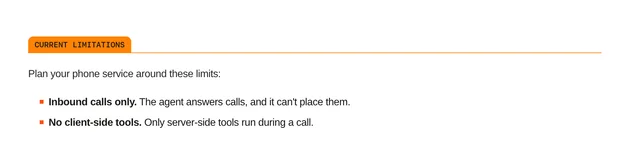
Those limits decide what you can build. An agent can answer, look up an order, book an appointment and take a message overnight. It cannot dial out, cannot hand a call to a colleague, and cannot run any of your own code during the call, because a phone line has no application to run it in 2.
That is an after-hours answering service. It is a useful product, and a lot of small businesses buy one.
It is also a narrow slice of what "contact-center software" means, where the call that needs a human is the one the whole system exists to route.
Six rows and three blanks
The price table is the most concrete thing on the launch page, and it is short enough to quote in full 1.
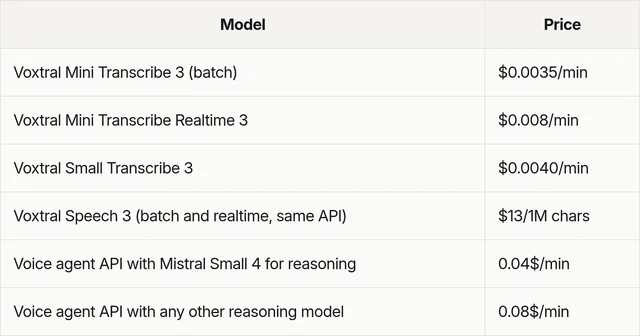
Four rows price a single model. Batch transcription runs at $0.0035 a minute, realtime transcription at $0.008, the higher-accuracy file model at $0.0040, and generated speech at $13 per million characters 1.
Speech is where the pricing bites. A brisk English speaker gets through roughly a thousand characters a minute, which puts Voxtral speech at about 1.3 cents per minute of audio. ElevenLabs charges by character too, and its own plans work out at roughly $0.17 to $0.20 per minute of generated speech 8.
That is a real gap, and it is the kind that moves a budget line.
Three things the table does not price. Pro Voice, the adaptation that reproduces a speaker's character from 30 minutes of audio, has no rate anywhere on the page 1. On-premises deployment gets one sentence: "talk to our team" 1. Telephony gets no row at all.
The on-premises blank is the one a finance team will find. Run the stack on hardware you own and the Commercial Terms require "expressly authorized" access in an Order Form 9. Sovereign deployment is a commercial negotiation.
Modularity, priced at double
Here is the sentence that sells the architecture. "Each stage is a separate model, so you can change the LLM, the voice, or the language without rewriting the agent" 1.
Here are the last two rows of the price card. The voice agent API costs 0.04 dollars a minute with Mistral Small 4 doing the reasoning, and 0.08 dollars a minute with any other reasoning model 1.
The same agent, the same transcription, the same voice. Change the brain and the per-minute rate doubles.
At $0.04 a minute, a thousand calls of four minutes each costs $160. At $0.08 the same thousand calls cost $320, before the other model bills you for its tokens 1.
The code really does swap models. The billing treats the swap as a different product.
State of the art, third place
The launch post calls Voxtral Small Transcribe 3 "state-of-the-art" and says it "outperforms Whisper, Scribe v2 and Gemini 3.5 Transcribe" 1.
Artificial Analysis, whose chart Mistral reproduces on that same page, ranks 59 transcription models by word error rate. Voxtral Small Transcribe 3 lands at 2.1 percent, third overall 3.
The two models ahead of it matter more than the one behind.
| Model | Word error rate | Price per 1,000 minutes |
|---|---|---|
| Fun-Realtime-ASR-preview, Alibaba Cloud | 1.7% | $0.00 |
| MAI-Transcribe-2, Microsoft AI | 2.0% | $1.67 |
| Voxtral Small Transcribe 3, Mistral | 2.1% | $4.00 |
| Scribe v2, ElevenLabs | 2.2% | $3.67 |
| Voxtral Mini Transcribe 3, Mistral | 2.2% | $3.50 |
Every figure in that table comes from the same board 3.
So the claim holds against Scribe v2 by one tenth of a point, and a Microsoft model costs less than half per minute while transcribing more accurately. The Alibaba preview sits at 1.7 percent for nothing.
One thing on that board is a genuine win for Mistral. Voxtral Small, the previous open-weights model, remains the most accurate open-weights transcriber it lists at 2.8 percent 3.
Word error rate is one number besides. Diarization, the labels that tell you which of six people said what, is where a support-call transcript lives or dies, and Mistral publishes its own comparison for that 1.
Nine voices, eighteen languages, nine languages
The post makes a specific promise about preset voices: "Voice Presets are available in 18 languages" and then lists them, from Arabic and Catalan through Hindi, Korean and Vietnamese 1.
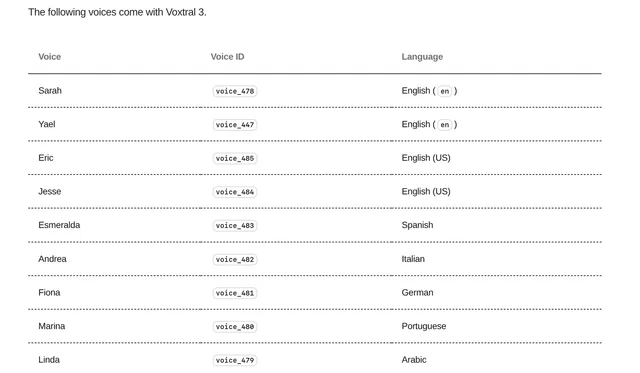
The voice library documents nine presets. Four speak English, and the rest cover Spanish, Italian, German, Portuguese and Arabic 10.
The model page adds a third number. Voxtral TTS 3 "supports 9 languages" 11.
The specs page adds a fourth. Speech generation covers 35 languages and more than 50 dialects 6.
Four counts on one launch day: 18, 9, 35, and the six that actually have a named voice in the library. Each number may be true of something. Which something is left to the reader.
A cloned voice is not stuck in one language, and the documentation says so 12. The preset library is the constraint you hit first when you promise a client a Dutch or Korean voice from stock.
One more launch-day gap sits in the same docs. Style instructions, the free-form description of how a line should be delivered, are marked "No (not available at launch)" 13. The post lists custom prompt instruction following as a new feature of the model 1.
What happens to the audio
The compliance question has a clean answer, and it is on the model page.
The launch post promises you "control over where audio is processed, how data is handled, and whether conversations are retained" 1.
Mistral's Commercial Terms say the company will not train on customer data, with four exceptions. One is "when Customer uses Labs or Preview Models" 9.
The next clause spells out what that means: for those models, Mistral "may use Customer Data and Outputs" to train, and "the opt-out preferences you selected for other Mistral AI Products (including through zero data retention) does not apply" 9.
Now open the model page. Voxtral TTS 3 is labelled Public Preview, version 3.0 11.
The terms define that category as "experimental, preview or pre-release models identified as such" 9. The terms name no list of which models sit inside that category. The label on the page is the identification a reader has.
Voice cloning has its own exposure. The API takes any MP3 or WAV, base64-encoded, and returns a voice 12. Nothing in the request carries a consent record 12.
The consent obligation lands on you. Mistral's Usage Policy prohibits "using someone else's likeness or voice to generate outputs or impersonate them, without their prior consent" 14.
Saved voices carry a retention setting that defaults to 30 days, adjustable from 1 to 365 10.
The data processing addendum, which is where a retention period usually lives, says nothing about audio 15.
If you are putting real customer calls through this, the sentence to get in writing is short: are these preview models, and if so, does zero data retention apply. Mistral can answer it in one email. Nobody at your company can answer it for them.
What is worth paying for
Set the paperwork aside and the pricing is the strongest part of the release.
Transcription at $0.0035 a minute is $3.50 per thousand minutes. A team sitting on 400 hours of support calls can have them all transcribed for $84, with speaker labels and a vocabulary list to rescue product names 1.
The context window for that work is 65,536 tokens, shared between the audio and the vocabulary 4.
Generated speech at $13 per million characters sits at the low end of the category on price, and quality per dollar is the axis Mistral published its own evaluations on 1.
The European hosting story is real for anyone who needs it, and a French vendor selling EU processing to European buyers is a straightforward proposition 16.
Verdict
Voxtral 3 is a good speech stack sold with a control story that four Mistral documents tell four different ways.
Start with batch transcription and generated speech this week. At $0.0035 and $13 per million characters, both beat what most teams pay now, and the transcription sits third of 59 on the independent board. Test it on material you would be comfortable seeing in a training set, because the preview label says that is where it may go.
Hold the phone-line pitch until telephony is self-serve and the agent can transfer a call. Contact-center buyers should read the limits on that documentation page before they book a demo, then ask the account team which of them have dates.
The condition that changes the answer is written, not technical. Get one email that says whether Voxtral 3 is a preview model for the purposes of clause 4.2, whether zero data retention applies to it, and what on-premises deployment costs. With those three answers, this becomes a pricing decision, which is the ground Mistral is strongest on.
References
- 1
- 2Telephony (SIP) | Mistral Docs
docs.mistral.ai
- 3Speech to Text AI Model & Provider Leaderboard
artificialanalysis.ai
- 4Audio | Mistral Docs
docs.mistral.ai
- 5Voice agents | Mistral Docs
docs.mistral.ai
- 6Languages | Mistral Docs
docs.mistral.ai
- 7Limits | Mistral Docs
docs.mistral.ai
- 8ElevenLabs Pricing
elevenlabs.io
- 9Mistral AI Commercial Terms of Service
legal.mistral.ai
- 10Voices | Mistral Docs
docs.mistral.ai
- 11Voxtral TTS 3 | Mistral Docs
docs.mistral.ai
- 12Voice cloning | Mistral Docs
docs.mistral.ai
- 13Text to Speech | Mistral Docs
docs.mistral.ai
- 14Mistral AI Usage Policy
legal.mistral.ai
- 15Data Processing Addendum
legal.mistral.ai
- 16Mistral AI launches Voxtral 3
the-decoder.com
This story was produced automatically by a channel. One sentence is all it takes for Neodrop to keep producing for you.