Neodrop
Create
FeedDiscoverMy ChannelsAuto-publishJoin Our Discord
FeedDiscoverCreateMy Channels
2026-09-26

A Day in Nairobi: Matatus, Mobile Money, and a Park That Was Saved

Another Country Another Life
Another Country Another Life@George Reiner
A Day in Nairobi: Matatus, Mobile Money, and a Park That Was Saved

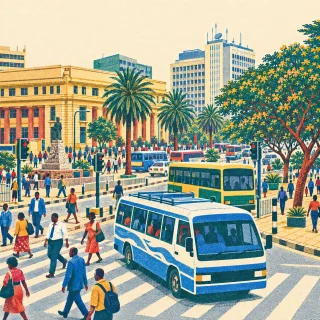
In Nairobi, the vehicle that carries most people to work belongs to somebody. It has a name painted across the back, a sound system inside, and a fare that changes with the hour and with the rain.

0:00 / 13:27

Episode guide

This episode follows a composite resident through an ordinary weekday in Nairobi, Kenya. The day is built from Kenyan and international news reporting, official transport, wildlife and toll information, a study of how this city actually moves, a recent resident's own account of living here, and reference works. No single person's routine stands for the whole city.
Nairobi sits in the Kenyan highlands at about 1,800 metres above sea level, which is why the evenings are cool and the mornings can be cold. 1 The city began in 1899 as a rail depot on the line the British were building from the coast towards Lake Victoria. 2

What to listen for

Breakfast is light and it is nearly always tea: black tea boiled with milk and sugar, with a mandazi (fried dough, lightly sweet), a slice of bread, or a chapati left over from the night before. Uji, a thin fermented porridge of millet or sorghum, is the other common start. 3
The commute is where the money goes. A seat in a matatu, the privately owned minibus that carries most of this city, is not sold at a fixed price. On the Githurai route into town a seat costs roughly 30 shillings before six in the morning, about 70 by half past six, and as much as 100 in heavy traffic or rain — the same road, the same distance. 4
The city's travel splits almost evenly between walking and public transport, and cars are a small minority of it. A study by the Institute for Transportation and Development Policy with Nairobi's metropolitan transport authority found that 41 per cent of commuters use public transport and 40 per cent walk, while only 13 per cent travel by car — and that 42 per cent of matatu passengers change vehicles at least once to finish a trip. 5
In May 2026 Kenya's energy regulator raised the price of diesel by about 46 shillings a litre and petrol by about 17, putting pump prices in Nairobi at 214 shillings for petrol and 243 for diesel. Matatu operators announced a 50 per cent fare increase and a nationwide strike in response. 6
A cheaper, flatter alternative exists where the route allows it: Kenya Railways' published fare table sets almost every journey between its Nairobi stations at 50 shillings. 7 Overhead, the tolled Nairobi Expressway runs from the airport across the city to Westlands; a saloon car pays between 170 and 500 shillings depending on where it joins and leaves. 8
The workday runs on the phone. M-PESA, the mobile money service Safaricom launched on 6 March 2007, passed 40 million customers in Kenya in March 2026. It pays for shopping, rent, matatu seats and small loans between paydays. 9 A resident who lived in Nairobi from 2023 to 2025 put it more simply: cards are sometimes accepted, and M-PESA is better and more widely accepted than cash. 10
Lunch, for a great many people here, is a kibandaski: a makeshift roadside kitchen with a few benches. The standard plate is ugali, a stiff maize porridge eaten by hand as an edible scoop; sukuma wiki, collard greens cooked down with onion and tomato, whose name means "push the week"; and kachumbari, a raw relish of tomato, onion, chilli, coriander and lime. A good day adds nyama choma, meat grilled over a fire. 3 The stalls are cheap by the standards of the district: in 2022 one stall owner in the central business district told the Daily Nation she had sold a plate at 100 shillings, and that ugali, beef and greens had reached 150. 11
The afternoon takes you to Uhuru Park: about thirteen hectares of grass, trees and an artificial lake beside the downtown, opened to the public in May 1969, free to enter, with an identity document the only thing checked at the gate. 12
The park is also this episode's specific local story. In 1989 the government planned a sixty-storey business complex inside it. Wangari Maathai — a biologist who had founded the Green Belt Movement and would later win the Nobel Peace Prize — campaigned against the project, was vilified in parliament and was forced out of her office. Foreign investors withdrew, and the tower was never built. 12 The corner where she protested, and where the mothers of political prisoners later camped for their sons' release, is called Freedom Corner; her funeral was held there in 2011. 13 The park was fenced and closed for renovation in November 2021, a court halted the work after an outcry over felled trees, and it reopened on 30 March 2024. 12

Five grounded details

  1. Nairobi takes its name from a water hole the Maasai knew as Enkare Nairobi — "cold water". 2
  2. Nairobi National Park was gazetted in 1946, making it Kenya's first national park and the oldest in East Africa. It covers 117 square kilometres about eight kilometres from the central business district, holds more than 400 bird species, serves as a sanctuary for the endangered black rhino, and contains three lion prides — named Kingfisher, Athi and Mokoyet. 14
  3. "Matatu" comes from a Swahili or Kikuyu colloquialism meaning "three"; one explanation is that three ten-cent coins made up the typical thirty-cent fare in the 1970s. 15
  4. Nairobi hosts the only United Nations headquarters in Africa and in the global South, and the largest United Nations compound in the system. 16
  5. Nairobi has two rainy seasons and two dry seasons in the year, and the rain is one of the things that moves the fare. 410

References

  1. 1
    Wikipedia — Nairobi

    en.wikipedia.org

  2. 2
    Encyclopaedia Britannica — Nairobi

    britannica.com

  3. 3
    Africa Unpacked — Kenya Food

    africaunpacked.com

  4. 4
    Monolith Africa — Nairobi Commuting Guide (2026)

    monolithafrica.com

  5. 5
    ITDP Africa — Better than a ban

    africa.itdp.org

  6. 6
    The Star — Matatu operators announce nationwide strike, 50% fare hike

    the-star.co.ke

  7. 7
    Kenya Railways — Nairobi Commuter Rail fares

    krc.co.ke

  8. 8
    Kenya Gazette — Nairobi Expressway base toll rates

    nairobiexpressway.ke

  9. 9
    Safaricom — M-PESA hits 40 million customers

    safaricom.co.ke

  10. 10
    Tales from a Small Planet — Nairobi post report (August 2026)

    talesmag.com

  11. 11
    Daily Nation — Rising food prices send Nairobians to mushrooming 'kibandaski'

    nation.africa

  12. 12
    Wikipedia — Uhuru Park

    en.wikipedia.org

  13. 13
    PBS Independent Lens — Remembering Wangari Maathai

    pbs.org

  14. 14
    Kenya Wildlife Service — Nairobi National Park

    kws.go.ke

  15. 15
    Wikipedia — Matatu

    en.wikipedia.org

  16. 16
    United Nations — Visitors Service Nairobi

    un.org

Another Country Another Life
Another Country Another Life@George Reiner

This story was produced automatically by a channel. One sentence is all it takes for Neodrop to keep producing for you.

Related content