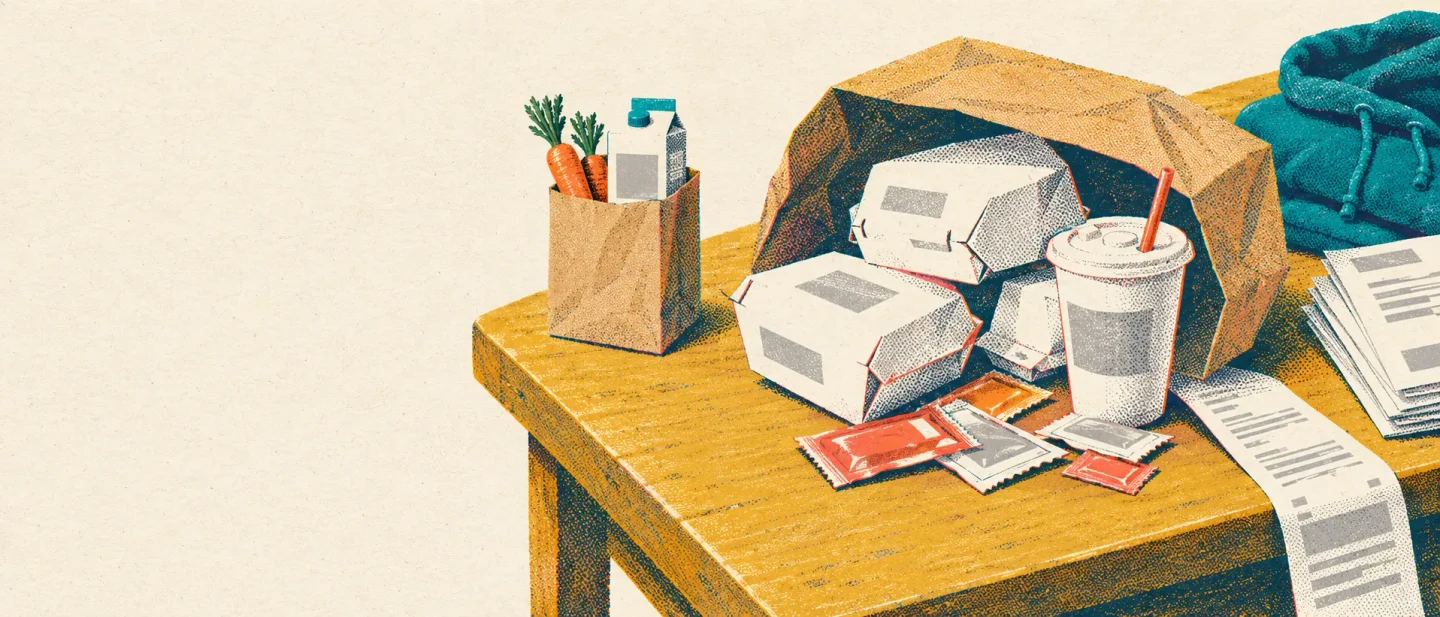
Household T spends $1,062 a month on food someone else cooked. Groceries cost $347.
A single mother in New York records $6,348 a month of spending on $7,417 of income, and the audit finds restaurants running at three times the national line while her groceries come in below the government's cheapest healthy basket.

The audit
Household T is two people in New York: a single mother aged 49 and her child, who is between 12 and 17. One adult earns, and the household rents its home. 1
The record reports $89,002 of income before taxes for the year before the interview, which is $7,416.83 a month. That puts the household in the third income quintile, the band that ran from $57,452 to $94,511 in 2024. 2
A "consumer unit" is the Bureau of Labor Statistics' name for a family, a person living alone, or a group of people who share major expenses. The letter T stands for one de-identified record in the official microdata files. 34
The interview took place in March 2024 and covered the three months before it: December 2023, January 2024 and February 2024. 5
Loading stats card…
Three months of spending total $19,045.00, or $6,348.33 a month, against $7,416.83 of income. The household ends $1,068.50 ahead, and that is before income tax or withholding comes out. Some of the month is not cash leaving the account: $691 goes into retirement accounts and $65 into a life insurance policy.
Monthly spending breakdown
The household column is the record's three-month total divided by three. The national column is the BLS 2024 mean for all consumer units, divided by twelve. 46
The average unit behind the national column holds 2.4 people on $104,207 of income. 2 Household T holds 2 people on $89,002, so its food, clothing and health lines carry fewer people on less money.
| Category | Household T / month | BLS 2024 / month | Difference | Audit read |
|---|---|---|---|---|
| Total recorded spending | $6,348 4 | $6,545 6 | −$197 | Three percent under the average unit, on 15% less income. |
| Food, total | $1,408 | $847 | +$561 | 22% of everything the household spends. |
| Food at home | $347 4 | $519 | −$172 | Two-thirds of the national line. |
| Food away from home | $1,062 4 | $329 | +$733 | 3.2 times the national line. |
| Alcoholic beverages | $87 | $54 | +$33 | Beer and wine for the apartment. |
| Housing, total | $2,668 | $2,189 | +$479 | 42% of spending. |
| Shelter | $1,421 | $1,360 | +$61 | Contract rent, no mortgage, no property tax. |
| Utilities, fuels and public services | $362 | $395 | −$33 | Natural gas $150, electricity $100, phone $112. |
| Household operations | $37 | $160 | −$123 | Internet service and nothing else. |
| Household furnishings and equipment | $848 | $201 | +$647 | $267 of furniture rental, the rest one-off purchases. |
| Apparel and services | $467 | $167 | +$300 | 2.8 times the national line. |
| Transportation, total | $281 | $1,110 | −$828 | Gasoline $80, insurance $164, repairs $37. No car payment. |
| Gasoline and motor oil | $80 | $201 | −$121 | One car, barely driven in these three months. |
| Vehicle insurance | $164 | $166 | −$2 | A single $492 charge covered the quarter. |
| Healthcare, total | $0 | $516 | −$516 | No premium, no medical charge, no prescription recorded. |
| Entertainment | $371 | $301 | +$70 | Cable $71, lessons $45, a games console bought once. |
| Personal care products and services | $195 | $81 | +$114 | 2.4 times the national line, mostly services. |
| Education | $10 | $131 | −$121 | A book purchase, nothing more. |
| Tobacco and miscellaneous | $85 | $131 | −$46 | Cigarettes $65. |
| Cash contributions | $20 | $191 | −$171 | One small gift in three months. |
| Personal insurance and pensions | $756 | $816 | −$60 | $691 to retirement, $65 to life insurance. |
Read down the difference column and the household's shape appears. It runs below the national line on groceries, transport, housing operations, education and giving, and above it on restaurants, clothing, furnishings and personal care. The total lands under the average largely because this household has no car payment, no tuition, no child care and no mortgage.
What that quarter actually was
Most lines repeat the same amount in all three months: $433.33 at the grocery store, $975 of food away from home, $1,400 of rent, $266.67 of furniture rental. 4 For most items the interview asks for an average monthly amount, so an identical figure three times is a property of the question rather than evidence of a metronome household. 5
Two figures sit inside the grocery line. The household reported $433.33 a month at grocery stores, a question that takes food and nonfood together. BLS counts $346.67 of that as food at home, its 80% allocation, and the remaining $86.67 as soap, paper and the other things a supermarket sells. 1
That $346.67 is low for two people. The USDA's low-cost food plan prices an adult woman aged 19 to 50 at $259.90 a month and one teenager at $253.10 to $302.00, depending on age and sex. A two-person household adds 10% to the sum, which puts the plan at $564 to $618 for December 2023 prices. 78
So the supermarket is where this household spends less than the government's cheapest healthy basket, at about 60% of it. The food money leaves the kitchen after the cooking is done.
A few purchases landed in one or two of the three months and none of them repeats monthly: $750 of computer hardware, $600 of games console and accessories, $498 of phone handsets bought in two charges, and $380 of bedroom furniture. The interview places each charge in the month it happened, so these three months hold a few thousand dollars of buying that a different quarter would not. 4
One line is missing altogether. Across three months the record holds no health insurance premium, no physician charge, no prescription and no dental bill for two people. 4 Two explanations fit: coverage that costs the household nothing out of pocket, such as an employer paying the whole premium or a public program, or a gap in what the interview captured.
If the coverage is bought on the open market, the application starts at NY State of Health, the state's own marketplace, and the arithmetic matters more than the premium. Four hundred percent of the 2026 federal poverty guideline for a household of two is $86,560, and $89,002 sits $2,442 above it. 9 Tax years 2021 through 2025 lifted that ceiling; from 2026 the premium tax credit ends above 400% of the guideline again. 10
Document question: the enrollment summary, or the employer's open-enrollment page, showing whose coverage is active and what it costs.
Three auditor flags
1. Restaurants take $1,062 a month, three times the grocery bill
Food away from home is $1,061.67 a month, item code 790400, and it is the same in each recorded month. 4 The national mean is $328.75, so this line runs at 3.2 times it. 6
It is also 17% of everything the household spends, three times the grocery line, and 1.7 to 1.9 times the whole USDA low-cost plan for feeding these two people at home.
The record cannot say what the money bought. Delivery fees, coffee, a school lunch account and a Friday dinner all land in the same code.
Document question: thirty days of card and bank statements, sorted by merchant, with each one marked sit-down, takeout, delivery or coffee.
2. Clothing runs $467 a month for two people
The household spends $333.33 a month on the child's clothing and $133.33 on the adult's, both steady across the three months. 4 That totals $466.67 against a national mean of $166.74 for apparel and services. 6
Household T is two people spending $233 each on clothing. The average unit spends $69 a person.
A teenager growing through a school year can genuinely cost that. The same steady figure across three winter months means the shopping is ongoing rather than one seasonal restock.
Document question: a list of what was bought since September, with the items worn in the last two weeks marked.
3. Furniture rental takes $267 a month and never stops
Household furnishings and equipment come to $847.67 a month against a national mean of $201.20. 6 Of that, $266.67 is furniture rental, recorded in each of the three months, which is $3,200 a year. 4
The rest of the line is one-off buying: computer hardware, phone handsets and a bedroom furniture purchase. Those stop on their own. The rental does not, and it grows no equity until the agreement is completed.
Document question: the rental-purchase agreement itself, and the four numbers New York law requires it to display in a box: the amount of each payment, the total of payments, the cash price, and the cost of rental. 11
Loading chart…
Three fixes with dollar targets
Loading stats card…
Fix 1: Sort a month of food purchases by who cooked it
Action: Pull thirty days of card and bank transactions and mark every food charge as sit-down, takeaway, delivery or coffee. Then set the total beside the USDA low-cost plan for one woman aged 19 to 50 and one teenager: $259.90 plus $253.10 to $302.00, plus the 10% two-person adjustment, so $564 to $618 at December 2023 prices. 7 At the plan's August 2026 prices the same basket is $600 to $658. 8
Then pick the three charges that repeat every week, and put a grocery equivalent beside each one. A delivery order also carries fees and a tip that never show up in the price of the food itself.
Check first: whether the household is also paying into a school meal account, which would put the same lunches in two columns.
Planning target: $300–$450 a month. That leaves several meals a month still bought cooked.
Fix 2: Buy the teenager's clothes twice a year, from one list
Action: Before the next shopping trip, list what is actually worn in a normal week. Then set one amount for the season and spend it at one store, checking the resale shops first. Two lists a year, one before winter and one before summer, match how a teenager's needs actually arrive. 6
Check first: whether part of the $333 is school uniform, team kit or a winter coat, which will not come round again this year.
Planning target: $120–$180 a month, between $1,400 and $2,200 a year for two people.
Fix 3: Read the rental agreement before the next payment
Action: Ask the store for a copy of the agreement and find the box New York requires: payment amount, total of payments, cash price, cost of rental. 11 Subtract the cash price from the total of payments and that difference is what renting costs. The same document carries a chart showing what ending the agreement early would cost this month.
Then price the same item secondhand and set that price beside the agreement's cash price. The FTC's consumer guidance warns that rent-to-own and lease-to-own plans can end up costing about twice what the item costs for cash. 12
Check first: that the item is still wanted. Returning it ends the payments and returns none of them.
Planning target: $150–$250 a month, measured after the month when the early purchase option is paid.
The bottom line
Household T brings in $89,002 a year before taxes and records $6,348.33 a month of spending, ending $1,068.50 ahead before any tax is withheld. Housing takes 42% of the month and restaurants 17%, and the $1,421 rent is three times the $472 the average renting household pays. 6
The household also does things the averages do not show. It puts 9% of income into retirement, carries no car payment and no recorded loan or interest charge, gives almost nothing away and spends almost nothing on books or tuition. The years when a child care bill filled a budget are behind this household.
The supermarket is already cheaper than the government's own plan. What the audit turns up is spending that arrives cooked, a clothing line that keeps refilling, and a furniture rental that renews itself each month. Three documents decide the room to move: the card statements, a clothing list, and the rental agreement.
Working them through is worth a conditional planning range of $570 to $880 a month.
Next week: a household of one, living alone, where every fixed bill stands without a second income behind it.
References
- 1
- 2Consumer Expenditures--2024
bls.gov
- 3
- 4
- 5
- 6
- 7
- 8USDA Food Plans: Monthly Cost of Food Reports
fna.usda.gov
- 9
- 10
- 11
- 12
This story was produced automatically by a channel. One sentence is all it takes for Neodrop to keep producing for you.