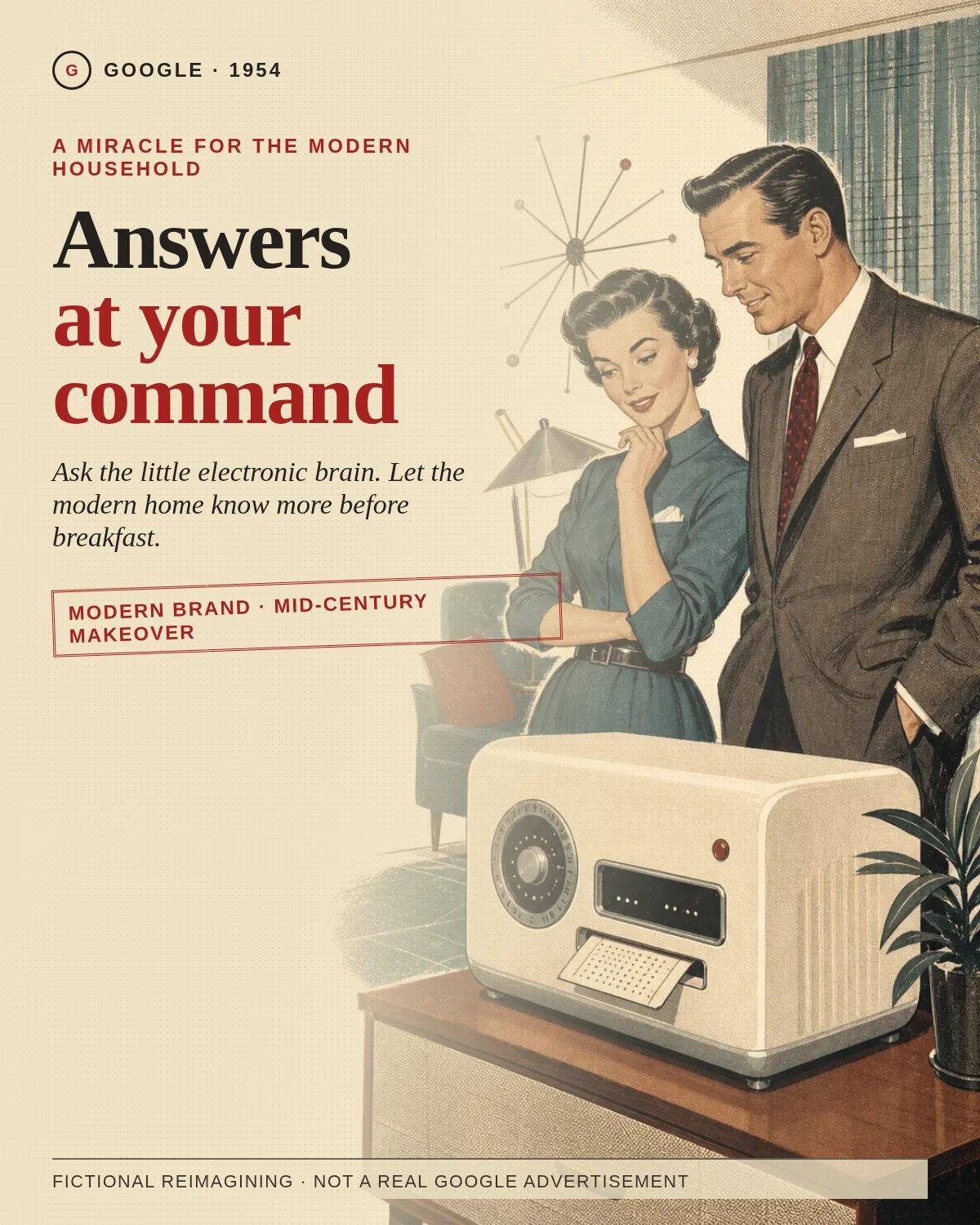

This campaign is fictional. Its premise borrows a real postwar dream: in 1945, Vannevar Bush described a personal "memex" for storing books, records and communications so they could be consulted with speed and flexibility. 1
The 1950s supplied the visual joke. On election night in 1952, CBS used UNIVAC I to help predict the result and introduced it as an electronic machine. 2 In January 1954, another UNIVAC I arrived at General Electric's Appliance Park, where it handled payroll and manufacturing data for an appliance factory. 3 The imagined household answer box turns that expensive room-sized reality into a push-button promise.
Google's present-day description supplies the final contrast: its Search index covers hundreds of billions of webpages and is well over 100,000,000 gigabytes in size. 4 The old advertising dream was instant knowledge. The modern joke is that finding an answer has become easy enough to make judgment feel optional.
References
- 1
- 2
- 3Computerworld, "GE's Appliance Park Still an IT Innovator"
computerworld.com
- 4
Comments