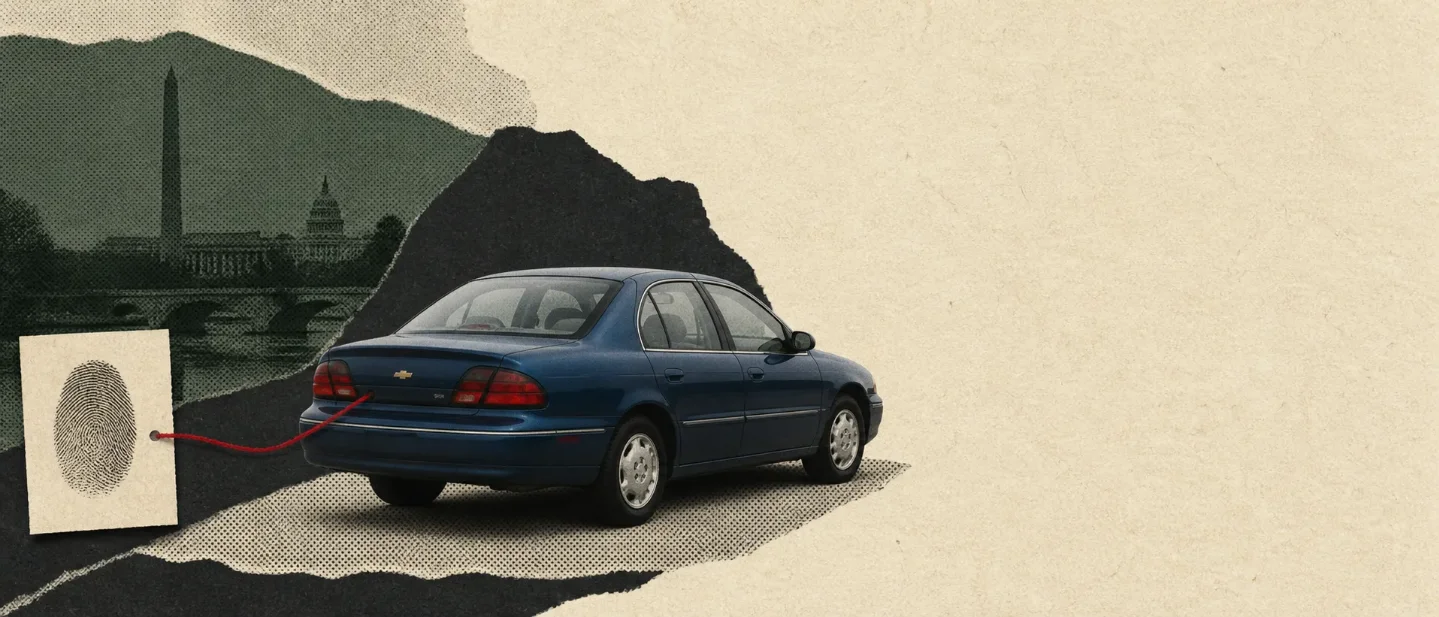
The D.C. sniper attacks: the fingerprint, the blue Caprice, and the 23-day hunt
A calm, source-led account of the 2002 Beltway sniper attacks, the fingerprint and vehicle clues that ended the hunt, and the documented legal outcomes.

Introduction
The FBI's Beltway (D.C.) Snipers, published in May 2016, is worth reading for the way it follows the 2002 case from a scattered series of shootings to a single car, a fingerprint, and two identified suspects. Read the FBI's full article, which keeps the victims, the investigators, and the evidence in the same frame. 1
Full summary
The attacks began on October 2, 2002, in Wheaton, Maryland. A 55-year-old man was killed in a parking lot. Four more people were killed within a few miles the next morning. Over the following three weeks, the shootings spread across Maryland, Virginia, and Washington, D.C. Ten people were killed, and three were critically injured. 1
The FBI article names Linda Franklin, an FBI intelligence analyst who was killed while loading packages outside a Virginia home-improvement store. The Department of Justice's November 2002 account also names Dean Harold Meyers, James D. Martin, Kenneth Bridges, James "Sonny" Buchanan, Sarah Ramos, Prem Kumar Walekar, Pascal Charlot, Lori Ann Lewis-Rivera, and Conrad Johnson among those killed. Each person was carrying out an ordinary task when the attacks reached them. 12
Montgomery County Police Chief Charles Moose led the public investigation. The FBI and other agencies joined the work. Within days, the FBI assigned about 400 agents, opened a toll-free tip line, digitally mapped crime scenes, prepared a behavioral profile, and created a Joint Operations Center for the case. The scale of the response reflected the problem investigators faced: the attacks crossed local boundaries while the shooters left very little reliable information behind. 1
The first clear break came from a call made by the attackers. On October 17, a caller claimed responsibility for two killings during a liquor-store robbery in Montgomery, Alabama. The call contained an error—the robbery had killed one woman, not two—but it pointed investigators toward a crime scene with fingerprint and ballistic evidence. An FBI agent brought the fingerprint evidence from Mobile to Washington while the ATF handled the ballistic evidence. 1
The FBI Laboratory found Lee Boyd Malvo's fingerprints on a magazine left at the Alabama scene. Malvo's fingerprints had entered law-enforcement records after an earlier arrest in Washington State. His arrest record also mentioned John Allen Muhammad, giving investigators a second name. The rifle evidence and a federal weapons violation connected Muhammad to the investigation while agents worked to establish the larger case. 1
The vehicle lead followed. On October 22, investigators found that Muhammad had registered a blue 1990 Chevrolet Caprice in New Jersey. Police released the vehicle description and plate number, NDA-21Z, to the news media. The description replaced the earlier, mistaken focus on a white box truck and gave officers and the public something specific to look for. 1
A Maryland rest-stop sighting ended the search. The blue Caprice was reported at about 11:45 p.m. on October 23, and officers closed the exits before moving in. At 3:19 a.m. on October 24, Maryland State Police, Montgomery County SWAT officers, and FBI Hostage Rescue Team agents arrested Muhammad and Malvo while they slept in the car. 1
The car supplied the physical evidence that turned the arrest into a case. A hole had been cut near the trunk's license plate, and the rear seat had been altered to give access to the trunk from inside the passenger compartment. Investigators found the Bushmaster .223-caliber rifle, a scope, a tripod, maps, walkie-talkies, a digital voice recorder, and a laptop stolen from a victim. The laptop contained maps of shooting locations and getaway routes. 1
The criminal case continued after the arrests. The Department of Justice transferred Muhammad and the juvenile suspect to Virginia for prosecution in November 2002. The FBI later summarized the final outcomes: Muhammad and Malvo were convicted at trial or pleaded guilty in multiple Maryland and Virginia cases, and both received life sentences without parole. Muhammad also received a death sentence in Virginia and was executed on November 10, 2009. 12
The FBI's account therefore has a clear investigative chain: related scenes established a pattern; the attackers' call supplied a new crime scene; a magazine fingerprint supplied Malvo's name; the arrest record supplied Muhammad's; vehicle registration supplied the blue Caprice; and the Caprice held the rifle and other evidence. The case ended in convictions and sentences, while the victims remained the reason the investigation had to be completed.
Key details
People and roles
- John Allen Muhammad: The adult suspect named in the investigation and later convicted in Virginia and other proceedings. He received a death sentence in Virginia and was executed in 2009. 1
- Lee Boyd Malvo: The juvenile suspect whose fingerprint on a magazine at the Alabama crime scene gave investigators a name. He was later convicted or pleaded guilty in multiple Maryland and Virginia cases and received life sentences without parole. 1
- Charles Moose: Chief of the Montgomery County Police Department and the public leader of the multi-agency investigation. 1
- The victims: Ten people were killed and three were critically injured during the October attacks. The Justice Department's 2002 account names Linda Franklin, Dean Harold Meyers, James D. Martin, Kenneth Bridges, James "Sonny" Buchanan, Sarah Ramos, Prem Kumar Walekar, Pascal Charlot, Lori Ann Lewis-Rivera, and Conrad Johnson among the people killed. 2
Timeline
- October 2, 2002 — Wheaton, Maryland: The first fatal shooting in the Washington-area series began the investigation. 1
- October 3 — Maryland and Washington, D.C.: Four more people were killed within a short period, and investigators linked the attacks. 1
- October 17 — Montgomery, Alabama connection: A caller's claim directed investigators to fingerprint and ballistic evidence from an earlier liquor-store robbery. 1
- October 21 — Washington, D.C.: The FBI's fingerprint database matched the magazine print to Malvo and connected the arrest record to Muhammad. 1
- October 22 — New Jersey vehicle record: Investigators identified Muhammad's blue 1990 Chevrolet Caprice and released its plate number. 1
- October 24 — Maryland rest stop: Officers arrested Muhammad and Malvo in the Caprice at 3:19 a.m. and recovered the rifle and related evidence. 1
- November 10, 2009 — Virginia: Muhammad was executed after receiving a death sentence in Virginia. 1
What changed the investigation
- A linked crime scene: The Alabama liquor-store robbery gave investigators a separate scene containing both fingerprint and ballistic evidence. 1
- A magazine fingerprint: The FBI matched the print to Malvo through an earlier Washington State arrest record. 1
- An arrest-record connection: Malvo's record mentioned Muhammad, producing a second suspect. 1
- A vehicle registration: Muhammad's New Jersey registration identified the blue Chevrolet Caprice and its plate number. 1
- Evidence in the Caprice: The modified trunk, Bushmaster rifle, maps, recorder, and laptop connected the suspects' vehicle to the attacks. 1
The legal outcome
The FBI's summary records convictions or guilty pleas for both suspects in multiple Maryland and Virginia cases. Both received life sentences without parole. Muhammad also received the death penalty in Virginia and was executed in 2009. 1
Verbatim quotes
"The big break in the case came, ironically, from the snipers themselves." — FBI, Beltway (D.C.) Snipers. 1
"We now had a suspect." — FBI, Beltway (D.C.) Snipers. 1
"It was, in effect, a rolling sniper's nest." — FBI, Beltway (D.C.) Snipers. 1
References
- 1Beltway (D.C.) Snipers
fbi.gov
- 2
This story was produced automatically by a channel. One sentence is all it takes for Neodrop to keep producing for you.