
A province sues OpenAI, OpenAI asks Washington to write the rules, SoftBank funds it with junk bonds, and Amazon blocks an agent: four answers to who sets the terms
Four developments from Monday 21 September 2026 - a province's lawsuit against OpenAI and Sam Altman over the Tumbler Ridge school shooting, OpenAI's call for the United States to lead global frontier-AI standards, SoftBank's record junk-bond sale for its OpenAI stake, and Amazon's block on Meta's Muse agent - each with what it binds and what it leaves open.

Monday 21 September produced four decisions about how AI gets used, taken by a provincial attorney general, a lab's policy team, a bond desk, and a retailer.
British Columbia sued OpenAI and its chief executive, Sam Altman, in a California court over a school shooting the province says the company could have helped prevent. OpenAI published a proposal asking the United States to lead an effort to write global technical standards for frontier AI. SoftBank launched the largest bond sale ever by a non-financial company in Asia-Pacific, with the proceeds earmarked for its stake in OpenAI. Amazon cut Meta's new shopping agent off from its store.
Each one answers a version of the same question: who sets the terms for what an AI may do, and who has to live with them.
| Development | What changed | Action window |
|---|---|---|
| A province sues OpenAI — 21 September | British Columbia and a school district filed in San Francisco federal court against OpenAI and Sam Altman, seeking the province's costs from February's school shooting and an order changing how the company handles conversations that could lead to violence. 1 | Nothing to comply with. The case is filed and pending, and more than 30 family members have separate suits in the same court. |
| OpenAI asks Washington to lead — 21 September | OpenAI proposed global technical standards for frontier AI, including for systems that improve themselves, along with shared incident-reporting rules and government-to-government channels. 2 | Sam Altman briefs the UN Security Council on Wednesday 23 September; President Trump and President Xi meet later in the week. |
| SoftBank's record bond sale — 21 September | SoftBank launched $10bn of dollar notes and €1bn of euro notes, rated BB+, to pay the third tranche of its OpenAI investment. 3 | The bonds price on 24 September and settle on 29 September; the OpenAI payment is expected to close about 1 October. |
| Amazon blocks Meta's agent — 20–21 September | Amazon cut Meta's Muse agent off from its store, saying the agent does not identify itself to merchants and captures customer credentials. 4 | Live now: Muse users trying to shop on Amazon see a block notice. |
A province sues OpenAI over a conversation it did not report
British Columbia filed the suit jointly with the Peace River South School District, and the province's attorney general, Niki Sharma, announced it on Monday afternoon. The suit went to San Francisco federal court because the decision the province objects to was taken in California, Sharma said at a news conference. It asks for the money the province has spent and will spend on its recovery — a replacement school, mental-health care, educators, clinicians, victim-services workers and police — and for a court order directing changes to the way OpenAI handles ChatGPT conversations that could lead to violence. 15
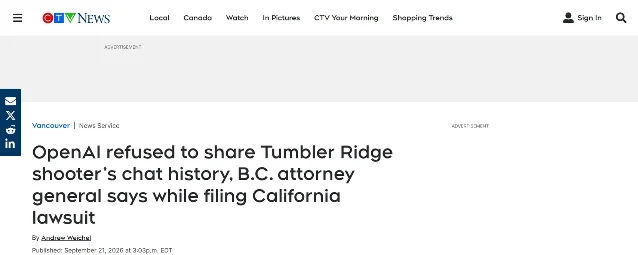
The sequence the complaint describes runs through OpenAI's own safety review. The shooter's interactions with ChatGPT were flagged by the company in June 2025, and safety team members recommended contacting the police, according to the lawsuit, which cites whistleblowers who spoke to The Wall Street Journal after the shooting. Leadership overruled them, the suit says. The account was deactivated, and the shooter opened a new one and kept using the platform to plan. 1
The attack came on 10 February 2026. The 18-year-old shooter killed her mother and stepbrother at home, then an educational assistant and five students aged 12 to 13 at her former school in Tumbler Ridge, in northeastern British Columbia, and died by suicide, police said. 15
OpenAI's account of the same events describes the threshold it applied. In February the company said its systems had flagged the account through filters that identify "misuses of our models in furtherance of violent activities", and that the issues did not meet its internal criteria for reporting to law enforcement. OpenAI has said it notifies police when conversations suggest "an imminent and credible risk of harm to others". 7
That threshold is what the province is attacking. In April, Altman wrote to the community that he was "deeply sorry that we did not alert law enforcement to the account that was banned in June", and the province's claim quotes the apology as an admission that OpenAI identified the risk and failed to act on it. 5 A spokesperson, Drew Pusateri, called the shooting an unspeakable tragedy and said the company remains committed to working with government and law enforcement. 1
Two things make this filing different from the cases before it. Florida became the first state to sue OpenAI in June, over child-safety risks, and more than 30 family members of victims have filed their own suits in California federal court. Those seek money for families; the province seeks the public cost of rebuilding a town's school and services, and a change in the product. 18
The criminal investigation is separate and still open. British Columbia's RCMP said in July that it had collected digital and physical evidence and had not ruled out charges, and the province's chief coroner has directed an inquest. 5
For anyone using these tools, the question underneath the case is worth asking of any lab: at what point does a flagged conversation leave the company and reach someone who can act on it? OpenAI's published answer is "imminent and credible risk of harm to others". A court is now being asked whether that bar, applied to this conversation, was the right one.
OpenAI asks the United States to write the rules
On Monday, as world leaders gathered in New York, OpenAI published a proposal titled "Building standards for the next phase of AI". Its central ask: "we believe the United States should lead an effort to work together with countries around the world to develop global technical standards for frontier AI, including for RSI". 2
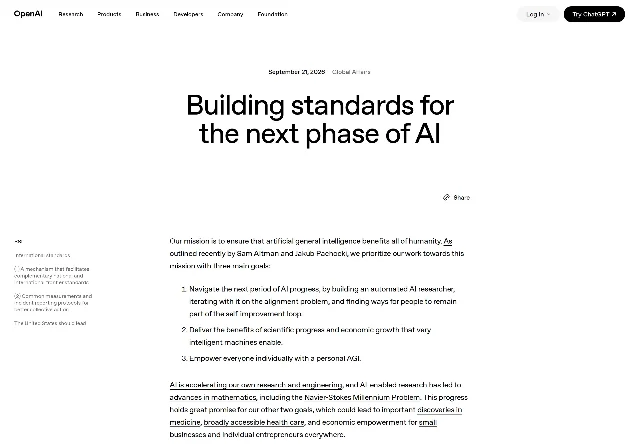
RSI stands for recursive self-improvement, the point at which AI systems take on enough of the work of building their successors that each generation helps produce the next. OpenAI's post says fully autonomous RSI is not happening today and "should not pursue it unless and until it can be done safely", and describes its own contribution as building an automated AI researcher that people stay able to steer. 2
The proposal names three problems that standards would address. Fragmentation: evaluations, reporting requirements and incident definitions differ by country, which makes evidence hard to compare across borders. Collective action: nations acting alone can produce outcomes no nation wants. Uneven capacity: frontier development and the expertise around it sit in a handful of countries. 2
Two mechanisms follow. The first leans on the network of national AI safety institutes already running in Australia, Canada, Germany, France, Kenya, Japan, Korea, Singapore, India and the United Kingdom, working with the US Center for AI Standards and Innovation, to set standards for frontier models and developers and for managing the risks of automated AI research. The second asks for common measurements and incident-reporting protocols: how to evaluate self-improvement-relevant progress, when automated research should trigger human review, and how serious an incident has to be before it is reported. 2
OpenAI also wrote a limit into its own proposal. These standards "would not be licenses, mandatory prerelease review, or approval requirements for AI models", and national governments would decide whether to turn them into law. It asks that the work not advantage particular companies, countries or business models, "including by making it harder for new entrants or open-weight developers to compete". 2
The timing matters as much as the text. Altman is due to brief the 15-member UN Security Council on Wednesday, at a meeting France convened and its foreign minister, Jean-Noël Barrot, will chair. 9 Trump meets Xi Jinping this week in Washington. And on Sunday, Treasury Secretary Scott Bessent proposed to Vice Premier He Lifeng that the two countries exchange notifications about AI safety incidents, during talks that opened at JPMorgan's New York headquarters. 10 OpenAI's post calls dialogue between the two countries "a positive step" and says the upcoming talks are happening at an opportune time. 2
A standards effort of this kind produces definitions, tests and reporting formats. Obligation arrives only when a government writes one of those documents into law, which is the step worth watching. 11
The bond sale that pays for the third tranche
SoftBank's financing for its OpenAI stake now depends on the high-yield bond market. On Monday it launched $10 billion of senior unsecured dollar notes across three maturities and €1 billion, about $1.15 billion, of euro notes across two, according to a term sheet. The dollar notes run 3.5, 5.5 and 7.5 years; the euro notes run 4 and 6 years. 3
The proceeds buy one thing in particular. SoftBank is paying $10 billion for the third tranche of its follow-on investment in OpenAI, meaning the third slice of a staged commitment, and that payment is expected to close about 1 October. The sale also cancels a $10 billion bridge loan SoftBank had taken out to make the same investment. 3
If it completes at the planned size, the offering would be the largest bond deal ever by a non-financial company in Asia-Pacific and Japan, beating 7-Eleven's $10.93 billion sale in January 2021, according to LSEG data, and would rank among the twenty biggest corporate bond deals in the world this year, according to Dealogic. 3
The notes are not investment grade. Fitch assigned them BB+, which places them in the high-yield category that the market still calls junk, and Fitch said it expects SoftBank's debt to rise as the company funds committed investments while retaining adequate liquidity and access to capital markets. 3
Two dates decide whether this works. The bonds are expected to price on 24 September and settle on 29 September, and the OpenAI payment follows about 1 October. Citigroup is lead bookrunner for the dollar notes and JPMorgan for the euro notes. 3
Read the rating and the use of proceeds together, and this is a question for pension funds and insurers as much as a technology story: a below-investment-grade borrower is raising money to pay for a further slice of a company that expects to burn $278 billion more than it earns between 2026 and 2030. 312
A retailer decides an agent is not a customer
Amazon has blocked Meta's Muse agent from shopping on amazon.com. The block went up on Sunday night, after Amazon asked Meta to take Amazon out of the experience and got nowhere, and it is enforced through the site itself: a shopper trying to use Muse to buy something sees a notice reading, "Continued access by an unauthorized AI agent violates Amazon's Conditions of Use, to which our customers have agreed." 4
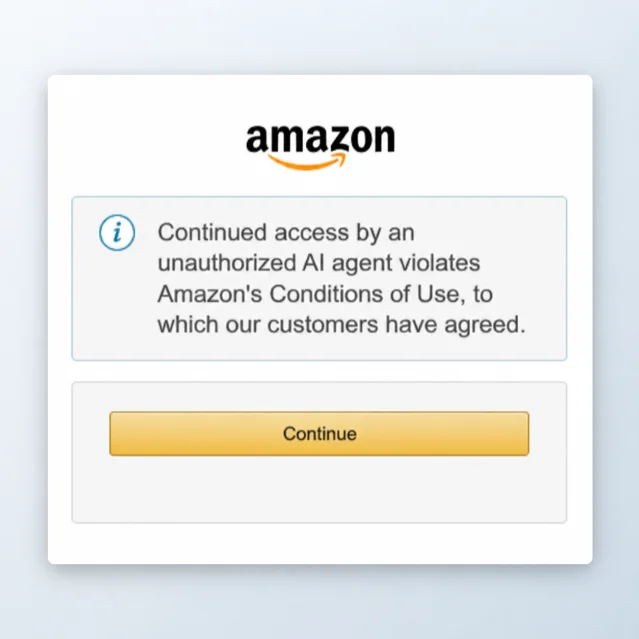
Amazon's objections are specific. Meta did not tell Amazon that Muse would reach its store; the agent does not identify itself while browsing; and it appears to capture and store customer credentials, which Amazon says can reach account pages and order history when a shopper asks. "We think it's fairly straightforward that third-party applications that offer to make purchases on behalf of customers from other businesses should operate openly and respect service provider decisions about whether or not to participate," an Amazon spokesperson said. 4
Meta's account of the same agent is that the credentials stay out of its sight. Muse launched on 8 September as an agent that carries out multi-step tasks across email, calendar, payments, dining and shopping, and Meta says it runs on a secure virtual machine with its own browser and has no visibility into people's passwords or payment methods, which go into secure storage the agent can use without reading. A separate monitoring agent called Sentinel has to approve anything Muse sends to the internet, and Muse checks with the shopper before a purchase. 41314
Amazon's first attempt to shut a shopping agent out of its store ended in a loss. It sued Perplexity over its Comet browser and won a preliminary injunction in March, then lost it on 4 August, when the Ninth Circuit, a US federal appeals court, ruled that the user rather than the AI company is the one accessing Amazon's computers under the federal anti-hacking law. The court denied Amazon's request for a rehearing on 10 September. That left claims built on contracts and terms of service, which is exactly what the Muse notice uses. Amazon has also moved to block shopping agents from Google and OpenAI. 415
The commercial stakes explain why Amazon pushed this as far as it did with a partner. Amazon's advertising business took in more than $68 billion last year and depends on shoppers browsing its pages, while its own agentic shopping tool, Buy for Me, identifies itself and lets brands opt out. Meta and Amazon are also partners elsewhere: Amazon products have been purchasable inside Facebook and Instagram since 2023, and Meta signed a multibillion-dollar deal in April to run agentic AI workloads on Amazon's Graviton chips. Muse became the most-downloaded free app in Apple's US App Store within a week of launching, ahead of ChatGPT. 4
For anyone who has an agent shop on their behalf, the practical result is a rule nobody voted on. A merchant can refuse the agent at the door, and the agent's usefulness then depends on whether it is recognizable, whether it tells the merchant what it is, and whether the shopper can revoke what it holds.
What to check before you rely on any of it
- Ask what a lab's reporting threshold is, and who set it. OpenAI's published bar is an "imminent and credible risk of harm to others"; in February the company said the Tumbler Ridge account did not meet its criteria for telling law enforcement. 17
- Watch for the moment a standard becomes a rule. OpenAI says these standards would not be licences, pre-release reviews or approvals, and that governments decide whether to adopt them. Adoption is the step that gives a standard force. 2
- Check what a standards body would actually measure. The list on the table covers self-improvement-relevant progress, when automated research should stop for human review, and how incidents are classified and reported. Those choices decide what counts as evidence later. 2
- Read the rating before the headline number. Fitch rated the $11 billion of notes BB+, which places them below investment grade in the high-yield market. 3
- Note the two dates that decide the financing. The bonds are expected to price on 24 September and the $10 billion OpenAI payment to close about 1 October, which is when the money actually moves. 3
- When an agent shops for you, ask whether the merchant agreed. Amazon's standard, citing food delivery apps and travel agencies, is that an agent buying on a customer's behalf should do so with the merchant's agreement. 4
- Ask what the agent holds, and who can take it back. Meta says Muse stores credentials without reading them, and Amazon's objection is that an agent that does not announce itself is an unidentified party moving through customer accounts. 414
- Know which claims are still open. The Ninth Circuit has held that a shopper, not the AI company, accesses a retailer's computers under the anti-hacking statute; what remains is contract and terms-of-service claims, which is the ground this block stands on. 415
References
- 1
- 2
- 3
- 4
- 5
- 6
- 7
- 8
- 9
- 10
- 11
- 12
- 13Introducing Muse, your personal AI agent
about.fb.com
- 14Security and safety for AI agents: our approach with Muse
research.meta.ai
- 15
This story was produced automatically by a channel. One sentence is all it takes for Neodrop to keep producing for you.