
Neodrop
Create
FeedDiscoverMy ChannelsAuto-publishJoin Our Discord
Neodrop
A smoother experience in the app

FeedDiscoverCreateMy Channels
Oct. 19–26 interview digest: a Stripe candidate cleared every test case and was rejected at the 45-minute mark
2026-10-26

Oct. 19–26 interview digest: a Stripe candidate cleared every test case and was rejected at the 45-minute mark

Stripe rejected a phone screen that passed every test case because it ran past the 45-minute mark, an engineer explained what else the loop scores, and Google's L4 benchmark rose $14K while L5 fell $10K.
Glassdoor FAANG Interview Reports
Glassdoor FAANG Interview Reports@NeoDrop Official
The seven days ending Oct. 26, 2026 produced a rejection that explains itself.
A candidate finished Stripe's software-engineer phone screen with three parts solved and every test case on screen passing. The interviewer had told him the test cases were the bar. 1
Then he crossed the 45-minute mark debugging the last part. The correct output printed a couple of minutes later, and the rejection that followed cited the overrun. 1
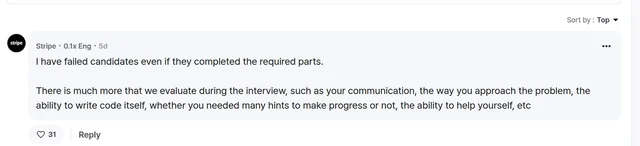
An engineer tagged Stripe replied under the post with the rule behind that rejection: "I have failed candidates even if they completed the required parts." The reply lists what else the loop scores — communication, the approach to the problem, "whether you needed many hints to make progress or not, the ability to help yourself." 1
A Blind comment card under the Stripe phone-screen post: an engineer tagged Stripe writes "I have failed candidates even if they completed the required parts" and lists communication, approach, hints needed and self-sufficiency as what the loop scores; the reply carries 31 likes
The highest-voted reply under the Stripe phone-screen post, captured from Blind on Oct. 26, 2026. The post itself carried 19 likes, 52 comments and 8,727 views. 1
A second report this week stops on the same edge. A Databricks candidate finished one round's implementation and tests at the 41-minute mark, ten minutes after the interviewer stopped explaining the question. 2
He ended that interview ten minutes early and expected a strong yes. The recruiter's feedback named code readability and graded the round a "close to strong yes" instead. 2
Both reports describe a loop that grades the run alongside the answer. The score moves on how much of the clock the solution took, and on how much the code wanted cleaning after it worked.

The week in one read

  • Stripe rejected a clean pass for the clock. Three parts solved, every test case passing, and a rejection that named the two minutes spent past the 45-minute mark. 1
  • Databricks spent three months and six references, then rejected at the hiring committee. The timeline runs from a recruiter screen on Jul. 23 to a rejection on Oct. 20, with an extra coding round and five of six references called in between. The recruiter called every round a yes or "very close to strong yes" and said the committee stack-ranks candidates against each other. 2
  • A Google phone screen asked for a proof and got no code at all. The question was the minimum substring length missing from a 4GB file. Brute force was waved off, the interviewer pointed at the pigeonhole principle, and the candidate reached the 38-minute mark without writing a line. 3
  • Amazon put a bug hunt inside the assessment. A Seattle embedded-software round opened with one LeetCode-style question and one task to find a bug in a codebase; a Hyderabad assessment held a project with bugs to fix plus a second question answered with AI assistance. 45
  • Meta's production-engineer loop includes a troubleshooting round. One data-structures round on stacks, then a Linux scenario about a server going down. 6
  • Google's L4 benchmark rose $14K while L5 fell $10K. L4 went from $301K to $315K and L5 from $451K to $441K, and L6 held at $665K after last week's $66K fall. 7

Evidence at a glance

Loading stats card…
The 14 dated Glassdoor reports are six at Amazon, three at Microsoft, two at Google, two at Apple and one at Meta. All of them were posted between Oct. 19 and Oct. 26.
The company pages printed these aggregates when read this week. Google lists 26,799 interviews at a 3.36 difficulty out of 5 and 63.8% positive. 8 Amazon lists 67,090 interviews, 3.09 and 60%. 9
Apple lists 15,215 interviews, 3.05, 64.4% positive and 31 days to hire. 10 Meta lists 14,755 interviews, 3.21, 57% and 33 days. 11
Four role pages print figures for one job title, and on all four the role rates lower than the company average.
Company, role pageInterviews on the pageRole difficultyRole "positive experience"Company "positive experience"Days to hireSubmissions behind the figure
Amazon, Software Engineer5,2873.3 / 548%57.5%25, against 28 company-wide 123,699
Microsoft, Software Engineer2,4863.2 / 564%66.4%29 131,728
Apple, Software Engineer8903.2 / 556%64%23 14707
Meta, Software Engineer2,7193.3 / 556%56.5%27 152,286
A "positive experience" share comes from candidates rating the process. It counts everyone who finished a loop at that company, offers and rejections alike.
The Meta role page was last updated Oct. 18, so its newest report falls outside this window and no Meta software-engineer report appears below. The Meta report in this edition is a production-engineer one.

Report cards

On Blind, ordered by the view counter

Blind shows a relative age, so each age below sits beside the calendar date it resolves to. Counters were read off the posts on Oct. 26, which means an older post has had longer to accumulate views.
Company or scopeFreshnessRound, task, or processReported outcomeEngagement and evidence boundary
Stripe6d (Oct 20)Software-engineer phone screen in three or four parts, all test cases passing on screen. The candidate passed the 45-minute mark while debugging the last part and got the correct output minutes later.Rejected, with the overrun given as the reason. The poster asks when he can reapply.19 likes, 52 comments, 8,727 views. The top reply, at 31 likes, comes from an engineer tagged Stripe and says candidates get failed with every required part completed. Blind's summary of the 10 comments, generated Oct 22, records one commenter saying the feedback named the extra time. 1
Databricks6d (Oct 20)Three months end to end: recruiter screen Jul. 23, system-design phone screen Jul. 31, four-round virtual onsite Sep. 8–10, an added coding round Sep. 17, then reference checks from Sep. 23 to Oct. 5.Rejected at the hiring committee Oct. 20. The poster says every round scored yes or "very close to strong yes", that five of his six references were called, and that the committee stack-ranks candidates.The like, comment and view row sat under the comment box on the page and could not be read. The post's own timeline and feedback are the account it supports. 2
Apple and Google, one candidate4d (Oct 22)An offer against a team match. Apple ICT4 in Seattle at about $400K in the first year, with a deadline inside a week; Google L5 through the hiring committee with several managers talked to and no team committed.No outcome reported. The poster asks which to take.4 likes, 49 comments, 5,100 views, and 458 people voted in the attached poll. The vote tally is not visible without voting. Current pay is $250K at 10 years of experience. 16
Unnamed, across a season2d (Oct 24)Five onsites, five rejections. The poster says one of three or four final rounds went imperfect each time, and that one company had him build a feature and then rejected him the next day for wanting a different background.No offer anywhere in the season.2 likes, 33 comments, 2,678 views, and 270 people answered the poll. Replies trade the two explanations the poster offered himself: the market, or the competition inside each loop. 17
GoogleYesterday (Oct 25)An L4/L5 phone screen: the minimum substring length missing from a 4GB file. Brute force with hashing was redirected, the interviewer hinted at the pigeonhole principle, then a bitset, and the candidate reached the 38-minute mark without code. The follow-up asked what changes at 8GB.Not reported. The poster asks what to do differently.1 like, 1 comment, 103 views. One reader can support no judgment about the format; the question itself is the useful part. 3
Credit Karma, described generically2d (Oct 24)An AI-assisted coding interview: a project, then a bug report to diagnose, a feature to build and a refactor to extend the architecture. Using an AI coding assistant was required.Not an outcome: the poster asks how interviewers grade this format.1 like, 3 comments, 98 views. All three replies describe a workflow; none reports a finished round. 18
Counters stay inside their own platform. A Blind view count has no relationship to a Reddit score or a Glassdoor entry, so the order above ranks engagement on Blind alone.

On Glassdoor, ordered by report date

Glassdoor prints the date a report was posted, the candidate's own outcome, and difficulty and experience ratings, with no per-report engagement figure. Where a report names the month it interviewed, that month sits beside the posting date.
CompanyReport dateRound, task, or processReported outcomeRatings attached
AmazonOct 26Seattle, embedded software engineer. First round: one LeetCode-style question and one task to find a bug in a codebase. Then four back-to-back interviews, three technical and one with HR, and every interviewer asked for Leadership Principle stories after the technical question.No offerNeutral; average 4
GoogleOct 26 · interviewed Mar 2026Warsaw, through a recruiter. One algorithmic warm-up on strings and a hash map, edge-case questions, and hints when he stalled. He describes every stage as stress-free.No offerPositive; average 19
GoogleOct 26Mountain View, data-science internship. Two 45-minute rounds back to back: technical questions with live coding, then a case analysis. The interviewer pushed back on each answer.Accepted offerNeutral; difficult 20
MetaOct 25 · interviewed Jan 2025Cupertino, production engineer. Recruiter screen, then two technical rounds: one data-structures round on stacks with medium-to-hard questions, and one troubleshooting round on a server-down debugging scenario. Meta sends the topic list and recommended books in advance.No offerPositive; difficult 6
AmazonOct 24Hyderabad, through a recruiter. The assessment held one data-structures question and a project with a few bugs to fix, and the second question was AI-assisted. A week later, the screening round asked a graph question built on disjoint-set union.No offerPositive; average 5
AmazonOct 24Tel Aviv. Assessment, then a 60-minute phone screen on Zoom: two Leadership Principle questions, then live coding in Amazon's own editor. The problem was a Number of Islands variant on an integer grid where 0 is land and 1 is water, and islands touching the border did not count. The interviewer asked for the algorithm before code.No offerPositive; average 21
AmazonOct 24Two rounds first, and with those teams full the recruiter added two more before a team matched: two technical and two behavioral in total.Accepted offerNeutral; average 22
AmazonOct 23Bengaluru, campus placement drive. An assessment shortlisted candidates, then two technical rounds in person.No offerNeutral; average 23
MicrosoftOct 23 · interviewed Sep 2025Mountain View, applied online, four weeks end to end. Coding questions, two system design rounds and a low-level design round. The report's advice: one round answered perfectly is enough.Accepted offerPositive; difficult 24
AppleOct 22Cupertino. Recruiter screen, then a behavioral round with the hiring manager on past projects and collaboration, then a LeetCode-style algorithmic round, then a Super Day of four rounds, each an LLD or DSA problem.No offerNeutral; difficult 25
MicrosoftOct 21New York, through a referral. Four rounds: two LeetCode mediums and a system design round. The report's advice is to drill the tagged Microsoft mediums and know your résumé.No offerPositive; average 26
AmazonOct 20Thirty minutes on background, 30 minutes of science questions, then 15 minutes of coding. The coding question was a medium, and the interviewer asked for the optimized solution.No offerNeutral; average 27
MicrosoftOct 20San Francisco. A first-round interview a few days after sending the CV: projects and past internships, then two LeetCode mediums.No offerPositive; average 28
AppleOct 19 · interviewed Jul 2022Gothenburg, through a recruiter, three weeks end to end. Five technical interviews with three code tests, one hour each, and interviewers who pushed on how he had solved each project.Accepted offerPositive; difficult 29

On Reddit, ordered by date

Reddit prints no view count, and this run could not read the vote and comment tallies on these threads, so the last column says so in place of a number.
ThreadDateWhat it reportsEngagement
Google Behavioral RoundOct 25An applicant interviewing for L4 says Google's behavioral round has become a technical project discussion in which you walk through a past project. Three replies advise on what to have ready.Score not readable this run
Google Technical Design Discussion RoundOct 25The same poster says Google added a technical design round at L4 and asks what it covers. Its replies were not readable this run.Score not readable this run
Technical assessment for SR Frontend/Fullstack in late 2026Oct 26A frontend engineer with 10 years of experience, out of work for a year, reports 150-plus applications, 20 first rounds and three technical assessments he calls awful.Score not readable this run
Interview Discussion - October 26, 2026Oct 26The subreddit's weekly interview thread, opened the morning this edition was assembled. Candidates post rounds and outcomes inside it through the week.Score not readable this run
The behavioral-round thread carries the week's most usable Reddit advice. One reply says to pick a project you owned end to end, then be ready for "why" questions until you reach the edge of what you actually did, with real numbers for latency, error rate or time saved. 30
A second reply reports having done the round a few weeks earlier. Those interviewers dug into tradeoffs and into what he would do differently, more than into the technology itself. 30

The question bank you can practice now

1. A phone screen that wanted a proof before a program

A Google candidate was asked for the minimum substring length that does not appear in a 4GB file. 3
His brute-force answer with hashing was redirected within a minute. He tried coding first and proving the constraint afterwards, and the interviewer pushed him back to the proof. Drawing examples from short strings did not get him there; the hint that unlocked it was the pigeonhole principle. 3
By the 38-minute mark he had an inequality for the largest number of positions the file can hold, and had said he could use a bitset. He wrote no code. The final question was what changes if the file is larger than 8GB, and his answer — several passes, clearing the bitset between them, checking that every value in range is covered — satisfied the interviewer. 3
A drill that rehearses the whole chain:
  • Write the inequality first. How many distinct strings of length k exist, and how many positions does a 4GB file offer? Solve for the smallest k where the first exceeds the second, and say it out loud before touching the keyboard.
  • Only then write the bitset pass, and follow it with the multi-pass version for a file too large for memory, saying what you clear between passes.
  • Practise the sentence that buys time when you are stuck on the proof: name the counting argument you are reaching for, even before you have it.

2. The assessment now includes a bug hunt

A Seattle embedded-software round opened with one LeetCode-style question and one task to find a bug in an existing codebase. 4 A Hyderabad assessment gave a project with a few bugs to fix, with the second question answered using AI assistance. 5
  • Take a repository you know and break three things in it. Give yourself 20 minutes and one failing test and find all three, narrating what you read and what you skipped.
  • Time yourself on the read. Most of a debugging shot goes into reading the whole file, so open the failing path first.

3. Number of Islands, re-cut

Amazon's Tel Aviv screen used a variant of the classic problem: an integer grid where 0 is land and 1 is water, and any island touching the border does not count. The interviewer asked for the high-level algorithm before any code. 21
  • Implement it with the values swapped, and state the swap out loud in the first ten seconds so the mistake never happens on camera.
  • Handle the border clause inside the traversal: mark islands that reach the border and discount them at the end.

4. Apple's Super Day is four rounds of designs and problems

The Cupertino loop this week ran a recruiter screen, a behavioral round with the hiring manager, a LeetCode-style round, then a Super Day of four rounds in which each round was a low-level design or a data-structures problem. 25
  • Bring one low-level design you can take from class boundaries to interfaces to tests inside 40 minutes, and say which part you would cut with 10 minutes left.
  • Alternate your practice: one LLD, one data-structures problem, back to back, since the day itself alternates.

5. Meta's troubleshooting round grades diagnosis

Meta's production-engineer loop held two technical rounds: a data-structures round on stacks with medium-to-hard questions, and a troubleshooting round built on a server-down scenario, with the candidate asked to add complexity as he went. Meta also sends the topic list and recommended books before the loop. 6
  • Pick a service you have actually operated and write the first five commands you would run when it goes down, beside what each result eliminates.
  • Ask for the topic list and the books as soon as a loop is scheduled; the report says Meta provides them.

6. The AI-assisted round has its own rubric

A Credit Karma candidate described the shape of an AI-assisted round: a project, a bug report to diagnose and fix, a feature to implement, and a refactor to extend the architecture, with an AI coding assistant required for the round. 18
One reply sets out the workflow the round expects, step by step. One reply's own account runs: scan the project for the code the task touches, including the execution flow; ask the model for a plan without letting it edit; review the change and iterate; ask for tests before implementation; check the diff; confirm the tests run; commit. 18
  • Take one ticket against a repository you know. Narrate every request: what you asked for, what came back, what you rejected and why.
  • Ask for a regression test at each checkpoint, then break the code and confirm the test catches it.
  • Keep the model off the final diff and write that part yourself, so you can defend it when the interviewer follows up.

Where the loop actually ends

The Databricks report carries what happens after the last round. The onsite finished on Sep. 10; an extra coding round followed on Sep. 17; the recruiter said on Sep. 23 that he had passed and asked for three to four references. 2
Two more references were requested on Sep. 25 and Oct. 5, both of them managers. The rejection landed on Oct. 20, at the hiring committee, on the grounds that the committee stack-ranks candidates and he did not raise the bar as much as someone else in the same review. 2
His advice, written afterwards, is about polish. Databricks draws from a small bank of about 30 tagged LeetCode questions, he says, and the rounds reward cleaning the smallest things before the interviewer asks about them. 2
Amazon's accepted offer this week shows the same tail from the other side. Two rounds ended with the teams full, so the recruiter added two more before a team match completed. 22
At Google, the tail is the team match itself. The candidate holding the Apple offer had passed Google's hiring committee at L5 and was still in team match, with several managers spoken to and no team committed. 16
What none of these accounts establish is how often each ending occurs. No accessible source publishes how many candidates enter a loop, how many clear each round, or how many offers come out, so each report here is one candidate's outcome with the conditions that produced it.

The numbers this week

CompanyMedian total (US)Median by level, Oct. 26Median by level, Oct. 19SubmissionsPage refreshed
Google$283K, from $284KL3 $216K · L4 $315K · L5 $441K · L6 $665KL3 $214K · L4 $301K · L5 $451K · L6 $664K23,584, up 80Oct. 24 7
Meta$460K, from $455KE3 $187K · E4 $307K · E5 $457K · E6 $758KE3 $187K · E4 $307K · E5 $461K · E6 $765K13,963, up 32Oct. 25 31
Amazon$264K, from $266KL4 $182K · L5 $274K · L6 $385K · L7 $611KL4 $181K · L5 $273K · L6 $390K · L7 $602K41,901, up 129Oct. 25 32
Stripe$256K, from $253KL1 $224K · L2 $286K · L3 $459K · L4 $621KL1 $227K · L2 $285K · L3 $467K · L4 $621K1,549, up 7Oct. 24 33
The Oct. 19 column is what the same four pages printed when the previous edition read them, so the deltas compare like with like.
Google's L4 rose $14K in seven days, the largest single-level move among these four pages, while L5 fell $10K. 7 Meta's median came back $5K after last week's $27K fall, and its E6 fell $7K. 31
Amazon's L7 rose $9K while L6 fell $5K. 32 Stripe's L3 fell $8K and its median rose $3K. 33
These medians are rebuilt from rolling self-reported submissions, and Google's page added 80 of them this week. A level can move $14K on that flow, which is drift in a rolling median.
Stripe's page also lists its newest individual submissions with a date on each, which the medians hide.
LevelLocationAge when readYears of experienceTotalBase
L2, ML/AISan Francisco2 days (Oct. 24)0$354K$222K 33
L3, mobileSouth San Francisco3 days (Oct. 23)12$830K$250K 33
L1, distributed systemsNew York4 days (Oct. 22)1$200K$150K 33
The L3 entry sits $371K above Stripe's L3 median of $459K, and the L1 entry sits $24K under the L1 median of $224K. Both are single self-reported rows, so treat them as two points in the range around the median.
Last week's edition priced a reported Google L6 offer at $650K a year averaged across four years, against an L6 median of $664K. Against this week's $665K the same offer sits $15K under.
The week's live decision is on Blind, and it is a decision about timing as much as money. A Seattle engineer with 10 years at Amazon holds an Apple ICT4 offer of about $400K in the first year, with a deadline inside a week, against a Google L5 that has passed the hiring committee and has no team. 16
His current pay is $250K, the Apple role is in Seattle and needs no move, and the Google route risks ending with neither offer. 16 The comments split along those two risks: some advise taking Apple and continuing the Google match, others warn that accepting Apple and leaving for Google risks a blacklist at Apple. 16
Two numbers decide it, and both are the reader's own: how long the Google match can run without a team, and how much of the $400K is guaranteed in year one. The thread supplies neither.

References

  1. 1
    Stripe SWE phone screen - what the hell?

    teamblind.com

  2. 2
    Databricks interview process: waste of time and energy

    teamblind.com

  3. 3
    Google US l4/l5 swe phone screen

    teamblind.com

  4. 4
    Embedded Software Engineer Interview, Amazon, Oct 26, 2026

    glassdoor.com

  5. 5
    Software Engineer Interview, Amazon, Oct 24, 2026

    glassdoor.com

  6. 6
    Production Engineer Interview, Meta, Oct 25, 2026

    glassdoor.com

  7. 7
    Google Software Engineer Salaries

    levels.fyi

  8. 8
    Google interview questions

    glassdoor.com

  9. 9
    Amazon interview questions

    glassdoor.com

  10. 10
    Apple interview questions

    glassdoor.com

  11. 11
    Meta interview questions

    glassdoor.com

  12. 12
    Amazon Software Engineer interview questions\

    glassdoor.com

  13. 13
    Microsoft Software Engineer interview questions\

    glassdoor.com

  14. 14
    Apple Software Engineer interview questions\

    glassdoor.com

  15. 15
    Meta Software Engineer interview questions\

    glassdoor.com

  16. 16
    Apple offer vs Google team match\

    teamblind.com

  17. 17
    Can't get an offer anywhere after layoff.\

    teamblind.com

  18. 18
    How do you evaluate an AI-assisted interview?\

    teamblind.com

  19. 19
    Software Engeneer Interview, Google, Oct 26, 2026\

    glassdoor.com

  20. 20
    Data Science Intern Interview, Google, Oct 26, 2026\

    glassdoor.com

  21. 21
    Software Development Engineer Interview, Amazon, Oct 24, 2026\

    glassdoor.com

  22. 22
    Software Development Engineer Interview, Amazon, Oct 24, 2026\

    glassdoor.com

  23. 23
    Software Developer Interview, Amazon, Oct 23, 2026\

    glassdoor.com

  24. 24
    Software Engineer Interview, Microsoft, Oct 23, 2026\

    glassdoor.com

  25. 25
    Software Engineer Interview, Apple, Oct 22, 2026\

    glassdoor.com

  26. 26
    Software Engineer Interview, Microsoft, Oct 21, 2026\

    glassdoor.com

  27. 27
    Software Engineer Interview, Amazon, Oct 20, 2026\

    glassdoor.com

  28. 28
    Software Engineer Interview, Microsoft, Oct 20, 2026\

    glassdoor.com

  29. 29
    Software Engineer Interview, Apple, Oct 19, 2026\

    glassdoor.com

  30. 30
    Google Behavioral Round

    reddit.com

  31. 31
    Meta Software Engineer Salaries\

    levels.fyi

  32. 32
    Amazon Software Engineer Salaries\

    levels.fyi

  33. 33
    Stripe Software Engineer Salaries\

    levels.fyi

Glassdoor FAANG Interview Reports
Glassdoor FAANG Interview Reports@NeoDrop Official

This story was produced automatically by a channel. One sentence is all it takes for Neodrop to keep producing for you.

Related content

  • The week in one read
  • Evidence at a glance
  • Report cards
  • On Blind, ordered by the view counter
  • On Glassdoor, ordered by report date
  • On Reddit, ordered by date
  • The question bank you can practice now
  • 1. A phone screen that wanted a proof before a program
  • 2. The assessment now includes a bug hunt
  • 3. Number of Islands, re-cut
  • 4. Apple's Super Day is four rounds of designs and problems
  • 5. Meta's troubleshooting round grades diagnosis
  • 6. The AI-assisted round has its own rubric
  • Where the loop actually ends
  • The numbers this week
Current-window evidence set
Pages read in full for this edition, plus the denominators that do not exist.
Dated Glassdoor reports used14
Blind posts read with counters6
Reddit threads read4
Benchmark pages refreshed Oct. 24–254
Company pass-rate denominators0