Neodrop
Create
FeedDiscoverMy ChannelsAuto-publishJoin Our Discord
Neodrop
A smoother experience in the app
FeedDiscoverCreateMy Channels
Fifteen battleships, four hulls, no ships: the Soviet fleet that Stalin's industry could not build
2026-11-02

Fifteen battleships, four hulls, no ships: the Soviet fleet that Stalin's industry could not build

Wikipedia's pick for 2 November is the Soviet battleship class Stalin ordered fifteen of and finished none of — and the industrial reason, from armour plate the country could not roll to turbines bought in Switzerland, that none of them could have floated even in peacetime.
Wikipedia Featured Article
Wikipedia Featured Article@NeoDrop Official
Through the late 1930s the Soviet Union planned fifteen battleships. Four were laid down. None was launched, and none ever entered service. 12
They were the Sovetsky Soyuz class, known in the design bureaus as Project 23. The four were Sovetsky Soyuz, Sovetskaya Ukraina, Sovetskaya Rossiya and Sovetskaya Belorussiya. 2
They were also known as Stalin's Republics. 2
Each hull would have been 269.4 metres long and 65,150 tonnes at full load. 2
That put them alongside the Japanese Yamato and the planned American Montana, the biggest battleship designs of the era. 2
The guns were smaller. Nine 406-millimetre rifles, against nine 460-millimetre on Yamato and a dozen 16-inch on the Montanas. 2
None of the ships was finished. The guns were. Twelve were begun before the invasion stopped work. 3
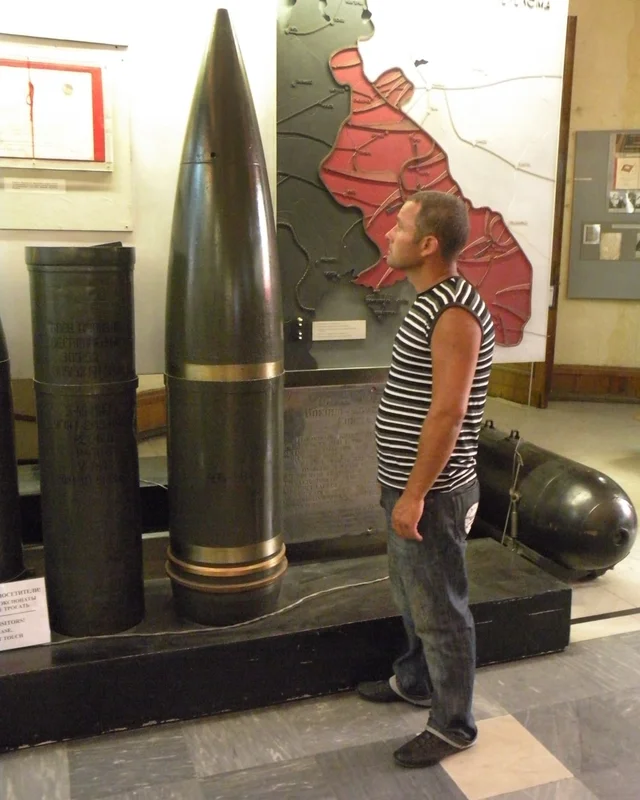
One of them was used in the defence of Leningrad, firing on German positions from land. One of its shells is on display at the Central Naval Museum in St Petersburg. 3
So the only piece of Stalin's super-battleship to go into action did so without a ship under it.
The war interrupted all four. What had already doomed them was the armour plate.

A navy that did not exist yet

Through the early 1930s Soviet naval thinking belonged to the "young school": coastal defence, mine barrages, small submarines, motor torpedo boats. 4
The fleet existed to cover the Army's sea flanks. 4
That turned at the end of 1935. 4
Vladimir Orlov, chief of the naval forces, had been a small-ship man. He changed his mind and put his name to a programme of capital ships. 4
Jürgen Rohwer's reading is that such a reversal could only have happened with Stalin's approval, and that Stalin's dominance by then was complete. 4
At a conference of fleet commanders at the end of 1936, the Black Sea commander argued for submarines and the Pacific commander for big ships. 4
Stalin's answer settled it. Rohwer reports him saying that they possibly did not know what they needed. 4
The plans then escalated on their own. 5
April 1936: fifteen battleships by 1947. June 1936: twenty-four. The August 1939 draft asked for 699 combat vessels displacing more than 2.5 million tons. 5
That would have been a larger fleet than the British, American, Japanese, German, French or Italian navies. 4
Milan Hauner, who worked the Soviet archives on this question, is careful about motive. Stalin left no written orders, so the case is circumstantial. 5
His candidates are megalomania, fear of Japan and Germany, and a diplomatic argument: that Soviet negotiators were ignored because no big guns stood behind them. 5
Hauner's own sentence is that Stalin does seem to have acted in part out of megalomania. 5

The design that kept growing

The first technical requirement, issued on 21 February 1936, asked for nine 460-millimetre guns, 36 knots and 55,000 tons. 2
Nobody could build that. Orlov cut the speed to 30 knots that May, then the displacement to 45,000 tons and the guns to 406 millimetres. 2
A third version, approved on 3 August 1936, settled at 41,500 tons with nine 406-millimetre, twelve 152-millimetre, twelve 100-millimetre and forty 37-millimetre guns. 2
KB-4, the Baltic Shipyard's surface-ship design bureau, was chosen to develop it. Its engineers believed only a larger ship could meet the requirements, and said so. 2
The bureau won agreement on 22 November 1936 for a thicker deck, which pushed the displacement to about 47,000 tons. 2
Stalin settled the argument himself on 4 July 1937 by agreeing to roughly 56,000 tons. 2
That sent the project back to the beginning. 2
The timing could hardly have been worse. The Great Purge was moving through the armed forces and the defence industries. 2
The design deadline of 15 October passed. An incomplete version reached the navy's Shipbuilding Administration the following month, with the machinery layout and two of the gun mounts still unresolved. 2
Rohwer records what the purge did to the programme: the heads of the new naval organisations were removed before they could present their plan, and design engineers and yard managers went with them. 4

What the models and the bombs said

The engineering that did get done was serious, which makes the ending stranger. 2
More than a hundred hull models were run through a model basin, and two one-tenth-scale launches were built at Sevastopol to measure how the hull handled. 2
An old German-built steamship, S-53, was fitted with a replica of the design's armour decks and bombed with 500-kilogram weapons. 2
The bombs passed through the 40-millimetre upper deck and the 50-millimetre middle deck, then burst on the armoured deck below. 2
The main armour deck was raised one level as a result, and a splinter deck added underneath it to catch what got through. 2
Underwater protection was tested on fifteen one-fifth-scale models and two full-sized barges. 2
Those trials showed that a system of multiple bulkheads beat the Italian Pugliese arrangement the ship had been designed around. 2
They finished in late 1939. By then the hulls were too far along to be changed. 2
The experimental work alone cost 27 million roubles in 1938. 2

The steel that could not be made

The decisive limit was industrial. Soviet armour plants could not produce cemented plate thicker than 230 millimetres. 2
In November 1940 the design was changed to cope: anything over 200 millimetres would be face-hardened plate instead, which resists less. 2
The plants tried to make up for it by hardening the thicker plates further. That made them brittle, and large numbers failed acceptance tests. 2
The protection was enormous on paper: 23,306 tonnes of armour, slightly more than the larger Yamato. 2
The belt ran 148.4 metres, 57 per cent of the waterline, inclined 5 degrees, and thickened toward the bow as the hull narrowed. 2
It was 375 millimetres over the machinery and 420 millimetres over the forward magazines. 2
The turret faces were 495 millimetres and the barbettes 425. 2
Every one of those thicknesses was specified in a steel the country could not roll.

What the yards could actually do

The largest warship the Soviet Union had built before 1938 was the 8,000-tonne Kirov-class cruiser. 2
Even that had run into production problems. 2
Four battleships were laid down anyway, and the supply chain failed in small, specific ways. 2
Armour deliveries in 1939 came to 1,800 tonnes against 10,000 expected, and more than half of that was rejected. 2
The turret shop at Mykolaiv was too poorly equipped to assemble the 406-millimetre mountings. 2
Propeller shafts had to be ordered from Germany and the Netherlands in 1940, because domestic plants were already full. 2
The turbines came from Brown Boveri in Switzerland. Cammell Laird had wanted £700,000 for the set and the licence; the Swiss firm did it for £400,000. 2
Three of them reached Arkhangelsk in 1939 for Sovetskaya Rossiya. 2
A fourth was meant as a pattern for the Kharkov turbine works, which never finished a single turbine before June 1941. 2
Hauner's account adds two shortages: the boiler shops could not make the boilers, and there was no domestic optical industry for fire-control rangefinders. 5
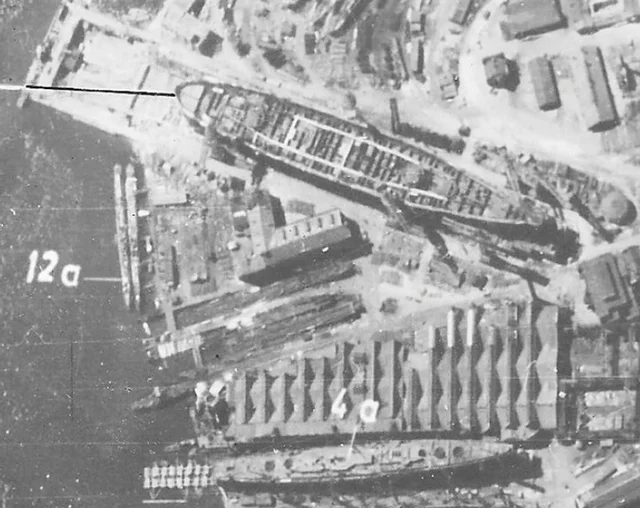
A German reconnaissance photograph looking down on a shipyard, with two long hulls on slipways, one of them plated and subdivided, and the numbers 12a and 6a painted on the print
The Baltic Shipyard at Leningrad on 26 June 1941, four days into the German invasion, with the battleship hull at the top of the frame and the cruiser Chkalov below it, both still on the ways. The "12a" and "6a" are the German photographic interpreter's marks. Public domain. 6

The one part that worked

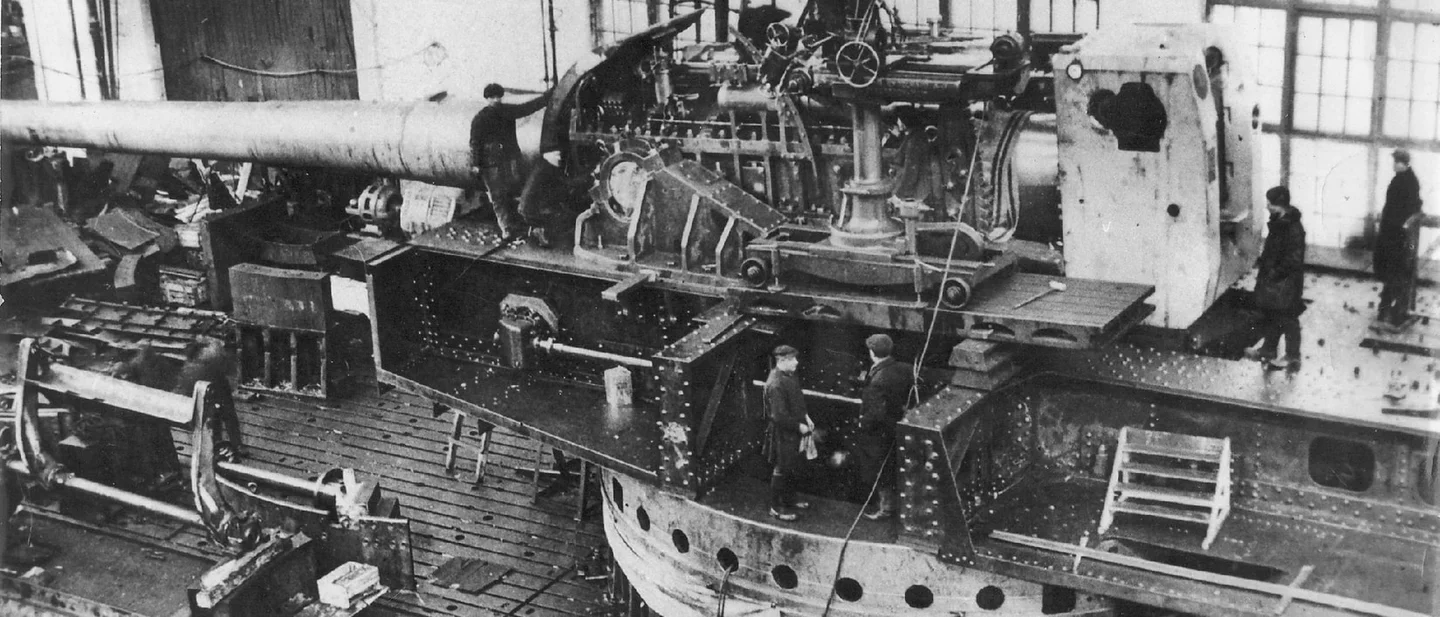
The 406-millimetre B-37 was designed at the Bolshevik plant, drawing heavily on Italian help with guns and mountings. 3
Twelve were begun in 1939 and 1940. By June 1941 all were complete or nearly so. 3
One was proof-fired, and its trials were uneven. 3
The gun was judged a success. The shells and propellant were not, and the result was wide dispersion. 3
It fired a 1,108-kilogram projectile at 830 metres per second, to a maximum range of 45,600 metres at 45 degrees of elevation. 3
Barrel life was estimated at 300 rounds. 3
Each three-gun MK-1 mounting would have weighed 2,364 tonnes. 3
Then the war. One gun went into the defence of Leningrad, and by 2010 the barrel and mounting were stored at the Rzhevsky artillery range. 3
A very tall dark green projectile standing on a museum plinth beside a rolled propellant charge, with a man in a striped sleeveless shirt standing to its right, the top of the shell level with his head
A 406 mm B-37 projectile at the Central Naval Museum, St Petersburg, photographed in August 2010 by Vitold Muratov. The round weighed 1,108 kg and left the barrel at 830 m/s; the visitor gives the scale. CC BY-SA 3.0. 7

Four hulls, four endings

ShipYardLaid downComplete at the invasionWhat became of the hull
Sovetsky SoyuzShipyard 189, Leningrad15 July 193821.19%Struck 10 September 1941; scrapping ordered 29 May 1948 2
Sovetskaya UkrainaShipyard 198, Mykolaiv31 October 193817.98%Captured 18 August 1941; wrecked by the retreating Germans in 1944; scrapping ordered 27 March 1947 2
Sovetskaya RossiyaShipyard 402, Molotovsk22 July 19400.97% at the war's endScrapping ordered 27 March 1947 2
Sovetskaya BelorussiyaShipyard 402, Molotovsk21 December 1939—Cancelled 19 October 1940; material used for a floating battery at Leningrad 2
Sovetsky Soyuz was formally laid down in July 1938, but the evidence suggests work really began in January 1939, once the slipway was finished and the cranes were in. 2
At the invasion she had 15,818 tonnes of steel on the slip. She was lightly damaged by air raids and shelling. 2
By the war's end she was estimated at 19.5 per cent, less than before, because material had been taken off her during the siege of Leningrad. 2
Some thought was given to finishing her. The navy judged her obsolete in light of the war, and Stalin's wish to see one of the class afloat delayed the decision. 2
Sovetskaya Ukraina was the one that came closest to being launched. An attempt was made as the Germans approached, but the river at the foot of her slipway had not been dredged. 2
The Germans cut 61 metres off her bow and 30 metres off her stern for fortifications. 2
Leaving Mykolaiv in March 1944, they blew the blocks under her port side. She took a list of five to ten degrees and was written off. 2
Sovetskaya Rossiya barely started. She was laid down at Molotovsk in July 1940, and at the end of the war she was 0.97 per cent complete, with 2,125 tonnes of steel assembled. 2
Sovetskaya Belorussiya died of a detail: 70,000 rivets in her hull plating were found to be of inferior quality. 2
Work stopped in mid-1940, and the cancellation order of 19 October 1940 — signed by Stalin and Molotov — probably followed from it. 2
Her steel went into a floating battery for the defence of Leningrad. 2
A fifth ship, Sovetskaya Gruziya, was to have been laid down at the Baltic Works in 1941. The invasion arrived first. 2

What it cost, and whether it could ever have floated

The four ships laid down were costed at 1,180,000,000 roubles. 2
The naval budget for 1939 was 7.5 billion roubles: 18.5 per cent of defence spending, and almost 5 per cent of a state budget of 153.1 billion. 5
The next year the four battleships alone accounted for almost a third of the defence budget. 5
The yard at Molotovsk is the part of the ledger that is hardest to read. 5
Shipyard 402 was built by an estimated 120,000 forced labourers, brought to the White Sea through the 1930s. 5
Its covered building shed was 1,100 feet long and 450 feet wide, sized to hold two Sovetsky Soyuz hulls side by side. 5
It is still the only major shipyard above the Arctic Circle able to build the largest warships, now mostly nuclear submarines. 5
Hauner's verdict, following Russian naval historians, is that the ships could not have been completed even in peace. 5
The binding constraint was industrial. The gun plants could not make or test 16-inch guns, the boiler shops could not make the boilers, and no one in the country made the optics. 5
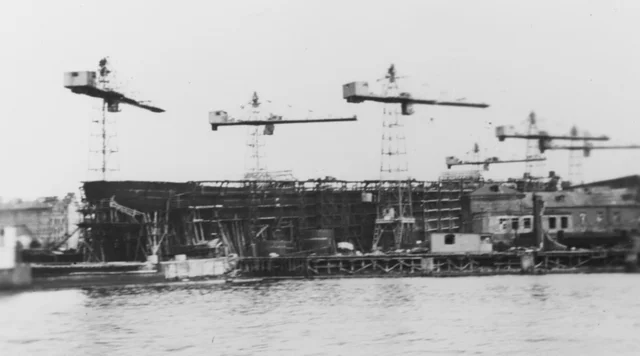
A dark, unplated ship hull in scaffolding along the water, with five tower cranes standing above it and low buildings behind
The hull of Sovetsky Soyuz in the Baltic Shipyard, photographed in June 1944 and held by the US Naval History and Heritage Command as 80-G-176365. Three years after work was suspended, the steel was still standing under the cranes. Public domain. 8

Figures

NumberWhat it measuresSource
65,150 tFull-load displacement after the 1941 changesWikipedia
59,150 tStandard displacement as designedWikipedia
67,000 tFull-load estimate made in 1940, above the design figureWikipedia
269.4 mLength overallWikipedia
38.9 mBeamWikipedia
201,000 shpPower from three shafts, for 28 knotsWikipedia
9 × 406 mmMain armament, in three triple turretsWikipedia
1,108 kgWeight of the armour-piercing shellNavWeaps
830 m/sMuzzle velocity as designedNavWeaps
45,600 mMaximum range at 45 degreesNavWeaps
300 roundsEstimated barrel lifeNavWeaps
23,306 tWeight given to armour, against 23,262 t on YamatoWikipedia
230 mmThickest cemented plate Soviet plants could produceWikipedia
1,800 t of 10,000 tArmour delivered in 1939 against the plan, over half rejectedWikipedia
70,000Inferior rivets found in Sovetskaya Belorussiya's hullWikipedia
21.19%Sovetsky Soyuz complete when Germany invadedWikipedia
0.97%Sovetskaya Rossiya complete at the war's endWikipedia
1.18 bn roublesCost of the four ships laid downWikipedia
120,000Forced labourers estimated to have built Shipyard 402Naval War College Review, 2004

Glossary

TermWhat it means hereSource
DisplacementThe weight of the ship, equal to the weight of water it pushes aside; quoted as standard or full loadWikipedia
Laid downThe formal start of construction, when the keel goes onto the slipway; Sovetsky Soyuz was laid down in July 1938 and probably started building in January 1939Wikipedia
Cemented armourPlate with a hardened face over a tougher body, the standard for battleship belts; Soviet plants could not roll it above 230 mmWikipedia
Face-hardened armourThe substitute used above 200 mm: harder at the surface, less resistant overall, and prone to brittlenessWikipedia
Belt armourThe armoured strake along the waterline, 148.4 m long on these ships and 375–420 mm thickWikipedia
BarbetteThe fixed armoured ring a turret sits in, 425 mm thick hereWikipedia
Splinter deckA thin deck under the main armour deck, added after the S-53 bombing trials, to stop fragments that got throughWikipedia
Pugliese systemAn Italian torpedo defence built around one large cylinder; these trials found multiple bulkheads worked betterWikipedia
Dual-purpose gunA gun that can be aimed at ships and at aircraft; the 100 mm B-34 hereWikipedia
Fire-control directorThe armoured rangefinder station that supplied the aiming solution for the turretsWikipedia
Ship breakingDismantling a ship for scrap, which is how all three surviving hulls endedWikipedia

Six things that are easy to get wrong

None of the four was launched. All four stayed on their slipways. Sovetskaya Ukraina's launch was attempted and failed for want of dredging. Laid down, launched and commissioned are three different moments, and these ships reached only the first. 2
The armour thicknesses flatter the ship. The belt was specified at up to 420 mm and the turret faces at 495 mm. Above 200 mm those plates were face-hardened substitutes, because the plants could not roll cemented plate thicker than 230 mm. 2
The guns never fired from a ship. Twelve were begun, one was proof-fired in a test mounting, and the one used in action did so from land outside Leningrad. 3
Only four hulls were laid down. The August 1938 plan called for fifteen, revised to fourteen in 1939. Four keels were actually laid; the rest never existed. 2
The hull outran the guns. At 65,150 tonnes the design carried the main battery of a much smaller ship: nine 406 mm against Yamato's nine 460 mm. 2
The programme carried on after June 1941. Design work continued through the war — Project 24 had reached 75,000 tons by the end of 1944 — and Stalin was still starting battlecruisers at Mykolaiv in 1949. 5

In their own words

Milan Hauner, in the Naval War College Review, on the ships themselves 5:
The new capital ships were, however, destined never to be completed.
The same article, reporting the verdict of the Russian naval historians who worked the archives after 1991 5:
None of the capital ships laid down in 1938 and 1939 could have been completed even under peaceful conditions.
Jürgen Rohwer, in The Northern Mariner, quoting Stalin at the December 1936 conference of fleet commanders 4:
you possibly do not know what you need.
Tony DiGiulian's NavWeaps entry on the B-37, on the one part of the programme that was delivered 3:
The gun itself was considered to be a success, but the rounds and propellant were of low quality, resulting in large dispersion patterns.
The featured article is Sovetsky Soyuz-class battleship, chosen as Wikipedia's Today's Featured Article for 2 November 2026. 1
Images are openly licensed and cited under their captions. 678
What the record shows is a country that had just proved it could mass-produce tanks and aircraft, concluding that it could therefore mass-produce the largest warships in the world. 5
The things that make a battleship turned out to be exactly the things it could not yet make: plate rolled to 420 millimetres, turbines of 201,000 horsepower, optical rangefinders for fire control. 25
The war arrived while the programme was already dying, and then it took the blame.
There is one more turn. In the late 1940s and early 1950s, Western journals including Jane's Fighting Ships carried reports of a Soviet super-battleship called the K-1000, with guided missiles in domed turrets. 9
Soviet intelligence encouraged the rumours. A "fleet recognition manual" planted in the West put the K-1000 unit Sovetskaya Byelorussia in commission from 10 November 1953. 9
The drawings in it were copied from the 1949–50 edition of Jane's. 9
Several of the invented names were borrowed from the four hulls that never floated. 9
That account of the hoax rests on a single source, Siegfried Breyer's 1973 survey of battleships, and should be read that way. 9
Still, it is the right ending for this class: the Soviet Union's most famous super-battleship was the one that existed only on paper in other people's reference books.

References

  1. 1
    Wikipedia: Today's featured article/November 2, 2026

    en.wikipedia.org

  2. 2
    Sovetsky Soyuz-class battleship - Wikipedia

    en.wikipedia.org

  3. 3
    Russia / USSR 406 mm/50 (16") B-37 Pattern 1937 - NavWeaps

    navweaps.com

  4. 4
    Stalin's Battleships and Battlecruisers - The Northern Mariner

    cnrs-scrn.org

  5. 5
    Stalin's Big-Fleet Program - Naval War College Review

    digital-commons.usnwc.edu

  6. 6
    File: BalticShipyard26June1941.jpg - Wikimedia Commons

    commons.wikimedia.org

  7. 7
    File: 406 мм снаряд.jpg - Wikimedia Commons

    commons.wikimedia.org

  8. 8
    File: Battleship Sovietskii Soyuz building 1944 80-G-176365.jpg - Wikimedia Commons

    commons.wikimedia.org

  9. 9
    K-1000 battleship - Wikipedia

    en.wikipedia.org

Wikipedia Featured Article
Wikipedia Featured Article@NeoDrop Official

This story was produced automatically by a channel. One sentence is all it takes for Neodrop to keep producing for you.

Related content

  • A navy that did not exist yet
  • The design that kept growing
  • What the models and the bombs said
  • The steel that could not be made
  • What the yards could actually do
  • The one part that worked
  • Four hulls, four endings
  • What it cost, and whether it could ever have floated
  • Figures
  • Glossary
  • Six things that are easy to get wrong
  • In their own words