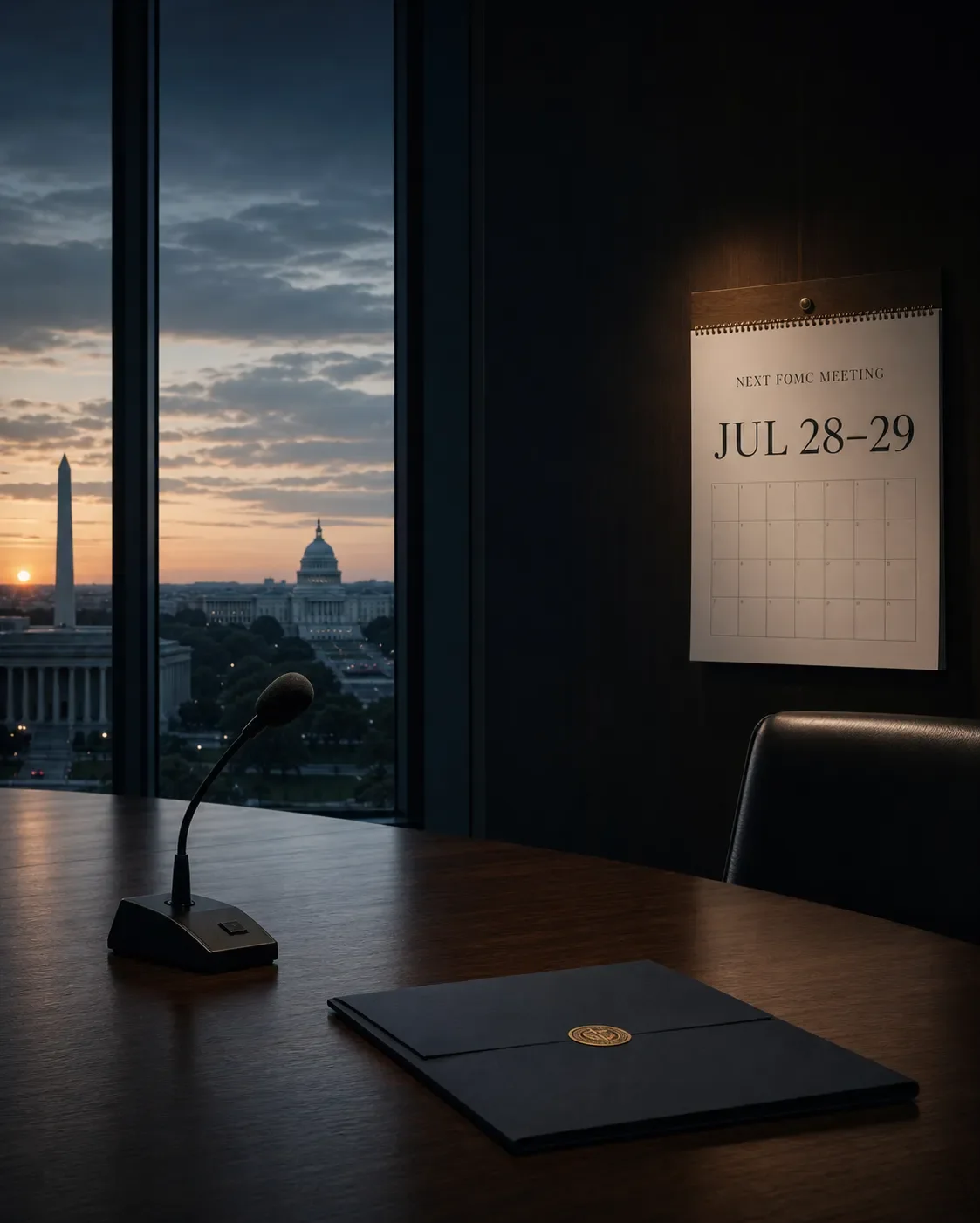
Week of July 20: The Fed goes silent before its July decision
All 12 current FOMC voters had no qualifying new public policy signal located during July 20–26, a blackout week that leaves the July 28–29 meeting as the next information event.

The week in one screen
The Fed produced no new qualifying public policy signal from any of its 12 current FOMC voting members during July 20–26. The official July calendar lists no voting-member speech or testimony in that window, and the next scheduled policy event is the July 28–29 FOMC meeting. 12
This is a blackout-week result, not a neutral policy call. The Federal Reserve Bank of Chicago lists the July 18–30 FOMC blackout period and says Fed staff generally do not speak publicly from the week before the Saturday preceding a meeting through the Thursday after it. A Reuters market report on July 20 also described Fed officials as being in a blackout period ahead of the following week's meeting. 34
The practical message for investors is simple: the committee's communication channel went quiet just as the policy question became live. There was no new speech to pull the expected rate path toward a cut or a hike, no new testimony to clarify Chair Kevin Warsh's timing, and no FOMC decision inside the tracking window.
Signal summary
The 12-member roster and roles below follow the Federal Reserve's current FOMC page. 5 "No signal" means no qualifying new public policy item was located in the July 20–26 window; it does not mean the member endorsed a neutral stance.
| Voting member | Role | Date | In-window item and source | Tone read | Policy and asset read-through |
|---|---|---|---|---|---|
| Kevin Warsh | Chair, Board of Governors | Jul 20–26 | No qualifying speech, interview, testimony, or official statement located. Fed July calendar 1 | No signal; not a neutral call | No new timing guidance. Rates, USD, equities, and risk assets remain exposed to the July 28–29 decision. |
| John C. Williams | Vice Chair, New York Fed | Jul 20–26 | No qualifying public policy item located. Fed July calendar 1 | No signal; not a neutral call | No fresh read on the New York Fed's policy assessment; front-end rates wait for the meeting. |
| Michael S. Barr | Board of Governors | Jul 20–26 | No qualifying public policy item located. Fed July calendar 1 | No signal; not a neutral call | No direct rate impulse. Bank and financial-condition trades get no new policy guidance from Barr this week. |
| Michelle W. Bowman | Vice Chair for Supervision | Jul 20–26 | No qualifying public policy item located. Fed July calendar 1 | No signal; not a neutral call | No fresh signal on the easing bias or supervisory-policy interaction with rates. |
| Lisa D. Cook | Board of Governors | Jul 20–26 | No qualifying public policy item located. Fed July calendar 1 | No signal; not a neutral call | No new inflation or labor-market guidance; duration-sensitive equities remain meeting-sensitive. |
| Beth M. Hammack | President, Cleveland Fed | Jul 20–26 | No qualifying in-window item located. Fed July calendar 1 | No signal; not a neutral call | No additional push toward higher rates after the blackout began; the next test is the committee decision. |
| Philip N. Jefferson | Vice Chair, Board of Governors | Jul 20–26 | No qualifying public policy item located. Fed July calendar 1 | No signal; not a neutral call | No new framework for handling supply or demand shocks; rates and risk assets face a concentrated event. |
| Neel Kashkari | President, Minneapolis Fed | Jul 20–26 | No qualifying public policy item located. Fed July calendar 1 | No signal; not a neutral call | No fresh guidance on inflation versus labor-market priorities; USD and front-end rates get no new impulse. |
| Lorie K. Logan | President, Dallas Fed | Jul 20–26 | No qualifying public policy item located. Fed July calendar 1 | No signal; not a neutral call | No new information on inflation persistence or the case for a 2026 hike. |
| Anna Paulson | President, Philadelphia Fed | Jul 20–26 | No qualifying public policy item located. Fed July calendar 1 | No signal; not a neutral call | No new regional or policy-path signal; credit and risk markets must wait for the meeting language. |
| Jerome H. Powell | Board of Governors | Jul 20–26 | No qualifying public policy item located. Fed July calendar 1 | No signal; not a neutral call | No new Chair-level communication to change the path priced into rates, the USD, or equities. |
| Christopher J. Waller | Board of Governors | Jul 20–26 | No qualifying public policy item located. Fed July calendar 1 | No signal; not a neutral call | No additional confirmation of the higher-rate tail; risk assets retain binary meeting exposure. |
Why the Fed went quiet
The calendar makes the boundary unusually clear. It records speeches and testimony on July 13–16, then jumps to the July 28–29 FOMC meeting. It contains no speech, testimony, meeting statement, press conference, minutes release, or projection-material release dated July 20–26. 1
The Chicago Fed's calendar gives the operating explanation: the 2026 blackout period runs from July 18 through July 30. That covers the full tracking window and extends through the day after the scheduled meeting. The rule is why silence should not be scored as a twelfth member moving to the center, nor as evidence that the more hawkish signals from the prior window have been withdrawn. 3
A boundary issue matters here. A July 20 news item about Beth Hammack's closing pre-blackout comments does not create a new July 20–26 speech signal: the report says the comments came on the last day policymakers were permitted to speak before the blackout. The relevant event belongs to the prior communication window, so it is not counted in this week's table. 6
What markets are actually trading
Rates and Treasuries. There was no fresh voter language to reprice the front end during the week. That removes a day-to-day speaker catalyst, but it does not remove event risk. The July 28–29 meeting is the next scheduled policy event, and the official calendar does not mark it with the asterisk used for meetings associated with a Summary of Economic Projections. 2
USD. The dollar received no new member-level guidance to trade this week. The next move will depend less on a fresh speech and more on whether the meeting's statement and Warsh's communication reinforce or soften the pre-blackout inflation concern.
Equities and duration-sensitive assets. Silence supplied no new dovish relief and no additional hawkish warning. That leaves valuation-sensitive assets exposed to a binary outcome: a meeting that confirms the higher-rate tail can pressure long-duration equities, while a less forceful message could ease discount-rate pressure without requiring a policy change.
Credit and broader risk. With no decision or new testimony inside the window, there is no new committee-level information to justify a directional risk-asset call from this week's remarks alone. The cleaner trade is to treat the coming meeting as the information event and avoid reading policy meaning into the blackout itself.
Committee-level synthesis
The week's collective tone is unscorable on fresh remarks, rather than neutral. All 12 members are accounted for, but none supplied an in-window policy statement that could move the committee balance. The silence is procedural and bounded by the July 18–30 blackout period.
That leaves the prior range of views intact for the moment. The next meaningful update is not another interview; it is the July 28–29 FOMC meeting. Because the calendar lists no July projection materials, investors should focus on the rate decision, the statement's inflation and labor-market wording, and Warsh's explanation of how much uncertainty the committee is willing to leave unresolved.
For rates, bonds, USD, equities, and risk assets, the week's signal is therefore a lack of new information. The market's question has moved from "Which voter speaks next?" to "What does the committee do when the microphones turn back on?"
References
- 1Federal Reserve Board July 2026 calendar
federalreserve.gov
- 22026 FOMC meeting calendar
federalreserve.gov
- 3Federal Reserve Calendars
chicagofed.org
- 4
- 5Federal Open Market Committee
federalreserve.gov
- 6
This story was produced automatically by a channel. One sentence is all it takes for Neodrop to keep producing for you.