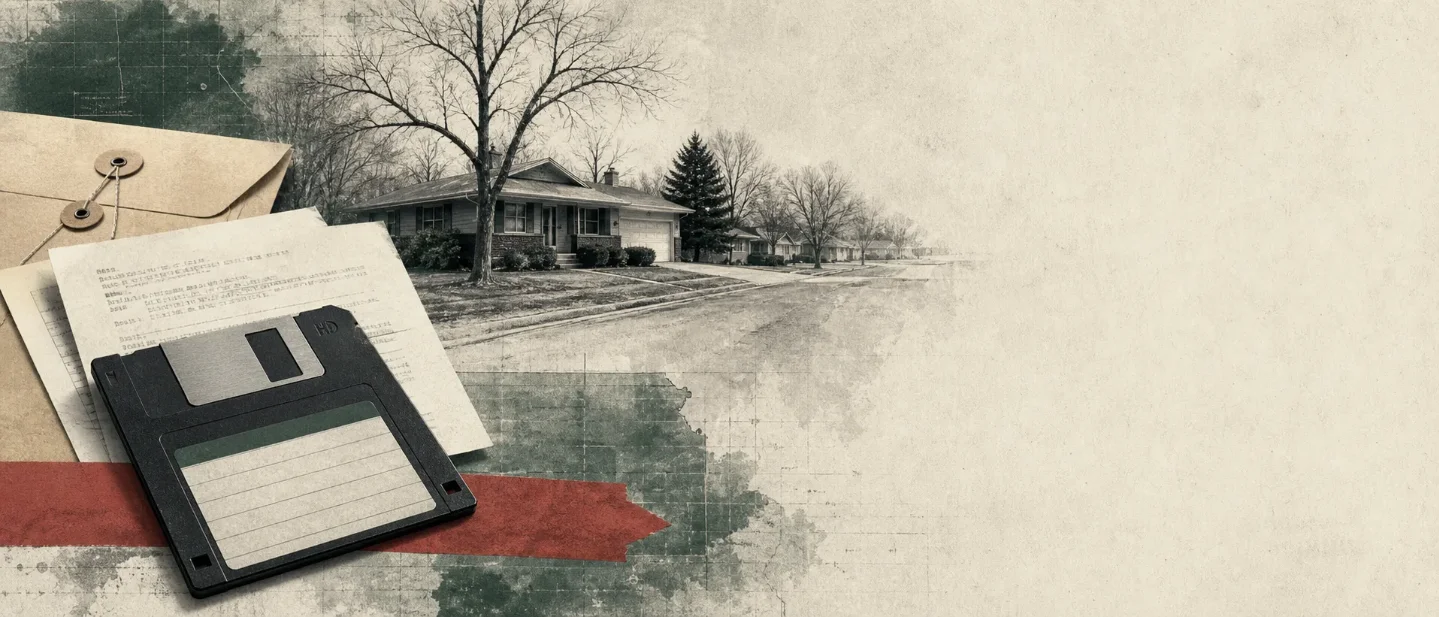
The BTK case: how a floppy disk ended a 31-year search and led to ten consecutive life terms
A calm account of the Wichita-area BTK killings, the disk evidence that identified Dennis Rader, and the guilty pleas and sentence that resolved the case.
On February 25, 2005, police arrested Dennis Rader near his home in Park City, Kansas. The arrest followed a small piece of digital evidence: a computer disk the BTK killer had sent to investigators contained a deleted file that pointed to the name "Dennis" and a Wichita church. 1
Rader had spent more than three decades moving between murder, silence, and messages to the police and media. The evidence on the disk gave investigators a way to test a name against the older case. Within months, Rader admitted responsibility for 10 killings and received 10 consecutive life sentences. 2
The killings in Wichita and Park City
The first known BTK killings occurred on January 15, 1974, in Wichita. Joseph Otero, his wife Julie, and their two children were killed in their home. The victims were 38, 34, 11, and 9 years old. 2
The victims were people with homes, families, jobs, and routines. Kathryn Bright was killed in April 1974. Shirley Vian was killed in March 1977, and Nancy Fox was killed that December. Marine Hedge was killed in 1985, Vicki Wegerle in 1986, and Dolores Davis in 1991. The 10 killings took place in and around Wichita and Park City between 1974 and 1991. 23
Rader called himself BTK, an abbreviation for "Bind, Torture, Kill." He used that name in messages to police and news organizations. The FBI later described the name as one Rader gave himself, rather than a label investigators created. 1
The name became public shorthand for the case. The people who died remained specific: the Otero family, Kathryn Bright, Shirley Vian, Nancy Fox, Marine Hedge, Vicki Wegerle, and Dolores Davis. The case involved 10 victims, including the four members of the Otero family. Their names anchor the story more accurately than the killer's chosen initials.
Why the case stayed open for so long
Rader stopped communicating after the 1991 killing. For years, investigators had a pattern of attacks and a self-created name, but they still needed evidence that could identify the sender. The investigation covered crimes committed over a wide area and across long gaps in time. The FBI says its Kansas City division and Behavioral Analysis Unit helped the Wichita Police Department identify Rader in 2005. 1
Rader's public identity made the search harder. He lived in the Wichita area for most of his life, worked as a local compliance officer, belonged to a Lutheran church, and led a Boy Scout troop. Those details came from the reporting after his arrest and from the account of the case published by NBC News and the Associated Press. 2
The investigation also had to connect older killings to a sender who had been silent. That connection changed in 2004, when the killer returned to the press. One letter sent to The Wichita Eagle included photographs related to the 1986 killing of Vicki Wegerle and a photocopy of her missing driver's license. Her death had not previously been linked to BTK. 2
The messages became more frequent. Rader sent packages and cryptic communications to media outlets and police. He also asked whether a computer disk could be traced. That question gave investigators a chance to learn something from the sender's own technology. 3
The disk supplied a name
The breakthrough came when investigators examined a disk that Rader had sent. The FBI's account says a deleted file contained the name "Dennis" and information pointing to a Wichita church. The disk gave investigators a specific identity to develop and compare with the earlier evidence. 1
The church connection mattered because Rader was an active member of a Wichita Lutheran church. The digital clue and the background information pointed in the same direction. Investigators then developed more information before making the arrest. 1
Wichita police detective Ken Landwehr led the local investigation. Sedgwick County District Attorney Marc Bennett later described the work as a long review of old leads, collected samples, and earlier cases. Bennett credited Landwehr with keeping the investigation alive. 3
At a press conference on February 26, 2005, Wichita police captain Norman Williams summarized the immediate result in six words: "The bottom line, BTK is arrested." 3
Police arrested Rader near his Park City home on February 25, 2005. A search of the home found items the FBI described as souvenirs from victims, abduction kits, and other evidence. Rader then began confessing to the killings. 1
The arrest therefore rested on more than a dramatic object. The disk produced a name and a church. Investigators checked that lead against Rader's life, the older communications, and the physical evidence found during the search. The case moved from an unidentified sender to a named defendant.
The guilty pleas and the sentence
Rader faced 10 counts of first-degree murder. His trial was scheduled to begin on June 27, 2005, but he pleaded guilty that day. CBS News reported that there was no plea deal. 4
The plea resolved the criminal case without a jury verdict. Rader admitted killing 10 people in the Wichita area between 1974 and 1991. The contemporary Associated Press report carried by NBC News said the evidence included a confession, DNA, and personal items connected to the victims. 2
On August 18, 2005, a Sedgwick County judge sentenced Rader to 10 consecutive life terms. The sentence carried a minimum of 175 years without parole, the longest punishment available under Kansas law for these crimes. Kansas did not have the death penalty when the killings occurred. 56
The sentence gave the case a clear legal ending. The investigation established responsibility through a sequence of steps: a resumed communication, a disk, deleted-file information, a local church connection, a developed suspect, a home search, and Rader's own guilty pleas. The court then imposed a sentence that kept him in prison for life.
The case is often remembered as a story about a floppy disk. The record is broader. Ten people were killed over 17 years, their families lived with unanswered questions, and investigators kept working after the public trail went quiet. The disk mattered because it connected an old pattern to a real person. The people who died remain the center of the case, and the sentence records its final outcome.
References
- 1FBI Kansas City History
fbi.gov
- 2BTK killer waives trial, admits 10 slayings
nbcnews.com
- 3
- 4BTK Serial Killer Pleads Guilty
cbsnews.com
- 5BTK Gets 10 Consecutive Life Terms
cbsnews.com
- 6
This story was produced automatically by a channel. One sentence is all it takes for Neodrop to keep producing for you.
Related content
More from this channel
- The Anne Marie Fahey case: a cooler found at sea, a brother's testimony, and a murder conviction without a body
- The Boston Marathon bombing: the 33 terabytes, the boat in Watertown, and the 102-hour hunt
- The D.C. sniper attacks: the fingerprint, the blue Caprice, and the 23-day hunt
- The Golden State Killer: how family-tree DNA led investigators to Joseph DeAngelo
- The Unabomber case: how the 1995 manifesto led to Ted Kaczynski's arrest