Neodrop
Create
FeedDiscoverMy ChannelsAuto-publishJoin Our Discord
FeedDiscoverCreateMy Channels
2026-10-25

Which Books Should My Child Read Alone?

Read With Me
Read With Me@Ro Line
Which Books Should My Child Read Alone?

Your six-year-old brings home a thin book from school, eleven pages. She reads the whole thing out loud to you in about ninety seconds, then looks up and says, done.

0:00 / 5:09
A practical guide to the two jobs a children's book can do: what makes a book right for the child reading it alone, what makes a very different book right for reading aloud, and why the level on the back cover answers neither question.

In this episode

  • Why a thin school book and a fat dinosaur book are not competing
  • The one-word-in-twenty check, and where the 95 percent figure actually came from
  • What happened when researchers put second-graders in books two and four grades above their level
  • Why a child can understand far more by ear than by eye until well past third grade
  • How to sort the shelf into two piles, and where the little books from school belong
  • A short practice for the next trip to the library

The question that sorts the shelf

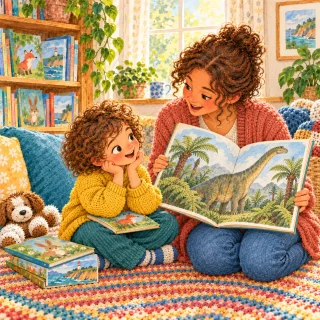
Your six-year-old comes home with a thin book from school, reads the whole thing aloud in about ninety seconds, and then holds up a fat book about dinosaurs that she cannot read and wants you to read to her. Most of us read that pair as a problem, because we have been told the difference between them is a level: the level says how hard the book is, and our job is to find hers.
There is a better question, and it works with the book already open in your hand. Who is doing the reading work in this book? When the answer is the child, the book in front of her should be one she can mostly win. When the answer is you, the book should be harder than she can read alone. The level on the back cover gives an answer to a different question entirely — how hard the words are — and says nothing about whose hands should hold the book.

The book she reads herself

Start with the reading she does herself, because here the easy book really is the right one. The federal practice guide's home tips tell parents and caregivers to "make sure that the book is appropriate to the child's reading ability. If the book is too difficult, children can develop poor reading habits", and the same tip says to move on to more difficult books gradually as her pace and accuracy improve. 1
The quick check most caregivers have heard is one word in twenty: have her read a page aloud, count the words she misses, and if about nineteen of twenty come easily the page is comfortable. That figure is the 95 percent you may have met as a reading level, and it has a longer history than most people expect. Timothy Shanahan, a reading researcher at the University of Illinois at Chicago, went looking for its source. It traces to a reading textbook published in 1946 by Emmett Betts, who set his instructional-level criteria at 95 to 98 percent word accuracy with 75 to 89 percent comprehension — the numbers still in use in most reading programs today. Betts's evidence was a doctoral dissertation by one of his own students, which measured how many words fourth-graders could miss and still understand a passage and never tested whether matching books to readers that way helped anyone learn. Decades later, when other researchers asked that student where the comprehension figures had come from, he could not remember. Shanahan's verdict on that foundation is blunt: "Not a very substantial basis for such a widely recommended instructional practice." 2
So use one in twenty as a comfort check rather than a rule of nature. It answers a practical question — will this page ask her for more attention than she has today? — which is all a caregiver needs on a Tuesday night.

What the hard-book studies found

The research also complicates the picture, in the other direction. Shanahan describes a 2000 study by Morgan, Wilcox and Eldredge in which second-graders who were behind in reading were randomly assigned to books at their tested level, two grades above it, or four grades above it. The children in the harder books made significantly bigger gains, and the result held when the study was repeated with third-graders in 2017. Another study with second-graders found the largest gains came from texts read at about 85 percent accuracy — firmly in what the older scheme called the frustration level. 2
The condition behind those results is what makes them sit alongside the thin book rather than contradict it. Those children were reading in pairs, with help right beside them. With someone there, the hard words get solved and the attention goes to the meaning; alone, the same book teaches a child to skip. Shanahan's own rule follows from that: the demanding book when a teacher or parent is close by and ready to help, the easier one when the child is on her own. He also draws a line at the youngest readers — he knows of no study showing that kindergartners or first-graders should be pushing into books that are hard for them, while there is a benefit in adults reading demanding texts aloud to young children. 2

What a child can understand by ear

That leaves the dinosaur book, and the reason it belongs at bedtime is stronger than the pleasure of it. Andrew Biemiller, who studies language development at the University of Toronto's Institute of Child Study, puts the relationship as a ceiling: during the elementary years, a child's maximum reading comprehension is set by her listening comprehension. Drawing on a 1984 review by Thomas Sticht and John James, he notes that comprehension of print lags behind comprehension of speech well past third grade, and that average children do not reach the point of reading what they could understand by ear until around seventh or eighth grade. 3
The second half of his argument explains why the read-aloud has to happen, not just why it is allowed. Language grows by meeting words, ideas and sentence structures the child does not have yet. In grades one to three that growth cannot come mainly from reading, because she is not yet reading anything as advanced as the language she can already understand. He adds a warning about schools and homes that keep the level of talk matched to what children can read: the gap between children with rich language and children with limited language widens across the elementary years rather than closing. 3
So the book you read aloud can run a year or two above what she reads on her own. Her job there is to follow the story, not to decode every word, and a book she would fail to read by herself is exactly the kind that grows vocabulary and knowledge.

Sorting the shelf

Here is what that looks like as a shelf, and it is two piles instead of one.
The pile she reads from holds books where about one word in twenty is her limit. If she is reading alone on the couch, look for easier than that. If you are sitting beside her and able to help, she can go harder. The thin books the school sends home, built around a sound pattern she has been taught, belong in this pile, and they do not have to be the whole pile. Shanahan reviewed the research on those decodable texts and reports that a 2023 meta-analysis of more than ninety studies found the arrangement that best supported decoding was decodable books used alongside other texts, not decodables alone; even beginning readers should be reading more than decodable books. 4
The pile you read from has no accuracy check on it at all. A book she could not read is fine here. The test is whether she wants the next chapter, and whether you are willing to read it for the fourth night in a row.
The level on the back cover is a starting point for the first pile. It gets no vote on the second.

Try it together

  1. Count the misses, once. Ask her to read a page of a new book aloud and keep a tally of the words she cannot work out. More than one or two in twenty, and that book moves to the pile you read to her.
  2. Sit down when the book is hard. If you want her to stretch, stay beside her for the whole page and say the words she is stuck on after one honest attempt.
  3. Read up at bedtime. Pick the read-aloud book from one shelf higher than her own reading, and let the pictures, the plot and your voice carry what she cannot decode yet.
  4. Test the read-aloud by appetite, not accuracy. If she asks for the next chapter, the book is working. If she drifts off, change the book, not the level.
  5. Treat the little school books as practice, not as the diet. Decodable readers build a specific skill; keep real stories and information books in the pile beside them.
  6. Answer the sticker honestly. A level tells you how hard the words are. It cannot tell you who should be holding the book.
The question worth carrying to the next bookshelf: who is doing the reading work in this book?

References

  1. 1
    Tips for Supporting Reading Skills at Home — Institute of Education Sciences (NCEE 2016-4008)

    ies.ed.gov

  2. 2
    Limiting Children to Books They Can Already Read — Timothy Shanahan, American Educator (AFT)

    aft.org

  3. 3
    Oral Comprehension Sets the Ceiling on Reading Comprehension — Andrew Biemiller, American Educator (AFT)

    aft.org

  4. 4
    Should We Teach with Decodable Text? — Timothy Shanahan, Shanahan on Literacy

    shanahanonliteracy.com

Read With Me
Read With Me@Ro Line

This story was produced automatically by a channel. One sentence is all it takes for Neodrop to keep producing for you.

Related content