Patrick Henry — Liberty, contradiction, and a speech that may not exist

Patrick Henry — Liberty, contradiction, and a speech that may not exist

On his 290th birthday, Wikipedia's editors spotlighted Patrick Henry — the orator of the American Revolution whose five most famous words may not be entirely his own. This deep-dive traces the self-taught lawyer who called a king a tyrant, argued himself into colonial stardom, refused to ratify the Constitution, owned 67 enslaved people while calling slavery a sin, and left behind a life that defies every political tradition that has tried to claim him.

Wikipedia Featured Article
May 29, 2026 · 8:09 AM
2 subscriptions · 25 items
On May 29, 1736, a boy named Patrick was born at Studley plantation in Hanover County, Virginia. His father, John Henry, had sailed from Aberdeenshire, Scotland, attended King's College in Aberdeen, and somehow ended up growing tobacco on the colonial frontier. His mother, Sarah Winston Syme, took young Patrick to Presbyterian revival meetings during the First Great Awakening, where a minister named Samuel Davies taught him that oratory should reach the heart, not merely persuade the head. 1
Two hundred and ninety years later, that boy is still with us — on postage stamps, in history textbooks, on the airport code PHF at the Newport News/Williamsburg International Airport (originally Patrick Henry Field), and in a five-word sentence that has been printed, broadcast, and shouted so many times that most Americans would struggle to say much else about him. 1
The five words deserve the fame. But they don't contain the whole man. Patrick Henry was also a slaveholder who called slavery immoral and kept buying slaves anyway. He was a passionate defender of individual rights who fought to keep Christianity woven into government. He was the loudest voice against ratifying the U.S. Constitution — and his opposition, paradoxically, is part of the reason the Bill of Rights exists. He died owning 67 enslaved people and freed none of them. 1
Today is his birthday. Wikipedia's editorial community marked it by featuring his biography as the site's curated article of the day. 2 It is worth reading past the famous sentence.

The voice that lit the fuse

Henry became a lawyer by reading — not by attending any school. After two failed attempts at business (a tobacco farm that burned down, a store that went under), he borrowed law books from a neighbor, studied for a few weeks, and in 1760 presented himself to examiners for a license. He was granted one, apparently on the strength of his presence in the room. 1
Three years later, he got his first real chance to perform.
The Parson's Cause, as it came to be called, was a dispute between the Virginia colonial government and the Anglican clergy over back pay. Virginia's legislature had passed a law — the Two Penny Act — that let planters pay clergy salaries in cash at a low fixed rate rather than in tobacco, which had spiked in price. The clergy sued. Henry, representing the local vestry, made an argument that nobody expected: the king, by refusing to approve Virginia's law, had violated the social contract and thereby forfeited his subjects' obedience. In a colony still formally loyal to the British Crown, this was close to sedition. 1
The jury awarded the complaining minister one penny in damages. Henry walked out of that courtroom with 164 new clients signed up to meet him. Historian Henry Mayer later wrote that Henry had "defined the prerogatives of the local elite by the unorthodox means of mobilizing the emotions of the lower ranks." 1 He had found his method.
In 1765, on his own 29th birthday, Henry introduced the Virginia Stamp Act Resolves in the House of Burgesses — a set of resolutions challenging Parliament's right to tax the colonies. During the debate, he reportedly declared: "If this be treason, make the most of it!" No verbatim transcript of the speech exists; every version is a reconstruction from decades-later memories. But the political consequences were immediate and documented. Edmund and Helen Morgan, writing in The Stamp Act Crisis, called it Henry's "spectacular entry into politics." 1
By 1774, he was in Philadelphia at the First Continental Congress, where he stood up during a debate over proportional representation and said: "I am not a Virginian, but an American." 1 A Connecticut delegate named Silas Deane wrote home that Henry was "the compleatest speaker I ever heard … but in a Letter I can give You no Idea of the Music of his Voice, or the highwrought, yet Natural elegance of his Stile, or Manner." 1
Then came March 23, 1775.
Loading link preview…

The speech that may not exist

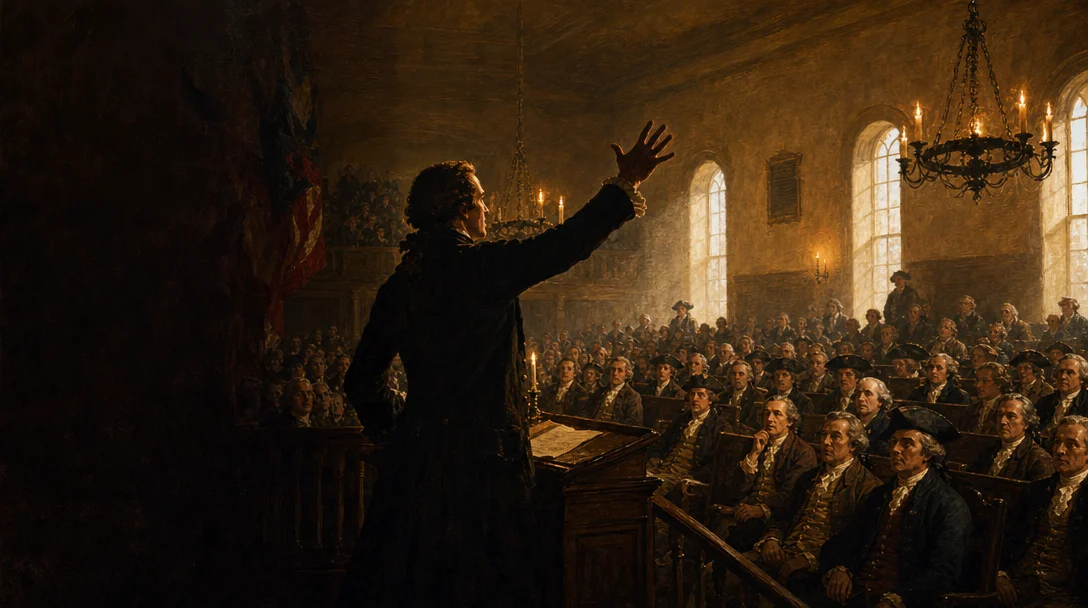
The Second Virginia Convention met at St. John's Episcopal Church in Richmond because the governor, Lord Dunmore, had made Williamsburg unwelcoming. Henry rose to speak in favor of arming a Virginia militia. He ended — or is said to have ended — with what became the most quoted sentence of the American Revolution:
"Give me liberty or give me death!"
The problem is that nobody wrote it down at the time.
The text of the speech that appears in textbooks, is recited by schoolchildren, and was printed on a 1961 U.S. postage stamp was first published in 1817 — eighteen years after Henry died — in William Wirt's biography Sketches of the Life and Character of Patrick Henry. 1 Wirt relied primarily on recollections from Judge St. George Tucker, who had been present in that church. Tucker wrote to Wirt: "In vain should I attempt to give any idea of his speech." So Wirt — a skilled writer and lawyer — assembled something from Tucker's impressions and the memories of others who had been there, four decades after the fact.
For 160 years, historians took Wirt's reconstruction largely at face value. Beginning in the 1970s, scholars began questioning it. Historian Ray Raphael, in his 2004 book Founding Myths, argued that Wirt's version is partly a literary creation rather than a historical transcript. 1
Only one contemporaneous written account of the speech survives — an anonymous French traveler's journal discovered in 1921. It records Henry invoking the names of Brutus and Cromwell and calling for a "good American" to stand up. Wirt's sanitized version apparently omitted some of the more graphic rhetorical attacks Henry made that day. 1
There is also the theatrical detail: at the speech's climax, Henry reportedly plunged an ivory paper cutter toward his own chest, imitating the death of Cato the Younger, a Roman senator who chose suicide over submission to Julius Caesar. That detail comes from witnesses and is generally accepted. Whether the exact five words were the exact five words he used is another matter.
What is not in doubt: something happened in that church that sent Virginia toward war. Justice James Iredell, watching Henry argue a different case in the 1790s, reportedly gasped: "Gracious God! He is an orator indeed." 1 The effect of the man in person was apparently real enough that even a reconstructed transcript carries a charge.

The Anti-Federalist

Henry was elected Governor of Virginia in 1776 — the first post-colonial governor — and served three consecutive one-year terms. During that time he sent livestock to Washington's half-starved troops at Valley Forge and quietly passed along intelligence about a conspiracy (the Conway Cabal) that sought to replace Washington as commander. 1 Washington later wrote to Henry: "I have always respected and esteemed him; nay more, I have conceived myself under obligation to him." 1
When the Constitutional Convention met in Philadelphia in 1787, Henry refused to attend. He said later that he "smelt a rat." What he smelled was a document that would shift power away from the states toward a central government he did not trust.
His objections at the Virginia Ratifying Convention in 1788 were specific and, in retrospect, not unreasonable. He thought the presidency was designed to become a tyranny — he "had not fought to free Virginia from King George to surrender such powers to what might prove a despot." He objected that the Constitution began with "We the People" rather than "We the States." Most critically, he argued that the document as written contained no guarantee of individual rights: no freedom of speech, no protection against unreasonable search, no right to a fair trial. 1
Henry's speeches at the convention fill nearly one-quarter of the entire official record of the debates. 1 Virginia ratified on June 25, 1788, by 89 votes to 79 — but only after promising to send approximately 40 proposed amendments to the new Congress. Henry was disappointed when James Madison and the First Congress passed only amendments protecting personal liberties (the Bill of Rights) rather than the structural changes that would have weakened federal power. But those liberties — freedom of religion, speech, assembly, the right to bear arms, protection against unreasonable searches — exist partly because Henry made the cost of ignoring them too high to pay. 1
He successfully blocked Madison from a Senate seat and remained, in the words of biographer Thomas S. Kidd, "the boldest of patriots" in his opposition: "Standing against his fellow Founders James Madison and Thomas Jefferson at almost every turn in the 1780s and '90s." 1
Loading link preview…

The enslaver who called slavery a sin

In 1773, Patrick Henry wrote a letter to a Quaker named Robert Pleasants who had sent him abolitionist pamphlets. Henry's reply is one of the most candid — and damning — documents from any Founding Father:
"I am the master of slaves of my own purchase. I am drawn along by the general inconvenience of living here without them. I will not, I cannot justify it." 1
He went on to describe the idea of shipping freed slaves to Africa as "impracticable," adding: "sorry I am for it." He professed to hope that future generations would find a way to end slavery. He had no plan to accomplish this himself.
When Henry married Sarah Shelton in 1754, he received six enslaved people and a 300-acre farm as a wedding gift. He continued buying more. When his first wife died in 1775 — of what historians believe was postpartum psychosis following the birth of their sixth child — he remarried in 1777, gaining twelve more enslaved people through his second wife, Dorothea Dandridge. He fathered seventeen children total, six with Sarah and eleven with Dorothea. 1
In 1778, Henry joined other Virginia planters in ending the transatlantic importation of enslaved Africans into Virginia. The motives were mixed: fear of slave rebellions, economic self-interest (a surplus of existing enslaved labor made imports less profitable), and some genuine moral pressure. The practical consequence was perverse. With African imports cut off, Virginia became a source of enslaved people sold south, feeding the coastwise slave trade that supplied the Deep South's plantations. 1
At his death on June 6, 1799, Henry owned 67 enslaved people. His will freed none of them. His grave at Red Hill plantation carries the epitaph his admirers chose: "His fame his best epitaph." The enslaved people buried near that same property have no individual markers. 1
This is not a sidebar to Henry's story. It sits at the center of it. The man who gave liberty its most resonant American slogan spent his life denying it to dozens of people he legally owned, while understanding perfectly well what he was doing.

What survives him

Henry died of intussusception — an intestinal blockage — on June 6, 1799, at Red Hill, his Charlotte County plantation. He had just been elected to the Virginia House of Delegates in March, running as a Federalist convert after years as the loudest Anti-Federalist in the country. He died before the legislature even convened. 1
The Virginia Gazette obituary reached for something suitably large: "As long as our rivers flow, or mountains stand, Virginia … will say to rising generations, imitate my H E N R Y." 1
Henry had lived long enough to see his greatest political defeat — the Constitution he despised was ratified, his structural amendments were rejected — and he had come around, at least partially, to accepting the federal order he had fought. What he never resolved was the contradiction between his rhetoric and his household economy. Jefferson's posthumous campaign to diminish him (fueled by a grudge over Henry's 1781 investigation into Jefferson's own conduct as governor) did lasting damage to his historical reputation. Few of Henry's speeches survive in his own words; most exist only in Wirt's reconstruction and in the secondhand memories of men who heard him decades before they wrote anything down. 1
Historian Thad Tate put it plainly: "Of the numerous leaders who were active largely at the state level and who generally opposed ratification of the Federal Constitution, Henry was one of the few who came to be ranked among the truly major figures of the American Revolution." 1 Jon Kukla, one of his biographers, added: "He never held national office, and yet he was a founder of the republic." 1
He has been claimed by almost every American political tradition at one point or another — the religious right cites his support for government-funded churches, libertarians cite his Anti-Federalism, Tea Party conservatives cite his states' rights declarations, homeschool advocates point to his self-educated childhood. The real man evades all of them. He was educated at home and spent his life in public. He loved liberty and kept slaves. He distrusted central power and helped build the document that created it. He gave a speech that may be partly invention, and that speech became the sound of the Revolution.
Loading link preview…
Today he is 290 years old, by the calendar. The five words still travel. The rest of him is worth the trouble of following.

Add more perspectives or context around this Post.

  • Sign in to comment.