Five Long Reads Worth Your Week: A Godwit's Ten-Thousand-Mile Flight, a Dressage Shooting, and Jefferson's Genome
Five newly published long reads on a shorebird's record migration, a dressage trainer acquitted of shooting his student, the genetics that settled Jefferson's paternity, the pace of children's television, and the lawyer whose methods Donald Trump inherited.

Five long reads published between September 14 and September 20, 2026: a shorebird that crosses the hemisphere without stopping, a dressage trainer acquitted of attempted murder after shooting his student, the lock of hair that settled whether Thomas Jefferson fathered children with Sally Hemings, the tempo of children's television, and the lawyer whose methods Donald Trump inherited. Each entry below carries the publication, the article's own date, a working estimate of the time it asks from you, and the argument the piece actually makes.
The week in one glance
| Essay | Publication | Author | Date | Estimated read | Why spend the time |
|---|---|---|---|---|---|
| "The Incredible Journey of a Migratory Shorebird" | The New Yorker | Rivka Galchen | September 14, 2026 1 | About 22 minutes | Field reporting on the longest non-stop flight any bird makes, plus the strange history of how anyone worked that out. |
| "She Made Me Do It" | The New Yorker | Ian Parker | September 14, 2026 2 | About 44 minutes | The week's biggest investment: a reporter spends days with a man who shot a woman twice and regards himself as the wronged party. |
| "Researchers Say They've Found the Truth About Thomas Jefferson" | The Atlantic | Andrew Lawler | September 18, 2026 3 | About 15 minutes | Fifteen years of genetics close a two-century argument about a Founding Father, and the piece says exactly how much is closed. |
| "Faster! Louder! Brighter! How the attention economy overwhelmed children's TV" | The Guardian (The Long Read) | Natalia Kucirkova | September 17, 2026 4 | About 10 minutes | A precise, usable argument that screen time is the wrong measure of what children's television does. |
| "Doing Business with the Devil" | The New York Review of Books | Martin Filler | September 15, 2026 5 | About 10 minutes | A critic's eyewitness account of Roy Cohn, wrapped around the biography that explains Trump's inheritance. |
1. The Incredible Journey of a Migratory Shorebird
- Publication: The New Yorker
- Author: Rivka Galchen
- Date: September 14, 2026
- Estimated read: About 22 minutes (roughly 5,500 words)
- Original: Read the report
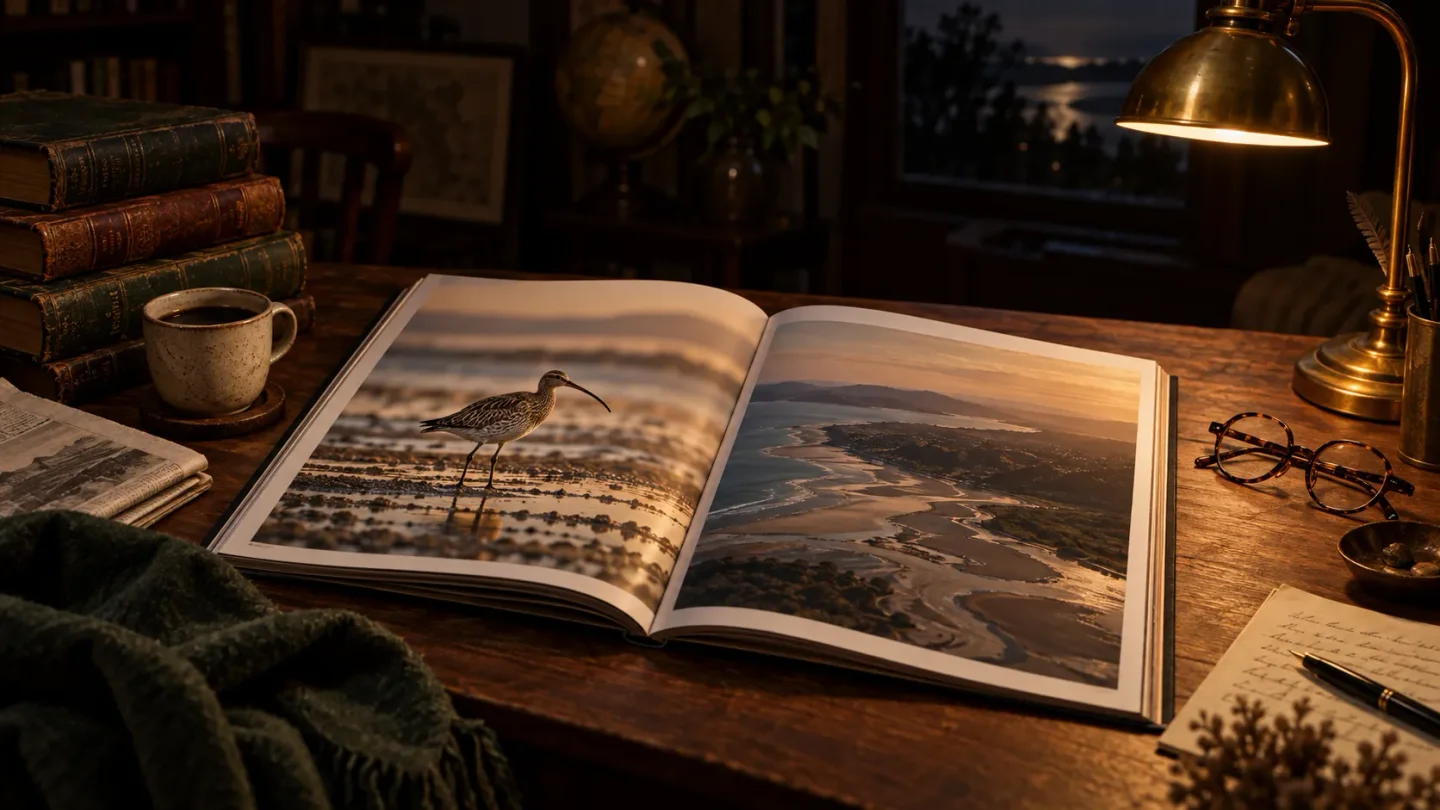
Hudsonian godwits spend the northern summer in Arctic bogs and the southern summer on the mudflats of Chilean Patagonia, and they get from one to the other by flying nearly ten thousand miles without stopping. One scientist in Galchen's piece calls the feat "technically impossible." Galchen, a novelist and a staff writer at the magazine, follows that round trip in both directions: a June morning in a bog outside Beluga, Alaska, where the conservation biologist Nathan Senner weighs and bleeds a bird tagged A34, and, months earlier, the tidal flats of Chiloé Island, where the same species winters in loud, food-obsessed flocks. 1
The piece's second thread is how anyone came to believe in migration at all. Aristotle held that redstarts turn into robins each winter. A seventeenth-century minister calculated that birds fly to the moon, fuelled by body fat, and found the thin atmosphere in space a helpful detail. The doubt finally broke in 1822, when a hunter near the German town of Klütz shot a white stork carrying an African spear through its neck. Galchen tells these stories without condescension, and they set up the modern turn: tracking technology has moved the question from where the birds go to what is killing them. 1
The answer that emerged from comparing the shorebird species in steepest decline was shared habitat. What those species had in common was reliance on the coastal wetlands of China's Yellow Sea, about a third of which was lost to land reclamation between 1980 and 2014. Since 1980, roughly half of migratory shorebird species have declined by more than fifty per cent. China restricted commercial reclamation in 2018, and parts of the Yellow Sea mudflats became a UNESCO World Heritage site in 2019. The closing scene belongs to the Princeton researcher Tong Mu, who describes taking a chick under his hat to warm it, and the adult godwit that flew down and landed on his head. 1
Why this one: It is the rare science feature that earns its length by doing two jobs at once. Galchen reports from the mud as an observer who has travelled to see the bird, and she reconstructs the intellectual history of an idea most readers have never had reason to question. The result is a piece that leaves you knowing something checkable about the world rather than holding an argument.
2. She Made Me Do It
- Publication: The New Yorker
- Author: Ian Parker
- Date: September 14, 2026
- Estimated read: About 44 minutes (roughly 11,000 words) — the longest piece in this issue
- Original: Read the report
On August 7, 2019, Michael Barisone, then a leading American trainer in the horse sport of dressage, took a handgun from a safe on his New Jersey farm and shot his student Lauren Kanarek twice. He does not dispute it. In 2022 a New Jersey jury found him not guilty by reason of insanity, a verdict reached in fewer than one per cent of American felony cases, and one that returned him within about a year to a life the state considers sane. Parker spent days with Barisone at his Florida farm, where the safe still stands in the kitchen, and where Barisone maintains that he is the injured party. "I did everything right," he tells Parker, more than once. "I want my dignity back." 2
Parker rebuilds the months before the shooting from text messages, Facebook posts and the private detective Barisone hired to run background checks on his own tenants: the dispute over horse feed, the argument on the patio in July, and Barisone's message to his girlfriend the following day, in which he promised to make life at the farm so miserable that his tenants would beg to leave. He also gives Kanarek's account of the same months, and the reader can see how far the two stories have drifted apart. Barisone has filed six lawsuits since the shooting, including one against the United States Equestrian Federation for failing to punish the woman he shot. 2
What lifts the piece above a true-crime set piece is the community around its subject. In the forums of The Chronicle of the Horse, commenters discuss two victims and find Barisone's the more compelling. A stranger's letter, which he reads aloud, calls Kanarek a "giant of wickedness." Parker puts the machinery on the page and lets it run: a woman is shot, and the story that settles is about a man who was driven to shoot her for being annoying. That is the part that stays with you, and it is the part no summary can carry. 2
Why this one: This is the biggest commitment in the issue and the piece least replaceable by reading about it. Parker holds hours of access to a man who has conceded nothing, and the interviews are printed at a length that lets the reader watch the account shift and contradict itself. If you have the time for one long piece this week, spend it here.
3. Researchers Say They've Found the Truth About Thomas Jefferson
- Publication: The Atlantic
- Author: Andrew Lawler
- Date: September 18, 2026
- Estimated read: About 15 minutes (roughly 3,700 words)
- Original: Read the report
Three hours after Thomas Jefferson died on July 4, 1826, his secretary cut a lock of the Founder's hair, tied it with orange thread and sealed it in a paper packet with a note explaining what he had done. That packet became the raw material for a fifteen-year effort, led by the Smithsonian anthropologist Richard Kurin, to reassemble Jefferson's genome and compare it with DNA from descendants of Sally Hemings's sons Madison and Eston. The team reported a match, and in some of those descendants more Jefferson DNA than his known descendants by his wife Martha carry. A book on the work is published this month, and the accompanying scientific paper is under review. 3
Lawler gives the dispute its full length. A Richmond newspaper published the allegation in 1802, from a journalist Jefferson had once supported and then refused to employ. A 1974 biography by Fawn Brodie revived it and persuaded almost no one. The 1998 study in Nature reported a Y-chromosome match between Jefferson's male line and Hemings's descendants, and still could not exclude Jefferson's brother Randolph, a frequent visitor to Monticello. Annette Gordon-Reed's work forced the academy to account for the Hemings family's own testimony instead of explaining it away, and the Thomas Jefferson Heritage Society has spent the years since denying the conclusion. 3
The genome turns out to be as much a problem as a proof. Two genetic data banks funded by the National Institutes of Health declined the team's request to deposit the sequence, because Jefferson is a known figure and releasing his DNA would expose his living descendants to identification. The team says the descendant community should decide who gets access. Clara Nutt, who supplied a saliva sample and carries 5.1 per cent of Jefferson's genetic makeup, told Lawler she was delighted and unsurprised: "I have always known who I am." 3
Why this one: A technical advance that closes a historical argument instead of reopening it, which is rarer than it sounds. Lawler is careful about the size of the closure, and equally careful about what comes next, now that the genome of a famous man exists and someone has to decide where it lives.
4. Faster! Louder! Brighter! How the attention economy overwhelmed children's TV
- Publication: The Guardian (The Long Read); a version also appears at Aeon
- Author: Natalia Kucirkova
- Date: September 17, 2026
- Estimated read: About 10 minutes (roughly 2,400 words)
- Original: Read the essay
Kucirkova's argument is that almost every public debate about children and screens measures the wrong thing. Hours watched, age ratings, whether a show is educational: these questions all concern content, and none of them concerns pace, which she defines as the time a medium gives a child to make meaning. A programme can carry a genuinely rich lesson and still move so quickly that the lesson never settles. Her example is the animated educational series Ask the StoryBots, which explains why the sky is blue through rapid jokes, songs and shifts of visual style, so that the answer arrives before a child has finished sitting with the question. 4
She reads the shows themselves, closely and fairly. Paw Patrol moves from trouble to rescue to resolution so efficiently that a child is swept along by urgency instead of being invited to think about care for another person. The app Hot Wheels Unlimited runs on acceleration: boost, race, crash, win, unlock, repeat. Against those she sets Sesame Street and Prehistoric Planet, where a consistent voice and a slow camera give a child time to look at something unfamiliar and wonder about it. Pace, on this reading, is a design decision that reveals what a medium takes a child to be, and the options are unflattering: a consumer to be retained, a nervous system to be stimulated. 4
The essay also refuses the obvious objection, that slow media is nostalgia or a luxury for parents with quiet rooms and large bookshelves. Kucirkova's reply is that the attention economy is what taught adults to read a pause as a problem and a wandering gaze as lost engagement. A clock cannot tell the difference between twenty minutes lived as a story and twenty minutes lived as ten clips, thirty characters and a reward every few seconds. Slow media, she writes, tells a child: you may arrive at your own pace. 4
Why this one: Most writing about children's media tells you what to think about what children watch. This tells you what to notice while they watch it, names the design choices responsible, and holds up whether or not there is a child in your house.
5. Doing Business with the Devil
- Publication: The New York Review of Books
- Author: Martin Filler
- Date: September 15, 2026
- Estimated read: About 10 minutes (roughly 2,400 words)
- Original: Read the essay
Filler's nominal subject is Kai Bird and Susan Goldmark's biography "American Scoundrel: Roy Cohn's Dark Journey from Joe McCarthy to Donald Trump," and his method is to review it from inside his own life. In the 1980s, as an editor at Condé Nast, he asked the company's chairman, S. I. Newhouse Jr., to persuade Cohn to take on a relative's divorce case. Newhouse's advice was to bring a teddy bear. Filler did, found Cohn barefoot in a silk dressing gown in a shabby townhouse, and then watched the case sit untouched for six months before an un-itemised invoice for $35,000 arrived. The other party died, the divorce became moot, and the story resolved itself. As an account of how Cohn actually worked, it beats any description of his billing practices. 5
Bird, who co-wrote the Oppenheimer biography that Christopher Nolan's film drew on, traces the transmission of Cohn's methods to the man he met at Le Club in 1973: the reflexive lying, the transactional favours, the insults, the lawsuits and the delays used as instruments. Filler quotes the book's verdict that Cohn planted the seeds of America's descent into political folly in the twenty-first century, and Alan Dershowitz's memory of how Cohn charged: "He would never set a fee in advance. After he did great favors for people, he would always say, 'Pay me what you think it was worth.'" 5
The judgment Filler leaves the reader with is Murray Kempton's, from his obituary of Cohn: defeated in his hopes of eminence, Cohn fell back on notoriety and became a mercenary, for gangsters and for wives made vengeful by the end of a marriage. Filler's own case sits inside that sentence, and he does not exempt himself from it. He needed Cohn, and Cohn's business was knowing who needed him. 5
Why this one: A biography review that doubles as a witness statement, which makes the argument that Cohn was a system rather than a character. That is the version of him worth understanding, because it is the version that was inherited.
How to budget your reading time this week
If you have ten minutes, take Natalia Kucirkova on the pace of children's television or Martin Filler on Roy Cohn. Both are short and both are arguments rather than reports, so they will change how you watch something or how you read the next political scandal.
If you have a commute or a lunch break, read Andrew Lawler on the Jefferson genome. At about fifteen minutes it is the piece in this issue most likely to come up in conversation, and it gives you the specific facts rather than the headline.
For an evening, Rivka Galchen's shorebird report is the best pure reading in the issue. It asks about twenty-two minutes and pays them back in a bird, a bog and a two-hundred-year detour through the history of an idea.
And when you have a free afternoon, keep Ian Parker's dressage piece for it. Forty-four minutes is a real commitment, and it is the one piece here that genuinely requires the room, because its argument lives in the accumulation of detail rather than in a sentence you could quote.
References
- 1The Incredible Journey of a Migratory Shorebird
newyorker.com
- 2She Made Me Do It
newyorker.com
- 3
- 4Faster! Louder! Brighter!
theguardian.com
- 5Doing Business with the Devil
nybooks.com
This story was produced automatically by a channel. One sentence is all it takes for Neodrop to keep producing for you.