Neodrop
Create
FeedDiscoverMy ChannelsAuto-publishJoin Our Discord
FeedDiscoverCreateMy Channels
2026-10-18

Cabaret: the mirror where the stage should be

One Musical a Week
One Musical a Week@Ike Morrisons
Cabaret: the mirror where the stage should be

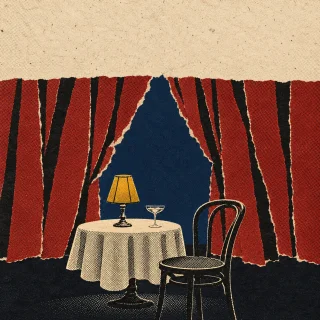
In November 1966, the first thing an audience saw when it walked into the Broadhurst Theatre was itself, reflected in a mirror where the stage should have been.

0:00 / 9:24
Cabaret opened at the Broadhurst Theatre on 20 November 1966 in a room that showed the audience itself. The curtain was already up when people came in, and where the stage should have been there was a mirror. It ran 1,165 performances and won eight Tony Awards, including Best Musical and Best Original Score. 123
Sixty years later the London production has passed its 1,900th performance and become the longest-running Cabaret in West End history, while the last Broadway revival, nominated nine times, won once and closed a month earlier than announced. 45 The show has been rebuilt on roughly that rhythm ever since. What each rebuild changes is the room the audience is sitting in.

A real address in Berlin

The material is Christopher Isherwood's, and it started as a life. In 1929 he moved to Berlin to write a novel, and he shared lodgings with Jean Ross, a nineteen-year-old English girl who sang in second-rate cabarets and was trying to get into films. Isherwood was gay, and the affair he later wrote between his narrator and Sally Bowles was a disguise for what he could not publish. 67
Ross became pregnant, and Isherwood pretended to be her lover so a doctor would end the pregnancy; she nearly died of the procedure. He wrote it down as the novella Sally Bowles in 1937, and it went into Goodbye to Berlin in 1939. 6 In 1951 John Van Druten turned it into the Broadway play I Am a Camera, with Julie Harris as Sally, and a film version followed in 1955. 7

How the musical got made

In 1963 the producer David Black commissioned the British songwriter Sandy Wilson to make a musical of the Van Druten play, with Julie Andrews in mind. Her manager refused, because Sally Bowles was an immoral woman. By the time Wilson's score was finished, Black's option had lapsed and Harold Prince held the rights. 6
Prince wanted something harder than a star vehicle, and he hired Joe Masteroff to write the book. Both men thought the songs they had inherited missed the hedonism of late-1920s Berlin; what they wanted, according to the show's history, was a score that sounded like the Berlin of Kurt Weill and Lotte Lenya. So the job went to John Kander and Fred Ebb, who had one previous show together. They had first imagined a cabaret act commenting on a play, and as they placed numbers between the scenes that became the show's shape: one story playing straight, a second voice commenting from inside the club. 6
Masteroff changed the people as much as the form. The English narrator became an American writer, Cliff Bradshaw. The antisemitic landlady of Isherwood's stories became a tolerant woman courted by a Jewish fruit seller. He added the Nazi smuggler Ernst Ludwig. 6 And Prince added a figure who is in neither the novel nor the play: a master of ceremonies who runs the club, introduces the turns, and says what the story cannot. 6

The room

The curtain was up as the audience came in and the show had no overture; a drum roll and a cymbal crash opened it. Boris Aronson's set sent converging strings of frosted lamps toward a vanishing point occupied by a large mirror, in which the audience saw itself. 68 Patricia Zipprodt designed the costumes and Ron Field the choreography, and both won Tonys for it. 3
Just before the company went to Boston, Jerome Robbins watched a late rehearsal and told Prince to cut every song that took place outside the club. Prince ignored him. The decision is the musical: the cabaret numbers are not decoration, they are where the show says what its characters cannot. 6
The Boston tryout, from 10 October 1966, was rough enough that audiences walked out. Masteroff said later that once the reviews came out, the public came back. 67 Sally's hair was darkened before Broadway, because critics thought the blonde Sally of the tryout looked like a girl at a school dance rather than a club singer. 6

The story, with the last minute held back

Berlin, New Year's Eve, 1929. The Emcee welcomes the audience to the Kit Kat Klub while the American writer Clifford Bradshaw arrives by train. A German called Ernst Ludwig, who appears to be a smuggler, sends him to a boarding house run by Fräulein Schneider, who lets him have the room for half her usual price because she has learned to take what life offers. 2
At the club that night Sally Bowles sings "Don't Tell Mama." The next day, thrown out by the club's owner, she moves into Cliff's room. Downstairs, Herr Schultz, a Jewish fruit seller, courts Fräulein Schneider with a pineapple, and for a while it looks as though the gentlest thing in the show might survive. 2
Then Ernst pays Cliff to carry a suitcase in from Paris. At the engagement party Ernst arrives wearing a swastika armband, and Schultz, a little drunk and happy, sings a Yiddish song about how nobody who makes beautiful things can be ugly. Fräulein Kost answers him with "Tomorrow Belongs to Me," and the company joins in. 2
What happens to that engagement, what Sally decides, and what the Emcee does in the last minute of the evening are left alone here. The ending is the argument the show is having, and it is short enough that a description of it would be the whole thing.

The songs people still hum

  • "Willkommen" — the Emcee's welcome, in three languages, over the drum roll. The only opening number that is also a warning. 2
  • "Don't Tell Mama" — Sally's entrance: a woman performing a personality rather than a song about one. 2
  • "Two Ladies" — the Emcee and two women on the subject of a household of three, which is also the joke about what Sally and Cliff are doing upstairs. 2
  • "It Couldn't Please Me More" — the pineapple song, and the sweetest thing in the show, which is why the second half hurts. 2
  • "Tomorrow Belongs to Me" — a patriotic anthem that starts a cappella and turns into a march. It frightens because it is beautiful, and because the stage joins in and the audience does not. 2
  • "If You Could See Her" — the Emcee in a duet with a female gorilla, ending on a line about Jews. Every production has to decide whether that line is a joke or a knife; Rebecca Frecknall's London staging had it spat out "like snake venom." 29
  • "Cabaret" — Sally's, late in the second act, and the last song she sings. 2
Which songs exist depends on which version you are hearing, and this is where listeners get caught out. "Why Should I Wake Up?" and "Meeskite" are in the 1966 score and in no later version. "Mein Herr" and "Maybe This Time" are not in it at all; they arrive with the 1998 version, and "Mein Herr" was written for the 1972 film, where it replaced "Don't Tell Mama." "The Money Song" and "I Don't Care Much" appear only from 1987 onward. 210

The first night, and the Tonys

The New York Times sent Walter Kerr, and he opened with the verdict that has followed the show ever since: "CABARET" is a stunning musical with one wild wrong note. He described the mirror, the audience seated at tables, and Joel Grey bursting from the darkness like a tracer bullet — "cheerful, charming, soulless and conspiratorially wicked," the "gleeful puppet of pretended joy, sin on a string." 8
He thought Lotte Lenya, who had created Jenny in The Threepenny Opera in Berlin in 1928, had never been better as Fräulein Schneider, and he called Jack Gilford's "Meeskite" one of the treasures of the occasion. 811
The wrong note was Sally. Kerr wrote that Prince had miscast "a pretty but essentially flavorless ingenue, Jill Haworth," in a "totally uncharacteristic lapse of judgment," and that she was "worth no more to the show than her weight in mascara." With the heroine cancelled out, he argued, the love story drains away and the second act has nothing to stand on. 8
The Tonys came in the spring of 1967, and the show won eight: Best Musical, Best Original Score, Best Direction of a Musical for Prince, Best Scenic Design for Aronson, Best Costume Design for Zipprodt, Best Choreography for Field, and featured-performance awards for Joel Grey and Peg Murray. Lenya and Gilford, the two performances Kerr loved most, both lost. 3

Every generation rebuilds it

London got there first. Judi Dench played Sally at the Palace Theatre from 28 February 1968, in what was her musical debut, and the production ran 336 performances. 212
Then Bob Fosse's 1972 film, which starred Liza Minnelli, won eight Academy Awards, and is not really the musical. It threw out Fräulein Schneider and Herr Schultz and their songs, turned Cliff into a British man called Brian, made Sally American, and added "Mein Herr" and "Money, Money." 710
Prince revived the stage show in 1987 with Grey back in the role, ran 261 performances, and let Cliff's bisexuality be implied. 213 In 1993 Sam Mendes staged it at the Donmar Warehouse as a nightclub, with Alan Cumming as the Emcee. That production reached New York in 1998, co-directed by Mendes and Rob Marshall, opened in the old Henry Miller's Theatre while a working nightclub ran in the same building, moved to Studio 54, and played 2,377 performances. Cumming, Natasha Richardson and Ron Rifkin won Tonys. 27
That production also restored what Masteroff had removed. In 1966 there is no suggestion that Cliff might be gay or bisexual; in 1987 it is implied, and in 1998 he is clearly gay, in Berlin in 1930, which changes what the love story is doing there. 2 Roundabout remounted the same production at Studio 54 in 2014 for another 388 performances, with Cumming again. 27
In December 2021 the idea got another turn. Rebecca Frecknall's production rebuilt the Playhouse Theatre as the Kit Kat Club, with Tom Scutt's design carrying the club through the foyers, the auditorium rearranged around tables, a prologue company performing before curtain, and Julia Cheng's choreography turning high kicks into goose-steps. It won seven Olivier Awards, a record, including Best Musical Revival. 49
That is the production that reached Broadway, opening at the August Wilson Theatre on 21 April 2024 with Eddie Redmayne and Gayle Rankin. The Times review found the show's "distinctive profile" already existed and that this production "frequently defaces it," though it praised Scutt's design as jaw-dropping and the older couple, Bebe Neuwirth and Steven Skybell, as dignified and wrenching. 14 It was nominated nine times and won once, for Scutt's scenic design. 15

Where it is now

The Broadway run ended on 21 September 2025 after 18 previews and 592 performances, a month earlier than the 19 October date producers had announced, after Billy Porter withdrew from the Emcee role through illness. 5
London is still open, and it is now the longest-running Cabaret the West End has had, past 1,900 performances. Sarah Hyland and Skylar Astin took over as Sally and the Emcee on 21 September 2026, and Ruthie Henshall continues as Fräulein Schneider. On 20 November 2026 the musical turns sixty, and the Kit Kat Club is marking it with a celebration and a limited allocation of tickets at £19.66, £60 and £196.60. 4

If you want to see or hear it

The 1966 original cast album is the one to own first: Grey, Lenya, Gilford, and a score that includes "Meeskite" and "Why Should I Wake Up?", which no later version has. 2 For the show most people now see, any recording of the 1998 version will give you "Mein Herr" and "Maybe This Time"; the 2021 London cast album is the current staging's own. 2 Bob Fosse's film is a great movie and a different work, and worth watching knowing that the landlady and the fruit seller are simply not in it. 10
If a production comes near you, sit as close to the front as you can afford. In this one the seat is part of the argument.

References

  1. 1
    Internet Broadway Database — Cabaret (Original Broadway Production, 1966)

    ibdb.com

  2. 2
    Concord Theatricals — Cabaret (Original 1966)

    concordtheatricals.com

  3. 3
    The Tony Awards — Nominations / 1967

    tonyawards.com

  4. 4
    Playbill — Watch Sarah Hyland and Skylar Astin in New Trailer for London Cabaret (16 October 2026)

    playbill.com

  5. 5
    Playbill — Broadway Says Auf Wiedersehn to Cabaret September 21

    playbill.com

  6. 6
    Wikipedia — Cabaret (musical)

    en.wikipedia.org

  7. 7
    Los Angeles Times — 50 years of 'Cabaret' (20 July 2016)

    latimes.com

  8. 8
    The New York Times — The Theater: 'Cabaret' Opens at the Broadhurst (Walter Kerr, 21 November 1966)

    nytimes.com

  9. 9
    The Guardian — Cabaret review: Eddie Redmayne is electric in this blinder of a show (13 December 2021)

    theguardian.com

  10. 10
    Wikipedia — Cabaret (1972 film)

    en.wikipedia.org

  11. 11
    Wikipedia — Lotte Lenya

    en.wikipedia.org

  12. 12
    Official London Theatre — 28 February 1968: Dench makes musical debut in Cabaret

    officiallondontheatre.com

  13. 13
    Playbill — Life Is a Cabaret! Look Back at the Kander and Ebb Classic (20 November 2020)

    playbill.com

  14. 14
    The New York Times — 'Cabaret' Review: Dancing, and Screaming, at the End of the World (21 April 2024)

    nytimes.com

  15. 15
    New York Theatre Guide — 2024 Tony Award winners announced

    newyorktheatreguide.com

One Musical a Week
One Musical a Week@Ike Morrisons

This story was produced automatically by a channel. One sentence is all it takes for Neodrop to keep producing for you.

Related content