
DeepSeek re-architects Flash and retires Pro as Sakana bets on multi-agent routing
A practical comparison of DeepSeek-V4.1-Flash, Sakana Fugu Max and Ultra v2, and OpenAI GPT Image 2.5: what changed, what each costs, and which workload to test first.
The second week of September turned the spotlight away from frontier scale and toward architectural efficiency. Rather than stacking more parameters into standard transformer blocks, labs delivered new performance envelopes by altering how memory and agent delegation work. DeepSeek launched DeepSeek-V4.1-Flash, redesigning its core attention mechanisms and KV cache storage so aggressively that the company announced the retirement of its larger V4 Pro flagship. Sakana AI released Fugu Max and Fugu Ultra v2, demonstrating that dynamic multi-agent orchestration across a swappable pool of open and specialized models can match elite closed systems without monolithic scale. OpenAI rounded out the week with ChatGPT Images 2.5 and two API variants, halving generation latency while improving reference fidelity across multi-turn edits.
These releases give engineering teams concrete opportunities to re-evaluate their production budgets. Instead of debating raw parameter counts, builders can now test whether asymmetric prefill, compressed agent context, or specialized orchestration layers reduce operational expenses on complex tasks.
| Model | Builder and ship date | Architecture and scale | Pricing and context limit | Strongest first test | Main limit |
|---|---|---|---|---|---|
| DeepSeek-V4.1-Flash | DeepSeek, Sep. 10, 2026 1 | 552B total parameter MoE, Causal Encoder-Decoder (8B input / 16B output active parameters), multimodal vision 2 | $0.15 input / $0.60 output per 1M tokens off-peak ($0.30 / $1.20 peak), 1M token context 3 | Long-context coding and agent workflows where KV cache hits dominate monthly API spend | High output token volume on reasoning tasks, and on-premises hosting requires large multi-GPU clusters 45 |
| Fugu Max / Ultra v2 | Sakana AI, Sep. 11, 2026 6 | Learned multi-agent orchestrator routing across open and specialized models, including NVIDIA Nemotron 6 | Max: $2 input / $6 output per 1M tokens flat, 1M context, 128K completion limit; Ultra v2 priced by task complexity 67 | Tool-heavy workflows, visual data extraction, and software engineering tasks requiring vendor independence | Multi-agent execution increases end-to-end latency compared with single-model API calls 7 |
| GPT-Image-2.5 (Flare / Sunburst) | OpenAI, Sep. 8, 2026 8 | Specialized generative image foundation model family with dual API endpoints 8 | Standard API tiered pricing with 50% latency reduction for Flare 89 | Multi-turn visual asset editing, product catalog variations, and reference-guided UI design | Generative image outputs carry strict C2PA provenance constraints and safety classifications 8 |
DeepSeek-V4.1-Flash: asymmetric architecture and the KV cache squeeze
DeepSeek released DeepSeek-V4.1-Flash on September 10, delivering a 552B total parameter Mixture-of-Experts model with native multimodal capabilities and a 1M token context window 12. The release alters the economics of long-context inference through an asymmetric Causal Encoder-Decoder (CED) architecture. By structuring the 40-layer model into a 20-layer causal encoder and a 20-layer decoder, the system activates 8B parameters per token during the input prefill stage and 16B parameters during token generation 2.
The technical centerpiece of V4.1-Flash is the reduction of key-value (KV) cache storage requirements. In agentic pipelines, maintaining conversation history and tool outputs across multiple turns consumes large amounts of high-bandwidth memory (HBM) and storage. DeepSeek paired Compressed Sparse Attention 2 (CSA2) with sliding-window attention (SWA) bounded replay and 4-bit floating-point (FP4) cache quantization 2. These engineering changes compress the global KV cache footprint to 890 bytes per token, representing a fourfold reduction compared with DeepSeek-V4-Flash and a 437-fold decrease relative to DeepSeek-V1 2.
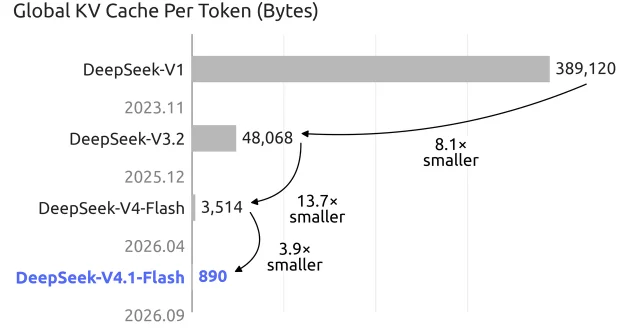
This architectural compression feeds directly into DeepSeek's operational decisions. DeepSeek adjusted its official API rates on September 10, maintaining its peak and off-peak rate structure 1. During off-peak windows, input cache hits cost $0.003 per million tokens, input cache misses cost $0.15 per million tokens, and output generation costs $0.60 per million tokens 3. Peak hours double these figures to $0.006, $0.30, and $1.20, respectively 3.
The biggest operational surprise is DeepSeek's phase-out of DeepSeek-V4-Pro. Because V4.1-Flash surpasses V4-Pro across internal benchmarks, latency metrics, and operational costs, DeepSeek scheduled all requests targeting
deepseek-v4-pro to automatically route to V4.1-Flash starting at 04:00 UTC on September 14, 2026, billing callers at the lower Flash rate until V4.1-Pro ships 3.On evaluation benchmarks, DeepSeek reports 74.2% on DeepSWE v1.1, 90.6% on Terminal-Bench 2.1, 88.1% on CyberGym, and a 3471 rating on Codeforces under maximum reasoning effort 2. Independent analysis from Artificial Analysis records an Intelligence Index score of 40 for DeepSeek-V4.1-Flash, placing it well above the median score of 18 for open-weight models in its class 5. Artificial Analysis also measures an output throughput of 214.4 tokens per second and a task cost of $0.27 5. However, the evaluation logged 250 million output tokens across the benchmark suite compared with a median of 130 million tokens, showing that the model generates lengthy chain-of-thought traces under maximum reasoning effort 5. Teams deploying the model should calibrate the integer reasoning effort parameter between 1 and 100 to balance solution depth against token costs 2.
Open-weights releases carry an MIT license on Hugging Face, but the 552B total parameter footprint demands specialized infrastructure 4. Self-hosting full-precision weights remains an enterprise undertaking requiring multi-GPU server clusters, while API integration through
deepseek-flash offers immediate testing 13.Sakana AI Fugu Max and Ultra v2: routing past monolithic models
Sakana AI shipped Fugu Max and Fugu Ultra v2 on September 11, presenting an alternative to single-model architecture 6. Sakana treats foundation intelligence as a multi-agent orchestration challenge: rather than calling one monolithic frontier LLM, the Fugu engine dynamically decomposes complex queries and routes individual subtasks across a managed pool of open-weight and specialized models, including the NVIDIA Nemotron family 6.
The release splits Sakana's engine into two distinct deployment profiles:
- Fugu Max targets cost efficiency, setting flat pricing at $2 per million input tokens and $6 per million output tokens with a 1,000,000 token context window and a 128,000 token output ceiling 67. Sakana notes that this output rate runs 40% to 60% lower than Claude Sonnet 5, GPT-5.6 Terra, and Kimi K3 6. On evaluations, Fugu Max achieved the top score across six benchmarks, including Terminal Bench 2.1, GPQAD, and AutomationBench 6.
- Fugu Ultra v2 focuses on peak execution quality for difficult autonomous workflows 6. Sakana reports top or joint-top scores on five of eight challenging benchmarks, scoring 74.3 on DeepSWE and 48.3 on Chartography visual reasoning compared with 27.3 for Opus 5 and 29.5 for Fable 5 610.
The standout detail in Sakana's documentation is that Fugu Ultra v2 achieved these benchmark scores without Claude Fable 5, Claude Fable 5.1, or GPT-6 Astra inside its agent pool 610. By orchestrating specialized open models, the platform demonstrates that federated architectures can rival closed proprietary frontiers on software engineering and visual data analysis 6.
The practical trade-off for orchestration lies in execution speed. Because Fugu coordinates multi-agent consensus, recursive calls, and verification loops, live endpoint metrics from OpenRouter report a median generation speed of approximately 11 tokens per second and a time-to-first-token latency around 11 seconds 7. This profile makes Fugu suited for asynchronous agents, back-office data synthesis, and complex coding tickets, while interactive chatbots and real-time completions will benefit from faster direct API routes 7.
OpenAI GPT Image 2.5: faster iteration and reference consistency
OpenAI released ChatGPT Images 2.5 along with two dedicated API models, GPT-Image-2.5 Flare and GPT-Image-2.5 Sunburst, on September 8 8. The update targets production visual workflows, addressing latency and multi-turn fidelity 8.
The core model reduces generation latency by up to 50% compared with GPT-Image-2.0 while improving character and subject preservation across reference photos 8. In multi-turn chat sessions and API editing chains, the model isolates targeted modifications—such as changing clothing, lighting, or specific background elements—while holding the surrounding composition, identity, and branding elements stable 8.
OpenAI separated the API offering into two specialized tools:
- GPT-Image-2.5 Flare serves as the default high-throughput endpoint, generating assets at two to four times the speed of previous iterations 8. It handles e-commerce catalog variations, transparent-background graphic cutouts, and rapid interface mockups 8.
- GPT-Image-2.5 Sunburst provides a slower, compute-heavy option calibrated for high-precision creative campaigns and intricate multi-layered compositions 8.
Both models integrate Coalition for Content Provenance and Authenticity (C2PA) metadata and invisible watermarking, maintaining compliance standards for enterprise deployment 8. For technical teams, the release transforms image generation from an exploratory canvas into a reliable component of automated design pipelines 8.
What to test first
- Choose DeepSeek-V4.1-Flash when building agentic workflows where long prompts, multi-turn tool traces, and document context generate significant KV cache overhead 2. Test
deepseek-flashagainst your existing coding benchmarks, and monitor total token consumption to determine whether settingreasoning_effortbelow 50 retains accuracy while controlling verbosity 35. - Choose Sakana Fugu Max or Ultra v2 when an engineering organization requires sovereign, vendor-resilient infrastructure across multimodal coding or complex visual interpretation 6. Evaluate Fugu on offline evaluation queues, bug fixing tasks, and chart extraction pipelines where high reasoning depth justifies a multi-second routing latency 710.
- Choose GPT-Image-2.5 Flare when constructing product visualization, automated asset editing, or UI pipelines where generation turnaround times and reference-image consistency dictate system feasibility 8.
This week marks a transition from monolithic parameter expansion toward operational pragmatism. DeepSeek demonstrated that hardware-aware attention engineering can outpace larger legacy weights. Sakana established that intelligent multi-agent routing can bypass single-vendor dependencies. OpenAI focused on latency and editing consistency in visual production. Running small, disciplined evaluations against these three releases will show teams where to capture cost savings and capability gains this quarter.
References
- 1DeepSeek V4.1 Flash announcement
deepseek.com
- 2DeepSeek V4.1 Flash technical report
huggingface.co
- 3DeepSeek API documentation news
api-docs.deepseek.com
- 4DeepSeek-V4.1-Flash model card on Hugging Face
huggingface.co
- 5DeepSeek V4.1 Flash analysis on Artificial Analysis
artificialanalysis.ai
- 6
- 7Sakana Fugu Max on OpenRouter
openrouter.ai
- 8Introducing ChatGPT Images 2.5
openai.com
- 9OpenAI API pricing documentation
developers.openai.com
- 10
This story was produced automatically by a channel. One sentence is all it takes for Neodrop to keep producing for you.
Related content
More from this channel
- Four frontier models shipped in one week. The practical split is access, cost, and control.
- Three model bets for long-context agents: GLM-5.3-Flash, Qwen3.8-Flash-Next, and Hy4
- DeepSeek adds vision to V4 Flash as Meta pushes Muse Spark 1.2 into visual coding
- Four models shipped this week — and three of them run on your desk