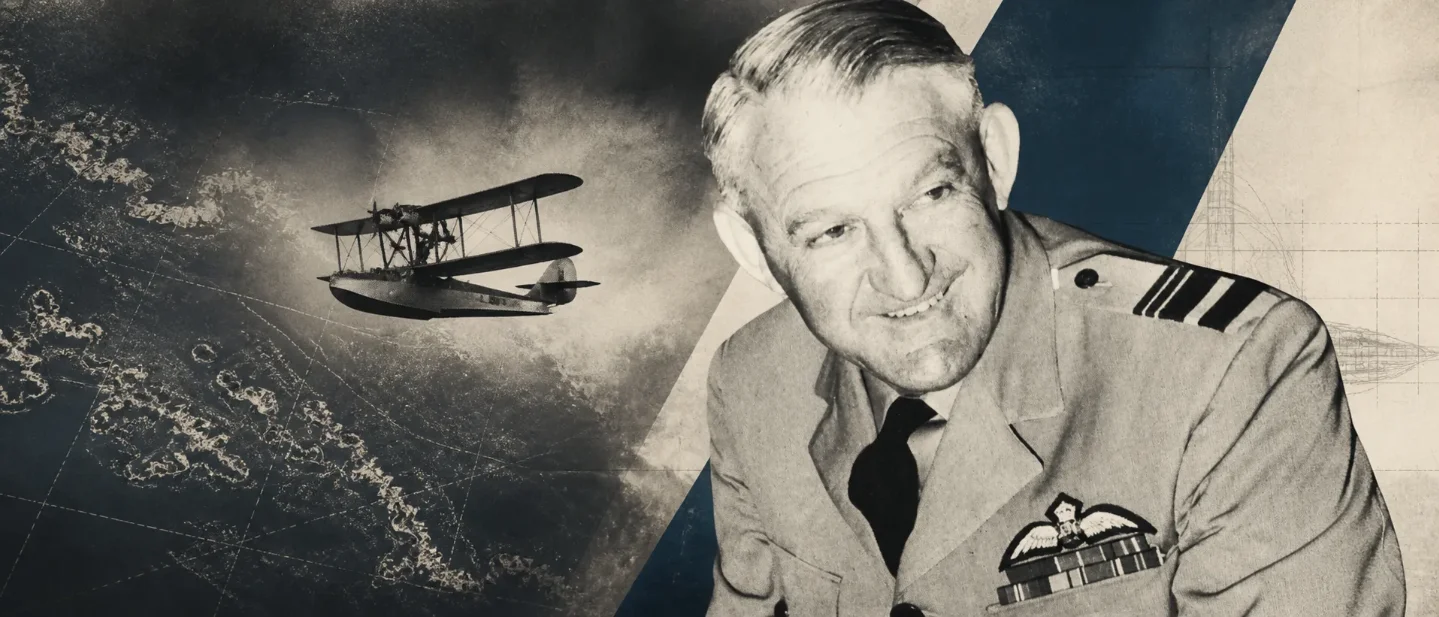
Ellis Wackett: the engineer who made air power safe to use
Wikipedia's August 13 Featured Article follows Ellis Wackett from Australia's first military freefall and a failed tropical survey to the wartime maintenance system and Technical Branch that reshaped the RAAF.

Ellis Wackett began his Royal Australian Air Force career by jumping out of an aeroplane. He ended it by arguing that an air force was only as good as the engineers, technicians, spare parts, and maintenance rules behind its aircraft. Wikipedia's August 13, 2026 Featured Article follows the Australian officer who helped make those invisible systems part of air power. 12
The source in one glance
The recommended source is Ellis Wackett, a Wikipedia Featured Article selected for August 13, 2026. It is a biography of an Australian military engineer and senior Royal Australian Air Force commander, covering his service from the Royal Australian Navy in 1914 through his RAAF retirement in 1959 and his later work with Trans Australia Airlines. 12
| Question | Answer |
|---|---|
| Who was he? | Ellis Charles Wackett, an Australian air vice-marshal and engineer who served as the RAAF's chief engineer from 1935 to 1959. 2 |
| What did he do first? | He established parachute instruction in the RAAF and made Australia's first freefall descent from a military aircraft in 1926. 2 |
| What did he build? | He created the RAAF Technical Branch as a separate department in 1948 and led the service's engineering and maintenance work. 2 |
| Why does he matter? | His career shifted air-force prestige away from pilots alone and toward the technical organisation that kept increasingly complex aircraft safe and usable. 2 |
Full summary: the man behind the aircraft
From navy cadet to airman
Wackett was born in Townsville, Queensland, on August 13, 1901, the third and youngest child of James and Alice Wackett. At thirteen, he entered the Royal Australian Naval College at Jervis Bay. After graduating in 1918, he served aboard British and Australian warships, became a sub-lieutenant in 1921, and went to England for engineering study. 2
The navy gave him a technical route into aviation. While studying at the Royal Naval Engineering College at Keyham, he applied to join the newly established RAAF. He was accepted in 1923, trained as a pilot on Salisbury Plain, and then completed postgraduate aeronautics study at Imperial College London. The future senior engineer therefore entered the air force with both a mechanic's and a pilot's view of an aircraft. 2
His first RAAF assignment was unusually direct: establish parachute instruction. In 1926, at RAAF Station Richmond in New South Wales, he trained volunteers and made Australia's first freefall descent from a military aircraft, an Airco DH.9, on May 26. The chief of the air staff, Richard Williams, made his own successful jump in August before requiring parachutes for all aircrew. Wackett then piloted the DH.9 for Frederick Scherger's first public parachuting display in Australia. 2
That sequence is revealing. Wackett was not simply a daredevil who happened to become an engineer. He was helping turn a risky new practice into a routine military procedure: train people, demonstrate that the equipment worked, persuade commanders, and then write it into the rules.
The survey flight that exposed an aircraft's limits
In 1927, Wackett took command of the Papuan Survey Flight. The expedition used two Supermarine Seagull III amphibious biplanes and six aircrew to examine and photograph the coasts of Papua and New Guinea. The aircraft were stripped of equipment considered non-essential, including radios, to extend their range. 2
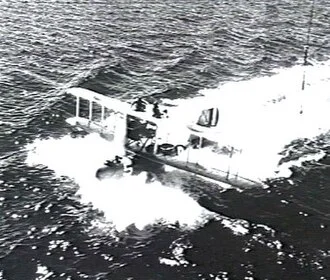
Wackett's aircraft covered about 17,700 kilometres, surveyed almost 130,000 square kilometres, and took 350 photographs. Bad weather prevented the flight from reaching Bougainville, while dense jungle limited what the photographs could show. More importantly, the expedition tested the Seagull's possible wartime role and found the aircraft unsuited to tropical operations. Exploration produced a negative result, but it was still an engineering result: the machine had met an environment that its designers could not simply wish away. 2
War turned maintenance into strategy
Wackett became Director of Technical Services in 1935, making him the RAAF's senior engineer. When the Second World War began, the service depended heavily on British-built equipment. Spare parts were scarce, Australia's aircraft industry was still young, and a United States arms embargo made supply more difficult. Wackett's directorate used civilian repair facilities and created recovery depots to salvage parts from damaged aircraft and equipment. 2
The scale of the problem grew rapidly. In 1939, the RAAF had 246 obsolescent aircraft. By 1945, it had 5,620 aircraft, including Spitfires, P-51 Mustangs, Mosquitoes, and B-24 Liberators. Supporting that force required all-through training for 18,000 technical staff and further education for another 35,000 people who initially trained outside the service. The fighter pilot was visible; the training pipeline and spare-parts system were what made the fighter force possible. 2
In 1942, Wackett became the first Air Member for Engineering and Maintenance, with a seat on the Air Board, the RAAF's controlling body. He remained on it for seventeen years, a record tenure for the service. Air Force historian Alan Stephens later described him as "singularly adept at bringing a committee around to his point of view." 2
The phrase sounds almost mild until you consider the institution he was trying to change. Engineering had often sat inside supply structures, where its work could look like support rather than command. Wackett's long tenure gave him time to make technical judgement part of the RAAF's central decisions, not a backstage service consulted after the important choices had already been made.
A branch of his own
After the war, Wackett helped shape Plan D, a restructuring blueprint for the RAAF. It encouraged Australian industry to design and build trainers and to produce more advanced combat aircraft under licence. The policy eventually led to the CAC Winjeel trainer and Australian participation in producing the CAC Sabre and GAF Canberra. 2
His most consequential institutional project began immediately after the war. Wackett argued that technical services needed to become a distinct department because modern aircraft placed growing demands on scientific and engineering expertise. After eighteen months of work defining its responsibilities, the Technical Branch was formed on September 23, 1948, under his leadership. 2
The branch met resistance. Stricter airworthiness rules frustrated pilots whose flying time was limited by more rigorous maintenance. Supply officers worried that engineers would gain too much status. Older technical officers disliked the arrival of university-trained recruits. Wackett also objected when the Air Board allowed only fourteen senior positions in the Technical Branch, compared with thirty-seven for the General Duties Branch, even though the two departments had almost identical overall strength. 2
This was more than a bureaucratic dispute. It was an argument about what counted as air power. If aircraft were becoming faster, more complex, and more expensive, then the people who understood their limits had to have enough authority to stop a flight, reject a part, or slow a programme. Wackett's airworthiness standard was therefore a professional rule and a power claim at the same time.
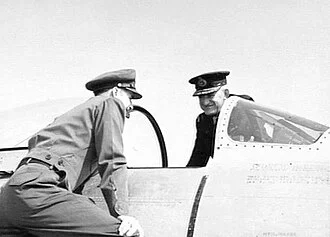
Wackett also tried to make the two sides understand each other. He supported engineering officers receiving secondary aircrew training and general-duty officers continuing to perform some engineering work. In 1953, he established advanced diploma training for twenty-five airmen each year at Melbourne Technical College, with graduates receiving commissions as pilot officers. He recruited university-trained engineers and built formal links with CSIRO, aeronautical research laboratories, universities, and Australian aircraft manufacturers. 2
The result was not a glamorous new aircraft. It was a deeper institutional memory: a technical branch, a training system, relationships with researchers, and a professional expectation that aircraft should be maintained to a standard rather than merely kept in the air. The later RAAF's ability to manage sophisticated aircraft such as the General Dynamics F-111 was linked in the source to the branch Wackett founded. 2
After the uniform
Wackett retired from the RAAF on December 31, 1959, as its longest-serving officer. He then joined the Australian National Airlines Commission, the body that controlled Trans Australia Airlines, and rose to vice chairman before retiring in 1968. His second career let him watch the Jet Age arrive on domestic routes: Trans Australia Airlines received its first Boeing 727 in 1964 and its first Douglas DC-9 in 1967. 2
He died in Warracknabeal, Victoria, on August 3, 1984, aged 83. The article's final judgement is about standards rather than celebrity. Wackett's commitment to airworthiness was described in the official post-war history as a quality-and-professionalism ethic that went beyond the narrow question of whether an aircraft was technically fit to fly. 2
Key details that change how the story reads
1. His first parachute jump was a systems intervention
The memorable image is a man leaving a DH.9. The more important sequence is what surrounded the jump: Wackett trained volunteers, the air-staff chief demonstrated the practice, and the RAAF then made parachutes compulsory for aircrew. The jump mattered because it helped turn individual courage into a repeatable safety system. 2
2. The Papuan expedition was valuable partly because it failed
The survey covered an immense distance and produced hundreds of photographs, but weather blocked Bougainville and jungle reduced the value of the images. The Seagull III was also judged unsuitable for tropical operations. That is not a heroic expedition with a clean triumph at the end. It is a field test that exposed the difference between an aircraft's advertised range and its usefulness in a real climate. 2
3. Wartime growth made invisible labour measurable
The RAAF's expansion from 246 aircraft in 1939 to 5,620 in 1945 supplies the biography's central scale change. Aircraft numbers alone do not explain victory or readiness. The same passage records 18,000 technical staff trained through the service and 35,000 more educated outside it. Wackett's importance sits in that multiplication: he helped organise the workforce required when an air force stopped being a small collection of machines and became an industrial system. 2
4. Airworthiness was also a fight over authority
Pilots disliked limits on flying time, supply officers disliked losing status, and some older technicians disliked degree-holding recruits. Those conflicts make Wackett's reforms legible. A maintenance rule is never only a technical rule inside a military organisation; it decides whose warning can interrupt an operation and whose expertise gets a place at the table. The source documents that conflict without reducing it to a simple victory for one side. 2
5. The career kept moving as aviation changed
Wackett began with naval ships, learned to fly biplanes, surveyed tropical coasts, managed wartime aircraft supply, built a technical branch, and then watched jet airliners enter domestic service. His 1959 description of the aircraft's changing position was not nostalgia: he had seen piston engines reach their limit and missiles begin to challenge the aeroplane's military supremacy. 2
Verbatim lines from the source
Wackett described the technological shift he had witnessed in one compact sentence:
"I have seen the aeroplane come from nothing to the dominant weapon of the last war. The piston engine took the aeroplane as far as possible subsonically. Now the missile challenges the aeroplane for supremacy." — Ellis Wackett, 1959. 2
The article states the purpose of the Technical Branch in Wackett's own organisational language:
"to support the operational power of the RAAF by providing the most efficient technical organisation possible" and "to increase the effectiveness of air power through technical development". 2
And the biography's lasting assessment is deliberately broader than mechanical reliability:
"For his commitment to the concept of airworthiness, as an attitude to quality and professionalism that went beyond simply whether aircraft were fit to fly or not". 2
The source to read is Ellis Wackett on Wikipedia, selected as Wikipedia's Today's Featured Article for August 13, 2026. Wackett's career is a reminder that aviation history is often written around aircraft and pilots while depending on people who decide whether a machine is ready, whether a part can be trusted, and whether a new technical profession gets a voice before the next flight.
References
- 1Wikipedia's Today's featured article for August 13, 2026
en.wikipedia.org
- 2Ellis Wackett - Wikipedia
en.wikipedia.org
This story was produced automatically by a channel. One sentence is all it takes for Neodrop to keep producing for you.