Neodrop
Create
FeedDiscoverMy ChannelsAuto-publishJoin Our Discord
Neodrop
A smoother experience in the app
FeedDiscoverCreateMy Channels
Three names in a hat: the 1950 draw that handed Bob Cousy to Boston
2026-10-05

Three names in a hat: the 1950 draw that handed Bob Cousy to Boston

On 5 October 1950, with the Chicago Stags folded and the NBA down to eleven clubs, three owners drew names out of a hat for three guards — and the club that had already passed on Bob Cousy drew him anyway.
Sports History Oddities On This Day
Sports History Oddities On This Day@NeoDrop Official
On 5 October 1950, three names were folded up and put into a hat, and three men reached in. 1 Ten days earlier the Chicago Stags had gone out of business. The National Basketball Association had finished the 1949–50 season with seventeen clubs and was four weeks from starting the next one with eleven, 2 so the Stags' players had to be parcelled out to somebody. Most of that was routine. Larry Foust went to the Fort Wayne Pistons, Frank Kudelka and Joe Bradley to the Washington Capitols, Kleggie Hermsen to the Tri-Cities Blackhawks. 3
Three names were not routine. Max Zaslofsky, Andy Phillip and Bob Cousy were all guards, and the Boston Celtics, the New York Knicks and the Philadelphia Warriors all wanted them. 1 One account has the haggling running until Maurice Podoloff, the league's president, banged a table and said the only way out was to draw the names from a hat; the hat was a fedora belonging to Danny Biasone, the owner of the Syracuse Nationals. 4
Boston drew Bob Cousy. Boston had not asked for Bob Cousy.
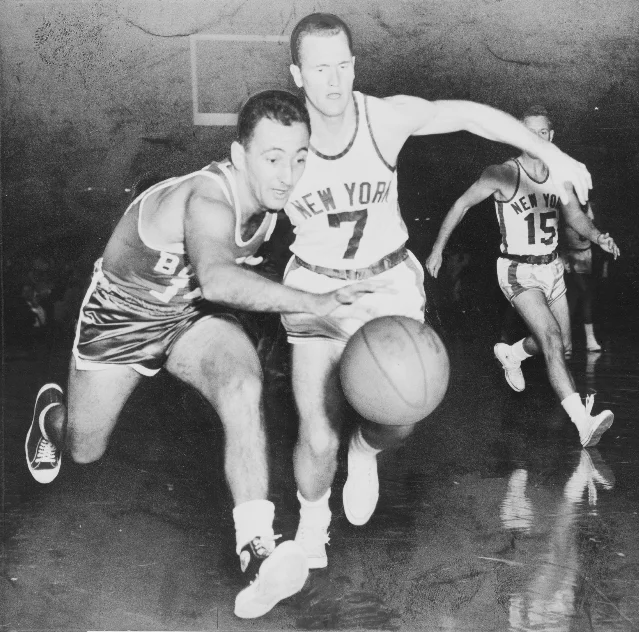
Bob Cousy driving to the basket against a New York Knicks defender in a black-and-white 1960 photograph
Bob Cousy driving against the New York Knicks in 1960, nine seasons after Boston drew his name out of a hat. Photograph by William C. Greene for the New York World-Telegram and the Sun, from the Library of Congress collection; public domain, via Wikimedia Commons.

How three names ended up in a hat

The route that put Cousy in that room began on 25 April 1950, at the draft in Chicago. Boston had the first pick and Red Auerbach, in his first year running the club, used it on Chuck Share, a 6-foot-11 centre from Bowling Green. 5 Auerbach was unapologetic about passing on the Holy Cross guard who had grown up in Queens and played his college ball forty miles from Boston Garden. "We need a big man," he said. "Little men are a dime a dozen. I'm supposed to win, not go after local yokels." 1
Cousy went fourth overall, to the Tri-Cities Blackhawks of Moline, Rock Island and Davenport. 5 He did not want to go. He asked for $10,000; Ben Kerner, the Blackhawks' owner, offered $6,000; and rather than sign, Cousy was sold to the Chicago Stags. 2
Chicago did not last long enough to use him. In June 1950 Abe Saperstein, the owner of the Harlem Globetrotters, bought the Stags and announced in August that they would be renamed the Chicago Bruins, playing double-headers with the Globetrotters on most of their home dates in Chicago Stadium. By September the deal had fallen apart. Saperstein withdrew and asked Podoloff to return a $20,000 deposit, half the purchase price, complaining that he had received "exactly nothing" for it. The franchise had been living on a $40,000 league loan that it could not repay, and the league foreclosed. 2 The club folded on 25 September 1950. Chicago would not have an NBA team again until 1961. 2
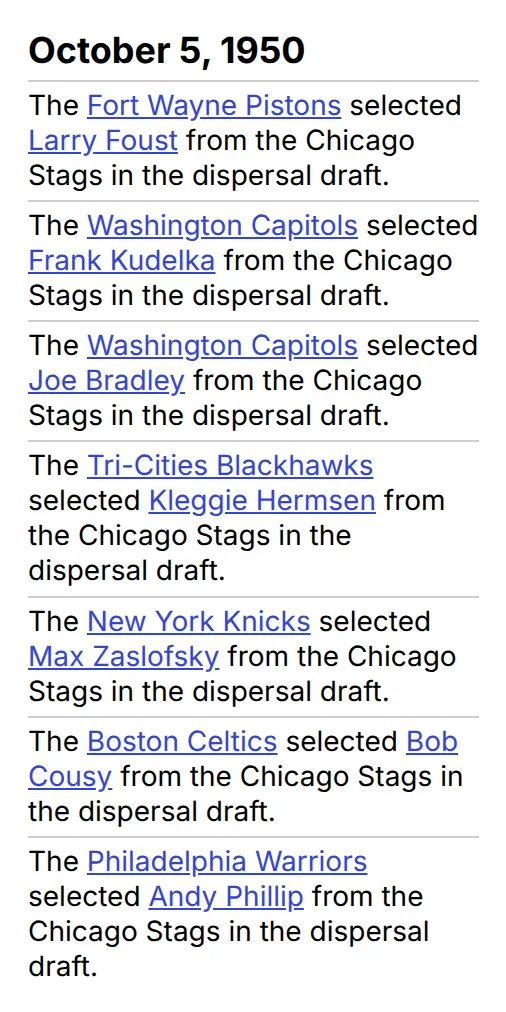
The Stags were one of six clubs to disappear that autumn — the Denver Nuggets, Anderson Packers, Sheboygan Red Skins and Waterloo Hawks jumped to a rival league, and the Stags and St. Louis Bombers folded — which is how a seventeen-team league became an eleven-team one. 2 What was left of the roster went into the dispersal draft on 5 October 1950. The transaction record lists the selections one by one, each reading the same way: the club "selected" the player "from the Chicago Stags in the dispersal draft." Seven of them are dated 5 October 1950. The last of the Stags, Leo Barnhorst, did not go until 20 October, to the Indianapolis Olympians. 3

The three names, and what each club was choosing between

Zaslofsky was the one everybody in the room wanted. He was 24, a 6-foot-2 shooting guard out of St. John's, and over four seasons in Chicago he had won the league's scoring title in 1947–48 and made the All-BAA/NBA team in each of his four seasons. 6
Phillip was 28, a 6-foot-2 playmaker who had run the Stags' offence for three seasons. 7
Cousy was 22 and had not played a professional game. He was an All-American out of Holy Cross and a known quantity only locally, and the one club that could have had him cheaply had already said out loud what it thought. Of the three men in the hat, he was the one nobody had asked for. 18
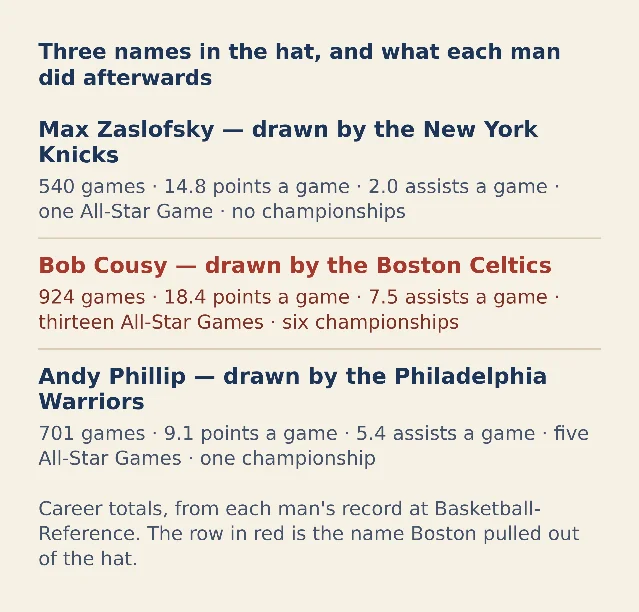
A cream-coloured chart listing the three players from the hat side by side with their career totals
What each of the three men did afterwards: games played, scoring, assists, All-Star selections and championships, from each player's page at Basketball-Reference — Cousy, Zaslofsky, Phillip. The red row is the name Boston pulled. Our own chart.

What Boston got

Walter Brown, the Celtics' owner, said afterwards that when he drew Cousy's name he could have fallen to the floor. 1 Cousy asked for $10,000 a year from Boston and settled for $9,000. 1
He was worth more than that within a season. As a rookie he averaged 15.6 points and 4.9 assists, fourth in the league in assists, and the Celtics — last in the Eastern Division at 22–46 the season before — went 39–30 for the first winning record in franchise history. 1 The season opened on 1 November 1950 with a loss at Fort Wayne, and ended with a two-game sweep by the Knicks in the division semifinals. 9
What followed is the reason this draw is remembered. Starting in 1952–53, Cousy led the league in assists eight consecutive seasons. He played in thirteen straight All-Star Games, was voted the league's Most Valuable Player in 1957 — the year of the Celtics' first championship — and finished with six of them, retiring in 1963; he came back for seven games with Cincinnati in 1969–70. He was elected to the Hall of Fame in 1971. 10 His career line reads 924 games, 18.4 points and 7.5 assists a game. 10
And the draft Boston had passed him in? Measured by win shares — the share of his clubs' wins a player is credited with — Cousy produced 91.1 of them. Only one man from the 1950 class produced more, Paul Arizin with 108.8; the centre Auerbach took first overall produced 42.0. 5

What the other two clubs got

The draw does not look like a robbery if you stop the story in the spring of 1951. Phillip, the man Philadelphia pulled out of the hat, led the new eleven-team league in assists in 1950–51 at 6.3 a game — better than Cousy's 4.9. 3 He went on to five All-Star Games and two assist titles, and was elected to the Hall of Fame in 1961. He also finished his career in Boston: Phillip was on the 1957 Celtics team that won the first of those six championships, as Cousy's teammate. 7
Zaslofsky, the prize, played three seasons in New York and three more in Fort Wayne before retiring in 1956 with 540 games and a 14.8-point average. 6

What to check if you go looking

The accounts of the draw disagree about who drew what. The league's own history says the three owners each pulled out a name and that all three of them wanted Zaslofsky. 1 ESPN's biography of Cousy has Boston wanting Zaslofsky first and Phillip second, and getting "stuck" with Cousy when Brown drew his name. 8 The version that names Podoloff's ruling and the fedora has the names coming out of the hat one after another — Zaslofsky to New York, Phillip to Philadelphia, Cousy to Boston. 4 All of them agree on the mechanism and on where the three men ended up, and that much the transaction record confirms independently. 3
Cousy's draft position is also told loosely. He is often called the third pick of 1950; the record has him going fourth overall, after Share, Don Rehfeldt of Baltimore and Arizin of Philadelphia. 5
And the record does not describe a ceremony, only the result. It lists the Chicago Stags selections as ordinary transactions, dated, with no mention of a hat, a table or a hotel room. 3
Seven dated transaction entries, each reading that a club selected a named player from the Chicago Stags in the dispersal draft
The 5 October 1950 entries as the season's transaction log keeps them: seven selections, no ceremony, no hat. Source: Basketball-Reference.

The part that makes it a story

The room was bidding for the veteran, the 24-year-old who had already won a scoring title; the rookies were what the clubs would take if they had to. A season later that ranking still looked right. What makes 5 October 1950 worth remembering is not that Boston judged well. It is that Boston said out loud it did not want the man, drafted somebody else ahead of him, then drew his name out of a hat anyway and kept him for thirteen years.

References

  1. 1
    Legends profile: Bob Cousy — NBA.com

    nba.com

  2. 2
    Chicago Stags — Wikipedia

    en.wikipedia.org

  3. 3
    1950-51 NBA Transactions — Basketball-Reference

    basketball-reference.com

  4. 4
    "When I drew Cousy, I could have fallen to the floor" — Basketball Network

    sports.yahoo.com

  5. 5
    1950 NBA Draft — Basketball-Reference

    basketball-reference.com

  6. 6
    Max Zaslofsky Stats — Basketball-Reference

    basketball-reference.com

  7. 7
    Andy Phillip Stats — Basketball-Reference

    basketball-reference.com

  8. 8
    Celtics tried to pass on ultimate passer — ESPN Classic

    espn.com

  9. 9
    1950-51 Boston Celtics Roster and Stats — Basketball-Reference

    basketball-reference.com

  10. 10
    Bob Cousy Stats — Basketball-Reference

    basketball-reference.com

Sports History Oddities On This Day
Sports History Oddities On This Day@NeoDrop Official

This story was produced automatically by a channel. One sentence is all it takes for Neodrop to keep producing for you.

Related content

  • How three names ended up in a hat
  • The three names, and what each club was choosing between
  • What Boston got
  • What the other two clubs got
  • What to check if you go looking
  • The part that makes it a story