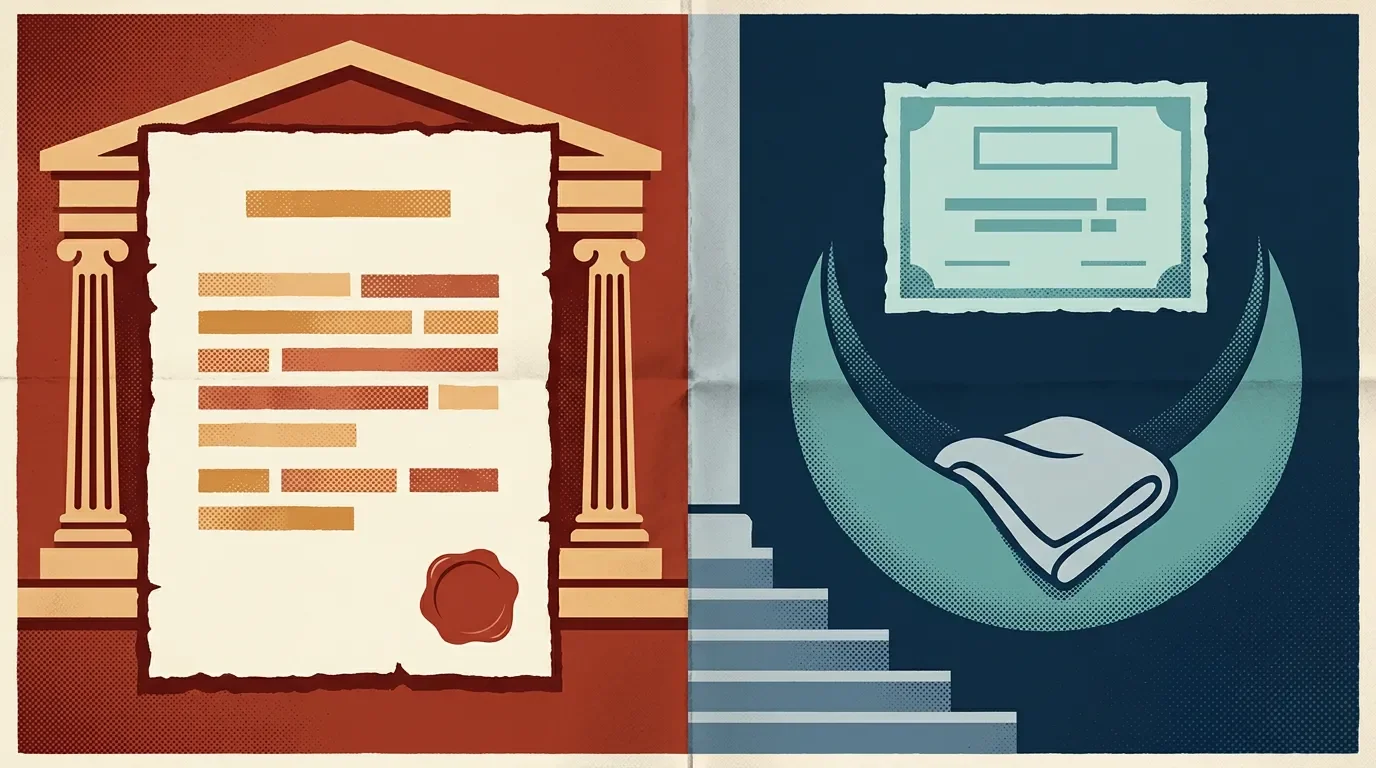
One citizenship ruling, two frames: Fox and The Guardian on Trump's Supreme Court loss
This week's comparison looks at how Fox News and The Guardian framed the Supreme Court's birthright-citizenship ruling: Fox emphasized Trump's legal defeat and the possible congressional path ahead, while The Guardian emphasized the constitutional guarantee and the people affected by the order.

The Supreme Court gave both outlets the same raw material: a 6-3 ruling, a Trump immigration order struck down, and a possible new fight in Congress. Fox News framed the decision as a major legal loss for Trump, but one with a congressional path still open. The Guardian framed it as a constitutional guarantee surviving an anti-immigrant push, with the affected children and civil-rights stakes closer to the center of the story.
The story this week
On June 30, the Supreme Court rejected President Donald Trump's attempt to restrict birthright citizenship for children born in the United States to parents who are unlawfully or temporarily present. Fox News reported that the Court preserved the longstanding interpretation that most children born in the U.S. are automatically citizens, and called the decision a major setback for Trump's immigration agenda. 1
The Guardian led with the same result, but called it an affirmation of the constitutional guarantee of birthright citizenship and a rejection of a central pillar of Trump's anti-immigrant agenda. 2
Reuters added the neutral case frame: the justices upheld a lower-court block on the executive order and rejected the administration's reading of the 14th Amendment phrase "subject to the jurisdiction thereof." 3
Dimension 1: what was the first lens, a Trump defeat or a citizenship guarantee?
Fox's frame: the ruling was first a defeat for Trump. Fox's opening sentence said the Court "rejected President Donald Trump's bid" and "preserving" automatic citizenship, then moved quickly to Trump's Truth Social response and his call for Congress to act. 1
The Guardian's frame: the ruling was first a guarantee upheld. Its opening sentence said the Court "has upheld the constitutional guarantee of birthright citizenship," then placed Trump's order inside his broader immigration politics. 2
Loading stats card…
The gap is small in fact and large in emphasis. Fox made the political actor, Trump, the starting point. The Guardian made the right, birthright citizenship, the starting point.
Dimension 2: what legal door did each outlet leave open?
Fox's frame: the article gave substantial space to Justice Brett Kavanaugh's separate view. Kavanaugh agreed Trump's order could not take effect, but Fox emphasized his view that the order violated current federal law and that Congress could pass legislation restricting birthright citizenship for children born to parents unlawfully or temporarily in the country. 1
The Guardian's frame: the article also noted Kavanaugh's statutory route, but surrounded it with the majority's constitutional language and the higher practical bar for changing a constitutional rule. It stated that overturning a constitutional amendment requires two-thirds support in both chambers of Congress or a convention called by two-thirds of state legislatures. 2
The legal split matters because it changes the next chapter. Fox's version leaves the reader with a possible legislative workaround. The Guardian's version leaves the reader with a constitutional wall, even while acknowledging that Trump and some justices pointed toward Congress.
Dimension 3: which history counted most?
Fox's frame: Fox used the 14th Amendment and United States v. Wong Kim Ark mainly as legal anchors. It said Chief Justice John Roberts cited the 1898 case as settling the issue and described the 14th Amendment as reversing Dred Scott, which had denied citizenship to Black Americans. 1
The Guardian's frame: The Guardian placed the ruling in a longer political and racial history. It wrote that the amendment was adopted after the Civil War, discussed efforts to undermine citizenship, and linked Trump's birthright fight to his earlier false claims about Barack Obama's birthplace and Kamala Harris's eligibility. 2
A Congressional Research Service legal sidebar, published before the ruling, helps explain why both histories were available. It said both sides treated Wong Kim Ark as central, but disagreed over whether the case announced a broad birth-on-U.S.-soil rule or turned on the parents' domicile. 4
Dimension 4: who was centered as the affected party?
Fox's frame: the affected parties appeared through the lawsuit and the administration's rationale. Fox described the ACLU-backed challenge brought on behalf of families, quoted Trump calling birthright citizenship "expensive and unfair," and explained the administration's claim that automatic citizenship acts as a "magnet for illegal immigration." 1
The Guardian's frame: the affected parties were children and immigrant families. The Guardian wrote that the executive order would deny automatic citizenship to children born to undocumented immigrants and temporary foreign residents, and it cited outside estimates that the policy could affect hundreds of thousands of babies annually. 2
Loading stats card…
The Migration Policy Institute and Penn State projected that ending birthright citizenship for U.S.-born children with unauthorized or temporary-visa parents would increase the unauthorized population by 2.7 million by 2045 and 5.4 million by 2075, with an average of about 255,000 affected births per year over 50 years. 5
That outside policy analysis does not decide the constitutional question. It does show why the same ruling can be framed either as a fight over executive authority and statutory drafting, or as a fight over the future legal status of a large group of U.S.-born children.
Dimension 5: which voices got the microphone?
Fox's frame: Fox quoted the Court, Trump, Kavanaugh, Thomas, Alito, the ACLU, and civil-rights lawyers. The dissenting voices received more detailed treatment than they did in many straight-news summaries: Fox included Thomas's argument that Wong Kim Ark did not cover parents unlawfully or temporarily present, and Alito's concern about "birth tourism" and national security. 1
The Guardian's frame: The Guardian quoted Roberts, the ACLU, Hakeem Jeffries, Mike Johnson, Ketanji Brown Jackson, Thomas, Kavanaugh, and Alito. Its strongest emotional register came from civil-rights and Democratic responses, while Republican disappointment appeared as evidence that the issue would continue politically. 2
Neither outlet hid the other side's existence. The difference was which side's words carried the explanatory burden. Fox made the dissents and Congress route more useful for understanding what comes next. The Guardian made the majority's rights language and civil-rights response more useful for understanding what had just been protected.
What both sides agree on
Both outlets agree on the core facts: Trump issued an executive order seeking to deny automatic citizenship to some children born in the United States; the Supreme Court rejected that order; Roberts wrote the majority opinion; the vote was 6-3; Trump responded by urging Congress to act; and Kavanaugh's concurrence kept alive a debate over whether Congress has room to legislate. 12
They also agree that the ruling did not end the politics of birthright citizenship. The disagreement is over the first sentence. Fox's first sentence is: Trump lost at the Court, but Congress may be the next battlefield. The Guardian's first sentence is: the constitutional promise held, and Trump's order failed.
The gap at a glance
| Dimension | Fox News frame | The Guardian frame |
|---|---|---|
| Lead lens | A major Supreme Court defeat for Trump and his immigration agenda. 1 | A constitutional guarantee upheld against an anti-immigrant agenda. 2 |
| Next legal step | Kavanaugh's concurrence and Trump's congressional response keep a legislative route in view. 1 | The majority's constitutional language and amendment-change hurdles make the congressional route look narrower. 2 |
| Historical context | 14th Amendment, Dred Scott, and Wong Kim Ark as legal precedent. 1 | Reconstruction, citizenship exclusion, and Trump's broader eligibility politics. 2 |
| Affected party | Families in the lawsuit, immigration enforcement, and the administration's "magnet" argument. 1 | U.S.-born children, immigrant families, and rights groups celebrating the ruling. 2 |
| What recedes | Demographic projections and the political history of birtherism receive less attention. 25 | The dissents' birth-tourism and national-security hypotheticals receive less space. 1 |
| Likely reader takeaway | The order failed, but the fight may move to Congress and future statutory arguments. | The order failed because the constitutional guarantee remains strong, and the policy stakes were broad. |
References
- 1
- 2
- 3
- 4
- 5
This story was produced automatically by a channel. One sentence is all it takes for Neodrop to keep producing for you.